June 22–September 1, 2024
Entrance in Taylor Hall
Art & Imagination in Spanish America, 1500–1800
Highlights from LACMA’s Collection
This exhibition features more than 100 works from the Los Angeles County Museum of Art’s renowned collection of Spanish colonial art. The paintings, sculptures, and decorative arts on view underscore the generative power of Spanish America and its central position as a global crossroads.
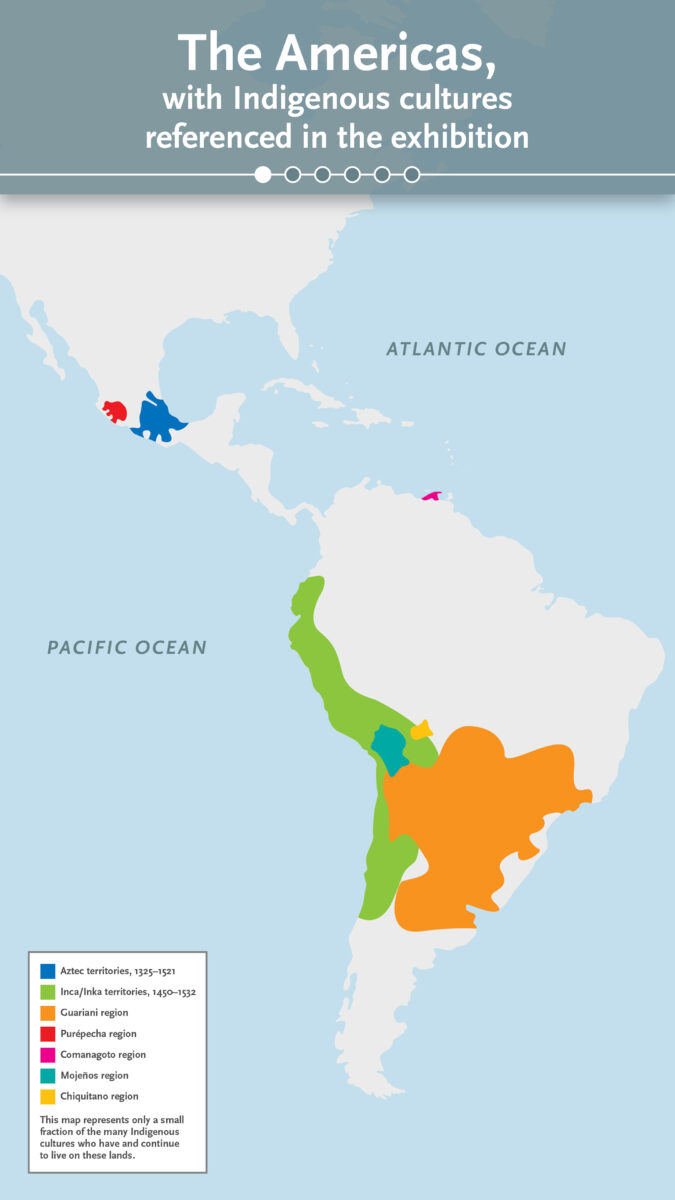
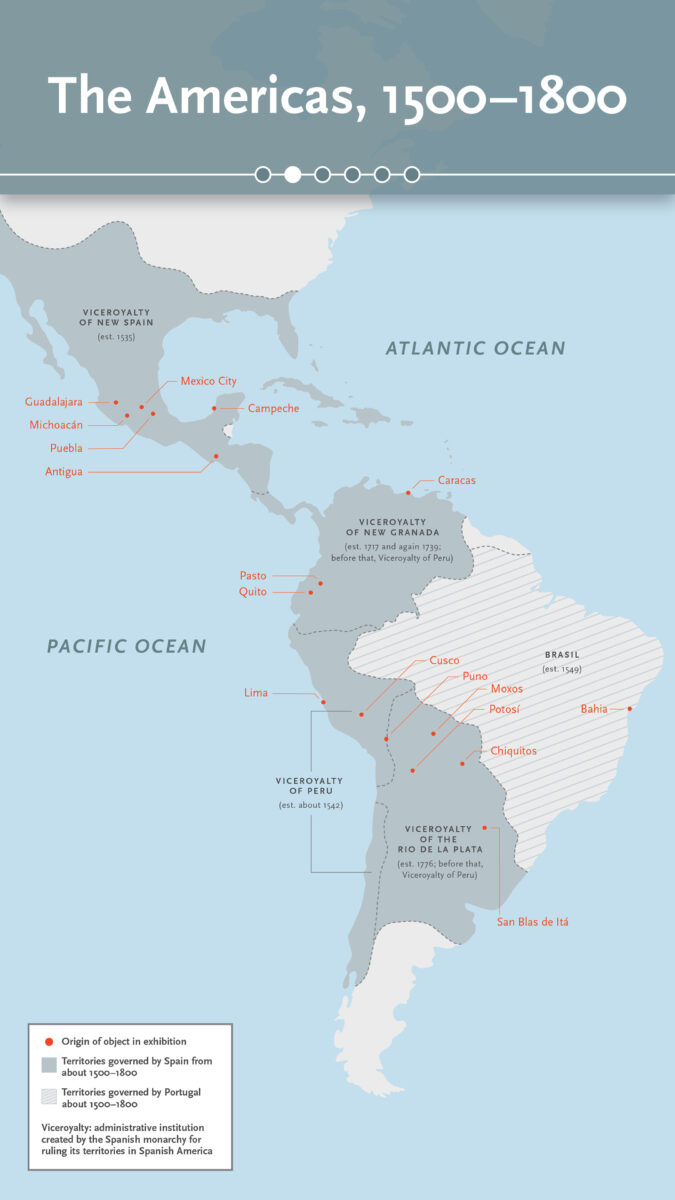
Imperial expansion, conquest, and the transatlantic slave trade marked the period spanning from 1500 to 1800. Cataclysmic social and geopolitical shifts brought people into closer contact than ever before—in real and imagined ways—propelling the creative refashioning of the material culture around them. After the Spaniards set out to spread Catholicism and colonize the Americas in the 15th century, artists drew on a range of traditions—Indigenous, European, Asian, and African—that reflected the interconnectedness of the world. Private and public spaces soon teemed with imported and domestic objects.
Spanish America was neither a homogenous nor a monolithic entity, and local artists, including those who remain unidentified, did not passively absorb foreign traditions. While acknowledging the profound violence that defined the process of conquest and colonization, this exhibition explores the intricate social, economic, and artistic dynamics of these societies that resulted in the creation of astounding new artworks.
Juan Patricio Morlete Ruiz. View of the Plaza del Volador (detail), 1772. Courtesy Heritage Malta, MUŻA – National Community Art Museum, Malta
Juan Patricio Morlete Ruiz painted two sets of views after Claude-Joseph Vernet’s Ports of France (1754–65), which he knew through prints. One set is on view later in this exhibition. The other set (today in Malta) includes two views of Mexico City, one of which is seen here. The addition of these local landscapes demonstrates Morlete Ruiz’s inventiveness, as well as his desire to inscribe Mexico within the panorama of European art and geography.
Legend (as transcribed from the original painting)
Vista de la Plaza del Volador por la parte del Sur construida desde lo alto del R.al Palacio, / Templos que se peciven, de Colx.s Comv. De Religosos, y de Monjas
2. La Real Universidad
3. Colegio de S Pablo.
4. N.a S.a de Balbanera
5. S.n Joseph de Gracia.
6. S.a Cruz Acatlan.
7. Colegio de Portaceli.
8. Parroquia de S. Miguel
9. Hospital de Jesus Nazareno.
10. Regina Celi.
11. Ayvda. d. Parroquia, y Barrio del Salto del Agua.
12. Belen de los Padres.
13. Comv.o de Monjas S. Bernardo.
14. S. Filiphe de Jesus, y Mm.s Cappn.s
15. Colegio de Niñas de los Viscain.s
16. Comv.o de Relig.os S. Agustin
17. Fiel remate.
18. El Puente del R.l Palacio
Antonio de Arellano, Mexico, 1638–1714
Manuel de Arellano, Mexico, 1662–1722
Virgin of Guadalupe, 1691
oil on canvas
Our Lady of Guadalupe is one of the most reproduced images of the Christian world. This image, copied by Antonio and Manuel de Arellano, depicts the Virgin surrounded by four vignettes. The scenes narrate her appearances to the Indigenous commoner Juan Diego in 1531 and culminate in the miracle that imprinted her image on his cloak.
To meet increasing demand for reputable copies such as this one, the Mexican artist Juan Correa (c.1645–1716) produced a waxed-paper template that enabled painters to accurately reproduce the design. This accounts for the similar dimensions of some copies, such as that by Antonio de Torres hanging nearby, despite variations of style and details. The Arellanos added the inscription tocada a la original (“touched to the original”) on the lower edge to emphasize that their copy was endowed with the power of the original icon.
Los Angeles County Museum of Art, Purchased with funds provided by the Bernard and Edith Lewin Collection of Mexican Art Deaccession Fund (M.2009.61)
Antonio de Torres,
Mexico, 1667–1731
Virgin of Guadalupe, c.1720
oil on canvas
Los Angeles County Museum of Art, Gift of Kelvin Davis through the 2014 Collectors Committee (M.2014.91)
Fashioning Identity
Dress powerfully asserts social and ethnic differences and vividly exemplifies global networks of exchange. Through the portraits and textiles in this gallery, people fashioned and refashioned their images, projected their elevated statuses, and asserted their identities. In the Inca Empire (c.1438–1533), specialized workshops wove magnificent men’s tunics (uncus) ornamented with tocapu—a type of geometric Inca rank insignia—exclusively for the king and his allies. After colonization, the Inca nobility continued to wear tocapu-banded tunics to gain privileges under colonial rule.
In 18th-century Mexican casta (caste) paintings, clothing became an essential means of highlighting an individual’s place within the social order. Since skin color was not a reliable marker, dress served to underscore socioracial differences in these complex works. Invented to classify and rank the racial mixtures resulting from unions between Spanish colonizers, Indigenous people, and free and enslaved Africans, the paintings also include a range of local products that emphasized the wealth and abundance of Spanish America. Vicente Albán’s depictions of Ecuadorian racial types exhibit a comparable sartorial focus. Standing next to an assortment of giant tropical fruits, the figures wear distinctive regional ensembles alongside a profusion of silver, gold, and pearls to reinforce their status.
Unidentified artist, Mexico
Folding Screen with Indigenous Wedding, Mitote, and Flying Pole, c.1660–90
oil on canvas
This imposing screen depicts an Indigenous wedding amid pre-Hispanic performances. On the right, the newlyweds leave a church. Spaniards and Indigenous guests wearing distinctive clothing gather outside the bride’s house on the left. Dancers, including a figure impersonating the Aztec emperor Motecuzoma, perform a mitote. An aerial palo volador (flying pole) also marks the festivities.
Local artists created their own versions of the folding screens that were imported from Asia to Mexico. Called biombos in Spanish (from the Japanese word byōbo, or wind wall), they were often exported to Europe to provide glimpses of local traditions and landmarks.
Los Angeles County Museum of Art, Purchased with funds provided by the Bernard and Edith Lewin Collection of Mexican Art Deaccession Fund (M.2005.54a-d)
attributed to Miguel Cabrera,
Mexico, c.1715–1768
or Juan Patricio Morlete Ruiz,
Mexico, 1713–1772
Morisca Woman and Albino Girl, c.1760
oil on canvas
The clothing worn by this woman offers clues to her ethnic origin. Women of African descent in New Spain wore similar black overblouses fastened with colorful ribbons and gold and silver brooches and covered their chests with local rebozos (shawls). They developed these fashions in response to sumptuary laws that banned Black women from wearing Spanish-style clothing. This figure holds an open box of cigarettes, calling attention to a typical American product—tobacco. While the scene likely portrays a mother of African ancestry and her albino offspring (at that time albinos were wrongly believed to descended from Black people), it is also possible that contemporaneous viewers imagined that it depicted a Spanish child and her wet nurse.
Los Angeles County Museum of Art, Purchased with funds provided by the Bernard and Edith Lewin Collection of Mexican Art Deaccession Fund (M.2009.62)
Miguel Cabrera,
Mexico, c.1715–1768
6. From Spaniard and Morisca, Albino Girl (from a set of 16 canvases), 1763
oil on canvas
This tender family scene belongs to a set of casta paintings. It depicts a morisca woman of Spanish and African ancestry, a Spanish soldier, and their albino daughter. The canvas is still attached to the Asian-inspired scroll case used to ship it from Mexico to Spain. The mother wears an Indian-cotton skirt and a Mexican rebozo (shawl) over a European-style blouse. The father sports a cuera (leather coat) worn by soldiers stationed in Mexico’s northern frontier. The artist Miguel Cabrera, who was racially mixed despite passing as Spanish in official documentation, employed open brushwork for the man’s and child’s faces but blended the woman’s skin to a high finish— a highly revealing detail of his artistic agency.
Los Angeles County Museum of Art, Purchased with funds provided by Kelvin Davis in honor of the museum’s 50th anniversary and partial gift of Christina Jones Janssen in honor of the Gregory and Harriet Jones Family (M.2014.223)
Unidentified artists,
Peru, Cuzco
Man’s Processional Tunic (Uncu), c.1675–1725
camelid-fiber plain weave with silk and metallic thread embroidery and glass beads
Brilliantly colored designs adorn this knee-length men’s uncu (tunic). Geometric bands of tocapu, a type of rank insignia used by Inca rulers and their allies, appear alongside Spanish heraldic motifs of lions, flags, and castles. While designs employ European embroidery techniques and materials, the black fabric was made of local yarns (likely alpaca) woven on looms long used in the Andean highlands. After colonization, Indigenous nobility asserted their status under Spanish rule by wearing these tocapu-banded tunics in annual processions celebrating the Catholic festival of Corpus Christi.
Los Angeles County Museum of Art, Art Museum Council Fund (M.2007.68)
Unidentified artist,
Peru, southern Andes
Poncho with Musicians, c.1675–1725
cotton, camelid-fiber, and silk and metallic-thread tapestry weave
This finely woven poncho would have been worn by a musician in a procession in Cuzco or Potosí (in present-day Peru or Bolivia). As its silver threads glimmered in the sunlight, it expressed the extravagance that characterized public celebrations in the colonial Andes. Made using traditional methods of the Inca cumbicamayos (expert weavers), the poncho features European-style imagery including cherubs, double-headed eagles, scrollwork, vines, vases, and trumpet players in fashionable Spanish dress. Tucked within these designs, birds, lions, monkeys, and other animals, including the Andean mountain viscacha (a rodent in the chinchilla family), provide ample evidence of Andean life.
Los Angeles County Museum of Art, Gift of Miss Bella Mabury (M.40.1.76)
Unidentified artist,
Peru, southern Andes
Man’s Tunic (Uncu), c.1500–1600
camelid-fiber and cotton tapestry weave, with
cross-looped embroidery and braided edging
Weavers trained for the royal Inca workshops, possibly in the southern Andean highlands, created this man’s uncu (tunic). Woven in the period straddling the end of the Inca Empire (c.1438–1533) and the arrival of the Spaniards in the first half of the 16th century, the tunic reflects complex social, political, and artistic traditions. With its intricate decorations—including its central waistband with Inca-style tocapu motifs (a geometric form of rank insignia)—the tunic would have signaled the high status of its wearer.
Los Angeles County Museum of Art, Costume Council and Museum Associates Purchase (M.78.54.2)
Casta Painting, the Colonial Paradox, and the Pseudoscience of Race
Eighteenth-century Mexico saw the invention of a unique pictorial genre known as casta (caste) painting. These complex works document the process of racial mixing among Amerindians, Spaniards, and Africans. Typically created as sets of 16 paintings (see image), each scene depicts a man and a woman of a different race with one or two of their children. The paintings’ inscriptions rank the family groups by race and class and often include zoological and other derogative terms. Paradoxically, the inclusion of local products in these paintings presented Spanish America as a place of boundless natural wonder and emphasized the colonists’ pride in the diversity and prosperity of the land—a friction that permeates the genre.
The Spanish created the sistema de castas (caste system) to ensure the power of European colonizers. There is, however, no scientific basis for the theory that biological distinctions exist between people from different parts of the world. These artificial ideas have a lasting legacy that continues to shape perceptions and the allocation of power today.
Juan Patricio Morlete Ruiz,
Mexico, 1713–1772
VII. From Spaniard and Morisca, Albino; IX. From Spaniard and Albino Woman, Return Backwards; X. From Spaniard and Return Backwards, Hold Yourself Suspended in Midair (from a set of 16 canvases), c.1760
oil on canvas
Fashionably dressed men and women, accompanied by their children, stroll together in lush landscapes alongside still life arrangements of local and imported fruits. The paintings appear to offer an idealized view of colonial society, with harmonious families at leisure. However, the titles at the bottom of each work reveal they are scenes 7, 9, and 10, in a set of casta paintings, which originally totaled 16 paintings. The Spanish labels “Return Backwards” and “Hold Yourself Suspended in the Air” are used pejoratively to describe individuals of multiethnic origin who moved away from the Spanish, or “white,” racial category.
Los Angeles County Museum of Art, Gift of the 2011 Collectors Committee (M.2011.20.1–.3)
Unidentified artists, Peru
Coca Bag (Ch’uspa) Fragment with Birds, Animals, and Floral and Geometric Patterns, c.1575–1625
cotton and camelid-fiber tapestry weave
This rectangular cloth appears to be fragmentary. It is, however, a complete panel designed to be folded in the center and sewn on the sides to create a bag. An Inca coya (queen) carries a similar bag in the illustration below. Such bags held coca leaves, consumed to relieve symptoms caused by the high altitude of the Andes and offered in ceremonial contexts. The exuberant design of tocapu (geometric motifs associated with the elite), animals, leaves, and feathers suggests this example belonged to a woman of noble Inca heritage.
Los Angeles County Museum of Art, Los Angeles County Fund (70.3.2)
Felipe Guamán Poma de Ayala, Quechua, c.1535–after 1616; The Ninth Coya, Mama Ana Uraque, from El primer nueva corónica y buen gobierno, c.1615; Royal Danish Library, Copenhagen (GKS 2232)
Vicente Albán,
Ecuador, active 1769–96
“Noble Woman with Her Black Slave”;
“Indian Woman in Special Attire”
(from a set of 6 canvases), c.1783
oil on canvas
Richly dressed figures stand beside oversized fruits in Vicente Albán’s depictions of Ecuadorian racial types. Intended to document the abundance of the land, these paintings are exceptional for their meticulous renditions of local plants and combinations of Indigenous and European clothing.
The Spanish woman with stark white skin—a tonal exaggeration distinguishing her from her enslaved companion—wears a pollera (petticoat) decorated with a profusion of gold and now-tarnished silver elements. Her crucifix and reliquary signal her faith, while her pearls reference the riches
of the Americas. The Black woman beside her is more modestly attired and portrayed barefoot to emphasize their different social statuses. The costume of the Indigenous woman integrates European elements with products of local manufacture—a silver tupu (pin) fastening her lliclla (mantle), a band of tocapu (geometric rank motifs), and a small ch’uspa (a bag to store coca leaves).
Los Angeles County Museum of Art, Purchased with funds provided by the Bernard and Edith Lewin Collection of Mexican Art Deaccession Fund (M.2014.89.1–.2)
Andrés de Islas,
Mexico, c.1730–c.1783
Portrait of Don Francisco Leandro de Viana, Count of Tepa, c.1775–80
oil on canvas
Francisco Leandro de Viana, a Spanish royal bureaucrat, wears a fashionable French-style suit made of multicolored silk velvet with gold metallic threads. He arrived in Mexico in 1758 as a judge of the high court. Profoundly invested in projecting an image of social respectability, he commissioned this portrait to commemorate his new title as Count of Tepa (1775). Following his appointment to the Council of the Indies (1776) and membership in the Order of Charles III (1780), he had the inscription altered to record his new titles and power.
Los Angeles County Museum of Art, Purchased with funds provided by the Bernard and Edith Lewin Collection of Mexican Art Deaccession Fund (M.2018.186)
Intimate Faiths
In Spanish America, faith was both public and profoundly personal. Some images served to instruct, recall the lives of saints, and awaken pious feelings—their intimate size helped draw in believers. After missionaries began converting the Indigenous populations in Spanish America, artists incorporated their own materials and techniques—some drawing on ancestral traditions—to create new Christian objects.
Devotional paintings and sculptures were kept in private domestic chapels and treasured by the faithful, reflecting their affection for particular saints and wonder-working images. Polychromed sculptures, for example, were painted and embellished with glass eyes and other materials to give them a more lifelike appearance.
Members of religious orders also commissioned small devotional images. A number of works were held near the body in more intimate acts of piety. The finely rendered badges worn by nuns and friars depict intricate microcosms of the saints they cherished and promoted. Pinned to their vestments for all to see, these personal objects carried pointed religious and political messages—not unlike the larger works that decorated their convents and churches.
Miguel Cabrera,
Mexico, c.1715–1768
The Divine Shepherdess, c.1760
oil on copper, tortoiseshell and bone frame
In 1703, the Capuchin friar Isidore of Seville (1662–1750) commissioned a painting depicting a vision he had of the Virgin Mary. According to his instructions, the work had to portray the Virgin wearing a red gown, blue mantle, and shepherdess hat, seated on a rock feeding roses to her flock, while St. Michael saved a stray sheep ensnared by the Devil. This new devotional image became popular across the Hispanic world. The celebrated Mexican painter Miguel Cabrera created a number of versions, both large and small.
Los Angeles County Museum of Art, Purchased with funds provided by the Bernard and Edith Lewin Collection of Mexican Art Deaccession Fund (M.2008.31)
José de Páez,
Mexico, 1721–c.1790
Saint John of Nepomuk, 1770
oil on copper
This painting shows St. John of Nepomuk, a priest from Prague who was martyred in 1393. The Jesuits promoted the saint as a symbol of resilience and discretion during turbulent times in the order’s history. The King of Bohemia brutally tortured St. John for refusing to reveal the secrets of the queen’s confession. When his body was exhumed in 1719, his reddish tongue allegedly remained intact, still pulsating with life. In this copper painting, created for private worship, the red tongue hangs from the saint’s priestly robes.
Los Angeles County Museum of Art, Purchased with funds provided by the Bernard and Edith Lewin Collection of Mexican Art Deaccession Fund (M.2016.110.1)
Unidentified sculptor
polychromed by Felipe de Estrada,
Guatemala, active c.1750–1800
Virgin of the Rosary, c.1750–1800
polychromed and gilded wood, and glass
This sculpture probably once included a rosary, or string of knots or beads used in prayer, hanging from the right hand. The Dominican order introduced the devotion of Our Lady of the Rosary to Guatemala in the 1500s. Designed for private use, this work is decorated with intricate estofados, painted and incised patterns made to emulate fine fabrics. It is a smaller copy of a famed sculpture venerated in the church of Santo Domingo in Antigua, and later moved to Guatemala City. The signature on the back is a rare detail pointing to the painter’s pride in his craft.
Los Angeles County Museum of Art, Purchased with funds provided by the Bernard and Edith Lewin Collection of Mexican Art Deaccession Fund (M.2007.159)
Antonio de Torres,
Mexico, 1667–1731
Sacred Conversation with the Immaculate Conception and the Divine Shepherd, 1719
oil on canvas
This painting depicts a rapturous vision of a Conceptionist nun wearing a prominent badge on her chest. She belonged to an order that believed Mary, the mother of Jesus, was conceived without sin (the doctrine of the Immaculate Conception). At the right, she engages in a sacred conversation with St. John of the Cross, a 16th-century Spanish mystic, as she hands him her kindled heart. To the left, a female figure representing the Immaculate Conception emerges from a giant lily (symbolizing purity), while Christ is portrayed as the Good Shepherd in the center. The bridge symbolizes the mystical passage, implying that the nun’s ecstasy and communion with the saint was aided by Mary and her son.
Los Angeles County Museum of Art, Purchased with funds provided by the Bernard and Edith Lewin Collection of Mexican Art Deaccession Fund (M.2020.7)
attributed to Antonio de Torres,
Mexico, 1667–1731
Nun’s Badge with the Immaculate Conception and Saints, c.1720
oil on copper
Francisco Martínez,
Mexico, 1687–1758
Nun’s Badge with the Annunciation and Saints, c.1750
watercolor on vellum on paper, tortoiseshell frame
attributed to Miguel Cabrera,
Mexico, c.1715–1768
Nun’s Badge with the Virgin of the Apocalypse and Saints, c.1760
oil on copper
attributed to José de Páez,
Mexico, 1721–c.1790
Nun’s Badge with the Immaculate Conception and Saints, c.1770
oil on copper
In Mexico badges were a central ornament of a nun’s habit, especially on the day of her profession of vows. The most common themes were the Immaculate Conception and the Annunciation; the perimeter was typically crowded with a choir of saints, which included the most important devotions for the order and cults of particular interest to the owner. Worn close to the body, badges often carried political messages and were painted by the best artists of the day.
Los Angeles County Museum of Art, Purchased with funds provided by the Bernard and Edith Lewin Collection of Mexican Art Deaccession Fund (M.2018.177.1), (M.2015.142.1), (M.2018.177.2), (M.2018.177.3)
Nicolás Rodríguez Juárez,
Mexico, 1667–1734
The Holy Family, c.1675–1725
oil on panel
Nicolás Rodríguez Juárez intended The Holy Family to elicit a pious reaction. Viewers directly meet the tender gazes of Mary and the infant Jesus as they receive his blessing. The scene is illuminated by the radiating haloes of the three holy personages set against a neutral, darkened background. The omission of spatial and temporal markers heightens the intimate, emotional power of the small icon.
Los Angeles County Museum of Art, Purchased with funds provided by the Bernard and Edith Lewin Collection of Mexican Art Deaccession Fund (M.2008.118)
José de Páez,
Mexico, 1721–c.1790
Christ of Ixmiquilpan or
“Señor de Santa Teresa,” c.1750–60
oil on canvas
This painting depicts the Christ of Ixmiquilpan, a life-size sculpture made of cornstalk paste venerated at the church of Mapethé, near the town of Ixmiquilpan, Mexico. According to legend, by 1615 the sculpture had become severely damaged. In 1621, it detached itself from the cross and was miraculously restored to its original condition. Soon thereafter, the sculpture was transferred to the Carmelite convent of Santa Teresa in Mexico City. Its fame as a miracle worker grew, yet the convent allowed only a limited number of artists to make painted copies for private and public veneration, such as this one of the sculpture in its altar.
Los Angeles County Museum of Art, Purchased with funds provided by the Bernard and Edith Lewin Collection of Mexican Art Deaccession Fund (M.2012.143.2)
Baltasar de Echave Ibía,
Mexico, c.1595–1644
The Martyrdom of Saint Catherine of Alexandria, 1642
oil on copper
This painting depicts a key episode in the life of St. Catherine of Alexandria. In the early 4th century, she was condemned to death on a spiked breaking wheel after defying the pagan Roman emperor Maxentius. Because of her learned reputation, Catherine was named patron saint of Mexico’s university in the late 1500s, and her willingness to adopt Christianity made her a religious model. Baltasar de Echave Ibía’s spirited composition, with fiery lightning bolts darting from the sky, was considered a novelty in his day.
Los Angeles County Museum of Art, Purchased with funds provided by the Bernard and Edith Lewin Collection of Mexican Art Deaccession Fund (M.2018.178)
Antonio Montúfar,
Spain [?], active Bolivia and Ecuador, 1614–29
Saint Francis Appearing before Pope Nicholas V, with Donors, 1628
oil on canvas
This painting draws on a Franciscan legend that gained popularity in the 1600s. In 1449 Pope Nicolas V and a small entourage visited St. Francis’s tomb in Assisi, Italy. In the darkened crypt, the flickering torchlight fell on the miraculously preserved body of the saint, and the pope fell to his knees.
The location of St. Francis’s tomb was a zealously guarded secret, preventing devotees from accessing it. The donors who commissioned this painting inserted themselves at left, symbolizing their entry into the sacred space and emphasizing their affection for the saint and their privileged status.
Los Angeles County Museum of Art, Purchased with funds provided by the Bernard and Edith Lewin Collection of Mexican Art Deaccession Fund (M.2008.85)
Unidentified artists,
Mexico, Mexico City
Chalice, 1575–78
silver gilt, rock crystal, wood, and feathers
This chalice stands out as one of the most complex works of 16th-century Mexican silversmithing. It combines precious metals, feathers, wood carvings, and rock crystal. Long used by Indigenous artists and invested with sacred meaning, these materials were redeployed after the conquest to create Christian objects, demonstrating an important level of artistic agency. Although mostly deteriorated, the feathers once glistened with ambient light and motion, helping to channel the spirit of the divine.
Los Angeles County Museum of Art, Gift of William Randolph Hearst (48.24.20)
Joaquín Caraballo,
Bolivia, active c.1750–1800
Virgin and Child with Saints Francis
of Paola, John, and Roch, 1773
oil on canvas
This sacred conversation depicts Mary and her son Jesus surrounded by three saints often invoked against disease. From left to right, they are St. John of God holding a pomegranate, St. Francis of Paola in brown, and St. Roch with a dog. They likely held special significance for the inhabitants of Potosí, Bolivia, who suffered several devastating epidemics. The composition is animated by uncanny details, such as the meticulously depicted features of the saints, the ripe pomegranate, and the rock crystal of Francis of Paola’s reliquary. The expressiveness of the figures (indebted to Melchor Pérez Holguín, whose painting hangs nearby), and the brilliant color scheme generates much of the picture’s power.
Los Angeles County Museum of Art, Gift of Nicolás Cortés Gallery, Madrid (M.2019.334)
attributed to Pedro Hernández Atenciano,
Spain, active Guatemala and Peru, c.1510–84
Altar Cross, c.1560
silver gilt, cast and chased
This portable altar cross from Guatemala is associated with the Dominicans, one of the three religious orders that evangelized the vast territory of Mesoamerica in the 1500s. Their churches were appointed with prescribed silver liturgical objects created by artists primarily from Spain. This profusely ornamented cross would have been placed on the altar during Mass. It depicts saints associated with the order, the four Evangelists (authors of four books of the New Testament), Old Testament prophets, the apostles, and other biblical subjects.
Los Angeles County Museum of Art, Purchased with funds provided by the Bernard and Edith Lewin Collection of Mexican Art Deaccession Fund, the Decorative Arts Deaccession Fund, and Jan and Frederick R. Mayer (M.2006.117a-b)
attributed to Francisco Antonio
Vallejo, Mexico, 1722–1787
Allegory of the Crucifixion with Jesuit Saints, c.1770
oil on canvas
This painting of Christ surrounded by saints was likely created for a Jesuit—presumably the figure in black on the right who gazes at the viewer. St. Ignatius of Loyola, the order’s founder, kneels in the foreground at left in front of the pope, with the king of Spain kneeling opposite. Both surrender their crowns, paying homage to Christ. This type of image might have served a mnemonic function, helping devotees to recall the lives of the saints. It was also a poignant allegory of divine over earthly power.
Los Angeles County Museum of Art, Purchased with funds provided by the Bernard and Edith Lewin Collection of Mexican Art Deaccession Fund (M.2016.110.2)
Unidentified sculptor and polychromer,
Guatemala
Saint Michael Vanquishing the Devil, c.1750–1800
polychromed and gilded wood, silver gilt, bone, and glass
This image of St. Michael demonstrates the refinement that made Guatemalan sculpture legendary. The triumphant archangel stands over the fallen demon, rendered naturalistically with hairy skin, bulging glass eyes, and bone teeth. Carved from a single block of wood, the sculpture bears a bewildering array of estofados, painted and incised patterns made to emulate fine fabrics. Small sculptures, such as this one, were commissioned for private use in homes and convents.
Los Angeles County Museum of Art, Purchased with funds provided by the Bernard and Edith Lewin Collection of Mexican Art Deaccession Fund (M.2021.1a-b)
American Emporium
Abundant natural resources and exploitative labor practices generated extraordinary wealth in Spanish America. By the 1500s, it had become a center of global trade and a major cultural hub. The founding of Manila as the capital of the Spanish-controlled Philippines in 1571 launched a new age of world trade, linking Asia, Europe, and the Americas. Ships filled with silver sailed from Acapulco, Mexico, to Manila. They returned packed with Asian goods, including spices, textiles, porcelain, and lacquered and shell-inlay furniture, which were then distributed across Spanish America and Spain.
The influx of Asian wares satisfied a growing taste for these luxury items among the elite and inspired the creation of new ones. Many of the works reflect the expert knowledge of Indigenous artists who had used precious metals, lacquer, and wood for centuries. This confluence of materials, techniques, and styles gave rise to astonishing artworks in dialogue with the wider world.
Joaquina,
active Mexico
Sampler, c.1785
linen plain weave with silk and metallic-thread embroidery, drawn work, needle lace, and
metal sequins
Identified only by the signatures they left behind, Joaquina and Catarina made these elaborate embroidered panels, known as samplers, to demonstrate their needlework skills. By the 16th century, the practice was firmly established in Europe as part of the education of girls and was transferred to Spanish America. These are among the two earliest known Mexican samplers. The inclusion of a roundel with the Immaculate Conception suggests they were made in a convent school. Both include a pelican feeding its young, a symbol of the Eucharist, as well as butterflies, flowers, striped birds, and spotted felines carefully stitched in precious silk and metallic threads.
Los Angeles County Museum of Art, Costume Council Fund (M.82.105.1)
Unidentified artists,
Mexico, Pátzcuaro [Michoacán]
Sewing Box, c.1810
wood, lacquer, and paint This lacquered sewing box combines
Asian-inspired and European motifs, including willow trees and scenes of courtship, charity, and battle. The interior features miniature portraits of a man and a woman in fashionable European clothing. However, the lid depicts an Indigenous woman wearing a rebozo (shawl), signaling that this cherished luxury good, which drew on multiple traditions, was an unmistakable product of Mexico.
Los Angeles County Museum of Art, Purchased with funds provided by the Bernard and Edith Lewin Collection of Mexican Art Deaccession Fund (M.2008.17)
Catarina,
active Mexico
Sampler, c.1785
linen plain weave with silk and metallic-thread embroidery, drawn work, and needle lace
Los Angeles County Museum of Art, Costume Council Fund (M.82.105.2)
Unidentified artists,
Paraguay, possibly the Franciscan mission of San Blas de Itá
Cabinet and Writing Desk, c.1700–50
wood, mother-of-pearl, and bronze
The exuberant designs on this cabinet and writing desk demonstrate the persistence
of Indigenous cultures within the Spanish colonial system. It was likely produced by Guaraní artists in one of the Franciscan missions established in Paraguay in the 1500s. The amphibious creatures in the second row from top may relate to the Guaraní cosmology, and figures of Indigenous chieftains, one wearing a lip ornament that symbolizes virility, recline nearby. These motifs combine with elements associated with the Spanish world, such as bulls, lions, horses, and angels, suggesting a remarkable degree of Indigenous artistic agency.
Los Angeles County Museum of Art, Gift of the 2022 Collectors Committee with additional funds provided by Ryan Seacrest, Ann Colgin & Joe Wender, and the Bernard and Edith Lewin Collection of Mexican Art Deaccession Fund (M.2022.11)
Unidentified artists,
Peru, possibly Puno or Cuzco
Altar Frontal Plaque with Angel, c.1600–1700
repoussé and chased silver
Elaborately decorated silver plaques adorned church altars across Peru and were shipped around the world, including to Jerusalem. These fragments were originally nailed to a wooden support as part of a larger ensemble (see image). This plaque represents the head of an angel framed by three pairs of wings—likely a seraph. The other plaques displayed here feature birds, a motif popular in Andean silver, woodwork, and textiles before the arrival of the Spaniards.
Los Angeles County Museum of Art, Purchased with funds provided by the Bernard and Edith Lewin Collection of Mexican Art Deaccession Fund (M.2006.196)
View of Altar Frontal, Cuzco, 1675–85, silver; 39 3/4 x 118 1/8 inches; Catedral de Cusco, photo courtesy Arzobispado del Cusco
Unidentified artists,
Viceroyalty of Peru
Altar Frontal Plaques with Birds, c.1700–1800
repoussé and chased silver
Los Angeles County Museum of Art, Purchased with funds provided by the Bernard and Edith Lewin Collection of Mexican Art Deaccession Fund (M.2007.29.3–.4)
Unidentified artists,
Upper Peru, possibly Potosí
Herb Box, c.1775–90
cast, repoussé, and chased silver
A quirquincho, or Andean hairy armadillo, perched on this silver box’s lid lends it an unmistakable local flavor. Figures in European dress parade around the sides, carrying trumpets, lances, and swords, representing an artificial hunt or mock battle. Silver was closely associated with empire building in the early modern world. In 1545 the Spaniards found the world’s richest silver deposit, the Rich Hill of Potosí (in present-day Bolivia). Indigenous laborers (mitayos) and enslaved African workers were forced to work in the mines, which fueled a silver bonanza that transformed the global economy. Intricate objects, such as this shell-shaped box, signaled the wealth and power of Spanish colonial society. This type of box was used to store leaves of the popular yerba maté tea, as well as other substances.
Los Angeles County Museum of Art, Purchased with funds provided by the Bernard and Edith Lewin Collection of Mexican Art Deaccession Fund (M.2020.159)
Enconchado Paintings
Among the most dazzling paintings invented in New Spain were those inlaid with mother-of-pearl, known as enconchados. Conceived in the manner of European painting, the works include shell fragments that reference a range of Asian decorative arts, which were introduced through various trade networks. Pearls had also been associated with the legendary riches of the Americas since the Spanish conquest. Their materiality connoted imperial power, ostentation, and wealth. The genre reached its peak from roughly 1680 to 1700, and Miguel González and Nicolás Correa were among its most salient practitioners. Aside from individual devotional pictures, many enconchados were created as multipanel series portraying the lives of the Virgin Mary, Christ, and various saints—the iridescent mother of-pearl helping to suffuse the works with a sense of the divine. With their mixed techniques and shimmering effect, the opalescent enconchados stood at the juncture of imperial vision, global trade, religious fervor, and colonial invention.
attributed to Nicolás Correa, Mexico, 1657–c.1708
The Imposition of the Chasuble on Saint Ildephonsus, c.1700
oil on canvas on wood, inlaid with mother-of-pearl (enconchado)
Los Angeles County Museum of Art, Purchased with funds provided by the Bernard and Edith Lewin Collection of Mexican Art Deaccession Fund (M.2017.85)
Miguel González,
Mexico, c.1664/66–after 1704
The Education of the Virgin, c.1698
oil on canvas on wood, inlaid with mother-of-pearl (enconchado)
Los Angeles County Museum of Art, Purchased with funds provided by the Bernard and Edith Lewin Collection of Mexican Art Deaccession Fund (M.2012.52)
Miguel González,
Mexico, c.1664/66–after 1704
Virgin of Guadalupe, c.1690
oil on canvas on wood, inlaid with mother-of-pearl (enconchado)
Los Angeles County Museum of Art, Purchased with funds provided by the Bernard and Edith Lewin Collection of Mexican Art Deaccession Fund (M.2011.1)
Unidentified artists,
Colombia, Pasto
Chest, c.1700
wood, barniz de Pasto, and silver fittings
Artists in the town of Pasto in present-day Colombia employed a resin from the mopa mopa tree to create their distinctive lacquer, known as barniz de Pasto (Pasto varnish). Layering the resin over silver leaf, they added a sparkling metallic sheen that recalled imported Asian lacquerware. Real and fictitious creatures—birds, monkeys, unicorns, dragons, and snail-like beings—drawn from Indigenous, Asian, and European sources populate the chest’s decoration, demonstrating the circulation of a wide repertoire of imagery in the region.
Los Angeles County Museum of Art, Purchased with funds provided by the Bernard and Edith Lewin Collection of Mexican Art Deaccession Fund (M.2008.34)
Unidentified artists,
Mexico, possibly Puebla
Chest, c.1675–1725
wood, metal, tortoiseshell, and bone
This chest incorporates bone and tortoiseshell inlay into fine geometric designs, employing a technique known as embutido. The eight-pointed star resembles decorative panels found in the choir of the Puebla Cathedral in Mexico. Similar designs circulated in gardening manuals referenced by a wide range of artists and craftspeople (see image). The smaller inlaid casket was likely made in Campeche, an important woodworking center in the region.
Los Angeles County Museum of Art, Purchased with funds provided by the Bernard and Edith Lewin Collection of Mexican Art Deaccession Fund (M.2015.142.2)
Jan van der Groen, Dutch, c.1635–1672; Garden Patterns, from Le Jardinier du Pays-Bas (Brussels: Philippe Vleugart), 1672; Art Institute of Chicago, Ryerson & Burnham Libraries
Unidentified artists,
Mexico, possibly Campeche
Casket, c.1675–1725
wood, iron, tortoiseshell, and bone
Los Angeles County Museum of Art, Gift of Ronald A. Belkin, Long Beach, California, in memory of Charles B. Tate, Long Beach, California (M.2014.196)
Ildefonso de Zúñiga,
Mexico, Guadalajara, active c.1700–50
Chest, 1736
wood, tortoiseshell, and silver
Beautifully fashioned out
of silver and tortoiseshell—two precious materials abundant in the region—this chest evokes New Spain’s legendary wealth. Such boxes were valued as gifts and circulated across Spanish America and Europe. An unusual detail is the engraved inscription on the back, which indicates its origin, the name of the maker, and the date of manufacture, pointing to a pride in craft.
Los Angeles County Museum of Art, Purchased with funds provided by the Bernard and Edith Lewin Collection of Mexican Art Deaccession Fund (M.2022.10)
Unidentified artists,
Guatemala, for the export market, possibly Peru
Sewing or Jewelry Box, c.1765–1800
wood, inlaid with mother-of-pearl, tortoiseshell, and silver
Los Angeles County Museum of Art, Purchased with funds provided by the Bernard and Edith Lewin Collection of Mexican Art Deaccession Fund (M.2019.264.1)
Unidentified artists,
Mexico or Guatemala
Coconut-Shell Cups, c.1700
polished and engraved coconut shell and silver
Coconut-shell cups, used for drinking hot chocolate, were ubiquitous in Spanish American and Spanish elite households. Many were fitted with silver bases and handles, and some were embellished with inscriptions identifying their owners, as one example here. Cacao trees were native to the Americas, and before the arrival of Europeans, the Mesoamerican nobility drank frothy chocolate. The coconut palm, however, was introduced to Mexico from Asia in the 1500s. The appeal of both the cups and the precious drink made these highly desirable exports.
Los Angeles County Museum of Art, Gifts of Ronald A. Belkin, Long Beach, California, in memory of Charles B. Tate (M.2015.69.2–.3)
Unidentified artist,
Brazil, possibly Bahia
Manioc Flour Bowl (Farinheira), c.1750
hammered, repoussé, engraved, chased, and stamped gold
This type of bowl, known as a farinheira, was designed to hold farinha de mandioca (manioc, or cassava, flour), which was consumed by all levels of Brazilian society. Gold farinheiras began to be produced in the 1700s, after the discovery of mines in the region. This bowl comes from a Portuguese colony rather than a Spanish one. It exemplifies the European fascination with the precious metal since the time of El Dorado—the mythical land of gold that the conquistadors imagined they had encountered in the Americas.
Los Angeles County Museum of Art, Promised Gift of the Marjorie W. Gilbert 2001 Trust, established by Sir Arthur Gilbert—Lady Marjorie Gilbert and Charles M. Levy, Trustees (PG.2011.8.3)
Unidentified artists,
Venezuela
Easy Chair (Butaca), c.1750
mahogany and pardillo, seat and back upholstered in horsehair over cedar frame
The butaca, or easy chair, ranks among the most original legacies of colonial cabinetmaking in Venezuela. The unique form of this seat derives from an Indigenous prototype, called a butaca or putaca in the language of the Cumanagoto people of the northeast coast of present-day Venezuela. Butacas were customized pieces designed to be used for relaxation in intimate spaces of the home. This example combines the form’s typical backward-tilting seat and high back with fashionable European chair elements, such as claw-and-ball feet.
Los Angeles County Museum of Art, Gift of Adriana Cisneros in honor of Gustavo Dudamel (M.2013.209)
Unidentified artists,
Philippines
Trunk, c.1700
Philippine mahogany and wrought-iron metalwork
An elaborate vegetal motif covers this travel chest, which is constructed with dovetail joints and a gently arching top. Below the lock plate is a double-headed eagle—a symbol of the Spanish monarchy. Trunks were a typical product of the prosperous trade of the Manila Galleons, the Spanish vessels that sailed annually between the Philippines and Mexico. When the Spaniards arrived in the Philippines in the 1500s, they capitalized on existing traditions of woodcarving and an abundance of fine woods, incorporating carved decoration into a range of luxury export goods, such as this trunk.
Los Angeles County Museum of Art, Gift of Ernest Schernikow (M.2019.269)
Unidentified artists,
Guatemala, for the export market, possibly Peru
Cabinet with Image of Saint John the Baptist, c.1750–1800
wood, inlaid with tortoiseshell, mother-of-pearl, and ivory, oil painting on tin, glass, brass, copper fittings, and iron hinges
Intricate shell-inlay designs cover this cabinet. A small painting of St. John the Baptist is framed in the central niche, asserting the piety of its owners. Made in Guatemala for export, possibly to Peru, this cabinet would have been displayed on a matching bufete (stand) with a second bureau stacked on top, forming a pyramidal ensemble
(see image). A valuable object or sculpture typically crowned these “towers of riches,” modeled after 17th-century German, Flemish, and Iberian prototypes.
Los Angeles County Museum of Art, Gift of Ronald A. Belkin, Long Beach, California (M.2013.130.1)
José García Hidalgo, Spanish, 1646–1719; Interior hall decorated with paintings and furnishings (detail), from Principios para estudiar el nobilissimo, y real arte de la pintura, 1693; Houghton Library, Harvard University, Cambridge, Massachusetts
attributed to José Manuel de la Cerda,
Mexico, Pátzcuaro [Michoacán], active c.1725–75
Tray, c.1760
wood, lacquer, and paint
The weaver Arachne, an ill-fated character in ancient Greek mythology, sits at her loom at the center of the large batea (tray) surrounded by regional costumbrista vignettes, or scenes of daily life. Attributed to the Indigenous artist José Manuel de la Cerda, the tray integrates diverse materials and visual languages and exemplifies the creative reinvention of lacquered luxury goods in New Spain. The smaller tray displayed nearby, decorated with Rococo motifs, evokes elite leisure activities, including a woman selling hot chocolate (right) and a street vendor peddling his goods (top). Artists in the region of Michoacán, in west-central Mexico, inlaid lacquered objects since pre-Hispanic times. Following the arrival of Spaniards in the 1500s and in response to the inflow of Asian objects and Asian-imitation lacquerware from Europe, local artists adapted the technique to new types of objects.
Los Angeles County Museum of Art, Purchased with funds provided by the Bernard and Edith Lewin Collection of Mexican Art Deaccession Fund (M.2010.6)
Unidentified artists,
Guatemala, for export market, possibly Peru
Side Table, c.1765–1800
wood, inlaid with mother-of-pearl, tortoiseshell, and silver
A mesmerizing pattern of hearts and leaves in shimmering, opalescent shell fragments envelops all surfaces of this side table. In Lima, intricately decorated tables like this one were often displayed in the salon de estrado (sitting room or parlor), a domestic space for women. The parlor served as a gathering or private place for the ladies of the house and their guests, who reclined on pillows and tapestries instead of sitting
on chairs.
Los Angeles County Museum of Art, Purchased with funds provided by the Bernard and Edith Lewin Collection of Mexican Art Deaccession Fund (M.2019.264.2a-b)
Unidentified artists,
Guatemala, for export market, possibly Peru
Chest with Matching Stand, c.1700–1800
wood, inlaid with tortoiseshell, mother-of-pearl, and ivory,
mirror glass, and iron
Geometric and floral patterns adorn the surfaces of this chest and matching stand. The designs of this chest and other shell-inlaid works displayed in this gallery draw on a range of European and Asian sources, which local artists creatively reinterpreted. Because of their materials and their designs that vaguely resemble Asian decorative arts, these works have been difficult to categorize. Scholars have suggested that they were imported aboard the famous Spanish trading ships that traveled annually between the Philippines and Mexico. But archival and material documentation suggests that such works originated in Guatemala City, many for export to Mexico and Peru.
Los Angeles County Museum of Art, Purchased with funds provided by the Bernard and Edith Lewin Collection of Mexican Art Deaccession Fund (M.2009.121a-b)
Unidentified artists,
Mexico, Peribán [Michoacán]
Trunk, c.1650–1700
wood, lacquer, and metal fittings
Riders on horseback parade across the front of this trunk. On the sides, crowned lions, symbolizing the Spanish monarchy, stand amid a profusion of local birds and plants, as well as pomegranates, first imported by the Spaniards. The town of Peribán in the region of Michocán in Mexico was an acclaimed production center for fine lacquerware. Prior to Spanish colonization, Indigenous Purépecha artists carved designs into lacquered gourds and used powdered pigments to inlay the excised sections. The technique was subsequently applied to a range of wooden furnishings introduced by the Spaniards, such as this trunk.
Los Angeles County Museum of Art, Gift of Ronald A. Belkin, Long Beach, California, in honor of the museum’s 50th anniversary (M.2015.69.1)
Unidentified artists,
Mexico, Pátzcuaro [Michoacán]
Tray, c.1760–80
wood, lacquer, and paint
Los Angeles County Museum of Art,
Purchased with funds provided by the Bernard and Edith Lewin Collection of Mexican Art Deaccession Fund (M.2020.12)
Unidentified artists,
Bolivia, possibly Moxos or Chiquitos
Herb Box, c.1775–90
wood and silver
Known today as yerberas (herb boxes) or coqueras (coca boxes), these densely ornamented, shell-shaped containers were part of elite households in the southern Andes and highland Peru. Their interior partitions indicate that the boxes were designed to store yerba maté leaves to brew tea, and perhaps also coca leaves and other substances. Indigenous carvers created these examples in the Jesuit missions of Moxos and Chiquitos, in present-day Bolivia.
Los Angeles County Museum of Art, Purchased with funds provided by the Bernard and Edith Lewin Collection of Mexican Art Deaccession Fund (M.2009.104)
Unidentified artists,
Bolivia, possibly Moxos or Chiquitos
Herb Box, c.1775–90
wood and silver
Los Angeles County Museum of Art, Purchased with funds provided by the Bernard and Edith Lewin Collection of Mexican Art Deaccession Fund (M.2007.30)
Unidentified artists,
possibly Antwerp, Belgium [cabinet] and Lima, Peru [silver applications and enamel]
Cabinet, c.1700
ebonized wood, silver with enamel, cast and chased
This exceptional luxury cabinet was constructed in Europe and ornamented in Peru by local expert silversmiths. Made of wood painted black to imitate highly-coveted ebony, the cabinet is embellished with intricately cast and chased openwork silver applications and enhanced with vivid blue and green enamel work. The central medallion reads: “I was bejeweled at the behest of my master His Excellency Don Melchor Portocarrero Lasso de la Vega, Count of Monclova,” Peru’s viceroy from 1689 to 1705. The cabinet creates an overwhelming first impression, revealing the virtuosity of its embellishments, its costly materials, and the role of the viceroy in its creation.
Los Angeles County Museum of Art,
Gift of the 2023 Collectors Committee (M.2023.51.1-.13)
Miguel Gonzalez, Mexican, c.1664/66–after 1704; Virgin of Guadalupe (Virgen de Guadalupe)(detail), c.1690; oil on canvas on wood, inlaid with mother-of-pearl (enconchado); 39 x 27 1/2 inches; Los Angeles County Museum of Art, Purchased with funds provided by the Bernard and Edith Lewin Collection of Mexican Art Deaccession Fund (M.2011.1); photo © Museum Associates/LACMA
The Art of Two Artists: The Culture of Copies
The assumption of an original model, or invenzione, from which other “less significant” images derived, is often applied to the study of colonial art. The creation of replicas, along with serial production, however, was essential to the practice of painting across the early modern world (c.1500–1800).
The Italian polymath Giulio Mancini (1558–1630) praised a copy when it was painted so convincingly that it tricked the viewer, as it contained the “art of two artists.” The Spanish painter and theorist Francisco Pacheco (1564–1644) elaborated that “invention ensues from good ingenuity, from having seen much, and from imitating, copying, and combining many things.”
The works in this gallery offer powerful visual commentary on the creative process of painters in Mexico. Artists demonstrated their own observational skills and engaged with source material, both local and foreign, attesting to the wide circulation of images and ideas between Europe and Spanish America. Quoting from, modifying, and elaborating on a wide range of sources not only proved their skill but also allowed them to position themselves in relation to a transatlantic community of artists with shared intellectual interests.
attributed to Juan Rodríguez Juárez,
Mexico, 1675–1728
The Miracles of Saint Salvador of Horta, c.1720
oil on canvas
This work portrays St. Salvador of Horta healing the sick. The artist’s grandfather, José Juárez (1617–1661/62), created a monumental painting of the subject based on a print after a work by the Flemish artist Peter Paul Rubens (1577–1640). In completing his own version, Juan Rodríguez Juárez referenced his grandfather’s work and the Rubens composition (see images), thus paying homage to a long line of local and European artists.
Los Angeles County Museum of Art, Purchased with funds provided by the Bernard and Edith Lewin Collection of Mexican Art Deaccession Fund (M.2008.32)
José Juárez, Mexican, 1619–1662; The Miracles of Saint Salvador of Horta, c.1660; oil on canvas; 157 x 127 15/16 inches; Museo Nacional de Arte, INBA, Secretaría de Cultura, Mexico City
Marinus Robyn van der Goes, Flemish, 1599–1639; after Peter Paul Rubens, Flemish, 1577–1640; The Miracles of St. Francis Xavier, c.1635; engraving; 22 5/8 x 17 13/16 inches; The British Museum 1887,0722.192; © The Trustees of the British Museum
Nicolás Enríquez: The Life of the Virgin
Nicolás Enríquez’s scenes from the life of the Virgin Mary are notable for the unusually large size of the copper plates on which they are painted and for referencing European and local source material. The Marriage of the Virgin borrows the figures from a painting by Peter Paul Rubens (1577–1640). The Visitation and the Birth of Saint John the Baptist adapts a print in Jerónimo Nadal’s Evangelicae historiae imagines (1593-94), an influential Jesuit text. In The Adoration of the Kings, Enríquez referenced a work by his predecessor Juan Rodríguez Juárez in Mexico City’s cathedral, particularly the figure of the soldier in blue carrying a treasure chest. By citing these works, Enríquez asserted the significance of local and European artists alike as part of his creative process.
Juan Patricio Morlete Ruiz,
Mexico, 1713–1772
Porus in Battle, from the series
The Battles of Alexander, 1767
oil on canvas
Juan Patricio Morlete Ruiz created at least two sets of paintings of the battles of the Macedonian king Alexander the Great (reigned 336–323 BC). He modeled them after French academic works by Charles Le Brun (1619–1690), which were widely known through a series of prints. Morlete Ruiz adhered closely to the source material but added the putti, or winged infants, on a plinth jutting from a stone ledge at the bottom of the painting. This clever demarcation of space draws attention to the composition’s double form of artifice—a European painting that served as a model (via a print), which is here dexterously copied and put on display by a Mexican artist.
Los Angeles County Museum of Art, Purchased with funds provided by the Bernard and Edith Lewin Collection of Mexican Art Deaccession Fund (M.2021.15)
Bernard Picart, French, 1673–1733; Porus in Battle, 1717; etching and engraving; 27 5/8 x 59 inches; Getty Research Institute, Los Angeles (2004.PR.39)
Adriaen Collaert,
Belgium, Antwerp, 1560–1618
after Joos de Momper the Younger,
Belgium, Antwerp, 1564–1635
January, from The Twelve Months,
after 1586
engraving
Saint Louis Art Museum, Funds given by an anonymous donor 159:2011.66
Hans Collaert the Younger,
Belgium, Antwerp, 1566–1628
after Joos de Momper the Younger,
Belgium, Antwerp, 1564–1635
February, from The Twelve Months,
after 1586
engraving
Saint Louis Art Museum, Funds given by an anonymous donor 159:2011.67
Antonio de Espinosa,
Mexico, Puebla, active c.1650–1700
from top to bottom, left to right:
The Twelve Months of the Year: January– February; March–April; May–June; July– August; September–October; November– December, c.1650–1700
oil on canvas
This unusual series of paintings exemplifies the circulation and dynamic adaptation of prints in Spanish America. Paintings representing the 12 months were derived from calendar miniatures in medieval books of hours and were popular in 16th- and 17th-century Flemish art. The works depicted labors associated with the times of the year, often alongside zodiac signs to signal the corresponding months.
Antonio de Espinosa deftly combined several sets of Flemish prints and introduced intriguing variants. The four prints on view nearby likely inspired his compositions for January–February and November–December. In the May–June canvas, he included local figures dressed in contemporary Mexican fashions. The strategic addition of these details enabled Espinosa to adapt the entire set to his local context, demonstrating his ability to creatively reconfigure his source material.
Los Angeles County Museum of Art, Purchased with funds provided by the Bernard and Edith Lewin Collection of Mexican Art Deaccession Fund (M.2008.30.1–.6)
Adriaen Collaert,
Belgium, Antwerp, 1560–1618
after Joos de Momper the Younger,
Belgium, Antwerp, 1564–1635
November, from The Twelve Months, after 1586
December, from The Twelve Months, after 1586
engraving
Saint Louis Art Museum, Funds given by an anonymous donor 159:2011.76–.77
Nicolás Enríquez,
Mexico, 1704–c.1790
The Marriage of the Virgin, 1745
oil on copper
Los Angeles County Museum of Art, Purchased with funds provided by Kelvin Davis, Lynda and Stewart Resnick, Kathy and Frank Baxter, Beth and Josh Friedman, and Jane and Terry Semel through the 2012 Collectors Committee (M.2012.38.1)
Schelte Adams Bolswert, Flemish, 1586–1659; after Peter Paul Rubens, Flemish, 1577–1640; The Marriage
of the Virgin, 1633–59; engraving, 17 3/4 x 13 11/16 inches; National Gallery of Art, Washington, DC, Andrew W. Mellon Fund 1978.25.2
Nicolás Enríquez,
Mexico, 1704–c.1790
The Visitation and the Birth of Saint John the Baptist, 1746
oil on copper
Los Angeles County Museum of Art, Purchased with funds provided by the Bernard and Edith Lewin Collection of Mexican Art Deaccession Fund (M.2016.148)
Hieronymus Wierix, Flemish, 1553–1619; after Bernardino Passeri, Italian, 1530 or 1540–1590, The Visitation and Birth of Saint John
the Baptist, engraving, in Jerónimo Nadal, Evangelicae historiae imagines (Antwerp: Martin Nuyts II), 1593–94; Getty Research Institute,
Los Angeles
Nicolás Enríquez,
Mexico, 1704–c.1790
The Adoration of the Kings with Viceroy Pedro de Castro y Figueroa, Duke of La Conquista, 1741
oil on copper
Los Angeles County Museum of Art, Purchased with funds provided by Kelvin Davis, Lynda and Stewart Resnick, Kathy and Frank Baxter, Beth and Josh Friedman, and Jane and Terry Semel through the 2012 Collectors Committee (M.2012.38.2)
Juan Rodríguez Juárez, Mexican, 1675–1728; The Adoration of the Kings, 1719–20; oil on canvas; 207 1/2 x 100 7/16 inches; Catedral Metropolitana, Secretaría de Cultura, Sitios y Monumentos del Patrimonio Cultural, Mexico City
Juan Patricio Morlete Ruiz,
Mexico, 1713–1772
from top to bottom, left to right:
View of the City and Harbor of Toulon; View of the Old Port of Toulon; View of the Port
of Antibes; View of the Port of Sète; View of the City and Port of Bayonne; View of the Town and Port of Bayonne from the Pathways of Boufflers, from the series Ports of France, c.1771
oil on canvas
Few works illustrate Mexican artists’ engagement with recent developments in European art better than Juan Patricio Morlete Ruiz’s imposing series of vedute (views). He painted two sets after Claude-Joseph Vernet’s Ports of France (1754–65), which he knew through prints by Charles-Nicolas Cochin and Jacques-Philippe Le Bas completed in 1767 (see image). Remarkably, Morlete Ruiz had access to the prints barely two years later, and from 1769 to 1772, he painted more than 20 canvases after them, which also included the strategic addition of Mexican views (see image). The inscription on View of the Old Port of Toulon reads “copied in Mexico by Juan Patricio Morlete Ruiz the year 1771,” signaling his claim of authorship. The addition of the coat of arms of Charles III (reigned 1759–88) in this set suggests that it may have been planned as a royal gift to take back to Spain.
Los Angeles County Museum of Art, Purchased with funds provided by the Bernard and Edith Lewin Collection of Mexican Art Deaccession Fund (M.2007.197.1–.6)
Jacques Philippe Le Bas, French, 1707–1783; and Charles-Nicolas Cochin the Younger, French, 1715–1790; after Claude-Joseph Vernet, French, 1714–1789; The City and Port of Toulon, 1762; etching; 21 x 29 5/16 inches; The British Museum 1870,0709.265; © The Trustees of the British Museum
Juan Patricio Morlete Ruiz, Mexican, 1713–1772; View of the Plaza del Volador, 1772; oil on canvas, 38 1/8 x 59 7/16 inches; Courtesy Heritage Malta, MUŻA – The National Community Art Museum, Malta
Eyes of the Imagination: Envisioning the Divine
Spanish colonizers brought their language and culture to the Americas and spread their religion among the Indigenous populations. Bishops, parish priests, and members of religious orders such as the Franciscans, Jesuits, and Mercedarians built impressive churches, convents, and schools and used art to instruct in matters of the Catholic faith. Paintings were routinely commissioned for retablos (altarpieces) and monasteries. While Europeans initially supplied these images, soon artists from different socioracial backgrounds born in the Americas fulfilled the growing demand. The church played an important role in promoting particular subjects, but artists retained significant agency, often grounding their compositions in local histories.
Since meditating on the lives of Christ, the Virgin Mary, and various saints was fundamental to Catholic devotional practice, images from their lives animated religious spaces. Many works evoked St. Ignatius of Loyola’s famed Spiritual Exercises (1548), a text in which the founder of the Jesuit order wrote of “seeing with the eyes of the imagination” and encouraged worshippers to visualize, feel, and identify with Christ’s sacrifice. A popular and especially inventive form of devotional images are known as statue paintings—two-dimensional depictions of sculptures on their altars, which effectively conveyed the miraculous nature of particular statues.
Unidentified sculptor and polychromer, Ecuador,
Quito Dressing Image of the Virgin of Mercy or “The Pilgrim of Quito,” c.1700–50
polychromed and gilded wood,
iron, and glass
The original Virgin of Mercy sculpture, also called the “Pilgrim of Quito,” was a miracle-working statue venerated in the city of Quito in Ecuador. After a devastating earthquake in 1698, friars from the Mercedarian order took her on a 30-year alms-gathering mission across Spanish America and Spain. Although many paintings of the sculpture exist, three-dimensional copies such as this imagen vestidera (a “dressing image,” or sculpture designed to be adorned with clothing and jewels) remain rare. The wooden bodies of such works were typically left plain, but this example is lavishly painted with brocateado (gilded patterns in imitation of fine brocades). The figures’ plump and shiny faces with rosy cheeks are characteristic of Quitenian sculpture.
Los Angeles County Museum of Art, Purchased with funds provided by the Bernard and Edith Lewin Collection of Mexican Art Deaccession Fund (M.2022.12a-e)
attributed to Luis Berrueco,
Mexico, Puebla, active c.1700–50
Saint Francis before Pope Honorius III, c.1710
oil on canvas
This painting depicts a scene from the life of St. Francis of Assisi (died 1226). Pope Honorius III, surrounded by cardinals, presents the kneeling saint with the written rule of the Franciscan order. Francis’s trusted companion, Brother Leo, appears at the left side looking out at the viewer. Luis Berrueco created this work during a turbulent time in the history of Mexico’s church, when the authority of the Franciscans was under siege. The picture can be read as a declaration of the power of the regular orders, which included the administration of Indigenous parishes.
Los Angeles County Museum of Art, Purchased with funds provided by the Bernard and Edith Lewin Collection of Mexican Art Deaccession Fund (M.2012.143.1)
Melchor Pérez Holguín,
Bolivia, c.1660–c.1732
Pietà, c.1720
oil on canvas
In this deeply moving pietà illuminated by candlelight, Christ lies gently on the Virgin’s lap, surrounded by angelic figures lamenting his gruesome fate. Melchor Pérez Holguín was regarded as one of the most important painters in the thriving silver mining town of Potosí, Bolivia. Through his strategic use of complementary colors of green and red and a profusion of gold applications (a fashionable technique known as brocateado), Holguín achieved a powerful image designed to invoke piety and arouse the senses.
Los Angeles County Museum of Art, Purchased with funds provided by the Bernard and Edith Lewin Collection of Mexican Art Deaccession Fund (M.2019.15)
Antonio de Torres,
Mexico, 1667–1731
The Elevation of the Cross, 1718
oil on canvas
This dramatic scene depicts Christ’s tormentors as they strain to lift his crucified body. Antonio de Torres created this monumental painting as part of a Via Crucis (Way of the Cross) series for the Franciscan convent of San Luis Potosí, Mexico. The pale color of Jesus’s body and his mother’s face emphasize their shared sorrow and effectively connected them in the viewer’s eye and imagination. The artist enhanced this connection by blending the paint to a high finish, in contrast to the looser brushstrokes he employed for other figures.
Los Angeles County Museum of Art, Gift of the 2016 Collectors Committee, with additional funds provided by Kelvin Davis (M.2016.149)
Unidentified artist,
Peru, Cuzco school
Virgin of Bethlehem, c.1700–20
oil on canvas
This work is an example of a statue painting—a representation on canvas of a religious sculpture on a church altar. The original statue is an imagen vestidera (a “dressing image,” or effigy designed to be adorned with clothes and jewels). According to legend, the Spanish monarchs sent the sculpture to Peru, where it was used in processions in the parish of Our Lady of Bethlehem in Cuzco. The use of brocateado (gold applications), a popular technique among Cuzco artists, enhances the painting’s sumptuousness, while the depiction of various textiles—local and foreign—demonstrates the long-standing Andean interest in woven materials.
Los Angeles County Museum of Art, Gift of Eunice and Douglas Goodan (M.2009.158)
Pedro Ramírez el Mozo,
Mexico, 1638–1679
The Marriage of the Virgin, 1668
oil on canvas on panel
The story of “The Marriage of the Virgin” includes the divine choice of Joseph as Mary’s husband, identified by his blossoming rod. An unusual detail in this version is the disembodied hands that reach down from heaven, symbolizing God’s intervention in human affairs. This element gained currency in Mexico and was repeated by several painters in the 1600s. Pedro Ramírez el Mozo descended from a prominent Sevillian family of sculptors and retablo (altarpiece) makers. The large size of this panel suggests that it might have formed part of an altarpiece ensemble.
Los Angeles County Museum of Art, Purchased with funds provided by the Bernard and Edith Lewin Collection of Mexican Art Deaccession Fund (M.2010.97)
attributed to workshop of Manuel José de Mena Cárdenas,
Mexico, 1711–1752
Dalmatic (from a set of ecclesiastical vestments), c.1730
silk satin with silk and metallic-thread embroidery and metallic-braid trim
Embroidered for Catholic priests to imbue them with special meaning, vestments were among the most resplendent art forms of 18th-century Mexico. These garments were created as sets in guild workshops led by master craftsmen, as well as by nuns in convents. The quality of the embroidery, alongside the abundant use of silk and gold, reveals the enormous resources invested in their production. Based on designs from Europe and constructed using silk and metallic threads imported from China and Spain, these elaborate vestments embody the intersection of cultures made possible by global trade networks.
Los Angeles County Museum of Art, Costume Council Fund (M.85.96.9)
Juan Correa,
Mexico, c.1645–1716
Angel Carrying a Cypress, c.1680–90 oil on canvas
This painting depicts an angel in a golden cloud carrying a cypress, a symbol associated with the purity of the Virgin Mary. The emphasis on changeable materials—the celestial light and the angels’ shimmering garment, opalescent boots, and iridescent wings—calls attention to the unreliability of sight to apprehend deeper spiritual realities.
The artist Juan Correa was the son of a Spanish surgeon and a freed Black woman. Despite the limitations often placed on people of mixed race in Spanish America, he became one of the most prominent painters in late 17th-century Mexico.
Los Angeles County Museum of Art, Purchased with funds provided by the Bernard and Edith Lewin Collection of Mexican Art Deaccession Fund (M.2013.129)
circle of Luis de Lezana the Younger, Peru, Cuzco, active 1665–1713
Monstrance, c.1675–1700
silver gilt with enamel, cast and chased
Los Angeles County Museum of Art, Purchased with funds provided by the Bernard and Edith Lewin Collection of Mexican Art Deaccession Fund (M.2021.103a-b)
Unidentified artist,
Peru, Cuzco school
The Defense of the Eucharist and Charles II, c.1675–1700
oil on canvas
This political allegory depicts King Charles II of Spain (reigned 1665–1700) at left as the defender of the Catholic faith. At right, figures representing Islam and Protestantism try to topple a monstrance, or container for displaying the Holy Sacrament (the wafer consumed during the Mass), and a symbol of the Habsburg monarchy. The composition was a Cuzco invention associated with the Spanish-born bishop Manuel de Mollinedo y Angulo (reigned 1673–99). Mollinedo sought to embellish the churches across his diocese in Peru by commissioning over 80 gilded monstrances similar to the one displayed nearby.
Los Angeles County Museum of Art, Purchased with funds provided by the Bernard and Edith Lewin Collection of Mexican Art Deaccession Fund (M.2021.42)