Collection Guide
Collection Guide
Ernst Ludwig Kirchner, German (active Switzerland), 1880–1938; Circus Rider (recto), 1914; oil on canvas; 79 x 59 7/16 inches; Saint Louis Art Museum, Bequest of Morton D. May 904:1983
This Collection Guide highlights objects and images in the collection that depict animals. We invited guest experts to share their knowledge and experiences with animals to broaden our understanding of animal behavior and why artists from different parts of the world would choose to represent particular animals. This guide is intended for visitors of all ages.
-
Access and Assistance
Free Public Wi-Fi
The Saint Louis Art Museum offers free Wi-Fi to visitors. From your device, access the SLAM_GUEST network.
AUDIO GUIDE TRANSCRIPT
The transcript for each audio track is available in expandable sections of individual object pages.
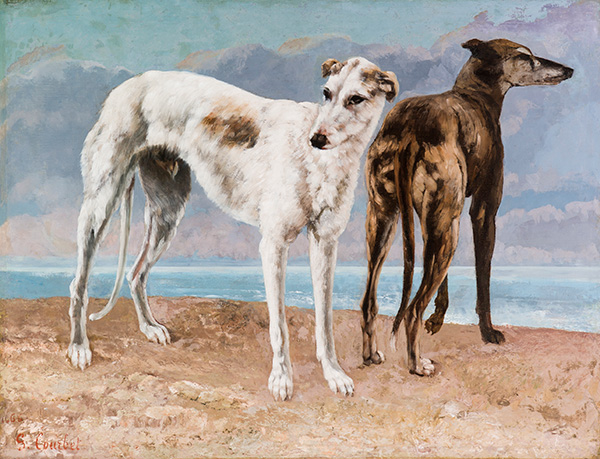
The Greyhounds of the Comte de Choiseul, 1866
Gustave Courbet, French
- Transcript
Speaker
Gisela Carbonell
Curator
Rollins Museum of ArtHi, I’m Gisela Carbonell, and I am the curator of the Rollins Museum of Art in Winter Park, Florida. I am a dog lover, and I have a soft spot for pointy-nosed dogs like whippets and greyhounds. I share my home and my couch with a beautiful senior whippet. Whippets are close relatives of the greyhounds like the two that appear in this painting, but I’ll let them tell you more about themselves.
Hi, there! Thank you for stopping by. You may be wondering if we are greyhounds, and yes, we are! Our ancestors have been traced back to the ancient world, but the modern greyhound was developed in England. Look closely. Do you notice our aerodynamic physique? That is because we are built for speed. We are sprinters and can run up to 45 miles an hour. In the old days we used to hunt in packs, but nowadays we prefer to run only for fun and spend the rest of the time cuddling at home with our humans. That’s why sometimes we are called “45-miles-an-hour couch potatoes.” We are sight hounds, which means we hunt by sight, like our relatives the whippets, salukis, and the Afghan hounds. Did you know we are the fastest dog breed? The only other land animal that is faster than us is the cheetah.
We have appeared in many works of art through the centuries, but we really like how we look in Mr. Courbet’s painting. And yes, you probably have seen us on TV too. If you have watched The Simpsons, you may have noticed their pet dog, Santa’s Little Helper, is also a greyhound. We are noble and quiet and sweet, and there are many of us available for adoption.
- Gallery Text
Gustave Courbet
French, 1819-1877The Greyhounds of the Comte de Choiseul, 1866
oil on canvasHere, Gustave Courbet shows two greyhounds with an aristocratic bearing. Perhaps they reflect characteristics of their owner, the young Count de Choiseul, who had proudly commissioned their portrait. The artist was a noted animal painter and often represented animals with human-like emotions. The elegant greyhounds are viewed from below to emphasize their height. They are silhouetted against the expansive shore of Deauville on the Normandy coast in France, where Courbet spent the summer of 1866 as a guest of the Count.
Funds given by Mrs. Mark C. Steinberg 168:1953
Learn More
Other greyhounds featured in artwork
Paolo di Dono, called Uccello (1397–1475), The Hunt in the Forest (detail), c.1465–1470

External Links
Recommended Reading: "Mama Pajama Tells a Story: A Collection of Writings About Dogs and Their Servants," by Patience Renzulli
Recommended Reading: "Comet's Tale: How the Dog I Rescued Saved My Life," by Steven D. Wolf
Recommended Reading: "Timbuktu: A Novel," by Paul Aster
Credits
Gustave Courbet, French, 1819–1877; The Greyhounds of the Comte de Choiseul, 1866; oil on canvas; 35 1/4 x 45 7/8 inches; Saint Louis Art Museum, Funds given by Mrs. Mark C. Steinberg 168:1953
Paolo di Dono, called Uccello (1397–1475); The Hunt in the Forest (detail), c.1465–1470; tempera and oil, with traces of gold, on panel; 28 7/8 x 69 11/16 inches; Ashmolean Museum of Art and Archaeology