Collection Guide
Collection Guide
Ernst Ludwig Kirchner, German (active Switzerland), 1880–1938; Circus Rider (recto), 1914; oil on canvas; 79 x 59 7/16 inches; Saint Louis Art Museum, Bequest of Morton D. May 904:1983
This Collection Guide highlights objects and images in the collection that depict animals. We invited guest experts to share their knowledge and experiences with animals to broaden our understanding of animal behavior and why artists from different parts of the world would choose to represent particular animals. This guide is intended for visitors of all ages.
-
Access and Assistance
Free Public Wi-Fi
The Saint Louis Art Museum offers free Wi-Fi to visitors. From your device, access the SLAM_GUEST network.
AUDIO GUIDE TRANSCRIPT
The transcript for each audio track is available in expandable sections of individual object pages.
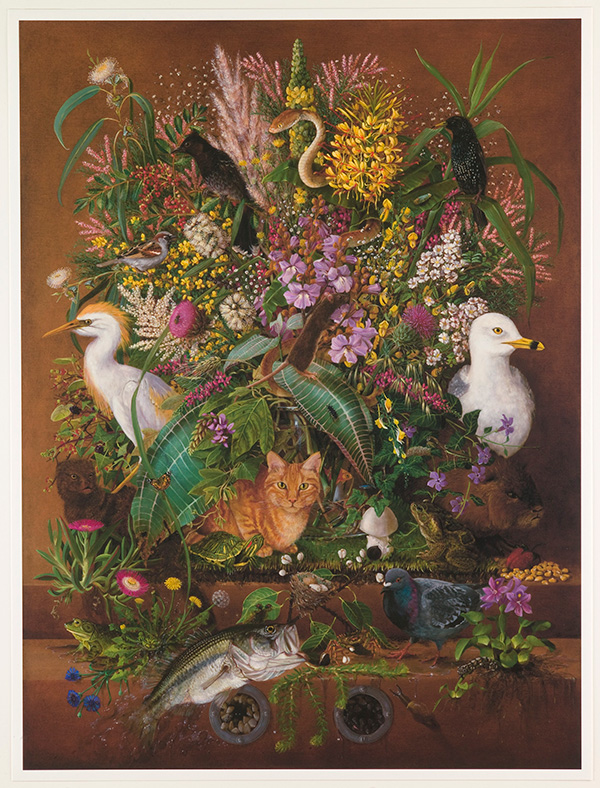
Ascendant, from the portfolio Taxa, 2006
Isabella Kirkland, American, published by Feature Inc.
Works on paper can be viewed in-person with an appointment at the Study Room for Prints, Drawings, and Photographs.
- Transcript
Speaker
Andrea Liebl
Biologist
University of South Dakota
Hi, my name is Andrea Liebl. I’m a biologist interested in how animals adjust to and live in different environments.
I’ve studied invasive species, which I think is why I’m drawn to Ascendant by Isabella Kirkland. Some of the species in the print, like the house sparrow—the small brown bird in the upper left—or the dandelion with the yellow flowers in the lower left, are species many of us have seen before. But perhaps surprisingly, none of the species shown here are actually from the United States. They were all brought here from other parts of the world by humans. Some species were brought here on purpose, like the house sparrow and the European starling—the black speckled bird in the upper right. Both of these birds were transported here and released by an early Shakespearean society that wanted all the species ever mentioned in a Shakespeare play to live in the US.
Other species, like the rat seen in the middle of the print and the brown tree snake right above the rat, were accidentally brought to the US from their native habitats. All of the species shown here, though, are now thriving in the US, often at the cost of native species. This is because, unfortunately, many of the species in this print compete with, spread disease to, and prey on species meant to be here, often threatening or even leading to the extinction of our own native species.
- Gallery Text
Isabella Kirkland,
American, born 1954
published by Feature Inc.Ascendant, from the portfolio Taxa, 2006
inkjet printColonization of the New World brought a wealth of species to the Americas from around the globe. The seventy-four species in Ascendant are all non-native, but they are also thriving as their populations continue to grow—often at the expense of indigenous flora and fauna. The Indian mongoose, for example, was originally imported to the Hawaiian Islands in the 1880s to control sky-rocketing numbers of another invasive species: rats. Instead, the mongoose has had tragic consequences for rare local bird colonies.
The Sidney S. and Sadie Cohen Print Purchase Fund 158:2011.2
Credits
Isabella Kirkland, American, born 1954, published by Feature Inc.; Ascendant, from the portfolio Taxa, 2006; inkjet print; image (each): 34 1/16 x 25 1/2 inches, sheet (each): 35 x 26 1/2 inches; Saint Louis Art Museum, The Sidney S. and Sadie Cohen Print Purchase Fund 158:2011.2; © Isabella Kirkland