Installation view of Art Along the Rivers: A Bicentennial Celebration
This audio guide features 15 commentaries on objects created over the past 1,000 years near the confluence of some of the continent’s most powerful rivers—the Mississippi and Missouri. Listen to a general introduction, narrators from the Saint Louis Art Museum, and voices from the confluence region community.
-
Access and Assistance
Free Public Wi-Fi
The Saint Louis Art Museum offers free Wi-Fi to visitors. From your device, access the SLAM_GUEST network.
Large Print Labels
Large-print labels are available on your own device and upon request at the Taylor Hall Welcome Desk.
AUDIO GUIDE TRANSCRIPT
The audio guide transcript is available to view on your own device.
Robe, c.1835
Mató-Tópe, Mandan
- Transcript
Speaker: Alex Marr
Assistant Curator for Native American Art
Saint Louis Art MuseumThis is Alex Marr, assistant curator for Native American art at the Saint Louis Art Museum.
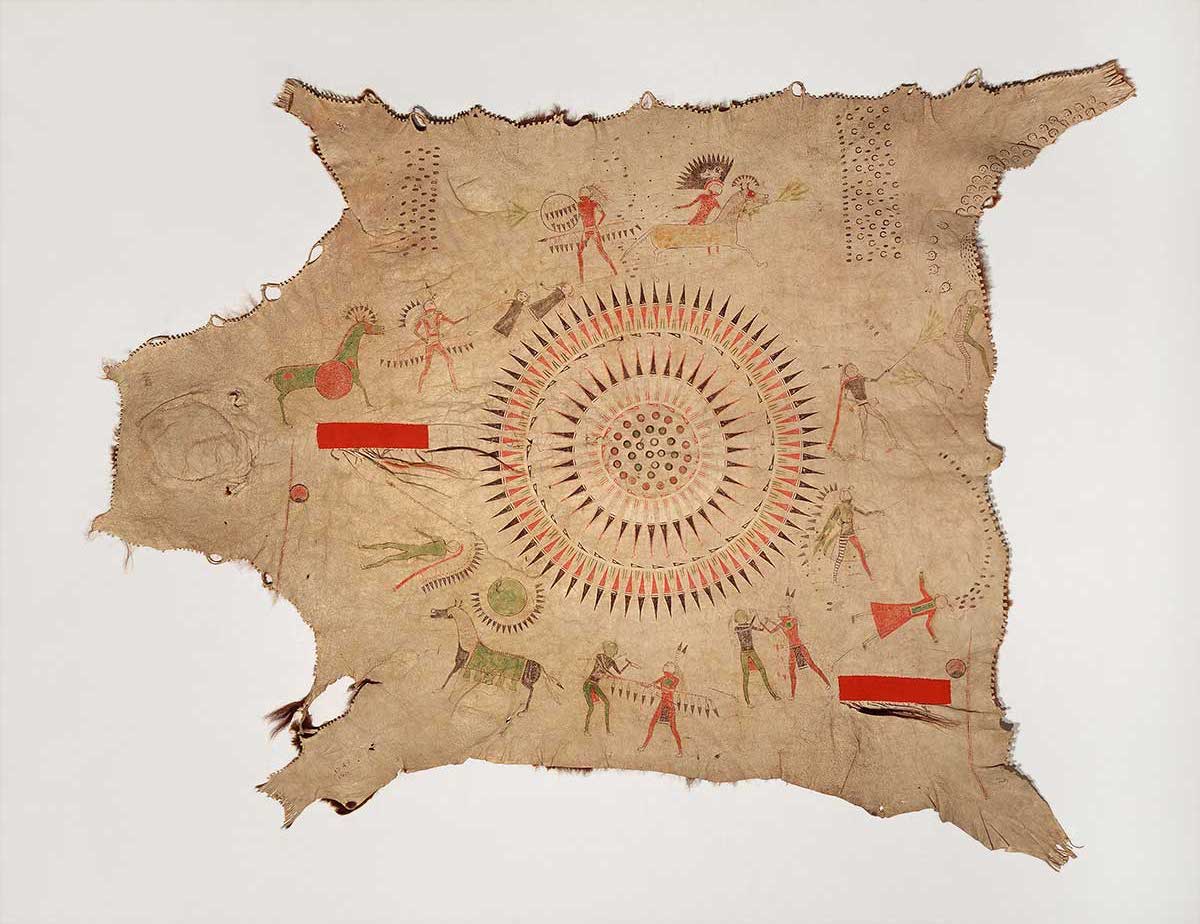
The artist of this Robe was a high-ranking leader of the Mandan, a Native American group from the upper Missouri River. Across the plains in the 19th century, men created autobiographical records of their military achievements in multiple forms, including figural paintings such as this. These visual representations counted as personal property, and they were used to certify a man’s claim to elevated status within Indigenous political organizations.
Narrative action on this painting represents eight distinct events that took place through a span of years, though the composition relays Mató-Tópe’s bravery with an arresting sense of simultaneity and power. Looking closely at one story at the top of the painting, Mató-Tópe stands in profile while holding a spear and shield. This depicts an experience when he single-handedly faced down an attack from several 100 enemies. Tracks, circles, and lines behind the figure convey his allies’ retreat in the midst of flying bullets. In the top left corner, four rows of tracks represent the attackers. The enemies later claimed that he charged with the strength of four bears. This is the episode where the artist received his adult name; in the Mandan language, Four Bears translates to Mató-Tópe.
- Gallery Text
Art at the Confluence
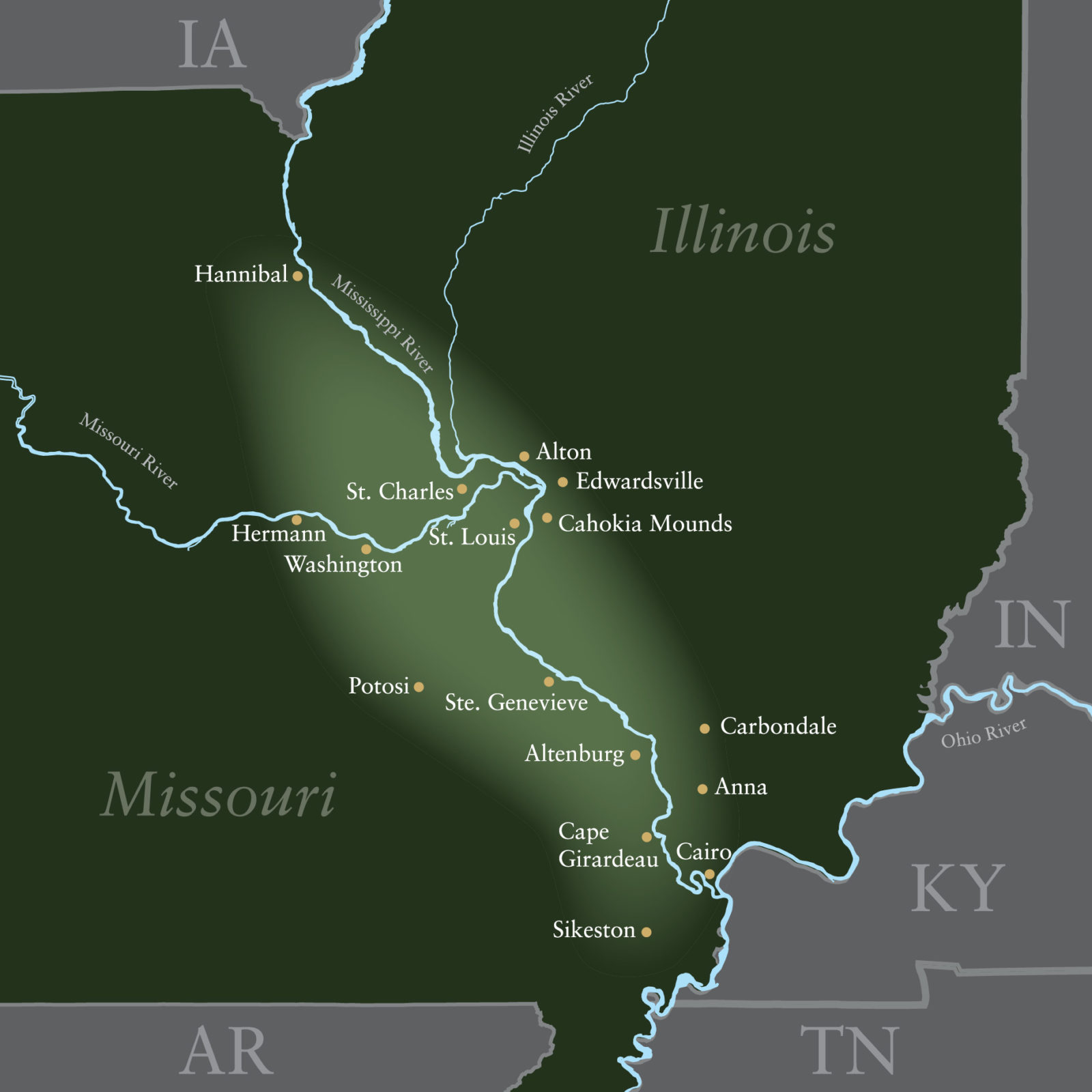
The confluence region witnessed some of North America’s most significant movements of people and materials for over 1,000 years. The continent’s three most powerful rivers—the Mississippi, Missouri, and Ohio—meet within its boundaries. Indigenous trade routes stretched through the region from the Great Lakes to the Gulf of Mexico. The Mississippi River provided a major north-south artery. The Missouri River and, later, western overland trails made the confluence region the “Gateway to the West” for non-Indigenous commercial, scientific, and military explorers.
St. Louis, founded in 1764, and its surrounding area soon resembled a busy cosmopolitan hub despite its distance from other major colonial settlements. Europeans, Americans, and Native Americans gathered in the city to connect with suppliers, guides, government officials, and traders. Many artists departed from St. Louis on their journeys to provide a visual accounting of western lands and peoples. The development of this hub also led to the removal of Native American groups such as the Osage Nation.
Some communities came to the confluence region to stay. Their artists produced works that are, at times, a stylistic mix derived from the area’s diverse cultures. At other times, these artworks sustained a community’s resilience by maintaining its distinct visual traditions.
Mató-Tópe, Mandan, c.1784–1837
Robe, c.1835
hide, pigment, hair, and quillsBernisches Historisches Museum, Bern 2021.95
Eight battle scenes surround a sun-like circle of abstracted eagle feathers. For the war leader Mató-Tópe and his fellow Mandan peoples, this robe constitutes a powerful narrative self-portrait. A devoted artist, Mató-Tópe carefully studied the work of European and American artists who visited him. In his robe, he incorporated European techniques of pictorial volume and depth into the pictographic conventions of Plains narrative art.
Mató-Tópe’s most famous battle is depicted next to the red cloth strip in the lower left corner of the robe. A grueling contest between a Tsistsistas (Cheyenne) chief, in green, and Mató-Tópe, on the right in red, ended in hand-to-hand combat. Mató-Tópe received a deep wound in his hand before killing the Tsistsistas enemy with their own knife.
Mató-Tópe and over 90% of the Mandan peoples tragically perished in 1837 during the smallpox epidemic. His robe, considered a pivotal work of Plains art, traveled down the Missouri River along trade routes from his winter home, in what is now North Dakota, to Kansas City, Missouri. It was purchased there later that year by merchant Alphons Schoch and displayed in his St. Louis home.
Credits
Mató-Tópe, Mandan, c.1784–1837; Robe, c.1835; hide, pigment, hair, and quills; 78 3/4 x 90 15/16 inches; Bernisches Historisches Museum, Bern 2021.95