Unidentified artist, Southern Andes; Poncho with Musicians (Poncho con músicos), late 17th–early 18th century; cotton, camelid-fiber, and silk and metallic-thread tapestry weave; 69 1/2 x 66 inches; Los Angeles County Museum of Art, Gift of Miss Bella Mabury M.40.1.76; photo © Museum Associates/LACMA
Language
While acknowledging the violence that marked the process of conquest and colonization in Spanish America from 1500 to 1800, this exhibition audio guide highlights the intricate social, economic, and artistic dynamics of these societies that led to the creation of new artworks. Alongside local community members from the Missouri Botanical Garden and Washington University, listen to commentary from the Museum director, curators, a textile conservator, and a docent.
-
Access and Assistance
Free Public Wi-Fi
The Saint Louis Art Museum offers free Wi-Fi to visitors. From your device, access the SLAM_GUEST network.
Large Print Labels
Large-print labels are available on your own device and upon request at the Taylor Hall Welcome Desk.
AUDIO GUIDE TRANSCRIPT
The audio guide transcript is available to view on your own device.
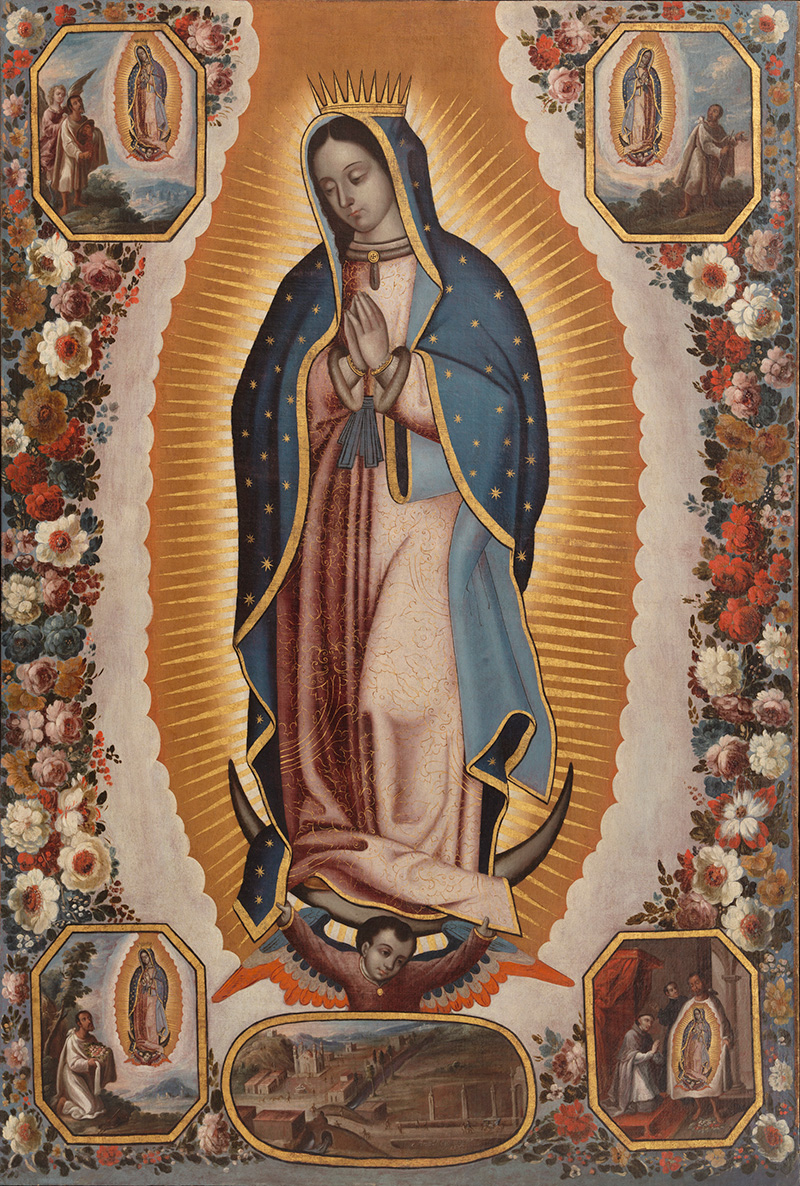
Virgin of Guadalupe, c.1720
Antonia de Torres, Mexico
- Transcript
Speaker
Clare Kobasa
Associate Curator of Prints, Drawings, and Photographs
Saint Louis Art MuseumHello, my name is Clare Kobasa, and I’m the Associate Curator of Prints, Drawings, and Photographs.
As you look at these two paintings with the same title—The Virgin of Guadalupe—what similarities do you notice? What are the differences? In large scale at the center of each canvas appears the Virgin herself, the mother of Jesus in Catholic tradition, but as she miraculously appeared to Juan Diego in 1531 in Mexico. This story is recounted in the four roundels at the corners of each, culminating in the bottom right, where Diego has dropped his tilma, or cloak, to reveal the heavenly apparition in material form as a painting. By both replicating the miraculous image and including the narrative of its making, these two later copies participate in and expand on a long history of powerful images in Catholic practice. The Spanish introduced Catholicism as part of their often-violent colonial project, seeking to convert Indigenous inhabitants to this new religion. This process often occurred through the appropriation of existing sacred practices, such as the landscape where Diego first encountered the Virgin—the hilltop of Tepeyac, the site of previous Mexica worship of the goddess Tonantzin. In Antonio de Torres’s painting, he also included a depiction of a new sanctuary, completed in 1709, which quickly became the site of pilgrimage, the goal of a journey. While people could go to the image, the image itself also began to travel in the form of these copies, whose authority was confirmed by the involvement of celebrated artists who closely followed rules laid down for the reproductions. The extent of that spread extends to the present, with images of her still visible worldwide today.
- Gallery Text
Antonio de Torres,
Mexico, 1667–1731Virgin of Guadalupe, c.1720
oil on canvasLos Angeles County Museum of Art, Gift of Kelvin Davis through the 2014 Collectors Committee (M.2014.91)
Credits
Antonio de Torres, Mexican, 1667–1731; Virgin of Guadalupe (Virgen de Guadalupe), c.1720; oil on canvas; 81 1/2 x 55 1/8 inches; Gift of Kelvin Davis through the 2014 Collectors Committee 2024.97; photo © Museum Associates/LACMA