Claude Monet, French, 1840–1926; Water Lilies (detail), 1914–1917; oil on canvas; 59 7/16 x 79 1/8 inches; Musée Marmottan Monet, Paris 2023.96; © Musée Marmottan Monet, Académie des beaux-arts, Paris
The exhibition audio guide offers multiple voices on the dialogue between the work of French Impressionist Claude Monet and the American Abstract Expressionist Joan Mitchell. Listen to the Director’s welcome, curator Simon Kelly, museum scholars, and experts in music, horticulture, and art as they share their perspectives on art and nature.
-
Access and Assistance
Free Public Wi-Fi
The Saint Louis Art Museum offers free Wi-Fi to visitors. From your device, access the SLAM_GUEST network.
Large Print Labels
Large-print labels are available on your own device and upon request at the Taylor Hall Welcome Desk.
AUDIO GUIDE TRANSCRIPT
The audio guide transcript is available to view on your own device.
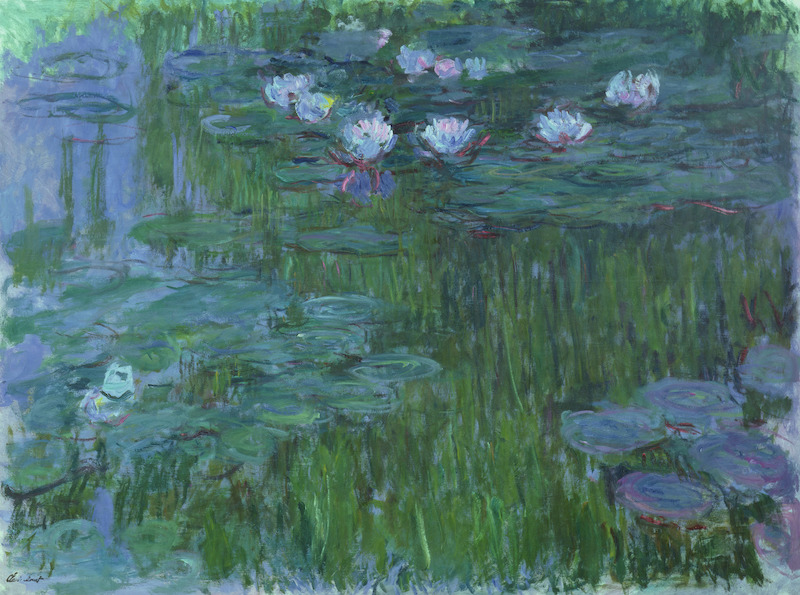
Water Lilies, 1914–1917
Claude Monet, French
- Transcript
Speaker
Derek Lyle
Senior Manager of the Nurseries and Greenhouses
Missouri Botanical GardenHello, I’m Derek Lyle, the senior manager of the nurseries and greenhouses at the Missouri Botanical Garden.
A historical relationship was created in the late 1800s when Claude Monet first witnessed hybridized, hardy water lilies by Joseph Bory Latour-Marliac. His hybrids were unique and revolutionary to the aquatic world of horticulture.
Recurrently, white water lilies provided the lone focal color of painted aquatic landscapes until Latour-Marliac introduced vibrant, colorful, and award-winning cultivars. He cross-pollinated yellow-, pink-, red-, and white-flowered North American water lily species with those from Europe. Cross-pollination occurs naturally in the wild, but only when receptive species are nearby. Latour-Marliac mechanically introduced new traits of water lilies from other continents, and as a result, his breakthroughs established him as a pioneer of water lily hybridization.
In 1894 Claude Monet began purchasing Latour-Marliac’s hybrids for his personal water garden at Giverny. Commonly found hybrids in Monet’s landscapes are Nymphaea ‘Mexicana’, Nymphaea ‘Laydekeri Rosea’, and Nymphaea ‘Atropurpurea’. Hybrids such as these are still available for purchase from water gardening nurseries and are showcased in many public gardens, including the Missouri Botanical Garden.
- Gallery Text
Claude Monet,
French, 1840-1926Water Lilies, 1914-17
oil on canvasThese landscapes of water lilies and reflections have become an obsession.
-Claude Monet, 1908Animating this canvas is a reflection of weeping willow branches vertically depicted in shades of dark green. The play of natural light across water lily blooms and pads captivated Monet, who probably painted the picture beside his Giverny pond. His common practice of working outdoors is evident in a photograph of him perched on a stool with an umbrella overhead.
Musée Marmottan Monet, Paris 2023.96
Gardens and Trees
My garden is a slow work of art, a labor of love.
-Claude Monet, 1924I give gratitude to trees because they exist.
-Joan Mitchell, 1976Gardens bursting with plant life provided great inspiration for both Claude Monet and Joan Mitchell. Monet moved to Giverny in 1883, and initially cultivated a flower garden. Ten years later he diverted water from a branch of the nearby river Epte to create a pond for “the pleasure of the eye and also for motifs to paint.” Therefore, he expanded this pond, and planted a wide range of water lilies as well as trees and flowers around its edges.
The water lilies, and his weeping willow trees, became principal subjects of Monet’s late work. He represented the lilies and willows in many ways: by themselves; in relationship to the pond; and as reflections. Mitchell often visited Giverny, particularly in the 1970s, and described it as her “secret garden.”
In 1967, Mitchell purchased a two-acre property at Vétheuil and she moved there in 1968. Over the years, she cultivated a flower garden and separate vegetable garden. Her house had an impressive view looking down over the Seine river: her friend, the artist Ed Clark, described it as “goddamn beautiful.” This view, as well as the colors and shapes of the flowers and a linden tree, provided Mitchell endless creative material.
Credits
Claude Monet, French, 1840–1926; Water Lilies, 1914–1917; oil on canvas; 59 7/16 x 79 1/8 inches; Musée Marmottan Monet, Paris 2023.96; © Musée Marmottan Monet, Académie des beaux-arts, Paris