Gosette Lubondo, Congolese, born 1993; Imaginary Trip II: #3, 2018; inkjet print; image: 19 5/8 × 29 1/2 in. (49.8 × 74.9 cm) sheet: 22 × 32 in. (55.9 × 81.3 cm); Saint Louis Art Museum, The Helen Kornblum Fund for Women Photographers, and Gift of August A. Busch Jr., by exchange 40:2021; © Gosette Lubondo, work produced as part of the photographic residencies of the Museum of Quai Branly-Jacques Chirac
This exhibition audio guide explores how historical and contemporary African arts make visible narratives rooted in collective and individual memory and knowledge. Hear from Museum staff, scholars, artists, and cultural experts.
-
Access and Assistance
Free Public Wi-Fi
The Saint Louis Art Museum offers free Wi-Fi to visitors. From your device, access the SLAM_GUEST network.
Large Print Labels
Large-print labels are available on your own device and upon request at the Taylor Hall Welcome Desk.
AUDIO GUIDE TRANSCRIPT
The audio guide transcript is available to view on your own device.
Relative, 2010
Sokari Douglas Camp (born 1958, Nigeria, active England)
- Transcript
Speaker
Sokari Douglas Camp
Artist
London, EnglandHello, my name is Sokari Douglas Camp. I’m a sculptor. I live in London, and my heritage is Nigerian British. My people are called Kalabari people, and we live in the Niger Delta in Nigeria.
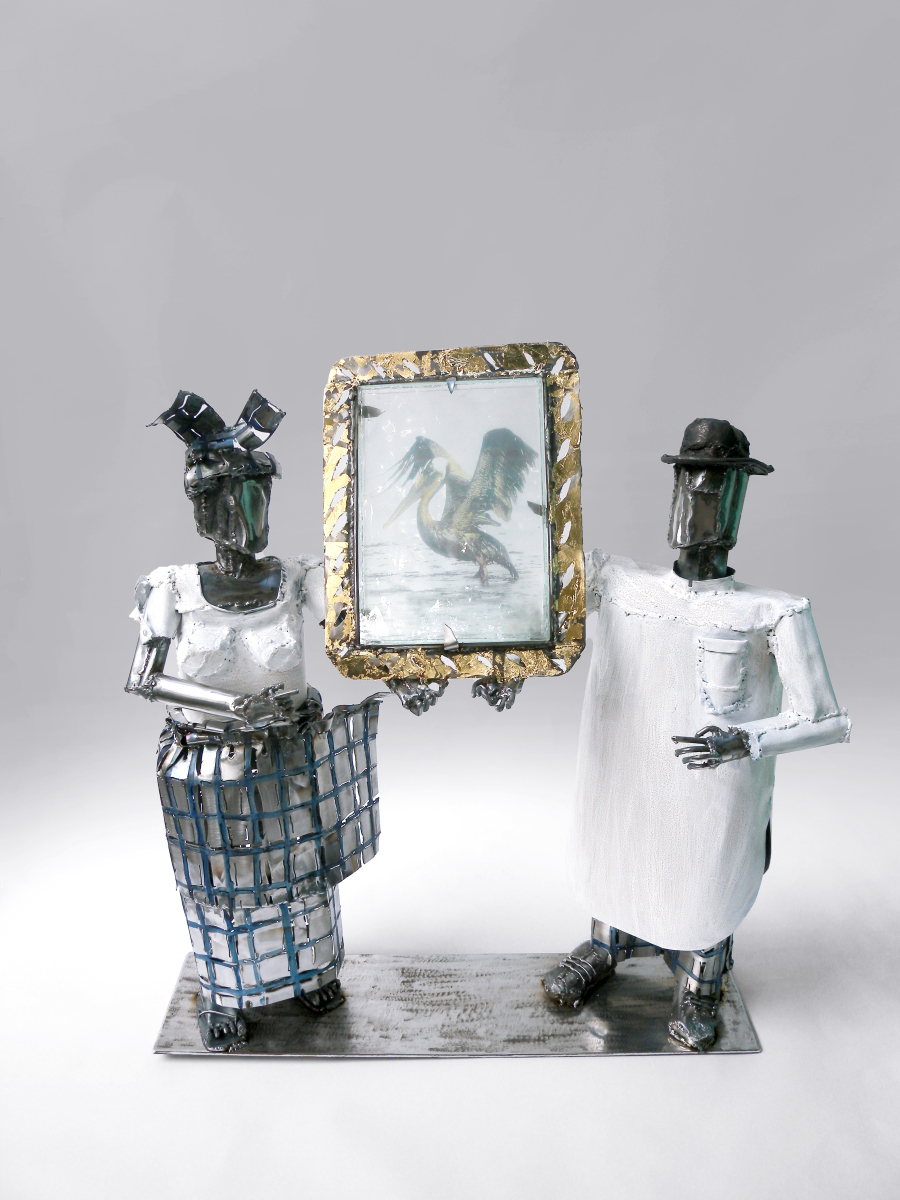
I have made a sculpture called Relative Pelican, and it depicts two figures in Kalabari attire, which is wrapper and top and head tie. And the man is wearing a shirt called Etibo and a bowler hat. These are traditional clothing that Kalabari people might wear to an important occasion. They are holding a framed picture of a pelican between them, just because we have a tradition as part of our funeral ceremonies that we might hold a picture of a beloved relative in our hands, a large A3-sized framed picture. And sometimes, you get relatives that look alike, and one might be male; one might be female. But you can see the family features are the same. And they parade through the town with pride to show whom they’ve lost and who they are. I thought that it was very important to show that we are members of the human race that should be acknowledged. But, we have a bird between us, the pelican who suffered very much in 2010 when there was an oil spill off the coast of Florida. And there were pictures of pelicans on newspapers all over the world, front pages of pelicans who had been covered in oil on the Florida coast. Fishing has been disrupted by this oil spill at this time, and the oil spill was created by BP. And Obama, the President of America at the time, made a campaign to get BP to compensate and clear up the mess they had made.
I felt very struck by this because people in the Niger Delta have been suffering from oil spills for over 30 years if not 40 years, and we’ve never had front page news to say how much we’re suffering. We haven’t really been compensated, and our communities have been disrupted, polluted. We’ve had to emigrate from our homes, and we haven’t been given the service that the pelicans got in 2010. And this isn’t really a memory; it’s a record of how some members of the human race are treated.
Relative Pelican is a—would it be called a whimsical piece? A whimsical but very, very serious piece of work. Just saying, “I’m your relative; take notice of me,” and the Kalabari people, and how our land and coast has been decimated by oil spills for the last 50 years almost. And we want to be noticed as much as these birds were in 2010.
- Gallery Text
Sokari Douglas Camp
(born 1958, Nigeria, active England)Relative, 2010
steel, acetate, glass, gold leafIt was always nice to go to this island and to walk around the palm groves and the mounds where our people are buried. Now we have a roaring oil well beside the island and so much pollution. It is no wonder that in the region, where there are still few modern conveniences, Kalabari people are only living to their fifties.
—Sokari Douglas Camp, 2023
A pair of figures hold a framed photograph showing a pelican and its watery surroundings. Here Sokari Douglas Camp referenced memorial traditions of the eastern Niger River Delta region where she was born. During Kalabari memorial traditions, family members carry photographs of recently deceased relatives to demonstrate their relationship to those who have passed on.
Kalabari communities have long engaged in political resistance against oil companies that exploit the region’s resources. With the bird and its environment occupying the place of honor in this work, the artist invites us to consider our relationship to creatures and places we have lost due to human-caused climate change, for fear that even more become pure memory.
Courtesy of the Artist 2024.288
Credits
Sokari Douglas Camp, Nigerian (active England), born 1958; Relative, 2010; steel, acetate, glass, gold leaf; 38 9/16 x 31 7/8 x 7 7/8 inches; Courtesy of the Artist 2024.288; © 2024 Artists Rights Society (ARS), New York / DACS, London