Installation view of Always Modern: German Art and Design from the Collection
As Art Nouveau trends were spreading across Europe at the turn of the 20th century, architects and designers in Germany were creating their own style. Jugendstil, the German contribution to the international movement, features the curving lines and abstract decorations of Art Nouveau, but Jugendstil designs were often simpler than their French counterparts.
The German movement, which translates to “style of youth,” took its name from the influential German art magazine Die Jugend, which became a style-setting icon showcasing fine and decorative arts from the period. German artists in the 1890s were rejecting the ornate revival styles in favor of more organic designs. Early phases of Jugendstil tended toward decorative floral motifs. However, it eventually moved toward simplified abstraction and focused on functional designs.
The Saint Louis Art Museum—widely known for its collection of 20th-century German art—has impressive Jugendstil holdings, a fraction of which are on view in the current, free exhibition Always Modern: German Art and Design from the Collection. The exhibition explores the spirit of bold experimentation and fresh ideas that defined the the modern art period through the lens of more than 30 works of German art and design from the collection.
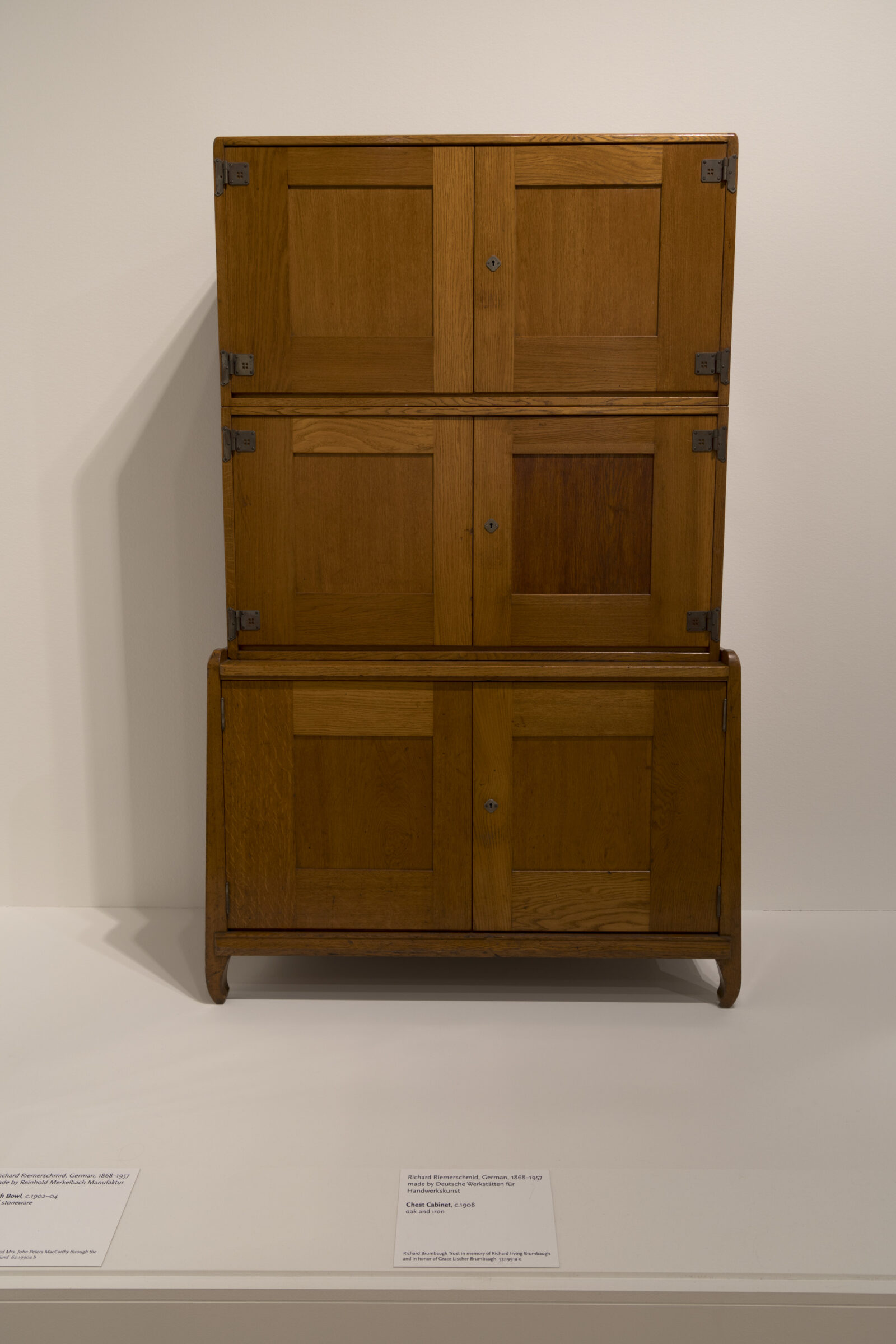
designed by Richard Riemerschmid, German, 1868–1957; made by Deutsche Werkstätten für Handwerkskunst, Dresden, Germany, founded 1898; Chest Cabinet, c.1908; oak and iron; overall: 78 1/16 x 49 3/4 x 21 1/4 inches; Saint Louis Art Museum, Richard Brumbaugh Trust in memory of Richard Irving Brumbaugh and in honor of Grace Lischer Brumbaugh 53:1991a-c

designed by Richard Riemerschmid, German, 1868–1957; made by Deutsche Werkstätten für Handwerkskunst, Dresden, Germany, founded 1898; Chest Cabinet, c.1908; oak and iron; overall: 78 1/16 x 49 3/4 x 21 1/4 inches; Saint Louis Art Museum, Richard Brumbaugh Trust in memory of Richard Irving Brumbaugh and in honor of Grace Lischer Brumbaugh 53:1991a-c
Two artists featured in the exhibition, Richard Riemerschmid and Albin Müller, were central figures in the Jugendstil movement. These designers collaborated with manufacturers to produce beautiful objects optimized for emerging machine production, with the goal of making well-designed furnishings affordable for middle-class consumers.
Riemerschmid’s modular chest exemplifies this approach. Riemerschmid designed furniture, metalwork, lighting, glass, and textiles in the early 20th century. This 1908 piece was assembled by hand from machine-milled pieces. The ingenious design combines three separate cabinets that function independently or stacked; side handles make them easy to move around the house.
Also designed by Riemerschmid, this punch bowl is featured in the exhibition as an example of the Jugendstil movement. It was made with a mold to form the vessel and create leaf– and flower-shaped cells on the surface. The use of molds also reduced cost. In 1900, Riemerschmid began a collaboration with Reinhold Merkelbach, a manufacturer of traditional stoneware, to create more modern and affordable ceramic wares such as this, with sleek geometric form and graphic ornament inspired by nature.

designed by Richard Riemerschmid, German, 1868–1957; made by Reinhold Merkelbach Manufaktur, Höhr-Grenzhausen, Germany, founded 1845; Punch Bowl, c.1902–04; glazed stoneware; 14 1/2 x 11 1/2 inches; Saint Louis Art Museum, Funds given by Mr. and Mrs. John Peters MacCarthy through the 1989 Art Enrichment Fund 62:1990a,b

Installation view of Always Modern: German Art and Design from the Collection
designed by Albin Müller, German, 1871–1941; made by Fürstlich Stolberg'sches Hüttenamt, Ilsenburg, Germany, active 1530-1930; Table Lamp, 1903; cast iron and copper plating; 16 3/4 x 8 7/8 x 5 1/2 inches; Saint Louis Art Museum, Richard Brumbaugh Trust in memory of Richard Irving Brumbaugh and in honor of Grace Lischer Brumbaugh 243:1992
designed by Albin Müller, German, 1871–1941; made by Metallwarenfabrik Eduard Hueck, Lüdenscheid, Germany, founded 1864; Serving Jug, c.1900–1902; copper; 15 1/2 x 6 5/8 x 6 1/8 inches; Saint Louis Art Museum, Richard Brumbaugh Trust in memory of Richard Irving Brumbaugh and in honor of Grace Lischer Brumbaugh 346:1991
The organic yet abstract aesthetic of Müller’s metalwork pieces also typifies the Jugendstil movement. On view in Always Modern, this cylindrical serving jug from 1902 is made of red-brown patinated copper with a domed cover, bird-beak spout, and strap handle. Made around the same period, this table lamp features a cast-iron stand and copper-plated brass bell shade. Together, these works reveal how Jugendstil artists reimagined everyday objects by balancing beauty, function, and modern life at a moment of profound cultural change.
Always Modern invites visitors to look closely at these thoughtfully designed objects and discover how their ideas continue to shape the world we live in today. The exhibition is on view through March 15 in Gallery 235 and Sidney S. and Sadie M. Cohen Gallery 234.