Local florist Ann Rabbitt adjusts her floral arrangement based on the painting In the Roman Campagna by George Inness for the 2026 Art in Bloom. Photo by Emily Wasserman.
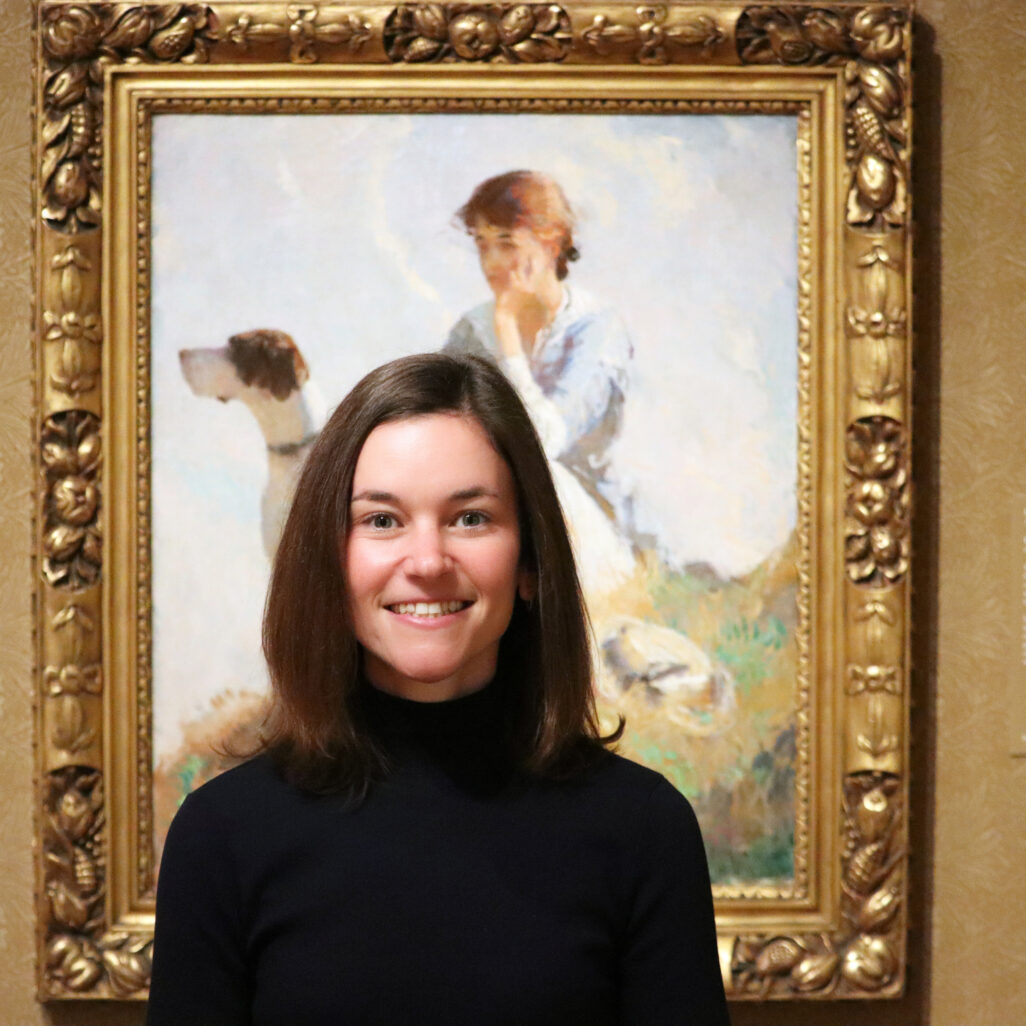
“During a professional competition, you get points taken off for foam showing,” local florist Ann Rabbitt said while stuffing more moss into her Art in Bloom floral arrangement. Rabbitt, owner of Thorn Studio and an AIFD- and CFD-certified professional florist, has participated in the event many years since its inception at SLAM in 2000. As SLAM celebrated Art in Bloom’s 20th year (an adjusted anniversary based on years missed during building construction and the pandemic), we spoke with Rabbitt to discuss her memories of events past, and her process for creating intricate arrangements based on works of art found around the Museum.

Local florist Ann Rabbitt stands next to her completed floral arrangement based on the painting In the Roman Campagna by George Inness for the 2026 Art in Bloom. Photo by Emily Wasserman.
Museum staff started to consider launching an Art in Bloom event as early as 1992, drawing inspiration from the Museum of Fine Arts, Boston, which is credited with originating the concept. However, it wasn’t until 2000 that SLAM kicked off its own version of the event. That year, the American Institute of Floral Designers (AIFD) hosted a symposium in St. Louis, where regional florists including Rabbitt participated in a floral arrangement session to become members. Florists brought one box of tools and created an arrangement; then, national directors and officers judged the arrangements on-site. Florists gained membership based on the arrangement’s approval as well as a previously submitted portfolio. Art in Bloom started as an offshoot of this session. SLAM invited 18 AIFD-member florists to the Museum to interpret 30 objects through floral arrangements while they were in St. Louis.
After the first year, the Museum formalized Art in Bloom and invited local garden clubs to participate. In the early iterations of the event, garden club members volunteered to create arrangements. Their arrangements were placed primarily in Sculpture Hall, although over the years, more locations across the Museum, including galleries on each level, displayed their creations.

Ann Rabbitt meets with SLAM staff to check her flower selections for Art in Bloom. Photo by Emily Wasserman.
Art in Bloom continued to evolve as time passed, with florists applying to participate in the event instead of responding to an invitation. Florists submit a portfolio ahead of time as part of an open-call application process, and Museum staff decides who will receive the 30 coveted spots. At a meeting in early January, selected florists convene at the Museum for a meeting to review detailed event protocols and information.
Florists, including Rabbitt, draw a number at the beginning of the meeting. At the end of the meeting, Museum staff call out the numbers, and the florists draw—at random—a piece of paper with their assigned work and its location in the Museum. Florists can then visit the work and begin the process of learning more about it to create their arrangement.

Ann Rabbitt puts the finishing touches on her arrangement for the 2026 Art in Bloom. Photo by Emily Wasserman.
Creating an arrangement is a complex, multistep process. Florists need to consider everything from the container, which should be a cohesive aspect of the arrangement without overpowering it, to environmental factors, Rabbitt said. A museum is a difficult place for flowers because of the controlled temperature, humidity, and lighting in galleries, so florists need to choose flowers strategically. They also need to keep their arrangements within strict measurements, adjusting as needed once they’re placed on a pedestal to make sure nothing blocks paths or views.
This year, Rabbitt created her arrangement based on In the Roman Campagna by American artist George Inness, which is currently on view in Gallery 336. The painting shows a flock of sheep grazing in the sunny Italian countryside. Ruins appear in the foreground and frame a shepherdess crouching in the field wearing a red scarf on her head. The verdant colors in the painting offered fertile ground for inspiration.

George Inness, American, 1825–1894; In the Roman Campagna, 1873; oil on canvas mounted on board; 26 x 43 inches; Saint Louis Art Museum, Museum Purchase 115:1946
Rabbitt visited the work ahead of time to study it and check on lighting, which she often does before she puts together an arrangement, she said. Her resulting arrangement included a variety of flowers, such as orchids, chocolate lisianthus, white Japanese sweet peas, ginestra, curly willow, and button mums, which mirror colors found in the painting. She used galax leaves, which are grown in the mountains of North Carolina, along with moss to help cover the foam in the containers.
To create containers for the arrangement, Rabbitt sponge painted plastic bins. She primarily used green and gold paint to reflect the pastoral and sunny qualities in the work. She also added sparkling purple threads throughout the arrangement to match the sheen you see if you view the painting up close. “You need to bring your perspective to art,” Rabbitt said.
Over the three days of Art in Bloom, Rabbitt and other florists came back to refresh their creations. This is often a key part of the event behind the scenes, as florists are required to revive and water their arrangements daily before the end of the weekend exhibition. Even though Rabbitt has participated in the event many times in the past 20 years, the process never gets old. “The beauty of arranging flowers is that it’s not forever. It has an end cycle, and those flowers open, grow, and change over time. There’s something exciting about that,” she said.