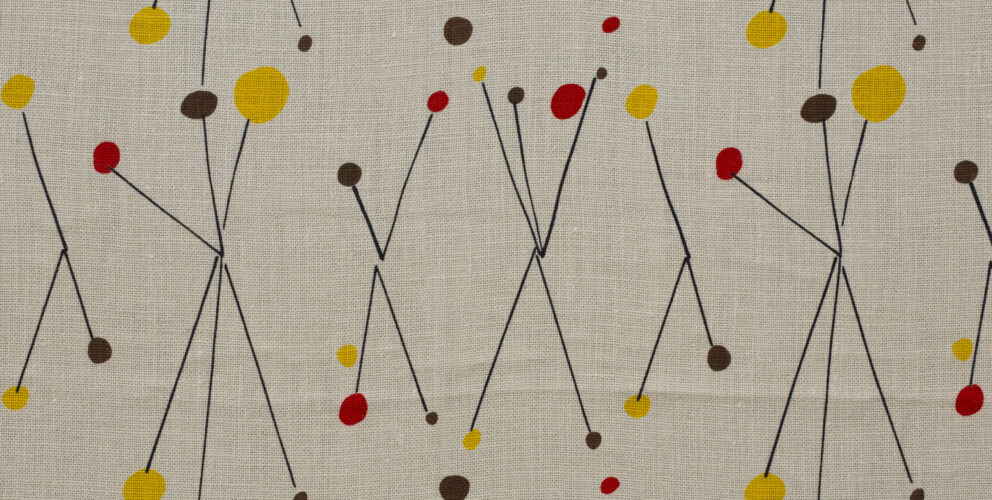
Althea McNish; N15 Archive, The Althea McNish Collection [50]; Photo by Horace Tonge
Trailblazing Caribbean artist and designer Althea McNish (1924–2020) forged her own vibrant path in an often-colorless field. Two works by the artist are featured in Bolts of Color: Printed Textiles after WWII, on view through May 25 in Carolyn C. and William A. McDonnell Gallery 100.
Known for her keen observation of nature, McNish worked to dismantle the silos of fabric, fashion design, and production, stating in a 1965 article: “Results can be so much better if we can all operate as a team. It enables us to get the very best out of the fabric and its design, and that in turn makes for much better garments in the shops.” With a deep knowledge of printing and manufacturing, McNish ensured her designs were realized with complexity and precision.
-
Althea McNish, English (born Trinidad), 1924–2020; Golden Harvest Textile, 1959; screenprinted cotton; 76 × 50 inches; Saint Louis Art Museum, Richard Brumbaugh Trust in memory of Richard Irving Brumbaugh and Grace Lischer Brumbaugh 41:2021
-
Althea McNish, English (born Trinidad), 1924–2020; Painted Desert, 1959; screenprinted cotton; 104 × 50 inches; Saint Louis Art Museum, Richard Brumbaugh Trust in memory of Richard Irving Brumbaugh and Grace Lischer Brumbaugh 42:2021


Her attention to detail can be seen in her works Golden Harvest and Painted Desert, on view in the Bolts of Color exhibition. Shown above (left), the painterly strokes and intense orange and yellow of Golden Harvest depict an image reminiscent of swaying stalks of wheat. Painted Desert is also a love letter to Mother Nature. Layers of color create the vibrant backdrop for McNish’s loose drawing of a towering clump of spiny desert plants. The work’s original title, The Old Man, is another name for Cephalocereus senilis, a giant cactus native to Mexico. The tropical representation of flora is a common thread that runs through McNish’s oeuvre.
The artist was born in Trinidad, one half of the island country now known as Trinidad and Tobago, located just north of mainland South America and, at the time, a British colony. Already a member of the Trinidad Arts Society, she moved to London, at first to study architecture before transitioning to study printmaking, where she made visual connections between the landscapes of the city and her hometown, Port of Spain. While visiting a tutor in Essex in the late 1950s, she noticed a field of wheat that reminded her of the sugarcane plantations back home. Drawing connections between northern and southern terrains, she created Golden Harvest, which became her first design for Hull Traders, an influential fabric production company. According to the Victoria and Albert Museum, “the furnishing fabric of printed heavy cotton satin was Hull Traders’ best-selling design when released the following year and stayed in production until the 1970s.” After the success of Golden Harvest, she was sought-after for several exclusive private and commercial designs, including Danasco Fabrics Ltd., Christian Dior, and for Queen Elizabeth II’s tour of Trinidad and the Caribbean.

Althea McNish; N15 Archive, The Althea McNish Collection [50]; Photo by Horace Tonge
Because she began during Britain’s bleak postwar years, McNish’s technical skill and fearless use of color allowed her career to flourish. She developed an affinity for the technical ins and outs of printing textiles early and would frequently show printers exactly how to achieve the correct results. According to her husband, artist John Weiss, “Once printers realized that she knew their business almost as well as they did, then suddenly, they could do what they had said five minutes earlier was impossible.” Her decisive knowledge of the industry and her use of vivid, abstract designs both intimidated and inspired British designers. Propelled by the beauty around her, McNish became one of the earliest, if not the first, designer of African-Caribbean descent to achieve international recognition, according to Christine Checinska in Pop Art and Design.