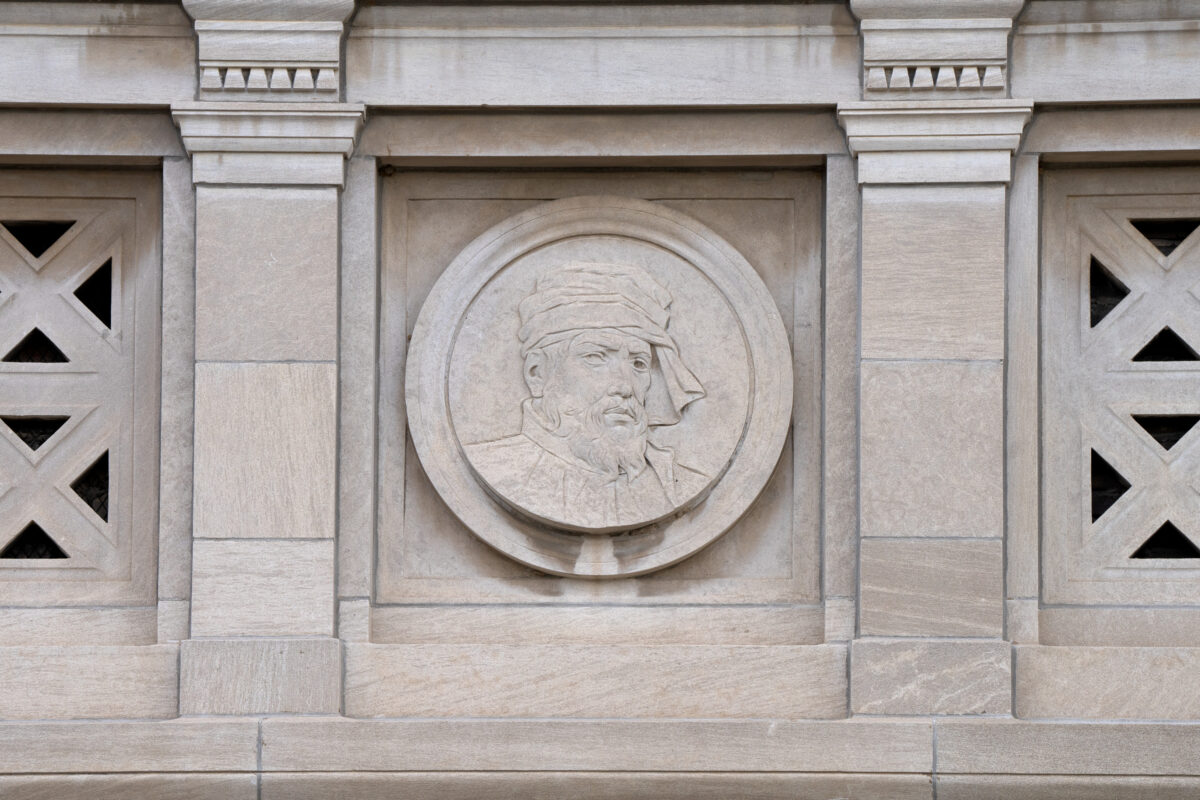
George Thopmas Brewster, American, 1862–1943; and Orazio Piccirilli, American, 1872-1954; Medallions: North West Wall (partial), c.1904; limestone
“Art in the Architecture” is a 1 Fine Arts Blog series dedicated to the ornamental details on the Saint Louis Art Museum’s Main Building, which was designed by Cass Gilbert for the Louisiana Purchase Exposition. In 1904, it was flanked by sprawling, temporary wings that together formed the Palace of Fine Arts, which presented fairgoers with approximately 11,000 works of art from 26 countries. It is the sole surviving permanent building from the World’s Fair.
American sculptor George Thomas Brewster (1862–1943) and Italian American sculptor Orazio Piccirilli (1872–1954) created more than 20 limestone portraits at the request of architect Cass Gilbert to adorn the upper exterior of the Palace of Fine Arts for the 1904 Louisiana Purchase Exposition. The building now serves as home to the Saint Louis Art Museum.
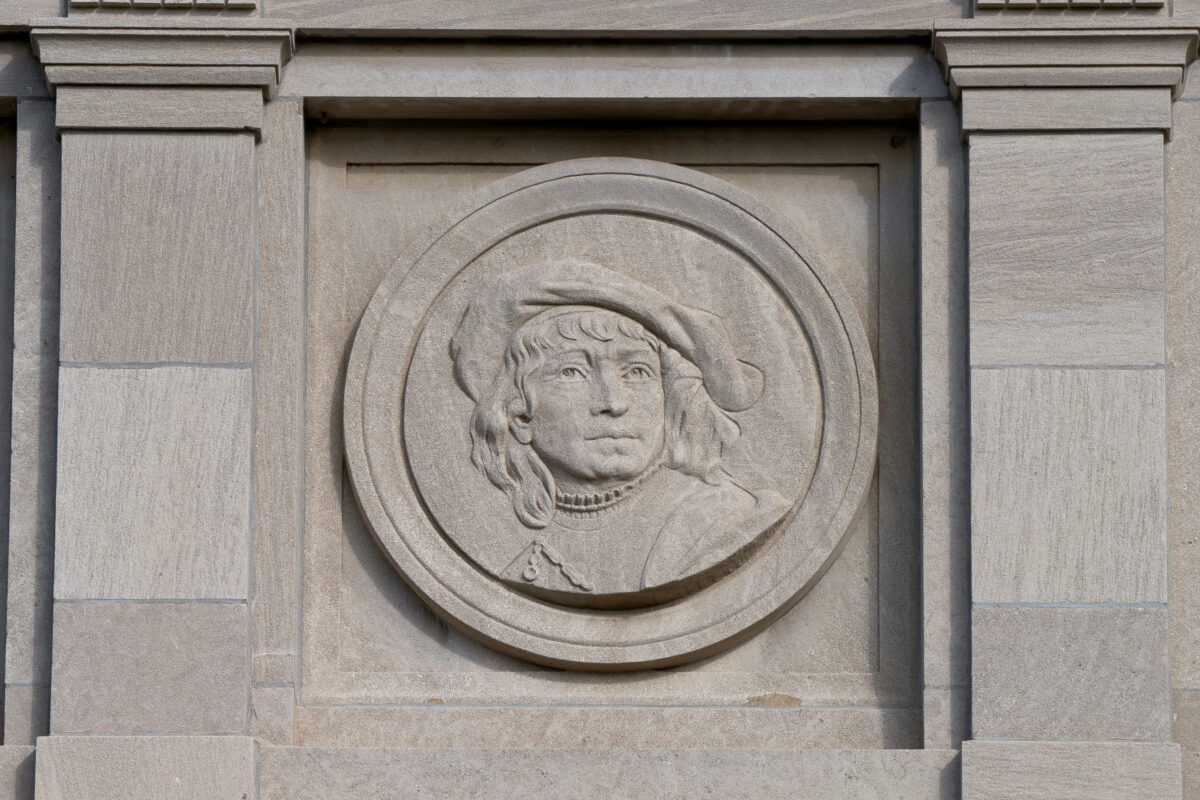
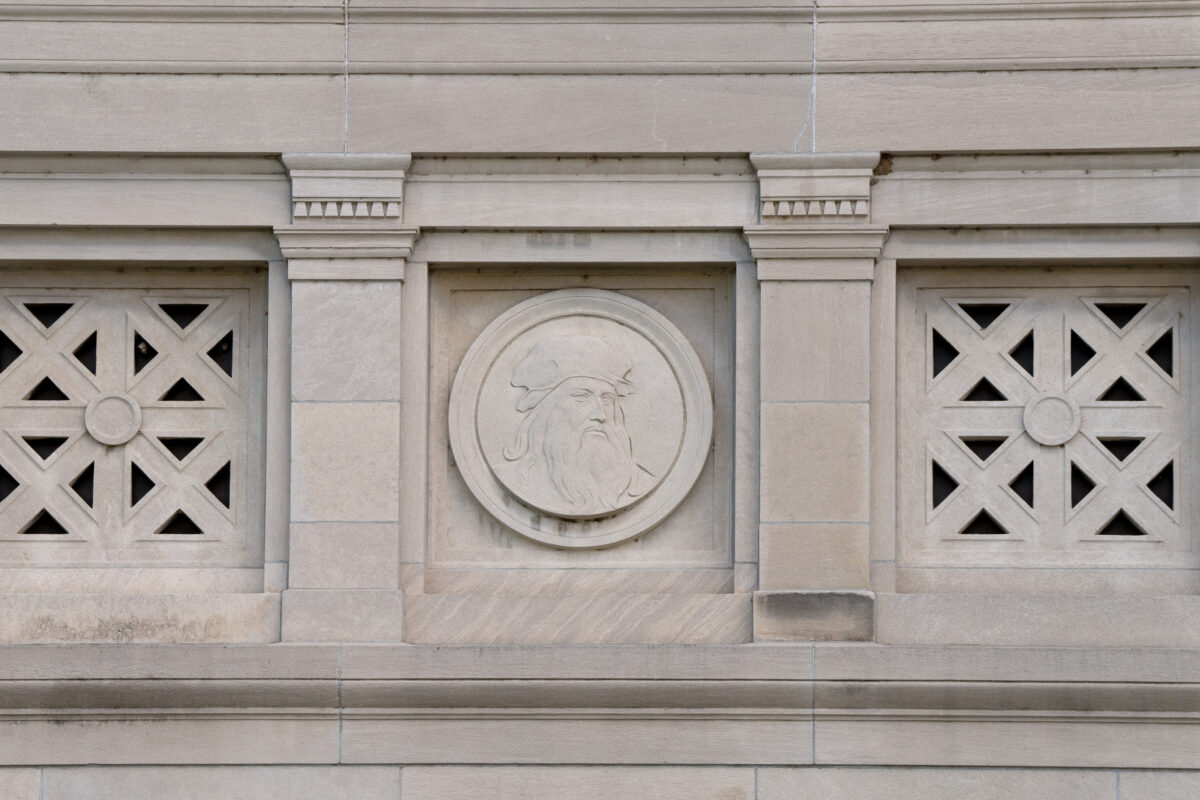
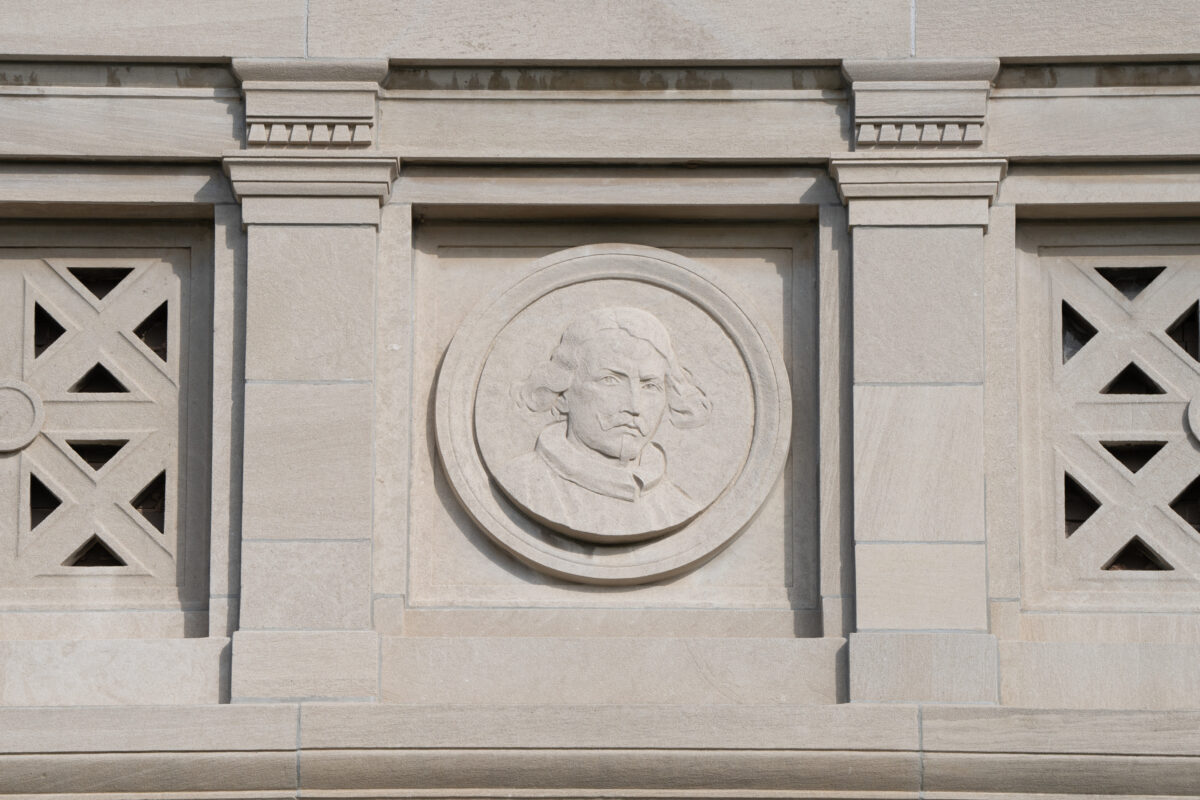
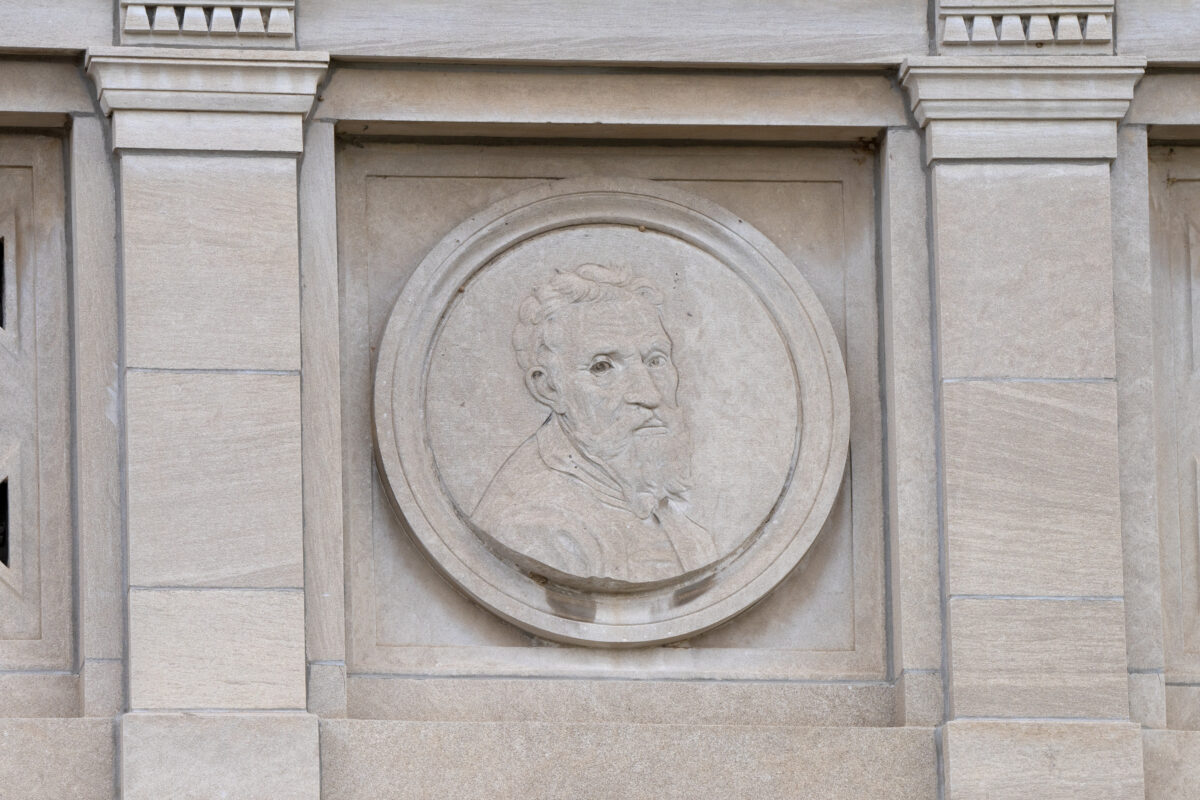
Portraying architects, painters, and sculptors, 22 limestone medallions line the Museum’s east, west, and north facades. Brewster and Piccirilli each designed 11 medallions.
On the north facade are Sandro Botticelli, Filippo Brunelleschi, Leonardo da Vinci, Albrecht Dürer, Tiziano Vecellio (Titian), Hans Holbein the younger, Andrea Palladio, Raffaelo Sanzio da Urbino (Raphael), and Benvenuto Cellini.
On the east facade are Phidias, Iktinos, Giotto di Bondone (Giotto), Luca della Robbia, Donato di Niccolò di Betto Bardi (Donatello), and Michelangelo Anselmi (Michelangelo). Due to the expansion of the Museum over time, Phidias, Iktinos, and Brunelleschi are no longer visible to the public.
Finally, on the west facade are Peter Paul Rubens, Diego Velázquez, Rembrandt van Rijn, Richard M. Hunt, John LaFarge, and Augustus Saint-Gaudens.
Three artists stand apart from the Renaissance, Baroque, and ancient Greek artists: American architect Richard Hunt, American painter John La Farge, and Irish American sculptor Augustus Saint-Gaudens. Gilbert wrote that no one more worthily represented architecture, painting, and sculpture than these three artists.
-
George Thopmas Brewster, American, 1862–1943; Rembrandt, c.1904; limestone
-
Orazio Piccirilli, American, 1872-1954; Leonardo, c.1904; limestone
-
Orazio Piccirilli, American, 1872-1954; Velazquez, c.1904; limestone
-
George Thopmas Brewster, American, 1862–1943; Michelangelo, c.1904; limestone
-
Orazio Piccirilli, American, 1872-1954; Donatello, c.1904; limestone
Brewster, a Massachusetts native, received a formal education at Massachusetts State Normal Art School in Boston and, later, abroad at the Ecole des Beaux-Arts in Paris. Back in the United States in 1886, the sculptor founded a modeling course at the Art Students’ League in New York. He was an established sculptor by 1900, and much of his career after was spent completing commissions for public sculptures, including the Soldiers and Sailors Monument in Indianapolis and the Independent Man atop the Rhode Island State House in Providence. Many of Brewster’s designs were sculpted in the Piccirilli studio in New York City.

George Thopmas Brewster, American, 1862–1943; and Orazio Piccirilli, American, 1872-1954; Medallions: West Wall, South End, c.1904; limestone
The Piccirilli studio was run by six brothers, who immigrated from Italy in 1888. By 1900, their Bronx studio had produced several well-known works for New York City, including the pair of lion sculptures outside the New York Public Library and the figures on the pediment of the New York Stock Exchange. While the brothers did create original sculptures, they also carved hundreds of commissions from other designers. Most notably, they sculpted the Lincoln Memorial’s 19-foot figure of Abraham Lincoln. This statue was designed by Daniel Chester French, a sculptor who also worked on SLAM’s exterior and is featured in Art in the Architecture. All but two of French’s designs were carved in the Piccirilli studio, according to a New York Times article.
Orazio Piccirilli, the second youngest of the six brothers, was well-versed in ornamental carving after studying under French sculptor J. E. Roine. The brothers carved several sculptures on Gilbert’s architectural works, including The Four Continents by Daniel Chester French that adorns the US Custom House in New York and an additional 12 statues on the cornice of the same building. The partnership to create the Museum medallions was a natural choice.
The medallions carvings use foreshortening, a perspective technique that creates an illusion of objects receding into the distance. The base of each medallion is skewed to accommodate the angle from which Museum visitors will view them. They are carved from Indiana Bedford limestone, the same material as the rest of the Museum.