Lakota artist; Moccasins (detail), c.1890; tanned hide and glass beads; each: 3 1/2 x 3 1/2 x 10 1/2 inches; Saint Louis Art Museum, The Donald Danforth Jr. Collection, Gift of Mrs. Donald Danforth Jr. 83:2010a,b

Tiny glass and metal beads envelop the hide surface of a pipe bag. Embroidered in crisp, even lanes, the beads align in checkerboard columns at top and, at center, form a symmetrical box-and-triangle motif. Suspended below, a panel of quillwork resumes the checkered pattern. This allover application of geometric beadwork reflects a major style of Indigenous women’s art on the Northern Plains—including the Dakotas, Montana, Wyoming, and the Canadian prairie provinces—in the decades following the 1880s when treaties established reservations and reserves.
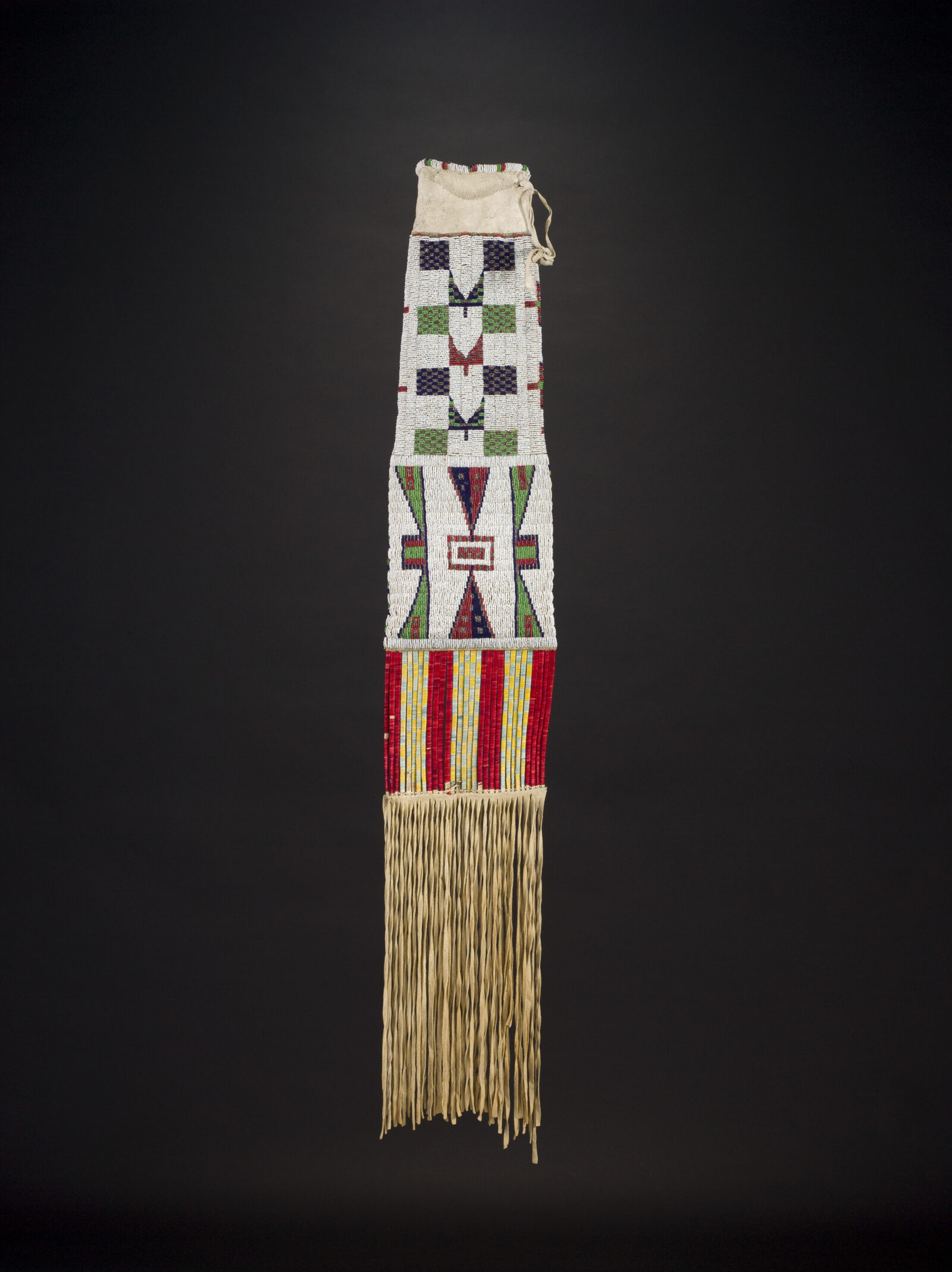
Oceti Sakowin (Sioux) artist; Pipe Bag, c.1900; tanned hide, rawhide, glass beads, metallic beads, and porcupine quills; 42 x 7 1/2 inches; Saint Louis Art Museum, The Donald Danforth Jr. Collection, Gift of Mrs. Donald Danforth Jr. 70:2012
In the Museum’s Danforth Gallery for Plains art, visitors can encounter a wide array of media. In one instance, an artist dyed organic materials, quills and horsehair, then meticulously folded them over slats to conceal a mass-produced metal cup. More commonly, as with the pipe bag, artists attached industrial media such as beads, mirrors, or metal cones to an organic substrate such as hide that the artist or an artist’s relation may have produced.
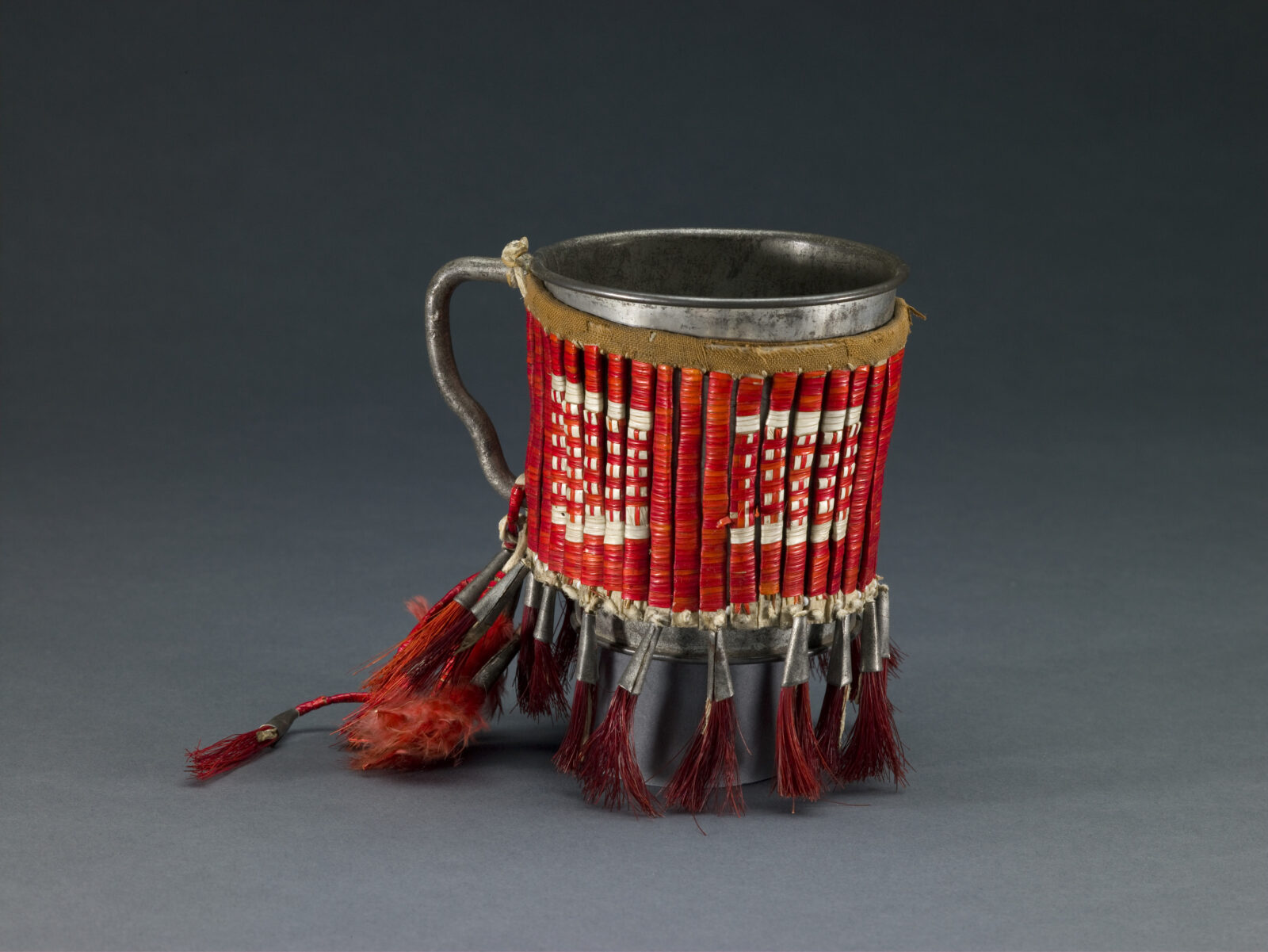
Oceti Sakowin (Sioux) artist; Cup, c.1900; metal cup, rawhide, porcupine quills, glass beads, dyed horsehair, tin cones, feathers, and cotton cloth; 4 x 3 inches; Saint Louis Art Museum, The Donald Danforth Jr. Collection, Gift of Mrs. Donald Danforth Jr. 89:2010
Across this rich array of media, one material predominates: glass beads.
Manufactured in Venice and Bohemia, beads made their way to the hands of Indigenous women through long-standing, transatlantic trade routes. A system of posts arose in North America, places where Native peoples exchanged furs with European traders for European-manufactured objects. The earliest trading posts date to the 17th century, along the eastern and northern shores of North America, and they followed the fur trade as it expanded to the continental interior. By the early 19th century, posts appeared en masse on the Plains, and many of these were connected to St. Louis families. By the late 19th century, the fur trade collapsed, and treaties established reservations. Smaller posts operated by individuals sprang up at reservation agencies, or federal stations.
The proliferation of beads during the early reservation era extends, rather than departs from, historical practice. Beads and other European goods arrived with the earliest posts and then circulated through Native economic and linguistic systems. As art historian Sherry Farrell Racette describes in a 2008 essay, Native peoples indigenized trade goods through multiple strategies, including naming that bestowed existing meaning on new forms. Speakers of some Algonquin languages called glass beads by terms such as mekis, meaning shell, a material previously used to create bead adornments.

Lakota artist; Moccasins, c.1890; tanned hide and glass beads; each: 3 1/2 x 3 1/2 x 10 1/2 inches; Saint Louis Art Museum, The Donald Danforth Jr. Collection, Gift of Mrs. Donald Danforth Jr. 83:2010a,b
In the early 19th century, Plains artists used large blue and white beads to create designs that showcased the materials themselves, as with a saddle blanket at the National Museum of the American Indian. By the second half of the 19th century, however, smaller beads made available in a wider range of colors allowed Indigenous artists on the Plains to create ever-more-elaborate and intricate compositions. Works from the Northern Plains often display an allover approach, such as the pipe bag discussed above or a pair of moccasins from the Danforth collection where beadwork extends across the soles.
Yet approaches to new, smaller beads differed across regions. Artists on the Southern Plains maintained the sparing use of beads for many forms, favoring the supple surfaces of tanned hide. For instance, a girl’s dress includes a zigzag line of blue beads at the bottom and a beaded medallion at the top center. Other adornments include a thin panel of red wool cloth, strips of fringe, beans, and elk teeth.
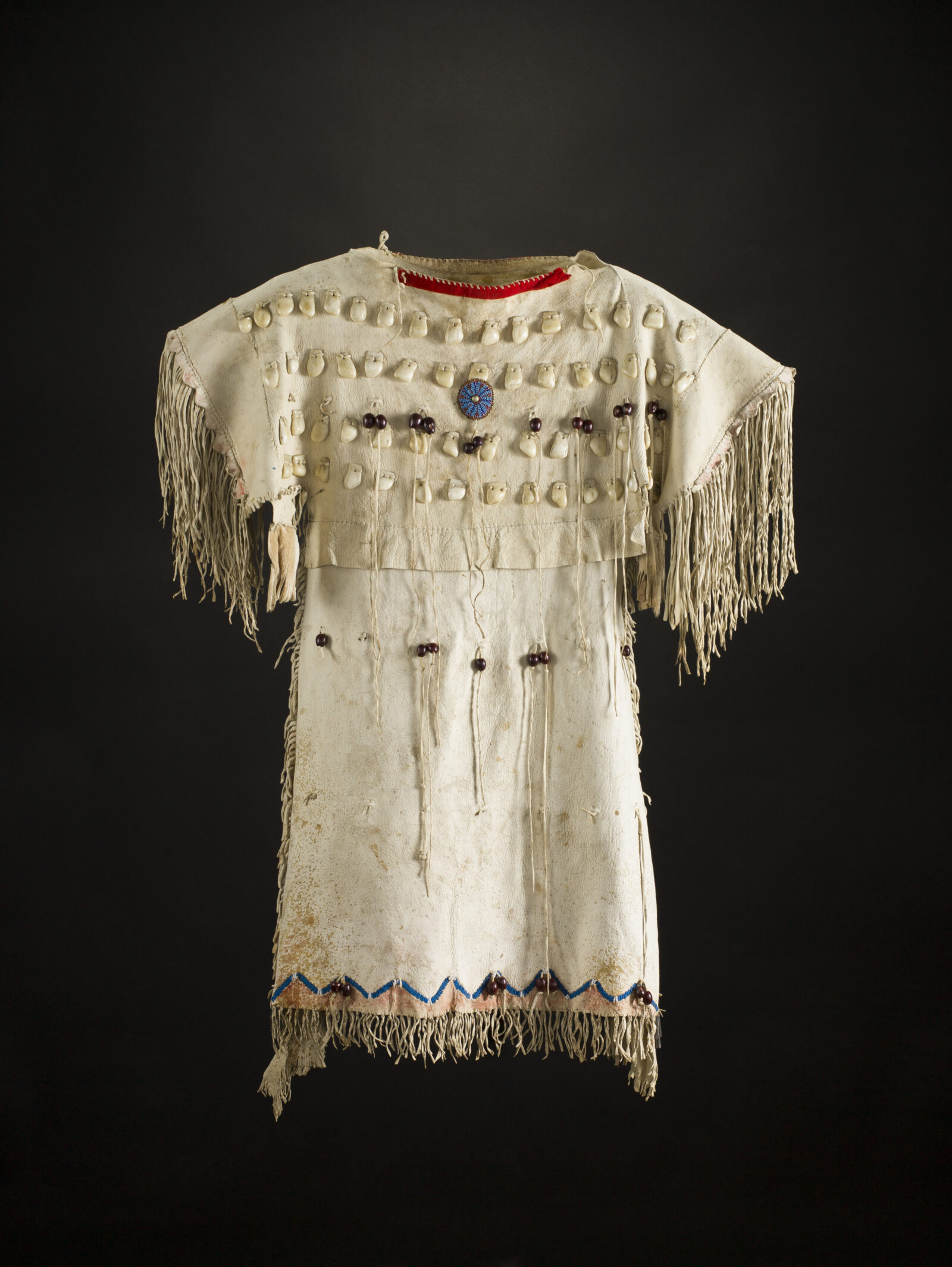
Kiowa or Tsistsistas / Suhtai (Cheyenne) artist; Girl's Dress, c.1890; hide, pigment, bone, elk teeth, mescal beans, glass beads, metal beads, metal buttons, metal cones, and wool cloth; 29 1/2 x 24 inches; Saint Louis Art Museum, The Donald Danforth Jr. Collection, Gift of Mrs. Donald Danforth Jr. 184:2011
Looking closely at the materials in the Danforth collection helps visitors to recognize the deep histories of trade in North America. Additional collection works from other moments and places tell variations on this story. In Morton D. May and Louis D. Beaumont Foundation Gallery 113, for example, a spouted vessel made by a Quapaw artist in present-day Arkansas in the 16th or 17th century uses ancient ceramic technology to mimic the form of a metal European kettle. And, in Shoenberg Gallery 326, a walrus tusk engraved by an Iñupiaq artist in Alaska in the 1890s pictures the very act of trading. These and other works in the gallery indicate some of the ways Native artists across North America made sense, and made use, of exotic goods.

Quapaw artist; Spouted Vessel with Painted Motifs, c.1500–1700; ceramic with pigment; 10 1/2 x 11 inches; Saint Louis Art Museum, Director's Discretionary Fund 65:2005

attributed to Guy Kakarook, Iñupiaq, c.1865–1906; Cribbage board, 1890s; ivory and pigment; 2 3/4 x 22 x 1 3/4 inches; Saint Louis Art Museum, Bequest of Marshall O. Buder 327:2020