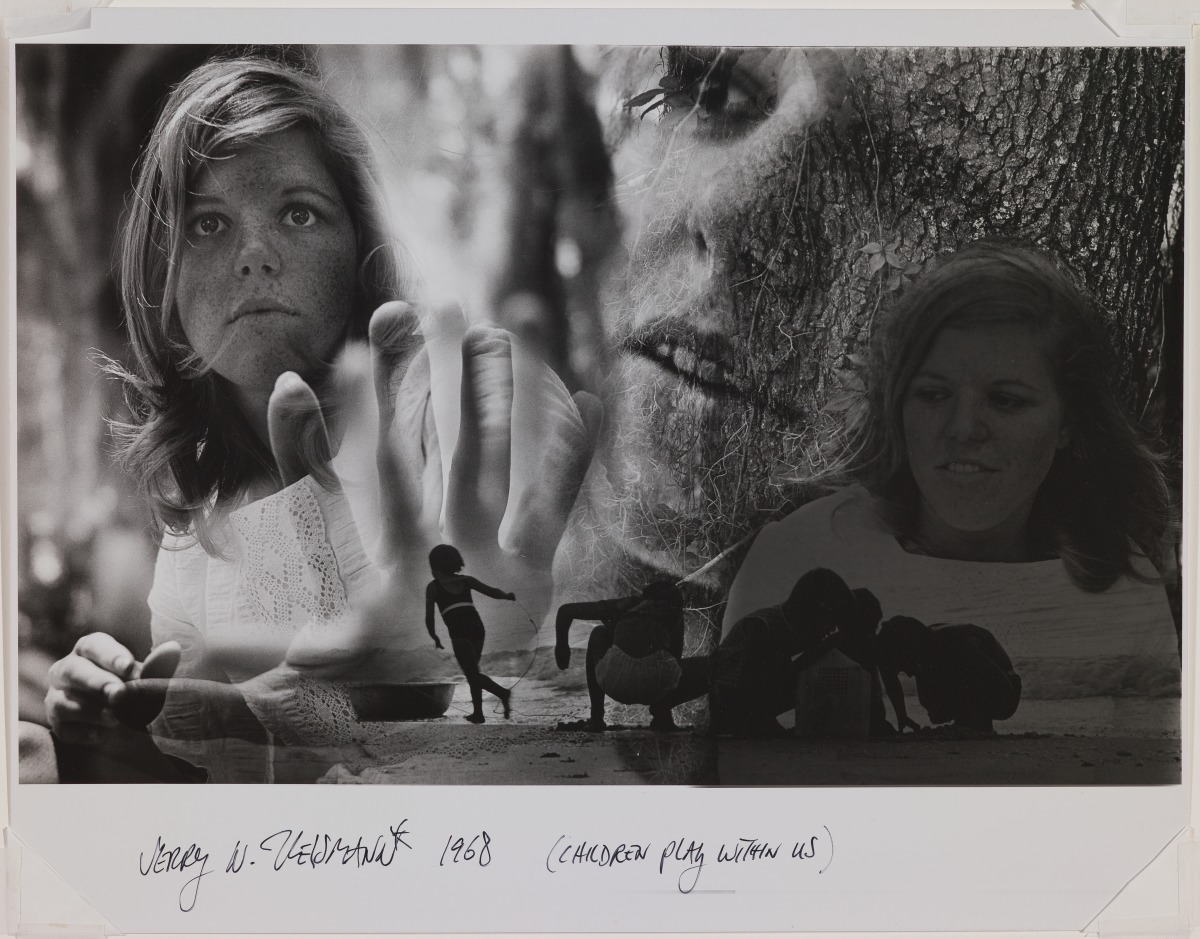
Untitled (Children Play Within Us)
- Photographer
- Material
- Gelatin silver print

Jerry Uelsmann, American, 1934–2022; Untitled (Children Play Within Us) (detail), 1968; gelatin silver print; image: 8 3/4 x 13 3/4 inches, sheet: 11 x 14 inches; Saint Louis Art Museum, Gift of Helen Kornblum 1202:2010; © Estate of Jerry Uelsmann
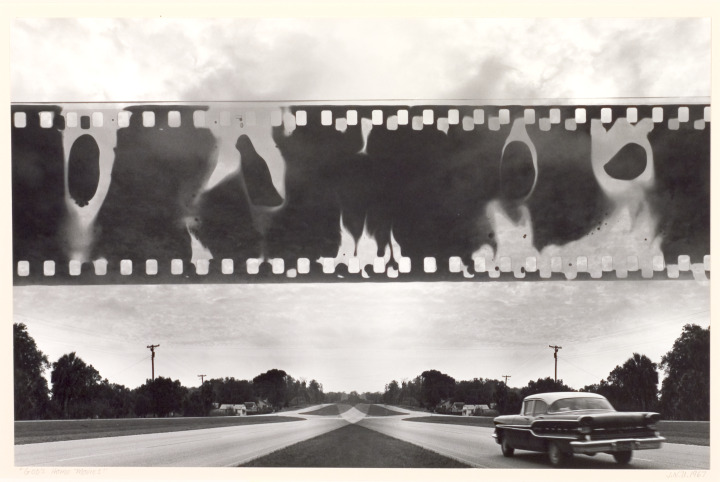
A 1967 image creates a mysterious unreality. In God’s Home Movies, two streets mirror each other, identical save for the car on the right side of the composition, blurry from speed. The disintegrating film-strip negative challenges photographic reality, joining an oeuvre that sparked controversy and dissent among critics and photographers.
By manipulating photographs well before the invention of photo editing software, American photographer Jerry Uelsmann created works like the one shown below and permanently altered the culture of photography in late-20th-century America.
Jerry Uelsmann, American, 1934–2022; God's Home Movies, 1967; gelatin silver print; image: 8 5/8 x 13 1/2 inches, mount: 16 x 20 inches; Saint Louis Art Museum, Funds given by Jeffrey Fort, Mariko A. Nutt through the 2001 and 2004 Art Enrichment Fund, and Yvette Drury Dubinsky and John Paul Dubinsky 70:2005; © Estate of Jerry Uelsmann
In his forward to Ueslmann’s 1992 book Photo Synthesis, critic and curator A. D. Coleman described Uelsmann’s work as germinal, the “progenitors of an approach to photographic image making so well-established and widespread that it’s strange to recall (and, for a younger audience, no doubt difficult to imagine) the storm of controversy that raged around them when they first began appearing in the early 1960s.”
Many critics claimed that his dreamlike prints, which joined human forms and natural objects, were far too manipulated to be considered photography. Photographer Miles Orvell worried that surrealist images like Uelsmann’s would fall “into sentimentality and a kind of bogus mysticism” in his 2003 survey American Photography.
Uelsmann accomplished photomontage with two popular techniques. The first was done by taking two or more photographs on the same negative, known as “double exposure,” causing two separate images to appear on the same frame of film. The second technique, utilized for the image shown above, was done in the darkroom, exposing the printing paper to multiple negatives. While Uelsmann did not invent these techniques, he became a specialist in them during a period when other artists were specializing in straight photography, a genre fortified by naturalism. Photomontage allowed Uelsmann to destabalize “boundaries more naturally than any other medium,” according to scholar Maria Makela.
During his college career throughout the 1950s, Uelsmann familiarized himself with photomontage, a practice not to be confused with photocollage. The latter involves cutting, reassembling, and gluing separate photographs and other materials together, whereas the former is the superimposition of one image over another. Coleman describes photomontage as both images being simultaneously present, showing through each other, so that the added image (or images) appears to be integral to the first. Generally, there is no discernible line of demarcation between different images.
As a burgeoning photographer, Uelsmann was heavily inspired by surrealist artists and by 19th-century photomontage artists like Henry Peach Robinson and O. G. Rejlander.
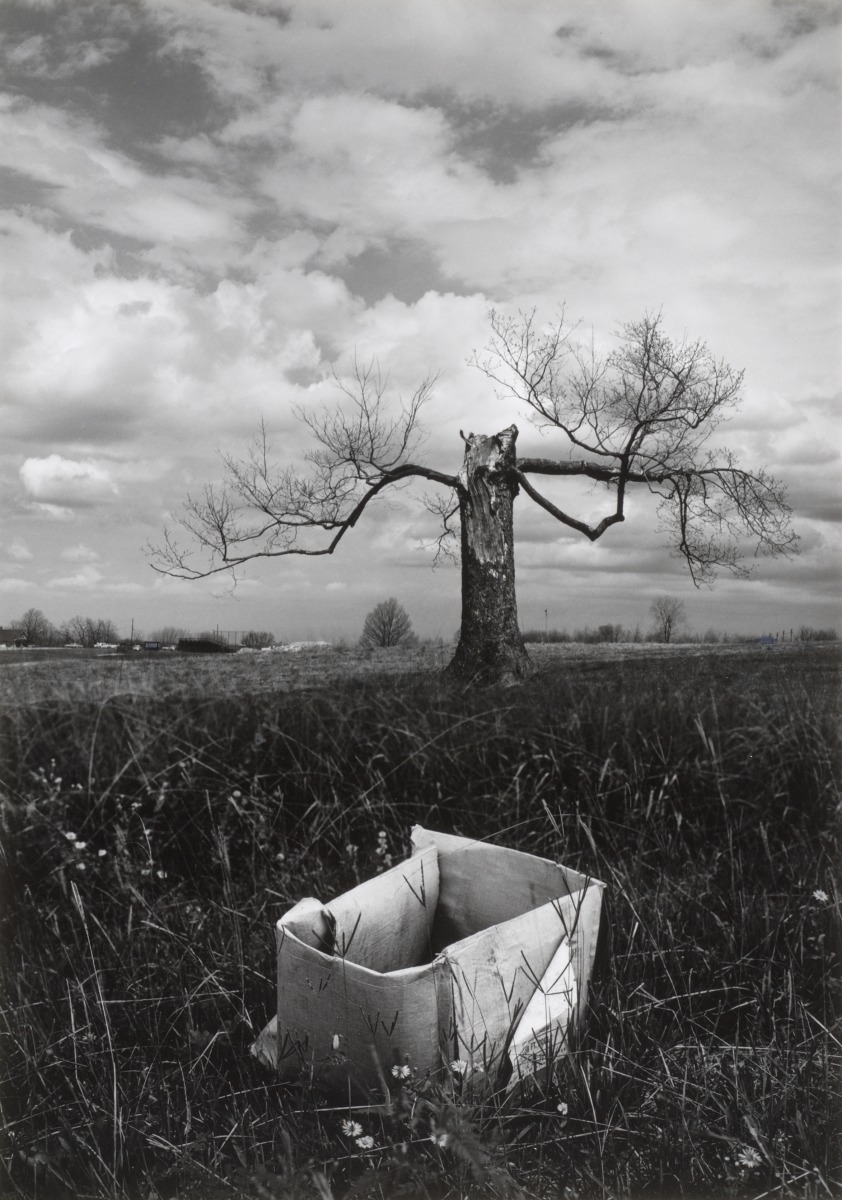
Jerry Uelsmann, American, 1934–2022; Box and Tree, 1965; gelatin silver print; 12 3/4 x 8 3/4 inches; Saint Louis Art Museum, Gift of Chips Godfrey 357:1979; © Estate of Jerry Uelsmann
The artist coined the term post-visualization in 1967 as a response to previsualization and to describe his artistic aesthetic. Previsualization was an existing photography term describing the act of visualizing the photograph in the eye and mind before capturing it with the camera in order to avoid postproduction modifications. In an essay written to supplement his experimental oeuvre, Uelsmann defined post-visualization as “the willingness on the part of the photographer to re-visualize the final image at any point in the entire photographic process,” including within the solitude of the darkroom. “Once in the darkroom the venturesome mind and spirit should be set free—free to search and hopefully to discover.”
The artist’s surreal works were created to evoke a variety of responses—wonder, nostalgia, disorientation—and trigger a double take from the viewer. The photographs invite the viewer “not to believe [the content of the photograph] but rather, in a theatrical sense, to suspend belief,” according to Coleman.
Jerry Uelsmann, American, 1934–2022; Untitled (Children Play Within Us), 1968; gelatin silver print; image: 8 3/4 x 13 3/4 inches, sheet: 11 x 14 inches; Saint Louis Art Museum, Gift of Helen Kornblum 1202:2010; © Estate of Jerry Uelsmann
For example, the above image seamlessly blends several images. A child’s face on the right side of the image transitions into a tree trunk, while another figure acts as the backdrop to a group of children playing on the beach. On the right, a young girl looks into the distance, a disembodied hand framing a child in motion.
Uelsmann’s ingenuity and experimentation garnered success throughout his lengthy career. As a professor, photographer, and author, he received significant accolades, including a Guggenheim Fellowship and a grant from the National Endowment for the Arts. He was also a founding member of the Society for Photographic Education, an organization “fostering understanding of photography in all its forms and related media.”
Many modern photographers use photo-editing software to accomplish photomontages; this software is easily accessible today because of pioneering artists like Uelsmann who permanently altered the artistic world.
Because of light sensitivity, works on paper are displayed for limited times only. However, these works and other prints, drawings, and photographs can be viewed by request in the Museum’s Print Study Room.