Paul Gauguin, French, 1848–1903; Modern Thought and Catholicism, written 1897–1898, transcribed in this form, 1902; manuscript with two woodcuts and two transfer drawings on the cover; 12 5/8 x 7 1/16 x 13/16 inches; Saint Louis Art Museum, Gift of Vincent L. Price Jr. in memory of his parents, Marguerite and Vincent L. Price 287:1948
In 1902, Paul Gauguin—an innovative painter, sculptor, and printmaker at the time—wrote a 91-page manuscript concerning philosophy, religion, and society. A critique of Western culture, Modern Thought and Catholicism is a sometimes meandering diatribe against the Catholic Church.
Horror movie legend and St. Louis native Vincent Price donated Gauguin’s manuscript to the Museum in 1948 in honor of his parents as a memorial to his “mother’s worrisome apprehension about the Pope wanting to rule the world. I knew this would tickle Mother, while it might have upset Dad—for he and I shared many a snicker over her worries about Catholicism,” according to a biography on Price.

Paul Gauguin, French, 1848–1903; Modern Thought and Catholicism, 1902; manuscript with two woodcuts and two transfer drawings on the cover; 12 5/8 x 7 1/16 x 13/16 inches; Saint Louis Art Museum, Gift of Vincent L. Price Jr., in memory of his parents, Marguerite and Vincent L. Price 287:1948
Modern Thought and Catholicism is the subject of a new Museum digital interactive element that pairs high-resolution images with commentary and contextual images. The multi-year initiative featured transcription by Elizabeth Childs, the Etta and Mark Steinberg professor of art history at Washington University, and translation from French to English by Stamos Metzidakis, professor emeritus of French and comparative literature at Washington University. It was achieved through closely studying the manuscript in the Museum’s Study Room for Prints, Drawings, and Photographs to decipher Gauguin’s handwriting and shorthand abbreviations, which were not always straightforward. Many months of back-and-forth editing between the authors and SLAM curators followed to try and best capture Gauguin’s intent with the text and keep the translation as close to his original language as possible. The Museum’s digital experience team then stepped in to create a user-friendly way to view the manuscript online, which features a full, downloadable transcription and English translation as well as are high-resolution images of the manuscript.
The front cover of the manuscript represents the brothel of Mary Magdalen, and the back cover shows the Virgin Mary presenting the Christ child in a cave with the Magdalen, an angel, and attendants, one of which is the artist himself. Gauguin created transfer drawings by completely inking a sheet, placing another sheet over it, and drawing with pencil and crayon on the top of the sheet, much like carbon paper is used.
Gauguin’s manuscript is one of around 300 books and manuscripts in the Saint Louis Art Museum’s global collection that spans thousands of years of history and cultures. These works are often light sensitive and therefore not regularly on view. However, many of the books and manuscripts can be seen by appointment in the Study Room.
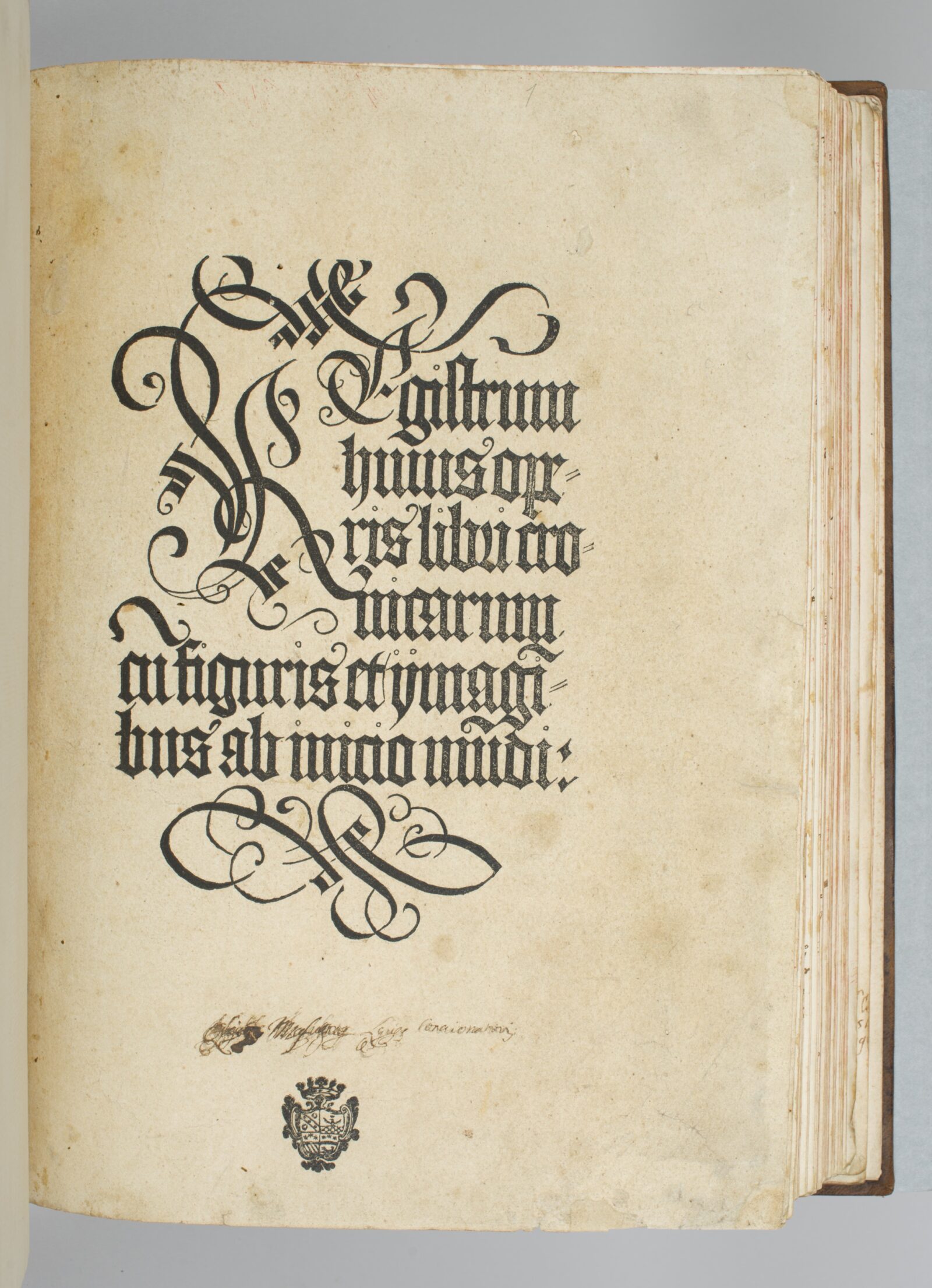
Hartmann Schedel, German, 1440–1514; illustrated by Michael Wolgemut, German, 1434–1519; and Wilhelm Pleydenwurff, German, c.1458–1494; published by Anton Koberger, German, c.1445–1513; Nuremberg Chronicle, 1493; book with woodcut illustrations; 20 x 14 x 6 inches; Saint Louis Art Museum, Gift of Julian and Hope Edison 86:2012
Nuremberg Chronicle
The Liber Chronicarum, or Nuremberg Chronicle, is one of the most celebrated illustrated books of all time for its ambitious historical scope and complex page layouts. A woodcut view of the German city of Nuremberg, where the book was produced, spreads across two pages. The book covers biblical world history from Genesis to late-15th-century Europe. Curiously, the 1,800 woodcut illustrations were printed from only 645 blocks, meaning many blocks were used multiple times to depict different subjects.

Enrique Chagoya, American (born Mexico), born 1953; printed and published by Shark's Ink, Lyons, Colorado, founded 1976; El Regreso del Canibal Macrobiotico (The Return of the Macrobiotic Cannibal), 1998; lithograph, woodcut, and chine colle on amate paper; sheet (folded): 7 1/2 x 11 9/16 x 3/8 inches, sheet (unfolded): 7 1/2 x 92 inches; Saint Louis Art Museum, Gift of Ted L. and Maryanne Ellison Simmons; and funds given by the Marian Cronheim Trust for Prints and Drawings, Museum Purchase, Friends Endowment Fund, The Sidney S. and Sadie Cohen Print Purchase Fund, and the Eliza McMillan Purchase Fund 467:2020; © Enrique Chagoya

Enrique Chagoya, American (born Mexico), born 1953; printed and published by Shark's Ink, Lyons, Colorado, founded 1976; El Regreso del Canibal Macrobiotico (The Return of the Macrobiotic Cannibal) (detail), 1998; lithograph, woodcut, and chine colle on amate paper; sheet (folded): 7 1/2 x 11 9/16 x 3/8 inches, sheet (unfolded): 7 1/2 x 92 inches; Saint Louis Art Museum, Gift of Ted L. and Maryanne Ellison Simmons; and funds given by the Marian Cronheim Trust for Prints and Drawings, Museum Purchase, Friends Endowment Fund, The Sidney S. and Sadie Cohen Print Purchase Fund, and the Eliza McMillan Purchase Fund 467:2020; © Enrique Chagoya
El Regreso del Canibal Macrobiótico (The Return of the Macrobiotic Cannibal)
Read from right to left, this accordion-style book on amate fig-tree bark paper was the first printed example of a form that Enrique Chagoya began making in 1992. That date marked 500 years after Christopher Columbus landed in the Americas, launching a genocide that decimated Indigenous populations and cultures. Among the losses were Mesoamerican books, burned by colonizers attempting to take control. In response, Chagoya revisited this violent collision, borrowing from a wide range of imagery to invert the power dynamics and propose an alternative history.

William Morris, English, 1834–1896; printed by Kelmscott Press, London, England, 1891–1898; The Water of the Wondrous Isles, 1897; letterpress book; 11 5/16 x 8 3/8 x 1 5/8 inches; Saint Louis Art Museum, Gift of Georgia Streett in memory of James D. Streett III 44:2007
The Water of the Wondrous Isles
This 340-page letterpress book by William Morris features a cover made out of vellum with three olive green tie-up ribbons. The text is printed in two columns with woodcut borders and ornamentation throughout. With its intricate page decorations of twisting vines and swirling foliage, The Water of the Wondrous Isles embodies William Morris’s fascination with book-making. The grapevine pattern seen on the opening chapter page and its facing leaf—designed by Morris himself—recalls 15th-century printed books and medieval manuscripts. Morris celebrated the ideas of handmade objects and sumptuous but understated ornamentation, and these principles carried over into his own book designs published by his Kelmscott Press. This book, one of Morris’s last, also relates to early medieval epics but differs significantly by featuring a heroine rather than a knight. It was ultimately published after his death by the Kelmscott trustees and Morris’s daughter, May, as a lasting tribute to Morris as an artist, writer, and craftsman.

Sri Lankan; Buddhist Manuscript of the Mahapēsakara Katavastua in Sinhala Script with Decorative Covers, 18th–19th century; palm leaves (ola leaves of the talipot tree), wood covers, paint, dye, string; height: 1 1/2 in. (3.8 cm) width: 21 1/8 in. (53.7 cm) depth: 2 1/2 in. (6.4 cm); Saint Louis Art Museum, Gift of Mrs. John S. Lehmann 266:1952
Buddhist Manuscript of the Mahapēsakara Katavastua in Sinhala Script with Decorative Covers
This Sri Lankan manuscript is made of palm leaves with 44 folios held between top and bottom wood covers. It dates to the 18th-19th centuries. The top and bottom covers are each painted on the exterior in a pinkish salmon color. Each cover is decorated in red paint, with a black rectangle containing the main scrolling floral design, while the beveled edges on all four sides are decorated in red with stylized lotus leaves. The interior of each cover is painted in indigo blue. The 44 folios are inscribed on both sides in Sinhalese, except for the first one (incised on the verso only) and the last one (incised on the recto only, with inscription in red ink on the verso). A red string with a wooden button at one end holds the book together.

Georges Rouault, French, 1871–1958; published by Ambroise Vollard, French, 1867–1939; Circus of the Shooting Star, 1932–37, published 1938; book illustrated with wood engravings and etchings; 18 x 13 5/8 inches; Saint Louis Art Museum, Gift of Mr. and Mrs. Joseph Pulitzer Jr. 154:1973; © 2024 Artists Rights Society (ARS), New York / ADAGP, Paris
Circus of the Shooting Star
Georges Rouault’s colorful etchings in this book combine heavy black outlines with areas of luminous color that glow like stained glass windows. They illustrate clowns, ballerinas, and other assorted circus performers, bearing names like Tristes Os (Weary Bones), Amer Citron (Bitter Lemon), and Douce-amère (Bitter-sweet). Like many western European artists in the 1930s, Rouault loved the circus, depicting performers frequently in his works. He was especially drawn to clowns, seeing them as symbols of human suffering and playing up the contrasts of their humorous performances with what he viewed as their private sadness. In this work, he strove to give them dignity, illustrating even the elderly clowns as proud and youthful. This impressive artist’s book was written and illustrated by Rouault himself, with 17 color etchings and 80 smaller black-and-white wood engravings interspersed throughout.