
Fading Cloth
- Material
- Metal bottle tops and copper wire

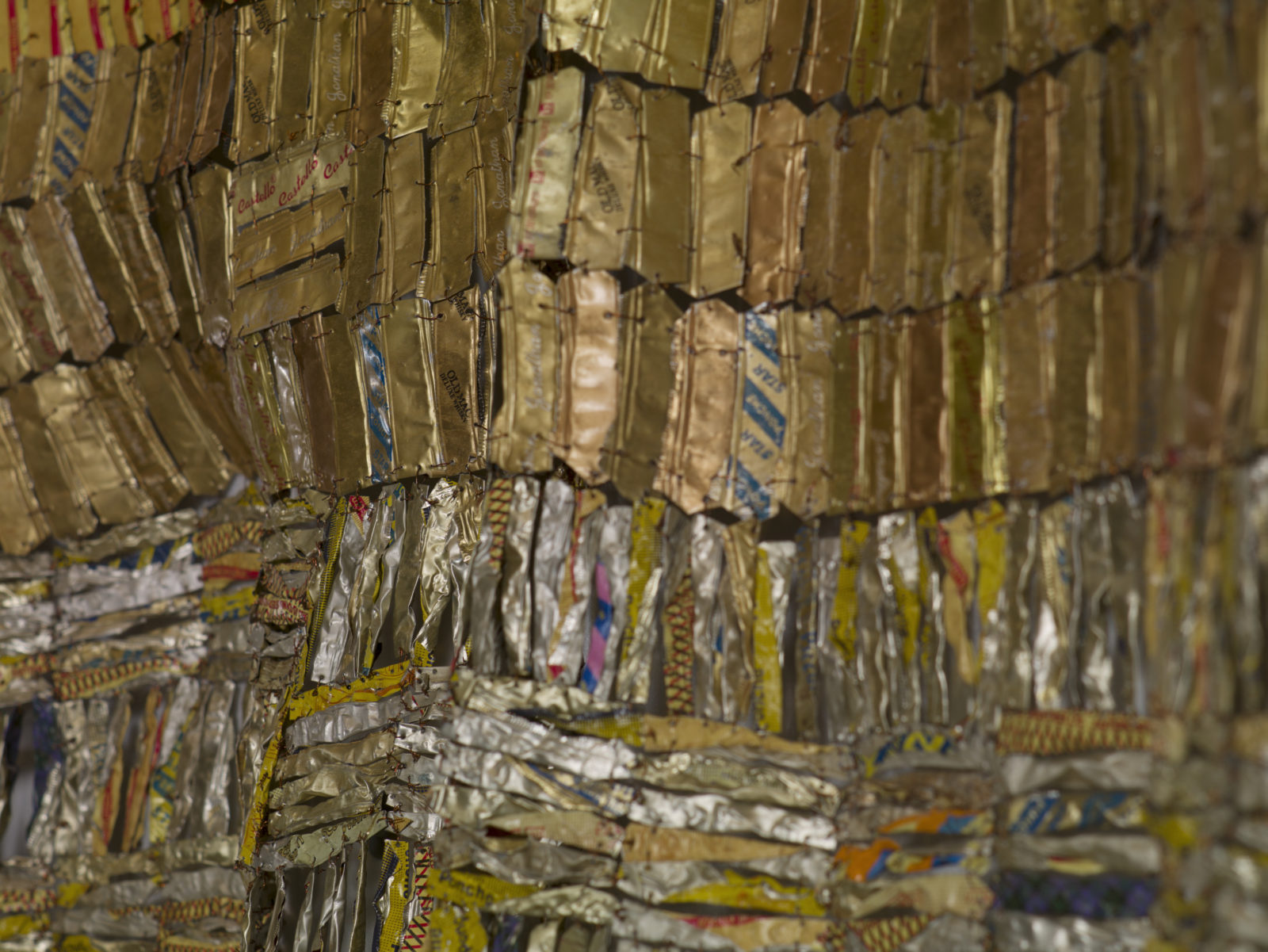
El Anatsui, Ghanaian, born 1944; Fading Cloth (detail), 2005; metal bottle tops and copper wire; dimensions variable according to installation: 126 inches x 21 feet; Saint Louis Art Museum, Museum Minority Artists Purchase Fund, funds given by the Third Wednesday Group, Director's Discretionary Fund, and funds given by the Saint Louis Art Museum Docent Class of 2006 in honor of Stephanie Sigala 10:2007; © El Anatsui, Courtesy of the artist and Jack Shainman Gallery, New York
Weaving together a range of political, historical, and visual references specific to West Africa, where the artist was born, El Anatsui’s Fading Cloth is both stunningly beautiful and deceptively complex. Its material may surprise you: discarded bottle caps.
On view in Taylor Hall, Fading Cloth is more than 10 feet tall and 21 feet long. These measurements are variable, as the piece has no mandated orientation. It includes seven rows of reflective red, gold, and yellow tones. Despite its name and fluid appearance, Fading Cloth is not a textile. It was created from thousands of discarded, shimmering, liquor-bottle caps, flattened and stitched together with copper wire, a process that takes a considerable amount of time. Anatsui, aided by assistants, used three techniques to arrange the bottle caps: the Plain technique, which uses the flattened neck of the cap arranged in long strips or rectangular blocks; the Designer One (Square) technique, which uses the round top of the cap but is folded on four sides to make a square shape; and the Crumpled and the G-8 techniques, which both employ a basket weave, according to El Anatsui: Art and Life. The blocks, or groupings of joined bottle caps, are then meticulously placed together into a larger work.
El Anatsui, Ghanaian, born 1944; Fading Cloth (detail), 2005; metal bottle tops and copper wire; dimensions variable according to installation: 126 inches x 21 feet; Saint Louis Art Museum, Museum Minority Artists Purchase Fund, funds given by the Third Wednesday Group, Director's Discretionary Fund, and funds given by the Saint Louis Art Museum Docent Class of 2006 in honor of Stephanie Sigala 10:2007; © El Anatsui, Courtesy of the artist and Jack Shainman Gallery, New York
Before and during the transatlantic slave trade, Europeans traded firearms, textiles, and alcohol in exchange for African people. In Anatsui’s Fading Cloth, the repurposing of bottle caps from discarded liquor bottles transforms the mundane into something visually mesmerizing while alluding to the devastating legacy of the transatlantic slave trade.
An esteemed sculptor, Anatsui was born in Ghana in 1944 and studied during the social and political changes of mid-20th century Africa. He relocated to Nsukka, Nigeria, in 1975. His membership in the local artist’s guild, Nsukka Group, and his time as a professor at the University of Nigeria affected how he viewed his environment.
“Anatsui belongs to a generation of African artists who came of age in the 1960s, a time of fundamental ideological realignments occasioned by the attainment of political independence,” art historian Chika Okeke-Agulu said in El Anatsui: When I Last Wrote to You About Africa.
El Anatsui, Ghanaian, born 1944; Fading Cloth, 2005; metal bottle tops and copper wire; dimensions variable according to installation: 126 inches x 21 feet; Saint Louis Art Museum, Museum Minority Artists Purchase Fund, funds given by the Third Wednesday Group, Director's Discretionary Fund, and funds given by the Saint Louis Art Museum Docent Class of 2006 in honor of Stephanie Sigala 10:2007; © El Anatsui, Courtesy of the artist and Jack Shainman Gallery, New York
Mid-century Africa experienced a collective push to end European colonial rule, a fruitful movement that granted nationhood to several countries, including Nigeria and Ghana. During this time, leaders, intellectuals, artists, and other people across the continent were committed to sculpting Africa’s postcolonial identity, according to El Anatsui: The Reinvention of Sculpture. Anatsui’s oeuvre showcases themes relating to the politics and culture of, not only Ghana and Nigeria, but Africa as a whole.
Today, El Anatsui lives and works in both Nsukka and Tema, Ghana, where he has two studios, respectively. According to the New York Times, he employs nearly 100 assistants between the two studios.