New Continent
- Material
- Wood and paint

Installation image from Modern & Contemporary - 1960s. Tony Smith, American, 1912–1980; Free Ride, 1962, fabricated 1968; steel; 80 x 80 x 80 inches; Saint Louis Art Museum, Funds given by the National Endowment for the Arts, the Contemporary Art Society, Museum Purchase, and the Eliza McMillan Trust 115:1976; © Estate of Tony Smith
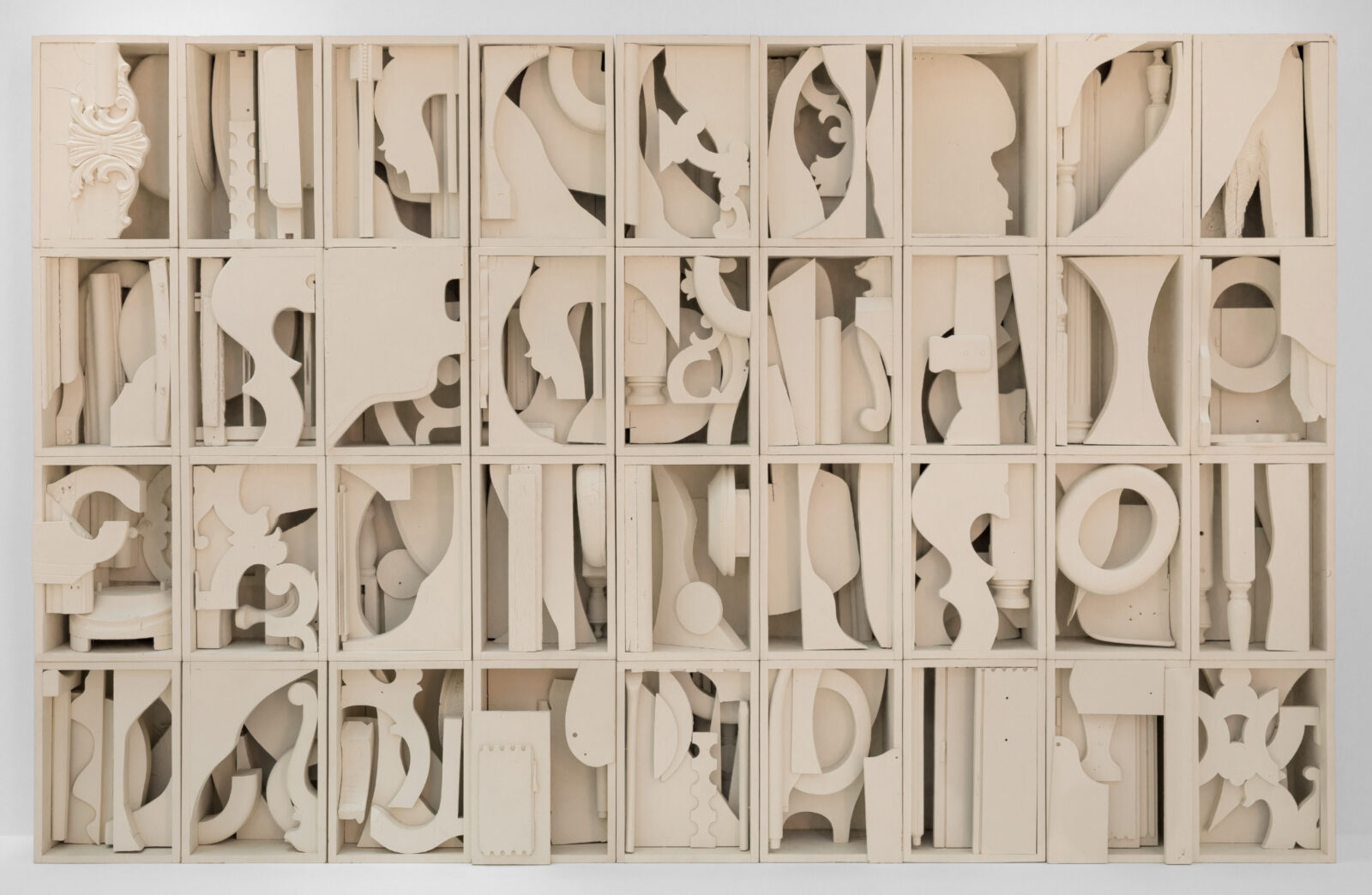
Louise Nevelson, American (born Ukraine), 1899–1988; New Continent, 1962; painted wood; 77 3/4 x 121 3/4 x 10 1/8 inches; Saint Louis Art Museum, Museum Purchase, by exchange and funds given by Martha I. Love, Mr. and Mrs. George S. Rosborough Jr., the Weil Charitable Foundation, Henry B. Pflager, Jane and Warren Shapleigh, The Lea-Thi-Ta Study Group, and Nancy W. Gilmartin 14:1967; © 2013 Estate of Louise Nevelson / Artists Rights Society (ARS), New York
Victor Vasarely, French (born Hungary), 1906–1997; Kalota, 1963; oil on canvas; 82 5/8 x 78 3/4 inches; Saint Louis Art Museum, Funds given by Henry B. Pflager and the Shoenberg Foundation, Inc. 5:1965; ©Artists Rights Society (ARS), New York/ADAGP, Paris
One of the United States’s foremost sculptors, Louise Nevelson (1899–1988) is featured in SLAM’s 1960s installation, a collection of works that highlight the innovative art movements in the 1960s. The featured artists challenged the conventional function and form of art.
Nevelson’s New Continent is currently on view in this installation. The more than six-foot sculpture is assembled from found architectural elements, such as chair legs, balusters, and moldings. The wood fragments fill nine columns and four rows of wooden compartments. The 36 boxes are all painted white, creating a stark contrast between the sculpture and the inner shadows it creates.
Louise Nevelson, American (born Ukraine), 1899–1988; New Continent, 1962; painted wood; 77 3/4 x 121 3/4 x 10 1/8 inches; Saint Louis Art Museum, Museum Purchase, by exchange and funds given by Martha I. Love, Mr. and Mrs. George S. Rosborough Jr., the Weil Charitable Foundation, Henry B. Pflager, Jane and Warren Shapleigh, The Lea-Thi-Ta Study Group, and Nancy W. Gilmartin 14:1967; © 2024 Estate of Louise Nevelson / Artists Rights Society (ARS), New York
New Continent is a canonical example of Louise Nevelson’s sculpture, which can be related to 1960s minimalism. In this work, Nevelson juxtaposed the geometric grid of the boxes with a lyrical arrangement of curves, textures, and light. The urban environment of Manhattan provided the artist with the discarded objects that were the building blocks of her sculptural practice.
Nevelson and her family moved to Maine when she was a young child, fleeing the antisemitic persecution rampant in 19th-century Ukraine. According to the biography Louise Nevelson: Light and Shadow by Laurie Wilson, the exact date of her family’s emigration is vague, as official documents for Jewish children born within the Russian Empire were difficult to trace at the time.
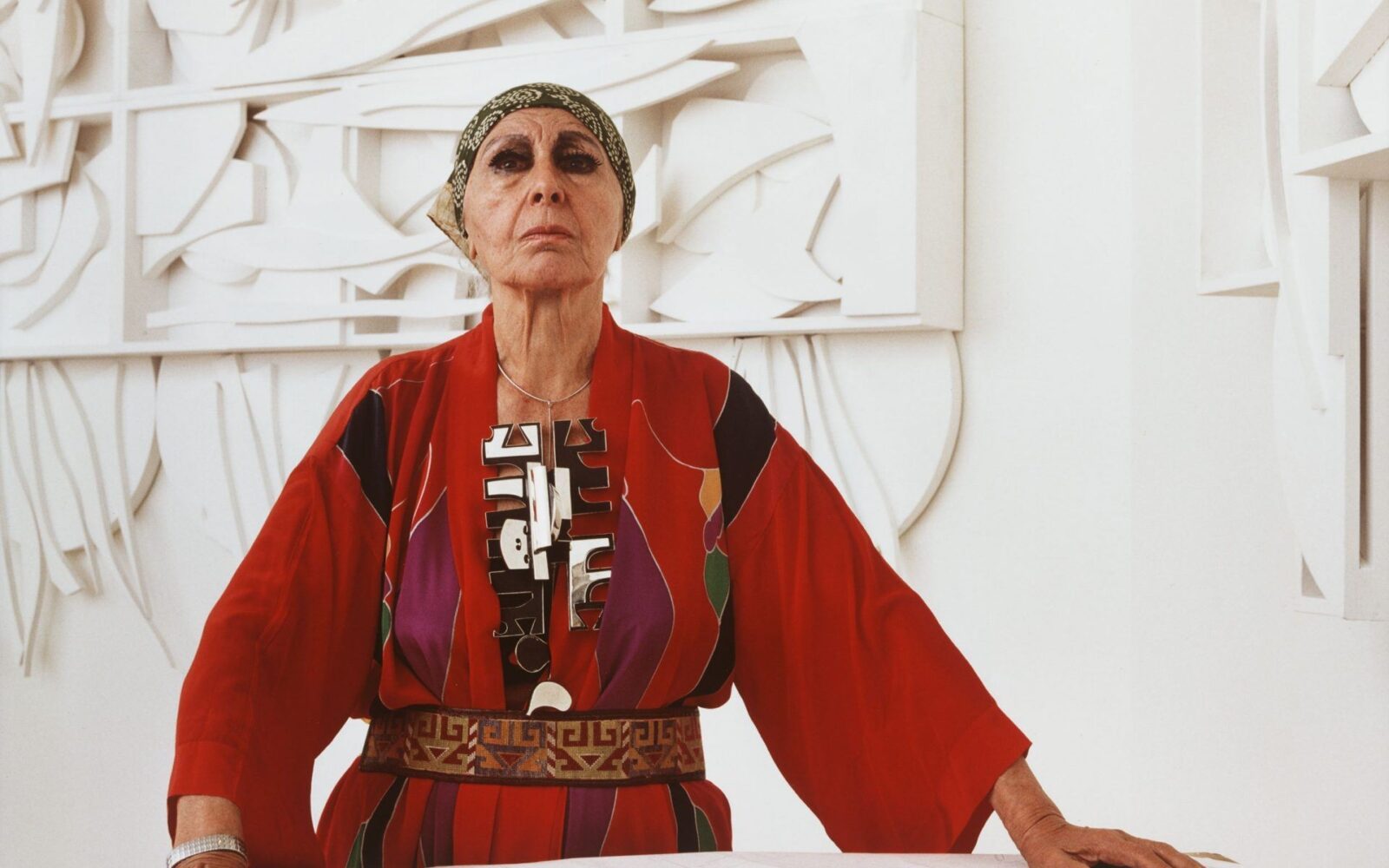
Hans Namuth, American, 1915–1990; Louise Nevelson, 1977; © Center for Creative Photography, The University of Arizona Foundation; © 2024 Estate of Louise Nevelson / Artists Rights Society (ARS), New York
Nevelson, along with her mother and two younger siblings, joined her father in Rockland, Maine, where he owned a lumber business after immigrating three years earlier and working independently. Settling in a new country was difficult for Nevelson as she watched her parents’ relationship deteriorate. Her mother became severely depressed, and the young Nevelson felt it was her responsibility to “be her mother’s mother and to take on both her mother’s sorrows as well as her hopes,” according to Wilson. Nevelson dreamed of becoming a successful artist and taking advantage of the opportunities for which her parents immigrated.
With the support of her parents, teachers, and other adults in the small Jewish community in Rockland, Nevelson practiced art constantly. The artist moved to New York City after graduating high school to pursue her artistic career. After starting a family with her husband, Charles Nevelson, she studied at the Art Students League, and later at Hans Hofmann’s School of Fine Art in Munich. Back in New York in 1935, Nevelson joined the Works Progress Administration—one of President Roosevelt’s New Deal programs that employed millions of Americans—as a teacher for the Educational Alliance Art School.
Nevelson developed her signature style of large-scale shadow-box wooden sculptures in the late 1950s. Her unconventional use of scrap wood contributed to her growing notoriety and distinguished her from her male counterparts, who used more-traditional materials, including marble and metal. Sky Cathedral (1958) and Dawn’s Wedding Chapel II (1959) are among the first sculptures in the artist’s oeuvre to be made in this style. New Continent, made just a few years after these works, was originally acquired by the Pace Gallery in 1967 before being purchased by SLAM later that same year.
A highly regarded artist, Nevelson represented the United States in the 1962 Venice Biennale, a renowned contemporary visual art exhibition held every two years. Outside of sculpting, she spent her time studying modern dance, singing, acting, and participating in local organizations, including the National Association of Women Artists and the Sculptors Guild. She exhibited art in solo shows and received prestigious awards until her death in 1988.