Selma Day, American, 1907–1994; Mural Study (detail), 1936 or 1937; oil on panel; sight in frame: 35 3/4 × 26 1/4 inches; Saint Louis Art Museum, Gift of the Federal Works Agency, Work Projects Administration 357:1943
Art always has and always will be for all ages. Whether for fun or function, the following selection of works from across SLAM’s collection were made with children in mind.
In the late 19th century, many forms of Native art were inseparable from daily and ceremonial life. Employing a variety of styles, Native American families on the Plains constructed clothing and toys for children, transforming useful items into objects of beauty—like this baby cradle and toy ball.

Tsistsistas / Suhtai (Cheyenne) artist; Cradle, c.1890; wool cloth, cotton cloth, glass beads, leather, and metal bells; 28 × 13 × 10 inches; Saint Louis Art Museum, The Donald Danforth Jr. Collection, Gift of Mrs. Donald Danforth Jr. 65:2010

Plains artist; Ball, c.1880; tanned hide, stuffing, and glass beads; diameter: 4 inches; Saint Louis Art Museum, The Donald Danforth Jr. Collection, Gift of Mrs. Donald Danforth Jr. 63:2012
Frequently made by an aunt or grandmother, cradles are among the most important objects made for a child. Plains cradles include multiple styles and are designed to provide a comfortable and secure place for rest and recreation. The body of this soft cradle, made around 1890, uses a single panel of red, twill-weave wool cloth. The outside of the crown portion is fully beaded with seed beads. It also features leather strips with beadwork charms and metal bells.
With its colorful beads, this ball is more than an undecorated toy—such as those made from tanned hide and filled with buffalo hair—used in a typical children’s stick game. As Smithsonian curator Emil Her Many Horses describes in a 2016 essay in the Museum’s Donald Danforth Jr. Collection catalogue, the artist likely made this ball not only as a toy but to convey blessings on the child. The beadwork design and colors suggest the cross-like Morning Star design. For many Plains peoples, star knowledge played an important role in origin stories. Traditionally, the colors red, yellow, white, and black carried sacred meaning. This ball is decorated in yellow, red, and blue beads. Blue was often used as a substitute for black; the undecorated section where the hide is exposed could represent white, thus incorporating the four sacred colors into the design.
This baby cradle and toy ball are part of the Museum’s Donald Danforth Jr. Collection and are currently on view in Donald Danforth Jr. Gallery 322.

Bamana artist, Mali; Puppet, 1960s; wood, pigment, animal hair, metal, cloth, fiber; 24 × 36 1/2 inches; Saint Louis Art Museum, Partial gift of Thomas Alexander and Museum Shop Fund 189:1994
Speaking of toys, this 1960s rod and string puppet by a Bamana artist was used to entertain children and young adults in the Ségou Region of central Mali. This particular horse-rider figure (sotigi) appears to represent a village elder or chief and would have been part of a larger puppet ensemble. The sotigi figure has a long history in Malian art, representing precolonial warriors and values like authority and moral order.
This work is on view in Morton D. May and Louis D. Beaumont Gallery 102.
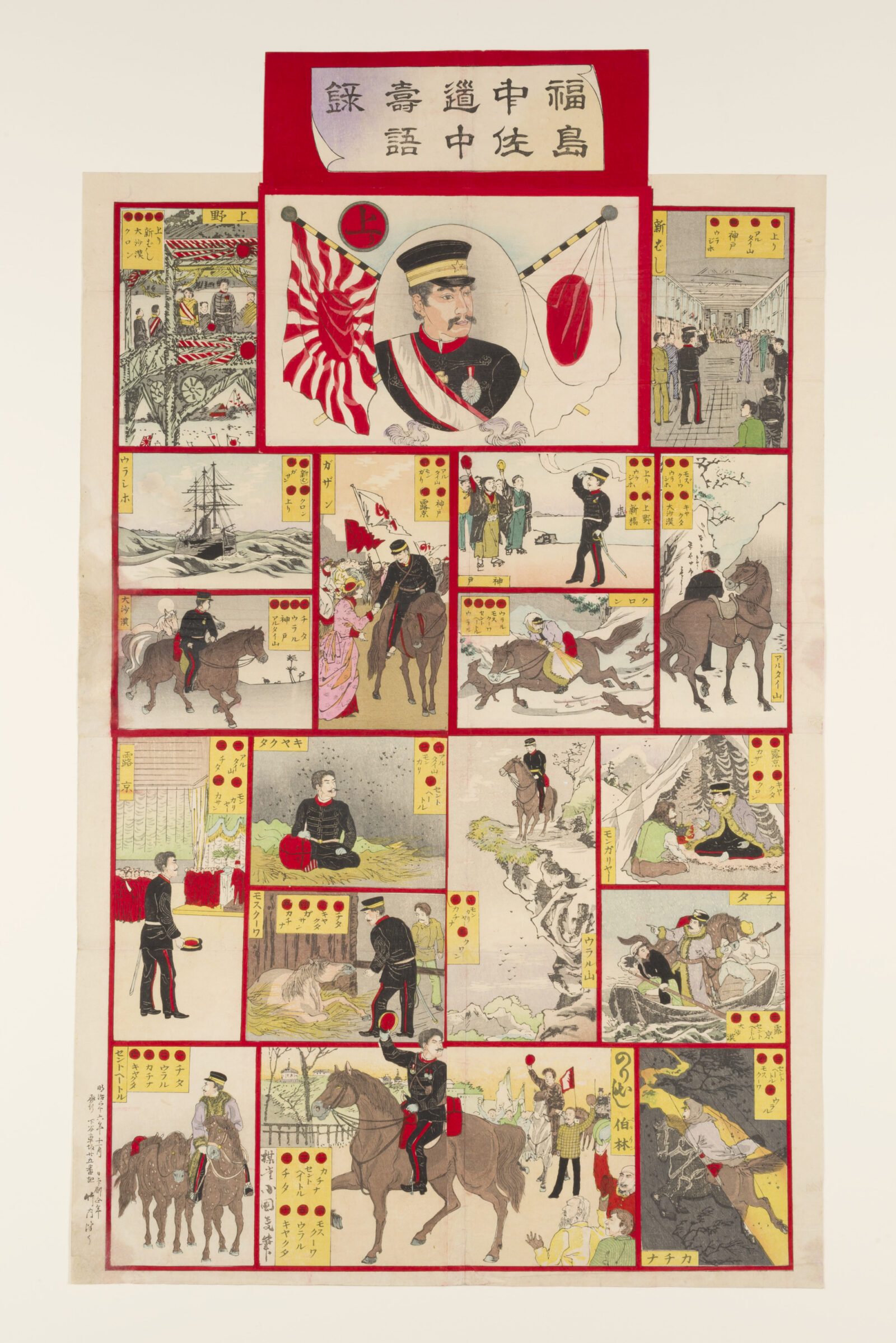
Utagawa Kokunimasa, Japanese, 1874–1944; engraved by Matsuue, Japanese, active late 19th century; published by Takeuchi Hanryō, Japanese, active late 19th century; Pictorial Board and Dice Game (sugoroku): Lieutenant Colonel Fukushima on His Route, 1893; set of joined color woodblock prints; sheet (overall): 31 1/4 × 18 7/8 inches; Saint Louis Art Museum, Gift of Mr. and Mrs. Charles A. Lowenhaupt 221:2011
Yet another toy, this set of Japanese woodblock prints combined play and history in the late 19th century. Designed as a pictorial board and dice game (sugoroku), this work depicts Major Fukushima Yasumasa’s long journey, mostly on horseback, from Berlin in February 1892 to Ueno Park in June 1893. He had just completed a posting as a military attaché and served as Japan’s first intelligence agent in Europe. Newspapers sent correspondents to report on Fukushima’s travels, and he became a national celebrity. Upon his return to Japan 14 months later, he was promoted to the rank of lieutenant colonel and fêted with parades all over the country. His exploits were celebrated in kabuki performances, woodblock prints, and popular songs. In this game, each space includes a key dictating where a player should move next as they haphazardly retrace Fukushima’s route.

attributed to Gebrüder Thonet, Vienna, Austria, founded 1853; Doll's Chair, designed 1885–86, made c.1890; beech and cane; 12 3/4 × 7 1/4 × 9 1/4 inches; Saint Louis Art Museum, Gift of Jane and Warren Shapleigh 30:2001
attributed to Gebrüder Thonet, Vienna, Austria, founded 1853; Doll's Table, designed 1885–86, made c.1890; beech and cane; 8 7/8 × 10 1/4 inches; Saint Louis Art Museum, Gift of Jane and Warren Shapleigh 33:2001
Dolls need someplace to sit, too. Made in the late 19th century, this set of miniature furniture features the bentwood technique, in which steamed beachwood rods were bent around iron molds, eliminating laborious hand carving. The lightness of the bentwood frame is often emphasized by seat and back panels of semitransparent woven cane. The Austrian firm of Gebrüder Thonet was ingenious at marketing and manufacturing bentwood furniture in a great variety of forms. Early on, their production included a line of furniture for children and even one for dolls. Thonet circulated catalogues illustrating their products, and by 1900, factories had been set up all over the world. The doll’s furniture, which is rare today, was put into production beginning around 1890. The set of doll furniture, which includes a table and chair, is on view in Gallery 122. The Museum’s collection also contains a rocking chair and settee made for a doll as well as a child’s armchair by Gebrüder Thonet.

Han Chinese Boy's Robe ("One Hundred Households" Robe) with Patchwork Design, late 19th century; Chinese, Qing dynasty, Guangxu period; silk embroidered with silk and metallic threads; back: 27 5/8 inches, arm span: 39 9/16 inches; Saint Louis Art Museum, Gift of Julius A. Gordon and Ilene Gordon Wittels in memory of Rose Gordon 112:1989
The Museum’s collection also contains clothing for children spanning cultures and time periods—like this late 19th–century Han Chinese Boy’s Robe, known as a “One Hundred Households” robe, featuring a patchwork design. For many centuries, when a young boy of Han Chinese descent reached a certain age, all the neighbors in his village or town would contribute bits of silken fabric and embroidered items for the mother to sew together into a new garment for him. Those who contributed wished the child good fortune and protection from evil.

Selma Day, American, 1907–1994; Mural Study, 1936 or 1937; oil on panel; sight in frame: 35 3/4 × 26 1/4 inches; Saint Louis Art Museum, Gift of the Federal Works Agency, Work Projects Administration 357:1943
“Little boy blue, / Come blow your horn, / The sheep’s in the meadow, / The cow’s in the corn.”
Selma Day combined elements of this nursery rhyme in a mural design intended for the Harlem Hospital. In late 1937, she covered the walls of its children’s ward with scenes from Mother Goose rhymes. Day was one of 36 painters who decorated the new hospital wing with murals, the first major commission awarded by the Federal Art Project to African American artists. A native New Yorker, Day worked as a commercial artist in advertising, followed by careers in marketing and interior design.

Dox Thrash, American, 1893–1965; Nursery Rhyme, c.1939–40; lithograph; sheet: 10 1/8 × 17 3/8 inches, image: 6 1/2 x 16 inches; Saint Louis Art Museum, Gift of the Federal Works Agency, Work Projects Administration 338:1943
Nursery rhymes are also the subject of another work in the collection dating back to the Federal Art Project: Dox Thrash’s lithograph titled Nursery Rhyme. The print depicts the classic nursey rhyme about the woman who lived in a shoe. Like Day’s mural study, this Thrash work from 1939–40 was also intended for a children’s hospital ward.