


Murnau with Locomotive
- Material
- Oil on canvas

Vasily Kandinsky, Russian (active Germany), 1866 – 1944; Murnau with Locomotive (detail), 1911; oil on canvas; 37 3/4 × 41 1/8 inches; Saint Louis Art Museum, Bequest of Morton D. May by exchange 142:1986

The use of white in a painting can play opposing roles.
Is it a non-color that represents an absence? Or, like a blank canvas, is white a symbol of limitless potential?
Expressionist painter Vasily Kandinsky likely believed the latter. He addressed these questions in his seminal text On the Spiritual in Art in 1911, the same year he painted the snowy, white expanse of Murnau with Locomotive. The abstract painting shows a train traveling through the valley below Kandinsky’s house, with Murnau, a village in the Bavarian Alps, in the background. A large snow-covered tree obscures the view.
Vasily Kandinsky, Russian (active Germany), 1866–1944; Murnau with Locomotive, 1911; oil on canvas; 37 3/4 x 41 1/8 inches; Saint Louis Art Museum, Bequest of Morton D. May by exchange 142:1986
Kandinsky covered the canvas with a thin preparatory layer of white, followed by a thin application of white paint. These layers are barely perceptible over the textured weave of the canvas. Embedded in the matrix of the fibers, the white transforms from a painted element to a neutral support. This effect is especially strong in the railroad tracks, which cross the snowy field like two charcoal lines drawn across a sheet of white paper.
During this period, the artist turned away from the direct depiction of nature in favor of a more abstract approach and came to believe in the suggestive power of color. In this painting, Kandinsky restricted his palette to subtle shifts in whites, browns, pinks, and blues. His choice of subject matter and paint application create a tension between stasis and movement in the canvas. In the foliage of the tree in the right foreground, Kandinsky applied oil paint in thin layers, giving the appearance of ephemeral watercolor washes. White paint mixes with color to create muted tones, such as the dirty brown smoke emitted from the small locomotive chugging across the frozen valley.
Associate painting conservator Courtney Books tests the painting with a stereo microscope.
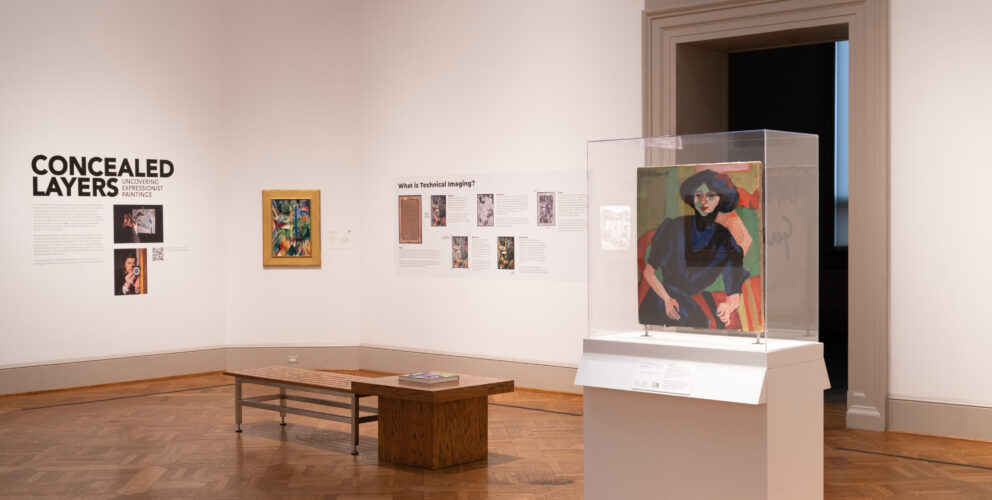
The painting will be featured in an upcoming exhibition, Concealed Layers: Uncovering Expressionist Paintings, which explores the Museum’s world-renowned German Expressionist collection from a conservation standpoint. In preparation for the exhibition opening in March, Murnau with Locomotive went to the Museum’s conservation lab for a thorough cleaning—after all, with so much white, dirt is more apparent and can obscure the subtle changes in the color Kandinsky crafted.
Typical of German Expressionist artists, Kandinsky intended for Murnau with Locomotive to be unvarnished. When the Museum received it in 1986, though, a layer of varnish had previously been applied and had yellowed over time. SLAM conservators removed the varnish in the 1990s, but cleaning solutions available at the time did not allow the painting under the varnish to be restored to its original brilliance. Thanks to advancements in water chemistry and cleaning agents, the recent treatment is expected to last at least 50 years.
Courtney Books, SLAM’s associate painting conservator, began with technical imaging to track the treatment’s impact. She then cleaned the surface with a soft brush and vacuum, followed by cotton swabs soaked in a custom pH-balanced water solution. Because the cleaning removed retouching from previous conservation work, minimal inpainting repaired minor damage to the painted surface. The entire process took about five weeks. Following treatment, Kandinsky’s whites are brilliant, and the snow glistens thanks to subtle changes in the white paint, now free from grime.
Associate painting conservator Courtney Books uses an aqueous cleaning method on the Kandinsky painting Murnau with Locomotive.
A deeper analysis of Murnau with Locomotive and Kandinsky’s practice is featured in an upcoming SLAM-produced catalogue detailing the Museum’s German Expressionist collection. A new book—German Expressionism: Paintings at the Saint Louis Art Museum authored by Melissa Venator, the Andrew W. Mellon Foundation Assistant Curator of Modern Art—provides an introduction to 48 paintings made by 25 artists between 1905 and 1939. They take the reader from the movement’s origins at the start of the 20th century, to its flowering before World War I, and dark years of censorship in Nazi Germany. An essay explores how such a remarkable collection came to St. Louis.
The book, available in Museum Shops this winter, will complement the non-ticketed exhibition, Concealed Layers, which offers a behind-the-scenes look at the three-year technical analysis of the works by SLAM curators and conservators.
Books and Venator curated Concealed Layers. It is on view from March 15 through October 27 in the Caro Nichols Holmes Gallery 214 and Sherry and Gary Wolff Gallery 215.