Installation view of Picturing Independence
This year marks the 250th anniversary of the signing of the Declaration of Independence. A collections-based exhibition, Picturing Independence, celebrates the milestone, inviting visitors to consider how artists have reflected on and shaped the ideas of American independence.
Exhibition curator Amy Torbert, the Andrew W. Mellon Foundation Associate Curator of American Art, has answered questions about the free exhibition, which features works in a variety of mediums from 1770 to 2017, spanning nearly every curatorial department. The exhibition is on view through January 24, 2027, in Shoenberg Gallery 236.

Amy Torbert, Andrew W. Mellon Foundation Associate Curator of American Art
What inspired you to select the works from SLAM’s collection for Picturing Independence?
As I began to develop this exhibition, I knew that it would focus nearly entirely on artworks owned by the Museum. I started by surveying our collection for all works that related directly to either the American Revolution, the Declaration of Independence, or to politics in the nation’s first decades. Though we have strong selections in these categories—most of which are included in the show—they were not numerous enough to fill the exhibition galleries. I then widened my search to include works from the 19th, 20th, and 21st centuries that related to the history and memory of the Revolution or artists’ use of national symbols first developed in the 18th century. In studying the results, I realized that our collection was filled with artworks with fascinating stories to tell about how Americans have communicated ideas about independence over 250 years.

Installation view of Picturing Independence
Paul Revere, American, 1734–1818; The Boston Massacre, or The Bloody Massacre perpetrated in King Street, Boston on March 5, 1770 by a party of the 29th Regiment, 1770; engraving with hand coloring; image: 8 7/16 × 7 3/4 inches, sheet: 10 3/4 × 9 1/4 inches; Saint Louis Art Museum, Museum Purchase 201:1942
What have been some noteworthy changes to how artists have depicted the concept of independence over the generations?
An exhibition centered on concepts of independence could take many shapes. For example, it might have explored independence in a purely art historical sense by tracing avant-garde artistic styles or daring subject matter. Instead, Picturing Independence brings together artworks that reflect on the history of the United States and symbols that artists have used to celebrate, question, and redefine what it means to be American, and for whom.
The works in this exhibition demonstrate that independence has never had a single, fixed meaning. Before and during the American Revolution, artists expressed their support for American independence through artworks that shaped understandings of current events. In The Boston Massacre, patriot and silversmith Paul Revere depicts a confrontation between British soldiers and Boston civilians in 1770. The print increased interest in the growing fight for independence by casting the Americans as defenseless victims through both its image and text to expand anti-British sentiments. In the 1850s, artists imagined scenes from the American Revolution in hopes of inspiring unity at a moment of division as the nation approached the Civil War. In the 20th century, artists used depictions of national symbols and events from American history to question who had access to independence.

Installation view of Picturing Independence
Many of these works showcase iconic imagery associated with the United States. How has the eagle, for example, been linked to art related to American independence?
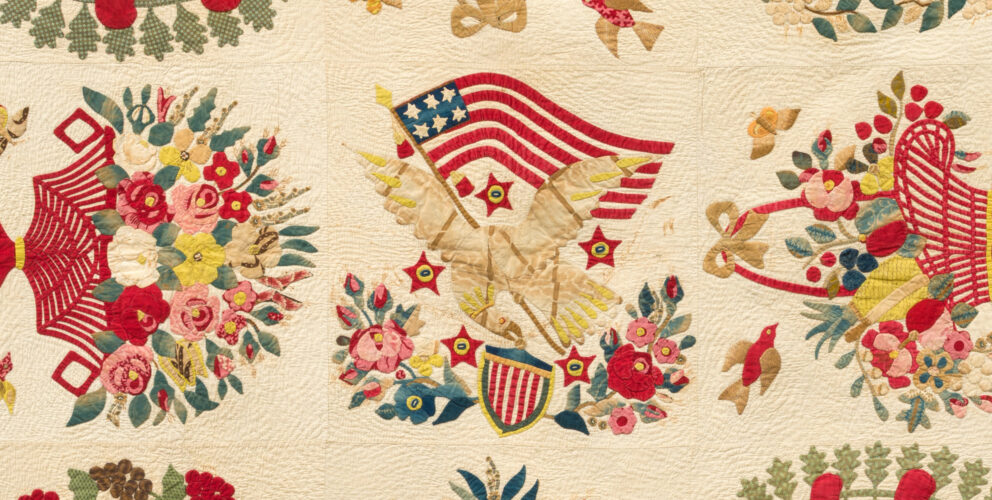
In 1776, the Continental Congress authorized the design of a national seal. Its main feature was the bald eagle—a selection that blended a species native to North America with a classical symbol long associated with power and might as the emblem of the Roman god Jupiter. Depictions of the bald eagle proliferated in architecture and decorative arts, quickly becoming the most pervasive symbol of the new nation through the 19th century. Picturing Independence features eagles carved from wood, woven into coverlets, painted on porcelain, formed from silver, and molded from clay. Many carry with them distinct political messages, from celebrating the establishment of the United States to commemorating victory in the War of 1812 to communicating support of the Union during the Civil War.

Installation view of Picturing Independence
The exhibition also features unexpected connections to independence, like the Benjamin West painting Daniel Interpreting to Belshazzar the Writing on the Wall. Why was this included?
Encountering portraits of George Washington and Benjamin Franklin or works by Paul Revere in this exhibition will probably come as no surprise. But what does this large painting of a biblical story have to do with independence? American-born Benjamin West embedded political meanings within this scene, created as the British Empire teetered on the brink of civil war in 1775. He depicts the Babylonian king Belshazzar committing an act of sacrilege. When mysterious writing appeared on the wall at the top left, the prophet Daniel interpreted the message to predict the downfall of the king’s empire. West displayed the painting at London’s most prominent annual exhibition in the spring of 1776, just a few months before news of the Declaration of Independence reached the city. Because he did not wish for independence, he hoped that Daniel’s warning to a prideful king might encourage viewers to act diplomatically rather than punitively toward Americans. West’s painting reflects the intense interest in the American Revolution from European countries and empires, who watched with curiosity as a colonial rebellion grew into a full-fledged movement for independence.

Installation view of Picturing Independence
What does the 250th anniversary of the signing of the Declaration of Independence mean to you?
During this semiquincentennial year, I hope that Picturing Independence will encourage visitors to question how art reflects the multitude of perspectives and voices that shape the American experience. Colleagues across the Museum and I worked to create an exhibition imbued with a spirit of curiosity and open-ended exploration to consider the ideals set forth at the nation’s founding and the ongoing efforts to realize them. In 1975, just ahead of the nation’s bicentennial, the Lorillard Tobacco Company posed a similar question to 12 American artists. In response to the query “What does independence mean to me?” they created prints that present differing interpretations of independence. Prints by artists Jacob Lawrence, Marisol, Audrey Flack, Fritz Scholder, and Robert Indiana are included in this exhibition as an invitation to contemplate this same question and the varied meanings of independence across 250 years of United States history.