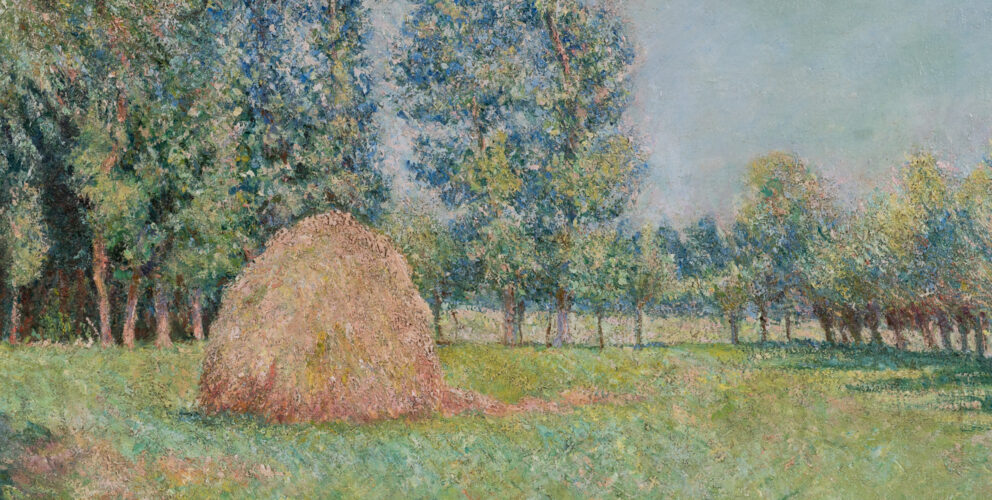
Blanche Hoschedé-Monet, French, 1865–1947; Morning on the Seine (detail), c.1896; oil on canvas; 23 13/16 × 18 3/4 inches; Alice and Rick Johnson 2026.06; Courtesy of Eskenazi Museum of Art, photo by Shanti Knight
The latest ticketed exhibition at the Saint Louis Art Museum focuses on landscapes as a distinct body of work essential for understanding the women artists of the Impressionism movement.
Exhibition curator Simon Kelly, SLAM’s modern and contemporary art curator, has answered the following questions about Women Impressionists and the Land, which is on view October 16 through January 10, 2027.

Simon Kelly, curator of modern and contemporary art
Women Impressionist artists are often associated with more-domestic scenes. Where did the idea come from to focus on landscape imagery in this exhibition?
I was struck by the fact that some of the most radical landscape imagery in the Impressionist movement was painted by women, and I felt that those works hadn’t really received their full recognition. Berthe Morisot’s paintings in particular are radical in their protoabstract quality and highly gestural brushwork. But there were many other women artists painting landscapes at the time, too. Morisot’s career and that of the other women artists in the show highlight the still-underappreciated importance of outdoor painting by women in the 19th century. Mary Cassatt, for example, who is primarily a figure painter, also had a deep understanding of and appreciation for the land. The exhibition explores the paintings of little-known artists like Marie Bracquemond and Blanche Hoschedé-Monet, whose work is only now being rediscovered. For all of these artists, landscape was an important way of pushing against the professional and social barriers they faced at the time, whether limitations on their travel and access to artistic training, or biased critical reception.

Mary Cassatt, American (active France), 1844–1926; Summertime, 1894; oil on canvas; 39 × 32 inches; Terra Foundation for American Art, Daniel J. Terra Collection 2026.169
Women’s activities outside the home were often constrained during this time period. Can you talk about one of the artists in the exhibition and her journey toward success as an artist?
Perhaps the best-known artist in the show is Mary Cassatt, and her career is really a story of transatlantic success. She was born in Allegheny, Pennsylvania, just outside of Pittsburgh, and first went to France in the 1860s. It’s true that Cassatt’s best-known pictures are her interior domestic scenes, but in this show, I wanted to focus on her less-known late paintings at the Château de Beaufresne northwest of Paris, where she lived for the last 32 years of her life. Cassatt was an accomplished gardener—she once talked about planting a thousand tea roses—and she treated her garden like an artist’s palette, planting flowers as color accents. Her paintings and prints of her garden—several of which are in the show—are full of color and life, and they enjoyed considerable commercial and critical success. Earlier this year, I visited Cassatt’s château and grounds, which are now privately owned, and it really helped me to understand the importance of the land in her practice.

Blanche Hoschedé-Monet, French, 1865–1947; The Weeping Willows on the Lily Pond at Giverny, 1893–97; oil on canvas; 23 3/4 × 32 inches; Columbus Museum of Art, Museum Purchase, through exchange 2026.189
What is Blanche Hoschedé-Monet’s connection to the famous Impressionist painter Claude Monet, and how did it impact her art?
Blanche Hoschedé-Monet was the stepdaughter and daughter-in-law of Claude Monet. That’s an unusual family relationship. Blanche was the daughter of Impressionist collectors Ernest and Alice Hoschedé and became Monet’s stepdaughter when Alice married Monet after Ernest’s death. Blanche later married Claude Monet’s biological son Jean in 1897. From an early age, Blanche showed a gift for painting, and she often painted outdoors side by side with Monet around the village of Giverny where they both lived. Monet was already a famous artist by the 1880s, but Blanche was never overawed; she developed her own identity, often paying more attention to details of plant life around the rivers and fields. This exhibition aims to show Blanche’s understanding of agricultural life and different seasons of the landscape of Normandy.

Edma Morisot-Pontillon, French, 1839–1921; Women in Woods, 1860–1869; oil on canvas; 19 3/4 × 25 1/2 × 1 inches; Saint Louis Art Museum, Gift of Bill Scott in honor of Simon Kelly 42:2026; Photo: Joseph Painter
The exhibition features a number of newly discovered works. Can you discuss how they came to be included in this exhibition?
There are newly discovered paintings in the exhibition by Berthe Morisot and her elder sister Edma Morisot-Pontillon, who is less well-known but exhibited repeatedly with Berthe at the Paris Salon in the 1860s. The two sisters traveled extensively around France, acting as chaperones for each other and painting outside together, often literally sitting next to each other. In this exhibition, it’s interesting to compare the subtle differences in technique between the two young artists. The exhibition also includes four rediscovered works by Marie Bracquemond, who was one of the three most well-known woman artists to show at the Impressionist exhibitions, with Berthe Morisot and Cassatt. Among these is Landscape (Path with Figures), which remained in Bracquemond’s family until 2024, when it was gifted to the Musée d’Orsay. The picture highlights Bracquemond’s feeling for light and color and will be premiered in this exhibition.

Berthe Morisot, French, 1841–1895; Hanging the Laundry out to Dry, 1875; oil on canvas; 19 5/8 × 22 5/8 × 3 inches; National Gallery of Art, Washington, Collection of Mr. and Mrs. Paul Mellon, 1985.64.28 2026.205
How does the topic of ecology show up in these artworks?
The 19th century saw the birth of ecological consciousness across Europe as a response to increasing industrialization and pollution. Artists played an important role in this. The exhibition shows the ways in which the women Impressionists painted age-old farming traditions at a time of increasingly mechanized agriculture, or they painted city parks, which effectively served as the lungs of the metropolis of Paris. Of all the artists in the show, Berthe Morisot’s work best expresses an ecological worldview. For example, in Landscape at Gennevilliers, she drew attention to the pollution of the steaming smokestacks around Paris. Even her brushwork—in fusing the human, animal, and vegetal—expresses the essential interconnectedness between species that is crucial to an ecological world view.

Berthe Morisot, French, 1841–1895; Young Girl Hanging a Bird Cage in a Tree, 1890; oil on canvas; 19 1/4 × 25 5/8 inches; Santa Barbara Museum of Art, Bequest of Leslie L. Ridley-Tree 2026.200
What do you hope visitors take away from this exhibition to expand their understanding of the well-known Impressionist movement?
I hope that visitors will see the centrality of women as landscape painters in the Impressionist movement. Landscape painting is the archetypal Impressionist medium. We generally think of the landscapes of artists like Monet and Cezanne, but I hope that this exhibition will encourage us to think more about the land imagery of women artists, whether relatively well-known artists like Berthe Morisot and Cassatt or lesser-known figures like Marie Bracquemond or Louise Abbéma. Hopefully, the exhibition will provide visitors with a new way of looking at Impressionism in which women have a more prominent role.