Jar
- Material
- Alkaline-glazed stoneware

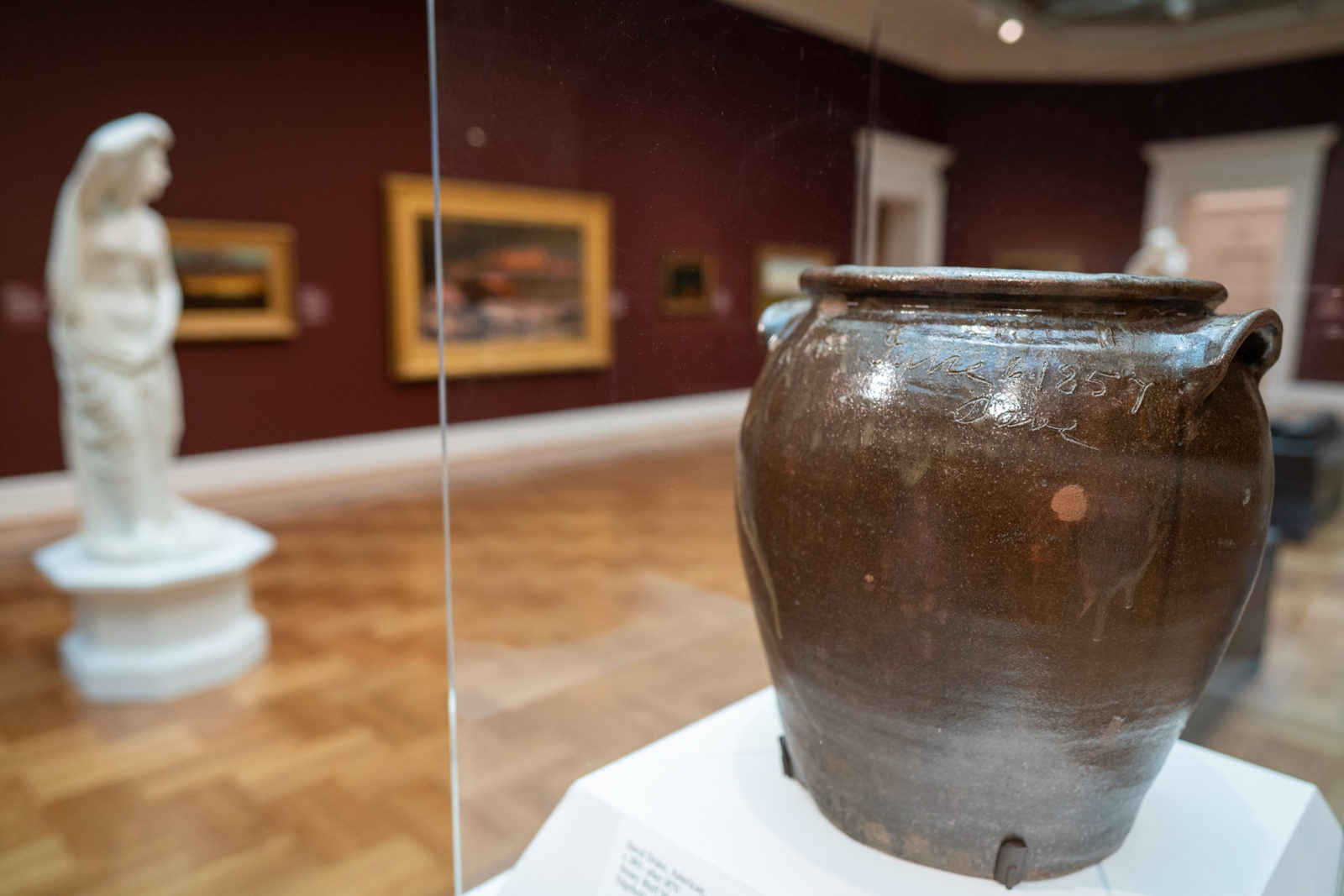
David Drake, American, c.1801–after 1870; made at Stony Bluff Manufactory, Edgefield District, South Carolina; Jar (detail), June 6, 1857; alkaline-glazed stoneware; 17 x 15 3/8 x 15 3/8 inches; Saint Louis Art Museum, Richard Brumbaugh Trust in memory of Richard Irving Brumbaugh and Grace Lischer Brumbaugh, Friends Fund, Marjorie Wyman Endowment Fund, The Lopata Endowment Fund, Mary Elizabeth Rosborough Decorative Arts Fund, and the Margarita M. and Roland E. Jester Endowment Fund for the Decorative Arts 326:2020
If you walk through Gallery 336 in the American art galleries, you’ll notice a large brown vessel sitting on a pedestal. At first glance, it may seem simple, but upon closer inspection, you’ll see two inscriptions—the date “June 6 • 1857” and the signature “Dave”—as well as fingerprints on the bottom. This outwardly humble jar reflects our nation’s history of slavery and tells the story of Dave the Potter.
Formally called David Drake, he was an enslaved African American who created stoneware jars in 19th-century Edgefield, South Carolina. Slavery was a significant part of Edgefield’s ceramic factories—by 1820 enslaved Black people were the majority of the local population.[1] Unfortunately, due to the dehumanization and anonymity of slavery, little is known about Dave’s life. Born around 1800, he was purchased before 1818 by slaveholders Harvey Drake and Dr. Abner Landrum.[2] Landrum owned a pottery manufactory, where Dave likely learned to create ceramic jars, jugs, and churns intended for food storage. In 1849 Lewis Miles purchased Dave to work at Stony Bluff Manufactory in Edgefield.[3] From 1849 until the abolition of slavery in 1865, Dave labored at Stony Bluff, where he produced most of his jars, which were used on neighboring plantations. He remained in South Carolina until his death sometime before 1880.
David Drake, American, c.1801–after 1870; Jar, June 6, 1857; alkaline-glazed stoneware; 17 x 15 3/8 x 15 3/8 inches; Saint Louis Art Museum, Richard Brumbaugh Trust in memory of Richard Irving Brumbaugh and Grace Lischer Brumbaugh, Friends Fund, Marjorie Wyman Endowment Fund, The Lopata Endowment Fund, Mary Elizabeth Rosborough Decorative Arts Fund, and the Margarita M. and Roland E. Jester Endowment Fund for the Decorative Arts 326:2020
Dave produced ceramics his whole life, but it took years of practice before he could have created his most substantial vessels, the biggest of which could hold 40 gallons. Yet, the most notable aspect of his utilitarian jars is that he wrote on them. Dave’s writing abilities are unusual—in 19th-century South Carolina only 5 to 10 percent of enslaved people could read, and in 1834 South Carolina’s General Assembly made slave literacy illegal. [4] Despite this ban, on a container created April 21, 1858, now in the collection of The Metropolitan Museum of Art, Dave inscribed: “when you fill this Jar with pork or beef / Scot will be there; to get a peace, – / Dave.”[5] On another dated July 31, 1840, in the Charleston Museum, he wrote, “Dave belongs to Mr. Miles / Whir the oven bakes and the pot biles.”[6] Reaching us across time through his jars, Dave’s words convey his intelligence, humor, and creativity—they also allow a glimpse into his feelings about his enslavement. Dave’s poetics rise above his status as a commodity to assert his dignity and individuality.
How Dave learned to write is unknown, but the most likely source is Landrum’s newspaper, The Edgefield Hive, where Dave occasionally worked.[7] Although Dave’s literary beginnings are unknown, the result is clear. Dave produced an estimated 40,000 vessels in his lifetime.[8] Currently, 270 are known, of which 36 have two-line verses and single words like Concatenation—many others are signed and dated. The Museum’s jar falls into this second category, and its size and shape are typical for his later work. As you visit Dave’s jar, consider how his legacy as a skilled potter and creative poet speaks to what is possible in the face of dire adversity.
[1] Cinda K. Baldwin, Great and Noble Jar: Traditional Stoneware of South Carolina (Athens: University of Georgia Press, 1993), 72.
[2] Jill Beute Koverman, ed., I Made This Jar: The Life and Works of the Enslaved African-American Potter, Dave (Columbia: University of South Carolina, 1998), 22.
[3] Leonard Todd, Carolina Clay: The Life and Legend of the Slave Potter Dave (New York: W. W. Norton, 2008), 115.
[4] Todd, Carolina Clay, 42.
[5] Storage Jar by David Drake, 21 April 1858, 2020.7, The Metropolitan Museum of Art. https://www.metmuseum.org/art/collection/search/747045?searchField=All&sortBy=Relevance&ft=david+drake&offset=0&rpp=20&pos=1.
[6] Storage Jar by David Drake, 31 July 1840, HC 1247, the Charleston Museum. https://www.charlestonmuseum.org/research/collection/storage-jar/DC055324-3125-4445-9DFB-131436324440.
[7] Baldwin, Great and Noble Jar, 76.
[8] Rita Reif, “Art/Architecture; In a Slave’s Pottery, a Saga of Courage and Beauty,” The New York Times, Jan. 30, 2000, https://www.nytimes.com/2000/01/30/arts/art-architecture-in-a-slave-s-pottery-a-saga-of-courage-and-beauty.html.