Ellsworth Kelly, Spencertown studio, New York, 2011; Photo by Jack Shear, courtesy of Ellsworth Kelly Studio; © Ellsworth Kelly Foundation
Ellsworth Kelly’s bold use of color and shape is often inspired by nature’s predictable unpredictability, though it is not always apparent on first view. A diligent student of Mother Nature, Kelly is one of the foremost postwar American abstract artists. There are 16 Kelly prints, paintings, and sculptures currently in SLAM’s collection.
Born May 31, 1923, Kelly lived in many cities along the east coast. As a young boy, he developed an affinity for birdwatching; the outdoors later became an incredible influence upon his practice.
After nurturing his artistic skills through school, Kelly attended Pratt Institute in New York to study applied art. Unfortunately, his education was cut short with the escalation of World War II. He was inducted into the United States Army in 1943 and would eventually be transferred to a base in Fort Meade, Maryland, “allowing him to regularly visit the National Gallery of Art [in] Washington, DC,” according to the Ellsworth Kelly Foundation. Like many artists enrolled in the US military, he produced silk-screen posters made for disseminating information to troops. He also continued to sketch and paint in his free time.
Following an honorable discharge in the fall of 1945, Kelly was able to continue his art studies at the School of the Museum of Fine Arts in Boston under the GI Bill of Rights. Between the fall of 1946 and the spring of 1948, the artist refined his figurative drawing skills, exhibiting his first works at the Institute of Modern Art, Boston (now known as Boston’s Institute of Contemporary Art) and Boris Mirski Art Gallery.

Ellsworth Kelly, American, 1923–2015; Untitled, 1982; weathering steel; 74 inches x 14 feet 6 inches x 13 feet 8 inches; Saint Louis Art Museum, Gift of the Ellsworth Kelly Foundation 108:2022; © Ellsworth Kelly Foundation
Kelly’s foundational appreciation of nature was substantiated by German expressionist Max Beckmann, who was invited to lecture by Kelly’s professor, Karl Zerbe. Beckmann’s practice was highly influenced by nature, and he urged the students before him to not “forget nature” in their art. This directive was dictated to the class in a letter that encouraged the class to “take long walks and take them often, and try your utmost to avoid the stultifying motor car which robs you of your vision, just as the movies do, or the numerous motley newspapers,” and to “learn the forms of nature by heart so that you can use them like the musical notes of a composition.”
Although he was “famous as a painter of the human condition,” the German artist “also renewed the genre of landscape painting with outstanding and haunting works that are virtually without equal in twentieth-century art,” according to Kuntsmuseum Basel. Kelly would continue to find inspiration and guidance in Beckmann’s works. Nature’s influence on Kelly’s work is evident in his 1982 sculpture, Untitled. The monumental work located on SLAM’s South Terrace interacts with its environment by creating a complex play of light and shadow.
Other Kelly works in SLAM’s collection are more abstract in nature, a quality the artist began implementing into his practice after graduating in the summer of 1948. Kelly spent the late 1940s and early ’50s studying at the École des Beaux-Arts in Paris, visiting French museums, and experimenting with Surrealist art alongside old and new friends. According to the Museum of Modern Art, during this time, he “absorbed the lessons of Byzantine icons and Romanesque frescoes, Jean Arp’s experiments with chance and Henri Matisse’s economical line, all of which helped him develop his own artistic language.”
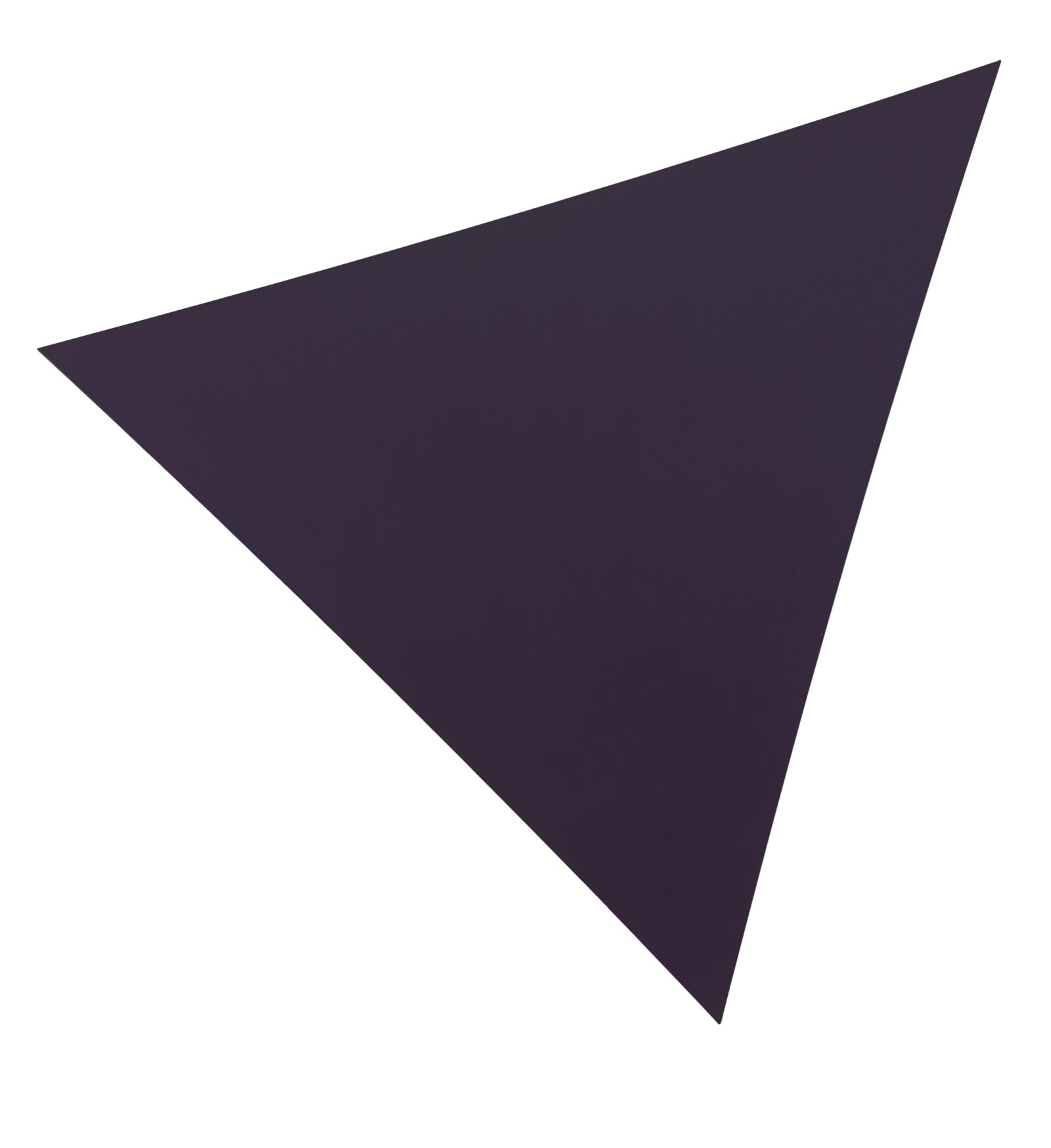
Ellsworth Kelly, American, 1923–2015; Purple Panel, 1988; oil on canvas; 110 1/2 x 110 1/2 inches; Promised gift, Collection of Emily Rauh Pulitzer and Joseph Pulitzer Jr. 2021.611; © Ellsworth Kelly Foundation
In 1951, while still living and working in France, Kelly submitted work to an alumni exhibition hosted by his Boston alma mater. His was the only abstract work in the show, garnering attention from northeastern art galleries. He continued to create and exhibit art in Europe, while his interest in abstract art and drawings from plants developed. He eventually returned to the US in 1954, where his career blossomed.
While Kelly’s art of the second half of the 20th century is characterized by “pre-Euclidean,” geometric features, the “special freshness in Kelly’s art lies in his reliance on his own vision, and the only ‘system’ he refers to is the one he has devised himself by simply looking at the world,” according to art critic E. C. Goossen for the Museum of Modern Art. Instead of aligning his practice with previously determined schools of art, he digested the basic shapes and color from his surroundings to fuel his work. This, coupled with his generally minimalist nature, culminated in the abstract works that bolster SLAM’s collection today.
One of SLAM’s most beloved works, Spectrum II is an example of Kelly’s fearlessness when it comes to abstract minimalist art. In the large—80 by 22 feet, 9 inches—artwork, he disrupted the predictable, standard red-to-violet progression of the color spectrum and, instead, offered a sequence that begins with one yellow and ends with another.
Of the 16 Kelly works in the Museum’s collection, 14 are prints and drawings, which were created between 1964 and 1997. Printmaking became an integral part of the artist’s communicative process following his return to New England. According to author Richard Axsom in The Prints of Ellsworth Kelly, “For Kelly, the making of a good print involves a series of intuitive decisions about shape, color, the relationship of color to shape and the relationship of colored shape to the field of paper it rests on.”

Ellsworth Kelly, Spencertown studio, New York, 2011; Photo by Jack Shear, courtesy of Ellsworth Kelly Studio; © Ellsworth Kelly Foundation
His experimentalism garnered him acclaim and longevity in his career. He received many accolades, including honorary degrees from the Royal College of Art and Harvard University; the Japan Art Association’s Praemium Imperiale for Painting; and the National Medal of Arts from the US Government, which was presented by then-President Barack Obama.
Kelly’s work was previously celebrated in the 2023 SLAM-organized eponymous exhibition, a display that covered six decades of his practice and showcased the strength of Kelly’s work in St. Louis private collections. It included Emily Rauh Pulitzer’s promised gifts of the painting Purple Panel (1988) and the graphite drawing Briar (1960) to the Saint Louis Art Museum. It also highlighted the aforementioned sculpture, Untitled, a gift from the Ellsworth Kelly Foundation.