


Eiffel Tower
- Material
- Oil on canvas

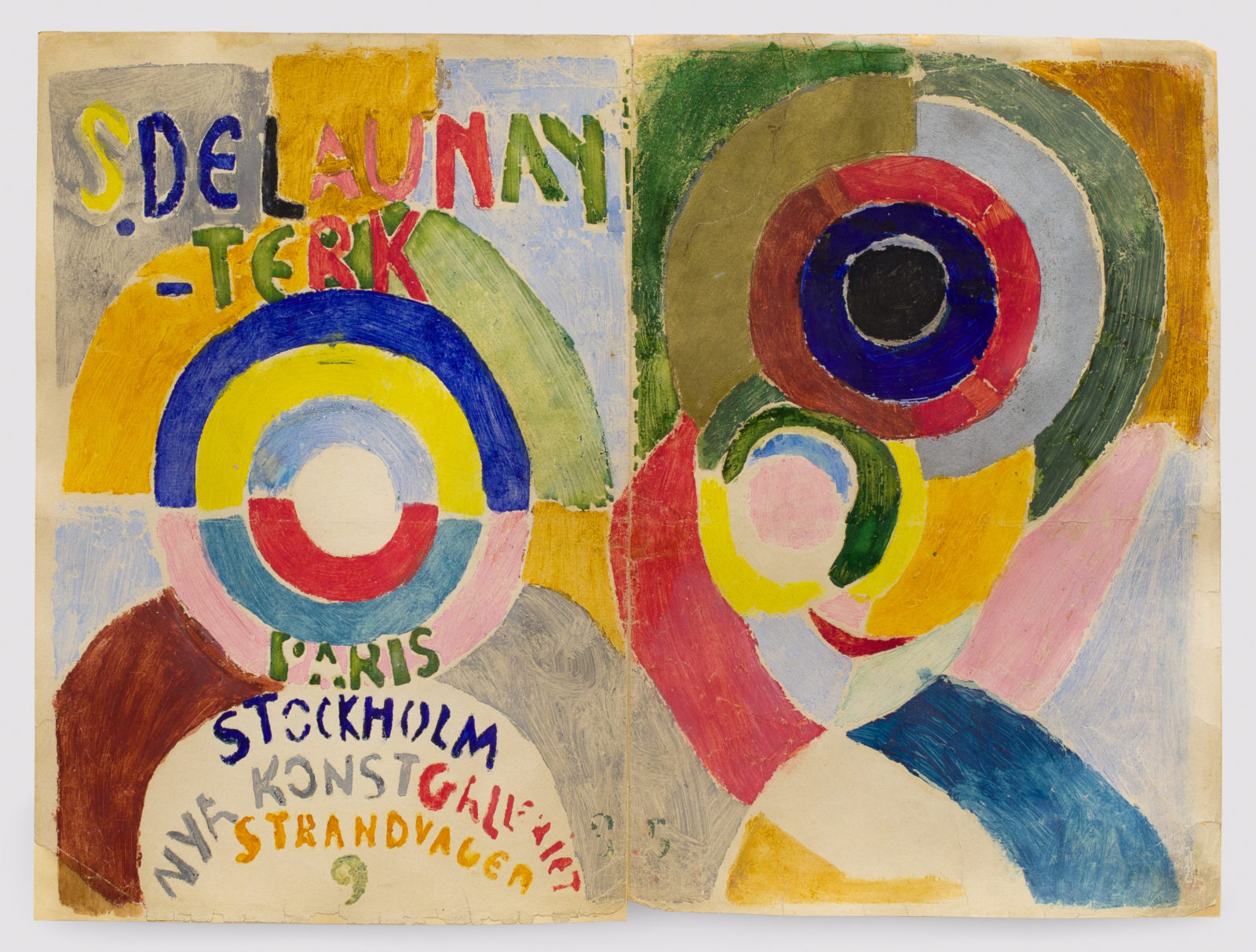
Sonia Delaunay, French (born Ukraine), 1885–1979; Maquette of Exhibition Catalog, 1916; pochoir; 13 1/2 x 17 3/4 inches; Private Collection 2022.11

“Now Sonia Delaunay is evoking a revolution in women’s wear with her fashion creations. Make no mistake about it: clothing too is a work of art!”
—Claire Goll, “Simultaneous Clothing,” Bilder Courier (Berlin, April 1924)[1]
Vibrant arcs and circles dominate this slipcover for an exhibition catalog. The cover was designed and handprinted by the Ukrainian-born artist Sonia Delaunay (also known as Sonia Delaunay-Terk)[2] for an exhibition of her work held in 1916 at the Nya Konstgalleriet in Stockholm. This remarkable image captures not only the color-saturated style that came to embody Delaunay’s oeuvre but also hints at the diverse range of work she produced—from paintings and ceramics to fashion and stage designs—throughout her lengthy career.
Sonia Delaunay, French (born Ukraine), 1885–1979; Maquette of Exhibition Catalog, 1916; pochoir; 13 1/2 x 17 3/4 inches; Private Collection 2022.11
The Swedish exhibition was one of Delaunay’s first major international exhibitions outside France. It was intended to introduce her work to an avant-garde market in Scandinavia, and the exhibition catalog cover emphasized her colorful style.[3] Delaunay blended abstraction and figuration in ways that may not be apparent at first glance. The cover design is made up primarily of swaths of color that arch across the paper. The image itself is continuous, but a vertical crease down the center indicates that the paper was folded to create distinct front and back covers. The right portion—the front cover—depicts concentric circles of red, blue, and green that seem to emanate from a black core near the top; just below this, semicircles of green, blue, and yellow surround a pale pink dot. Contrasting arcs of oranges, blues, reds, and other colors make up the rest of the image. However, in a clever bit of self-promotion, what at first seems to be simply an exploration of colors and shapes is actually a self-portrait by Delaunay. The pink dot and surrounding colors suggest her eye and face, with a thin red arc representing her mouth, while the deeper colored circles above suggest a colorful hat atop her head.
Sonia Delaunay, French (born Ukraine), 1885–1979; Maquette of Exhibition Catalog (detail), 1916; pochoir; 13 1/2 x 17 3/4 inches; Private Collection 2022.11
The left, or back, portion includes the artist’s name and home city of Paris[4] as well as the name and location of the gallery in Stockholm presenting the exhibition. Here again, though, she subtly displayed a human figure through her use of color and form. The areas of orange and green at the top make up the head and arms of a figure, with the concentric circles near the center forming the body, and the brown and gray stripes at the bottom forming legs. This act of transcribing the figure into geometric patterns of color was common within Delaunay’s artistic practice at the time. She and her husband, fellow painter Robert Delaunay, were fascinated with the color theory of the French chemist Michel Eugène Chevreul, particularly his ideas of simultaneous contrasts of color. These contrasting colors, when viewed together, created a sense of movement and harmonious unity that became key to the Delaunays’ works, developing into the style they referred to as Simultanism.
Color theory became essential to both artists, but Sonia sought to achieve “an extreme exaltation of color,”[5] working with a freer application than her husband. Both artists were painters, and as Robert gained renown for his works, Sonia supported his career while turning her attention to an entire range of other objects, including ceramics, bookbindings, and textiles. These were objects traditionally considered to be “minor” or “decorative” in relation to the so-called fine arts of painting and sculpture, but by the late 19th and early 20th century, many artists across Europe, including Sonia, made no distinction among these genres. Rather, she emphasized the significance of the intersections of art and modern life, applying her expressive color to all areas and incorporating art into the everyday.[6]
Sonia Delaunay, French (born Ukraine), 1885–1979; Maquette of Exhibition Catalog (detail), 1916; pochoir; 13 1/2 x 17 3/4 inches; Private Collection 2022.11
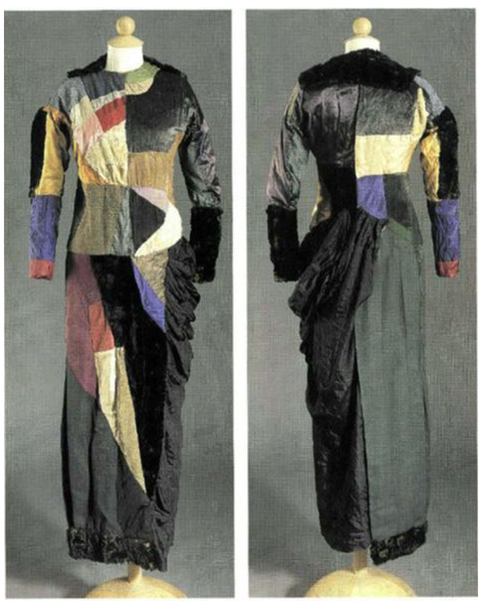
One of her earliest explorations of these intersections came in 1911, when she made a patchwork quilt for their infant son, Charles. The artist described the impact of the quilt many years later: “About 1911 I had the idea of making for my son, who had just been born, a blanket composed of bits of fabric like those I had seen in the houses of Russian peasants. When it was finished, the arrangement of the pieces of material seemed to me to evoke cubist conceptions and we then tried to apply the same process to other objects and to paintings.”[7] Soon after, she began applying this same formula—mismatched and irregular patches of colorful fabrics—to actual clothing. In 1913 she designed what she called the Simultaneous Dress. It was a collage of fabrics and colors—she incorporated silk, taffeta, wool, and fur in a range of hues from deep red, mauve, blue, and green to gold and black.[8] These contrasts evoked a sense of vibrating movement, as though the dress itself was in constant motion. Delaunay wore her dress to the Bal Bullier, a popular club in Montparnasse frequented by the avant-garde writers and artists of her and Robert’s social circle.[9] New popular dances like the tango and the foxtrot took the club by storm, and while Sonia preferred not to dance herself, her dress captured the same feeling of energetic movement.[10]
Designed by Sonia Delaunay, French (born Ukraine), 1885–1979; Simultaneous Dress, 1913; Image: wikiart.org/en/sonia-delaunay/simultaneous-dress-1913
Like the Simultaneous Dress, the Stockholm exhibition catalog cover suggests the same sense of movement through the push and pull of the color contrasts, which Delaunay achieved through a technique known as pochoir, the French word for stencil. Using this method, she made 50 copies of the cover with brightly colored gouache that was applied by hand through the cut stencils. This application allowed for the final images to retain a vibrancy of color but also slight variations of tone and texture that could not be achieved through other types of color printing at the time. Pochoir had risen in popularity by the 1910s and 1920s, particularly among book illustrators and fashion designers.[11] Delaunay was one of its greatest proponents, frequently using this method to reproduce her fashion studies as well as other explorations of color and form.[12]
The cover also provides insight into Delaunay’s fashion designs. Her 1913 Simultaneous Dress included a matching hat made up of contrasting rings of colored fabrics. Visually, the hat that appears in the self-portrait reflects the actual hat that was part of her ensemble. It serves to identify her not only as a modern painter but also as a designer and a modern woman of fashion. While her textile and fashion designs were likely not included in the exhibition, the catalog itself included a photograph of her wearing two of her own dresses.[13] In the years following the exhibition, fashion continued to play an important role in Delaunay’s art and life. In 1917 she opened her first boutique, Casa Sonia in Madrid, catering to the significant avant-garde population that had taken refuge there during World War I. During this time, she also received commissions for theater costume designs, including for the famed Ballets Russes performance of Cleopatra. Upon returning to France in 1920, she opened Maison Delaunay, modeled after the great haute couture fashion houses with which Paris was synonymous. Here she continued to design dresses and other clothing as well as printed fabrics and textiles, all decorated with her signature vibrantly colored geometric patterns.[14]
Delaunay’s Stockholm exhibition catalog cover represents a key moment in the development of her oeuvre. This period was a remarkably inventive and productive time for her, as she came into her own not only in terms of her experimentations with color but also her conquest of nearly all genres of art. This exhibition heralded her roles as painter, designer, illustrator, model, and modern woman, situating her at the forefront of the 20th-century avant-garde.
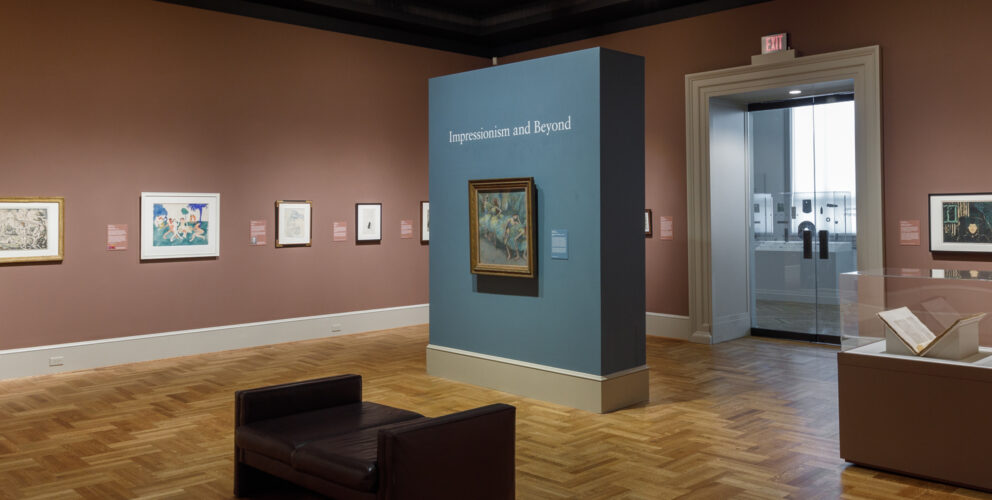
The cover is currently on view in Impressionism and Beyond, in the galleries for prints, drawings, and photographs.
Maquette of Exhibition Catalog is on view in Impressionism and Beyond.
Delaunay’s Stockholm exhibition catalog cover represents a key moment in the development of her oeuvre. This period was a remarkably inventive and productive time for her, as she came into her own not only in terms of her experimentations with color but also her conquest of nearly all genres of art. This exhibition heralded her roles as painter, designer, illustrator, model, and modern woman, situating her at the forefront of the 20th-century avant-garde.
The cover is currently on view in Impressionism and Beyond, in the galleries for prints, drawings, and photographs.
[1] Quoted in Arthur A. Cohen, ed., The New Art of Color: The Writings of Robert and Sonia Delaunay, The Documents of 20th-Century Art (New York: Viking Press, 1978), 184.
[2] Delaunay was born Sarah Stern in 1885 in the small village of Gradizhsk, in present-day Ukraine. She was adopted at age five by a wealthy uncle, Henri Terk, and moved to St. Petersburg, where she began to go by the name Sonia Terk. See Hajo Düchting, Tag Gronberg, and Nele Bernheim, “The Delaunay Family,” Grove Art Online, https://doi.org/10.1093/gao/9781884446054.article.T021944, accessed July 2, 2009.
[3] Annika Ohrner, “Delaunay and Stockholm,” in Ana Vasconcelos e Melo, eds., O Círculo Delaunay (Lisbon: Fundação Calouste Gulbenkian, 2015), 226–227.
[4] Delaunay lived and worked in Paris, but during World War I she and her husband, Robert, had relocated to Spain and Portugal, where she designed this cover.
[5] Sonia Delaunay, “Sonia Delaunay” (Paris: Musée National d’Art Moderne, 1967), 13–15; translated and reprinted in Cohen, ed., The New Art of Color, 194.
[6] Arthur A. Cohen, Sonia Delaunay (New York: Harry N. Abrams, 1975, reprint 1988), 52; and Marta Ruiz del Árbol, Sonia Delaunay: Art, Design, Fashion (Madrid: Museo Thyssen-Bornemisza, 2017), 16.
[7] Sonia Delaunay, “Collages of Sonia and Robert Delaunay,” XXième Siècle 6 (January 1956), 19–20. Translated and reprinted in Cohen, ed., The New Art of Color, 210.
[8] Alessandra Vaccari, “The Simultaneous Dress of Sonia Delaunay, Fashion, and the Tangibility of the Tango,” Elephant and Castle 26, L’Esprit du collage (December 2021), 9.
[9] Their social circle included the writers Guillaume Apollinaire and Blaise Cendrars, who both wrote about Delaunay’s colorful clothing designs. See Cohen, ed., The New Art of Color, 64–66.
[10] Vaccari, “Simultaneous Dress,” 15.
[11] April Calahan and Cassidy Zachary, Fashion and the Art of Pochoir: The Golden Age of Illustration in Paris (New York: Thames and Hudson, 2015), 7.
[12] Amy Ballmer, “Pochoir in Art Nouveau and Art Deco Book Illustration,” Art Institute of Chicago Museum Studies 34, 2 (2008), 28.
[13] Ohrner, “Delaunay and Stockholm,” 231.
[14] Petra Timmer, “Sonia Delaunay: Fashion and Fabric Designer,” in Matilda McQuaid and Susan Brown, eds., Color Moves: Art and Fashion by Sonia Delaunay (New York: Cooper Hewitt National Design Museum, Smithsonian Institution, 2011), 28–42.