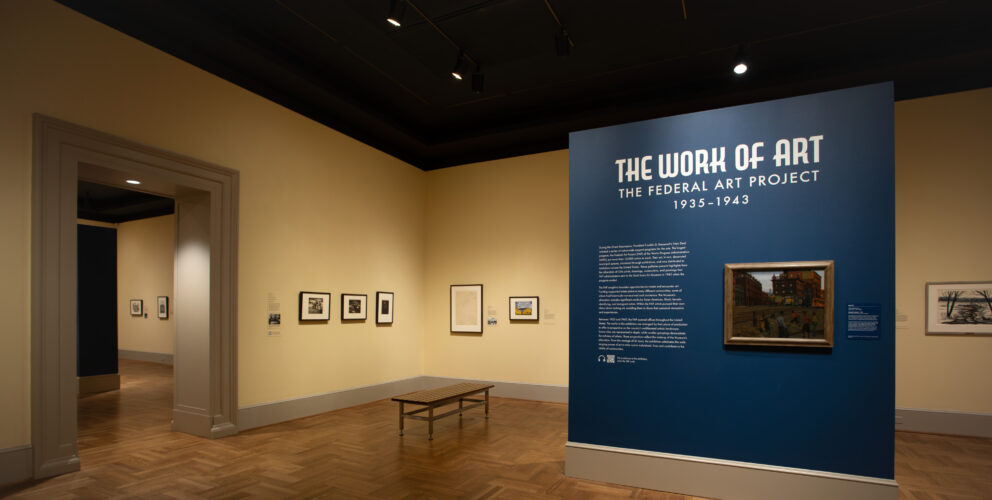
Installation view of The Work of Art: The Federal Art Project, 1935–1943

Murals are often at top of mind when people think of the creative outputs of the Federal Art Project (FAP). However, the Graphic Arts Division of the FAP produced prints and was incredibly prolific, leading to innovations in printmaking across the United States from 1935 to 1943.
SLAM’s current exhibition The Work of Art: The Federal Art Project, 1935–1943 is on view through April 13, 2025, and features around 60 works from the Museum’s collection that were made under the auspices of the FAP—many of which are prints that demonstrate a variety of techniques.
Prior to the FAP, etching mostly dominated the printmaking world in the United States. Etching is a technique that relies on acid to create recessed lines in a metal plate. Black ink is then transferred to paper under pressure from the recessed areas of the plate. Though common today, fine-art color prints were not widely made in the US at this time. Armed with the ability to experiment, the FAP artists were eager to try new techniques. Printmaking innovations such as carborundum mezzotint, screenprint, and color lithography were featured as important artistic developments happening under the FAP.

Dox Thrash, American, 1893–1965; Charlot, 1938 or 1939; carborundum mezzotint; plate: 8 7/8 x 7 inches sheet (irregular): 13 3/8 x 10 5/8 inches; Saint Louis Art Museum, Gift of the Federal Works Agency, Work Projects Administration 334:1943
In 1937, carborundum mezzotint was discovered within the Fine Print Workshop in Philadelphia by artists Dox Thrash, Hugh Mesibov, and Michael Gallagher. The process was discovered accidentally when Thrash was attempting to remove etched lines from a copper plate by grinding carborundum particles—an industrial abrasive powder—over it. After using a weight, and water as lubricant, Thrash found that the copper plate had taken on an evenly pitted surface. Mesibov was looking over Thrash’s shoulder and suggested to Thrash that lines could be burnished into the plate. The rough surface held onto the ink, enabling the printing of a deep black.
Under magnification, the texture of the background looks noticeably different from a traditional mezzotint. A traditional mezzotint was done by roughening the copper plate using a “rocker,” which is a semicircular tool with serrated edges. Unlike a traditional mezzotint, a carborundum mezzotint does not show the faint crisscross pattern from the rocker. Unfortunately, the technique did not spread beyond Philadelphia and remains somewhat anecdotal today.

Myron Kozman, American, 1916–2002; Abstraction #202, 1940; color screenprint (direct resist stencil); image: 22 5/8 x 14 7/8 inches sheet: 23 x 18 1/2 inches; Saint Louis Art Museum, Gift of the Federal Works Agency, Work Projects Administration 202:1943

Archives of American Art, Smithsonian Institution Washington, D.C., Federal Art Project, Photographic Division collection, circa 1920-1965, bulk 1935-1942
Another major contribution to modern printmaking by the FAP was the adaptation of screenprinting as a fine-art medium. In 1938, the Silk Screen unit of the Graphics Arts Division was initiated under the supervision of Anthony Velonis. The process had been employed commercially in the United States for several decades prior to the mid-1930s. The primary attraction of screenprinting was that it gave artists the ability to economically create prints in a wide variety of colors. Artists could employ 16–20 colors for one print; color lithography and woodblocks were limited to far fewer because of expense and labor. By 1940, 20 percent of the works created by the Graphic Arts Division of the FAP were screenprints.
The process relies on ink being forced through a mesh screen onto a surface. Making certain areas of the screen impervious to printing ink creates a stencil and blocks the ink from passing through the screen. The ink that passes through forms the printed image, and each color to be printed necessitates its own screen. Stencils can be composed of a wide variety of materials, such as fabric, greasy paint, glue, or film. During the FAP, artists were mostly using three types of stencils: resist and wash-out stencils, direct resist stencils, and cut film stencil. Resist and wash-out stencils involve drawing on the screen with a soluble material, applying an insoluble resist, and then washing away the original drawing material to create openings for ink to pass through. A direct resist stencil is done by selectively covering or “blocking out” parts of the screen with a resist such as glue or lacquer. Finally, a cut film stencil is made by placing a design cut from paper or plastic film directly against the screen.
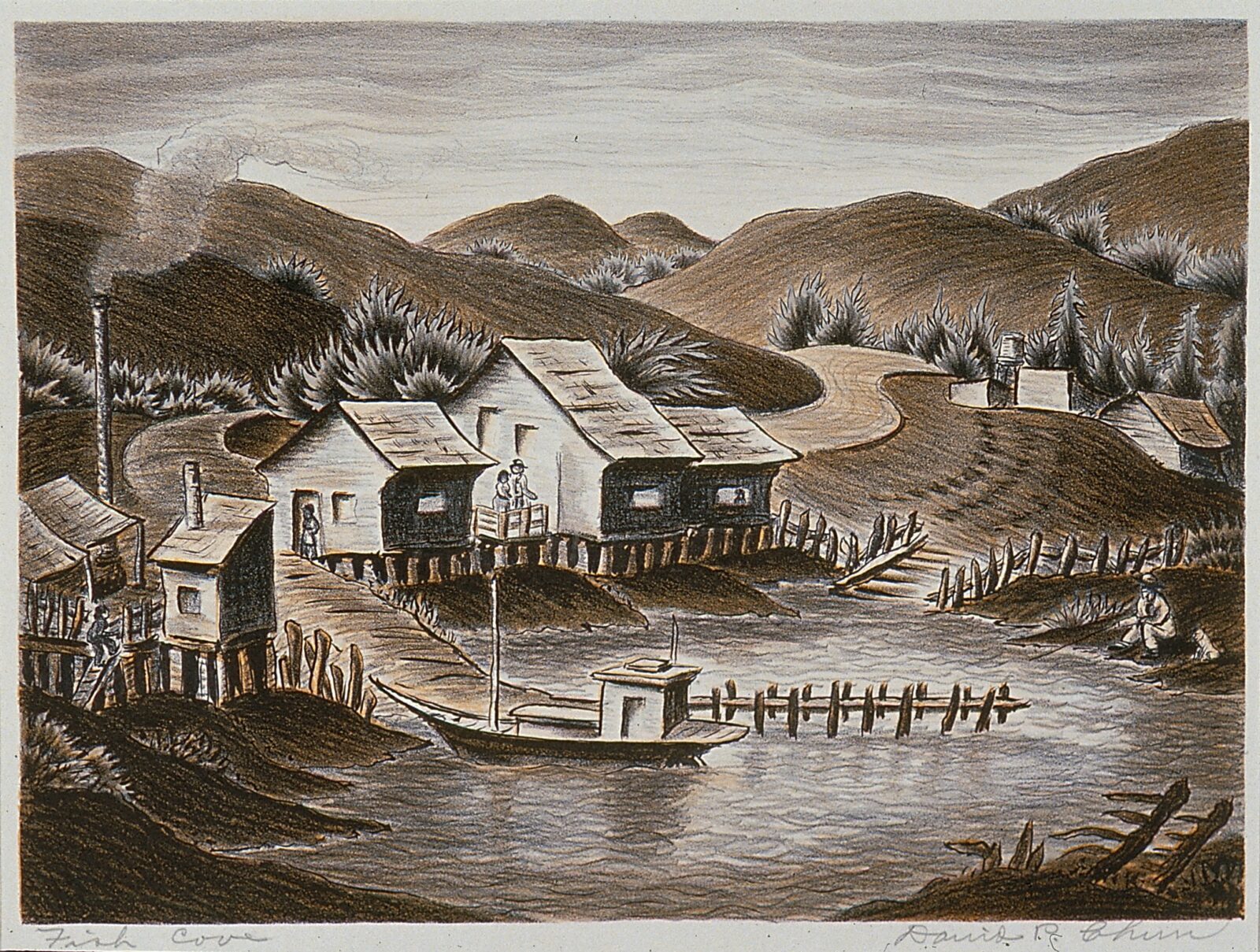
David P. Chun, American, 1898–1989; Fish Cove, 1939 or 1940; color lithograph, printed in black, orange, and blue inks from three stones, with crayon and tusche; image: 7 15/16 x 10 7/8 inches sheet: 11 15/16 x 14 1/8 inches; Saint Louis Art Museum, Gift of the Federal Works Agency, Work Projects Administration 174:1943
Color lithography was another technique popularized during the FAP. In 1937, the Graphic Arts Division established a color lithography unit in the New York City workshop. The technique had been used in Europe for fine-art prints since the early 19th century but was not used widely in the United States. Prior to the 1930s, lithography was principally used as a commercial printing method to create labels and ads. Through the advocacy of Russell T. Limbach, who was a technical advisor for the New York City workshop, color lithography entered the realm of fine-art printing.
Lithography relies on the chemical principle that water and oil repel each other. The technique attracted artists for its ease of use, because the drawing was laid directly on the plate. Tracing was traditionally done on limestone using an oily material, such as lithographic crayon or tusche, an oily ink. The stone was then etched with a mixture of chemicals, which enabled the exposed areas to retain water. The image drawn on the stone with litho crayon or tusche was then removed with turpentine. A wet rag was then passed over the surface of the stone. When an oil-based ink was applied, it was repelled by the water and stuck to the design. Color lithography relies on the same principles, but each additional color to be printed necessitates a different stone. Under magnification, each color can be seen separately.
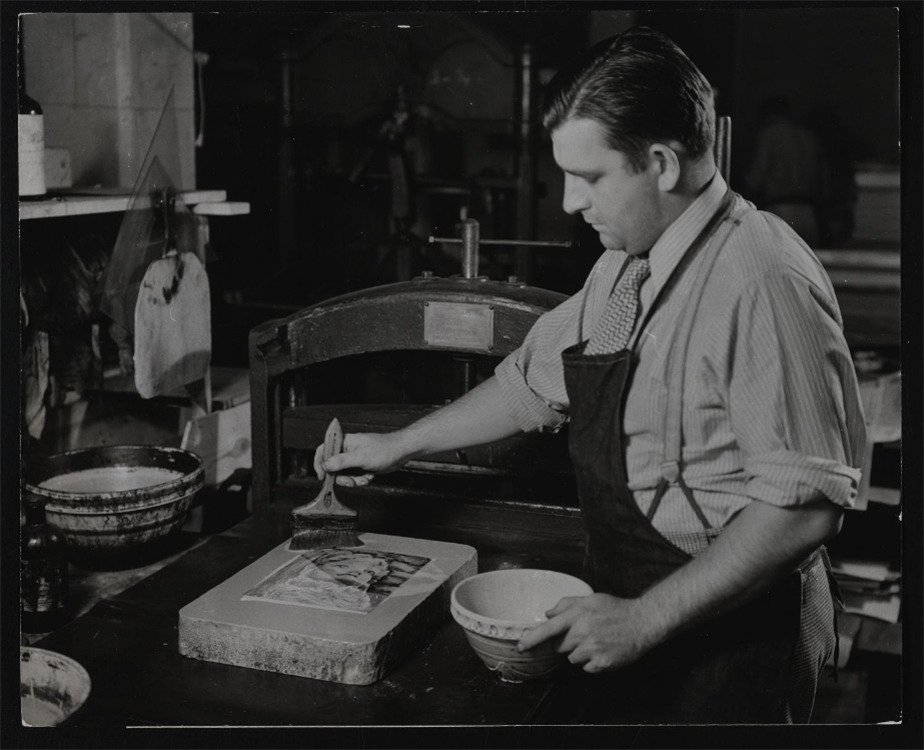
Archives of American Art, Smithsonian Institution Washington, D.C, Federal Art Project, Photographic Division collection, circa 1920-1965, bulk 1935-1942

Archives of American Art, Smithsonian Institution Washington, D.C, Federal Art Project, Photographic Division collection, circa 1920-1965, bulk 1935-1942
The Graphic Arts Division of the FAP was instrumental in the birth and development of modern and contemporary printmaking in the United States. Its influence ultimately led to the creation of contemporary print workshops like Tamarind Institute, Universal Limited Arts Editions (ULAE), Gemini G.E.L., Crown Point Press, and many others that have significantly impacted the print world from the 1960s onward.