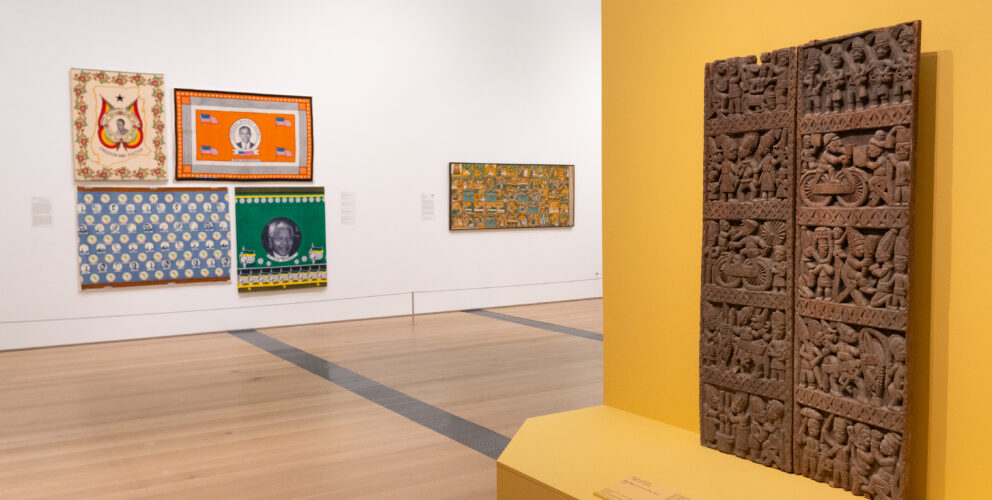
Installation view of Denkinesh: Birth on the Ground, Climbing, Standing 2016; © Aida Muluneh, Courtesy of David Krut Projects

In the first panel of Denkinesh: Birth on the Ground, Climbing, Standing, a pool of red cloth contrasts sharply with a bed of gray rocks.
The triptych, or three-part series of photographs, by Aïda Muluneh was acquired recently by the Saint Louis Art Museum and is featured in the closing gallery of Narrative Wisdom and African Arts, on view through February 16.
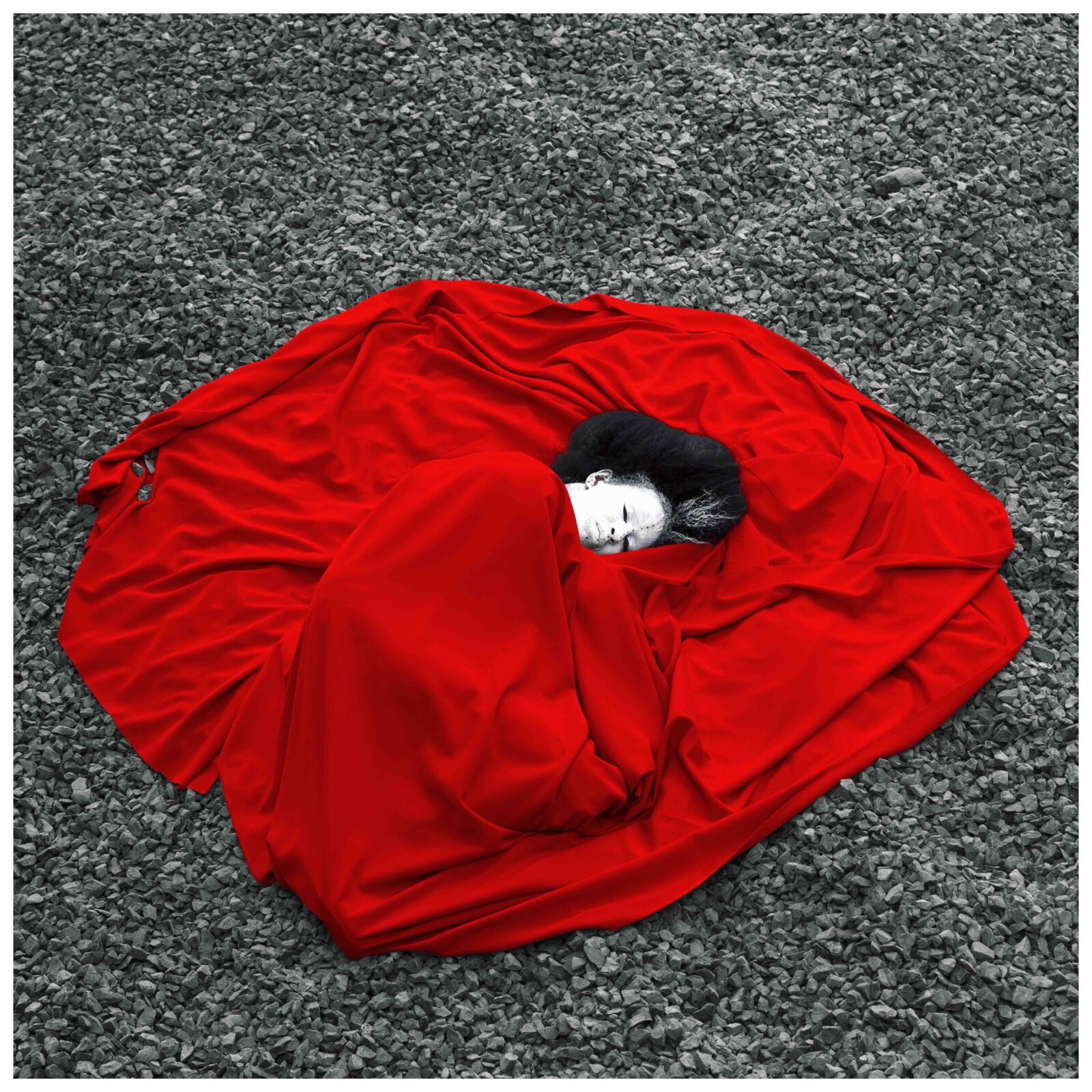
Aïda Muluneh, Ethiopian, born 1974; Denkinesh: Birth on the Ground, 2016; archival digital print; 31 1/2 x 31 1/2 inches; Saint Louis Art Museum, Friends Endowment Fund and funds given by Adrienne D. Davis 60:2024a; © Aida Muluneh, Courtesy of David Krut Projects
Barely discernable at center of the first panel lies a body in fetal position. Nearly disembodied from the curled corpus, a face with a shock of black and gray hair and starkly painted white skin sits like a stone atop the spread of red. Fragments of a body—a shoulder, an elbow—poke into the cloth.
Fragments are all we have of the artwork’s namesake, a 3.2-million-year-old partial skeleton called Denkinesh in Amharic. The public narrative about humanity’s past changed forever when, in 1974, a team of American and Ethiopian paleoanthropologists unearthed Denkinesh, referred to as AL 288-1 in scientific journals and in Western media as Lucy. Further research on Denkinesh led scientists to conclude that the remains belonged to Australopithecus afarensis, one of the oldest known species of hominin to share common ancestors with modern humans.

Aïda Muluneh, Ethiopian, born 1974; Denkinesh: Climbing, 2016; archival digital print; 31 1/2 x 31 1/2 inches; Saint Louis Art Museum, Friends Endowment Fund and funds given by Adrienne D. Davis 60:2024b; © Aida Muluneh, Courtesy of David Krut Projects
The central image in the triptych features the same figure, this time climbing. The same splash of scarlet conceals the figure’s body and remains close to the earth. Besides hair, all we see of the person underneath is one painted arm holding fast to the pebbled ground. Here, Denkinesh is no longer earthbound, but not yet upright. In these photographs, Muluneh gives a face, a body, and a visual narrative to the world-famous ancestor—illustrating the in-between. From within the earth, she rises. From hands and knees, she stands.
One of the significant conclusions drawn from the modern discovery of A. afarensis was that even millions of years ago, hominins stood upright, one of the features by which we separate contemporary human beings from our primate counterparts. With a modern human model as her reimagined Denkinesh, Muluneh asks us to reconsider the categories of human, animal, nature, and culture, and each of those categories’ connections to land. If standing upright doesn’t distinguish us from early hominins, perhaps culture, as signified by paint and cloth in Muluneh’s images, does. Or perhaps these binaries are less rock-solid than they seem: We are all united by living life on Earth.

Aïda Muluneh, Ethiopian, born 1974; Denkinesh: Standing, 2016; archival digital print; 31 1/2 x 31 1/2 inches; Saint Louis Art Museum, Friends Endowment Fund and funds given by Adrienne D. Davis 60:2024c; © Aida Muluneh, Courtesy of David Krut Projects
In the final frame, the figure stands erect and meets the viewer’s gaze. Mirroring the rise of the land below, the figure’s robe billows in the wind. Finally, Denkinesh meets our gaze.
In addition to posture, position partners us with A. afarensis. Although millions of years separate us, we walk the very same earth that Denkinesh once graced. Ground and sky propel Muluneh’s narrative of Denkinesh’s evolution, but they are also characters themselves. Only Denkinesh and the earth are visible in the first panel, but in each successive image, ground cedes a bit more real estate to sky. In the final panel, yet another element of the climate establishes its relevance in the form of the wind pushing Denkinesh’s robe up and out. The centrality of Earth in this version of Denkinesh’s narrative emphasizes the importance of the landscape connecting us all.
This information was adapted from the author’s essay “Grounded Narratives,” which appears in the exhibition catalogue Narrative Wisdom and African Arts. The catalogue considers ways in which historical and contemporary African arts make visible narratives rooted in collective and individual memory and knowledge. It is available for purchase online and in Museum shops.
Elyse Dianne Schaeffer is a former research assistant for SLAM’s department of arts of Africa, Oceana, and the Americas.