Decorative Arts and Design gallery installation view.
SLAM’s collection of timepieces dates back hundreds of years. Incorporating style and function, the works showcase a vast assortment of time-telling technology ranging from early 1700s Iran to mid-20th-century Michigan. They include a wide array of items including an astrolabe—a device considered the world’s first computer—and more recognizable hanging wall clocks. While they vary by size and shape, these objects align in function. Continue reading for highlights from SLAM’s collection of timepieces.
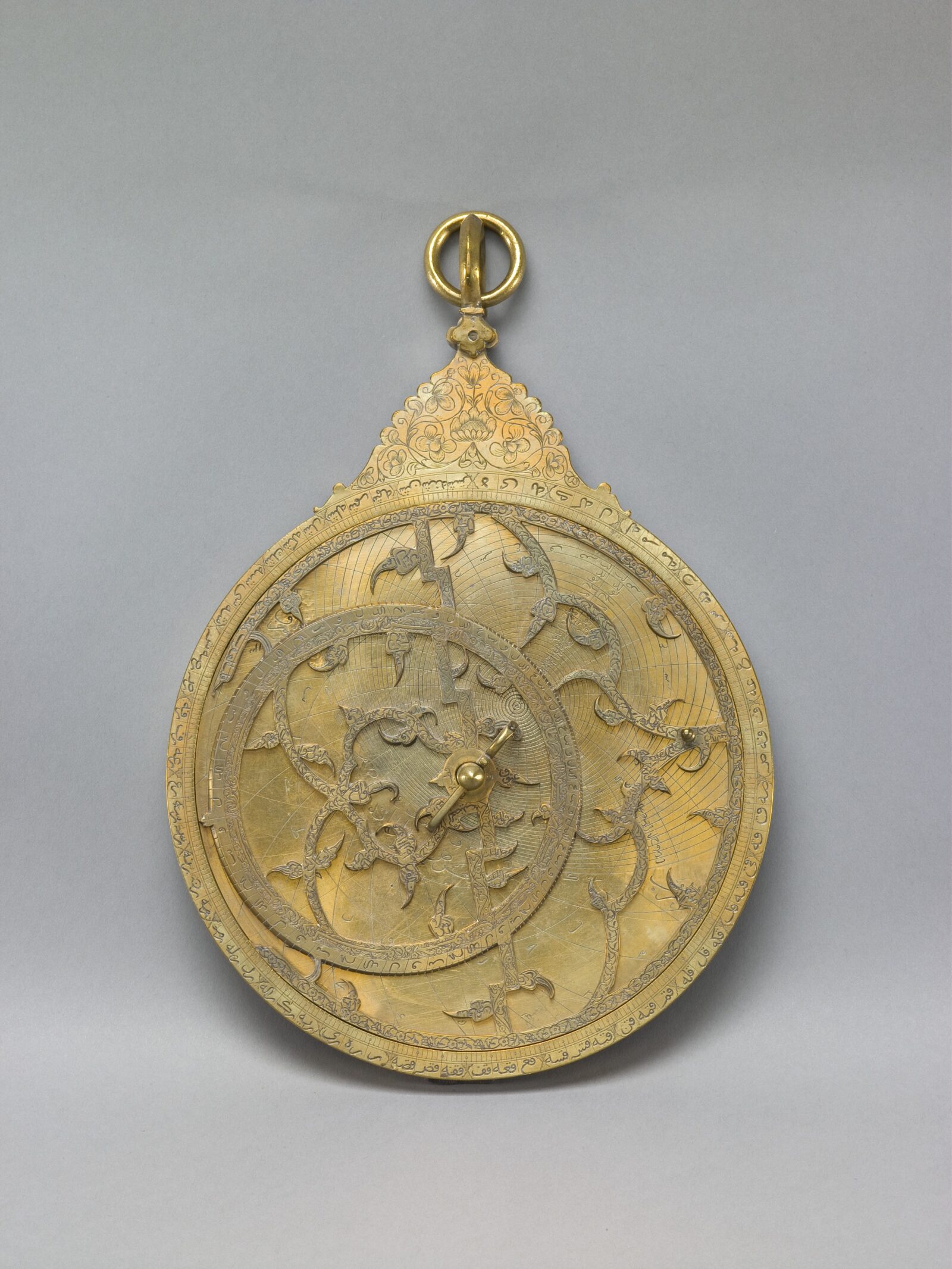
Made by Mohammad Amin ibn Mohammad Taher, Persian, active early 18th century; decorated by Abd al-A'immah, Persian, active early 18th century; Planispheric Astrolabe, 1715; brass; 11 1/8 x 7 1/4 x 1 3/8 inches; Saint Louis Art Museum, Museum Purchase 41:1926
Planispheric Astrolabe
This object was made by Mohammad Amin ibn Mohammad Taher and decorated by Abd al-A’immah, two famous astrolabe makers who worked both together and separately in the Iranian city of Isfahan. Astrolabes are a portable model that uses a stereographic projection to represent the three-dimensional night sky. They utilize the position of the stars in relation to where the person is standing to measure the date and time, among many other calculations.
The brass device is exact in scientific detail and contains the required inscriptions and tables without adding anything unnecessary. The front of the instrument contains a movable star chart with 42 leaves pointing to the stars. Thirty nested circles, beginning with the horizon and reaching the point of the zenith (the highest point), indicate circles of equal altitude on the sky, each three degrees higher than the one outside it. Additional arcs on the plate divide the sky in azimuth (a specialized measurement used in astronomy and navigation), and below the horizon, parts of still more circles display the equal and unequal hours used for time reckoning. The entire back surface of the astrolabe combines calligraphy with a compact assortment of astronomical graphs and tables.
This work is on view in Gallery 120.
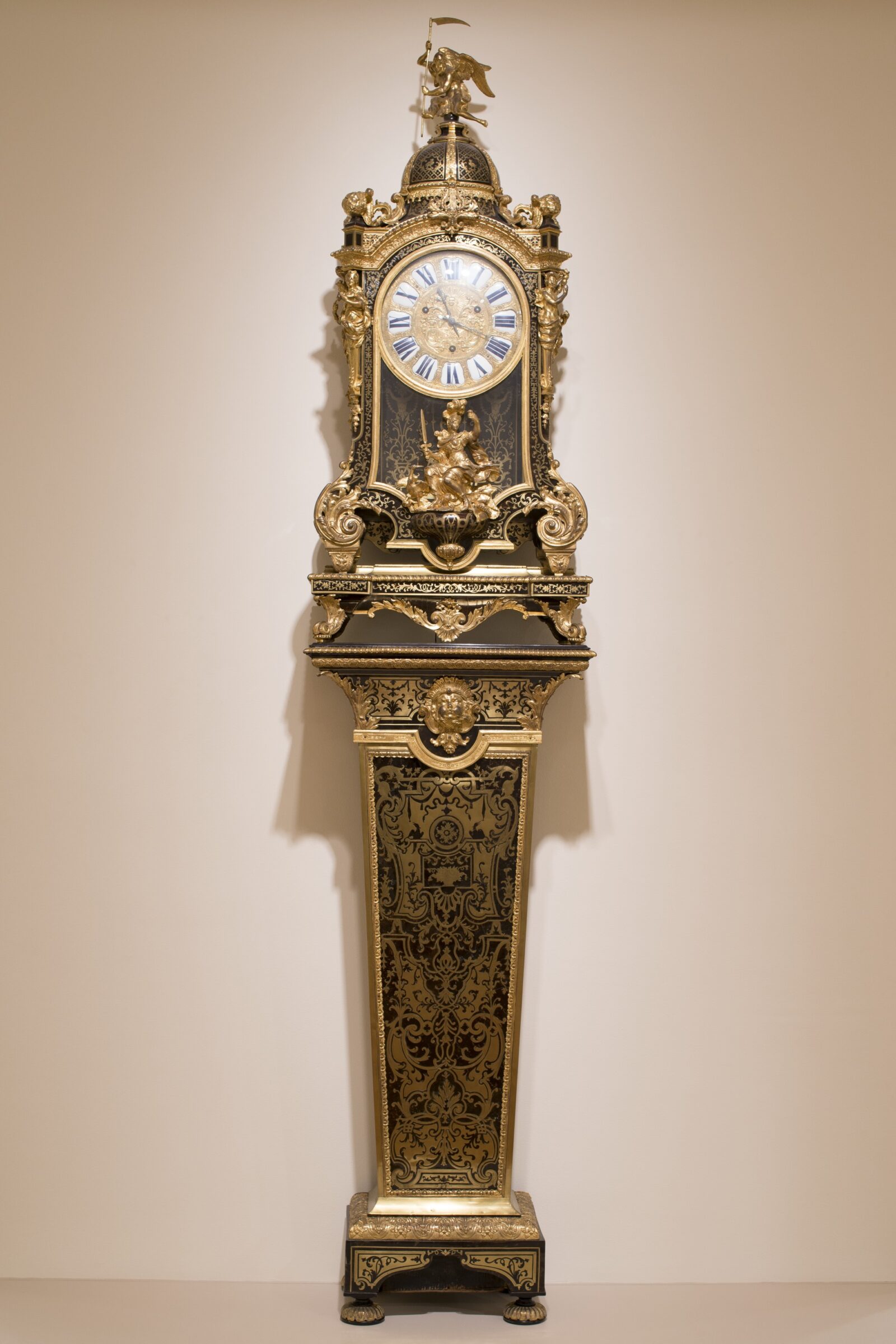
Movement by Jean Godde, French, 1668–1748; Clock and Pedestal, c.1710–20; gilded bronze, brass, tortoiseshell, ebony, wood, glass, and enamel; 99 3/8 x 21 3/8 x 12 inches; Saint Louis Art Museum, Friends Endowment Fund 32:1989a-g
Clock and Pedestal
Roman architecture and mythology inspired the design and decoration of this elaborate clock and its pedestal. At the top of the dome, a bearded man carries a scythe, symbolic of the concept of Time. Beneath the dial’s Roman numeral XII is the sun, a reference to Apollo, god of light, in addition to the Sun King, Louis XIV of France. Minerva, goddess of wisdom, is shown below the clock’s face with a crane, representative of her vigilance.
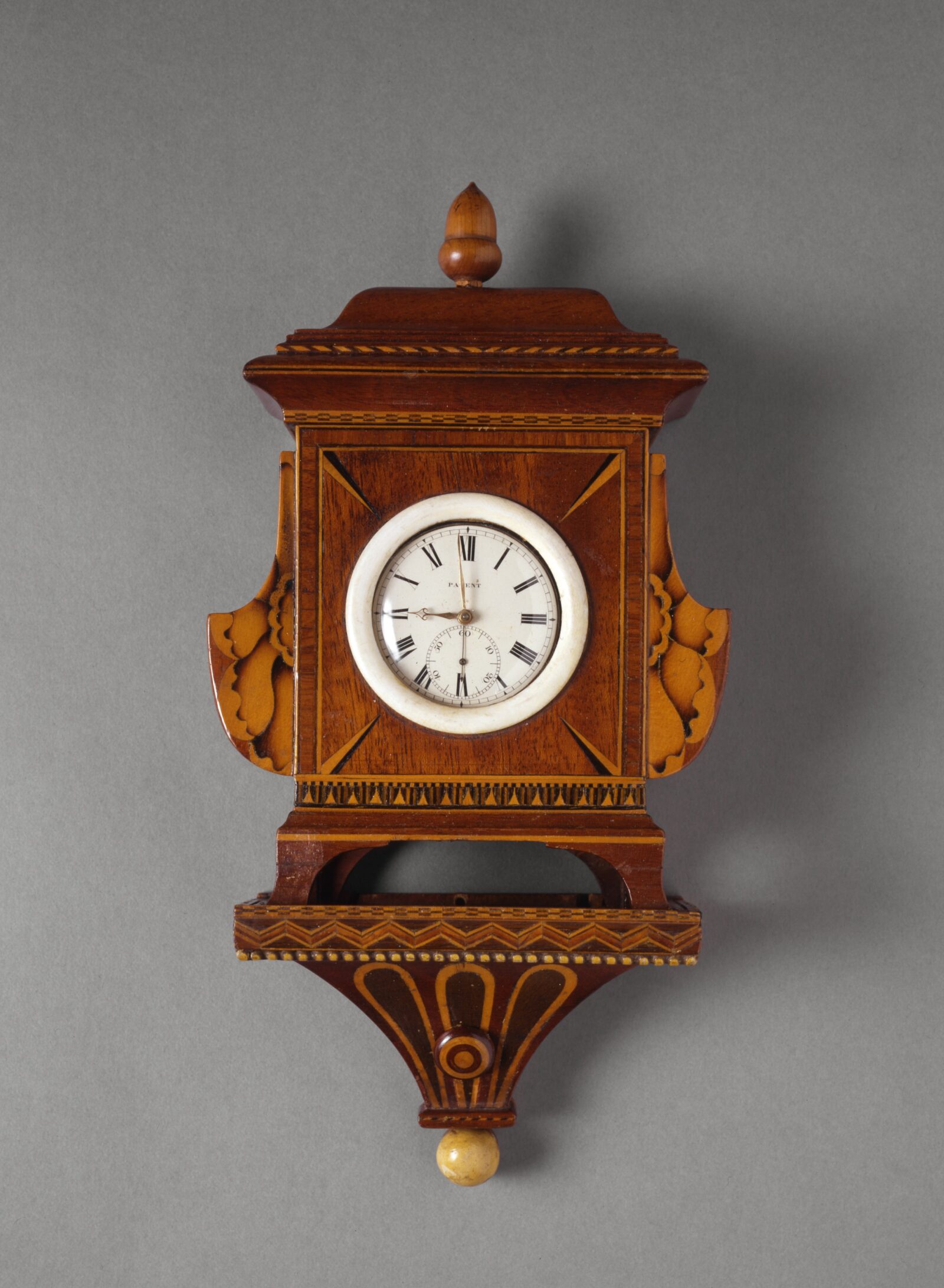
possibly David Poignand, American (born England), 1759–1830; Watch Holder with Bracket, c.1790–1800; mahogany, holly, and other wood inlays, ivory, composition, and brass; 10 3/4 x 5 1/4 x 2 1/4 inches; Saint Louis Art Museum, Bequest of Nellie V. Plant in memory of her husband, Frederick S. Plant, the great grandson of David Poignand 31:1936a,b
Watch Holder with Bracket
Inlaid strings, dark and light compass points, and fanlike patera motifs ornament this case for a pocket watch. An ivory circle frames the watch face, and the shelf is trimmed with a strip of ivory carved with tiny beads. The sphere at the base of the shelf, made of a plaster-like material, may be a replacement for an element that was originally made of ivory.
This work is on view in Warren and Jane Shapleigh Gallery 137.

Made by Simon Willard, American, 1753–1848; and James Wilson, English, 1755–1809; Tall Clock, c.1800; mahogany, white pine, brass, and glass; 87 3/4 x 20 3/8 x 9 7/8 inches; Saint Louis Art Museum, Museum Purchase 208:1931
Tall Clock
This timepiece was made in response to the late-18th-century interest in the arts of ancient Greece and Rome. With its round-arched top with open fretwork, floral motifs, and ball-and-spire brass finials, this clock is in the Classical Revival style.
The Classical Revival style emerged in Europe in the 1760s and 1770s, inspired by the discovery of ancient Roman architecture and artifacts at sites in Italy earlier in the century. In the United States, Classical Revival was the predominant style in the decorative arts between about 1785 and 1840.
This work is on view in Warren and Jane Shapleigh Gallery 137.

Antoni Gaudí, Spanish, 1852–1926; Wall Clock, from the Casa Milà, Barcelona, Spain, c.1909; gilded wood and plaster, brass, and metal; 51 x 18 x 7 inches; Saint Louis Art Museum, Richard Brumbaugh Trust in memory of Richard Irving Brumbaugh and in honor of Grace Lischer Brumbaugh, and funds given by the Pulitzer Publishing Foundation, Mr. and Mrs. William R. Orthwein, the Decorative Arts Society, Mrs. Charles W. Lorenz, Mr. and Mrs. David Mesker, Roxanne H. Frank, Nancy and Kenneth Kranzberg, Mrs. Eleanor J. Moore, Jane and Warren Shapleigh, donors to the 1996 Art Enrichment Fund; and Museum Purchase, by exchange 2:1997
Wall Clock, from the Casa Milà, Barcelona, Spain
For his Casa Milà apartment building in Barcelona, Antoni Gaudí designed furnishings, ceramic floor tiles, and wrought iron window grilles that complemented his sculptural treatment of the building. Many of these forms were inspired by aquatic themes; unlike some of his contemporaries, Gaudí did not copy nature but sought its essences. This clock is one of several similar versions made for the Casa Milà. Like the building’s undulating facade, the clock appears as a malleable mass, stretched downward by the pull of gravity. Its asymmetrical distortions create an illusion of movement: The clock could, in fact, be a commentary on time, and even on life itself.
This work is on view in Gallery 135.
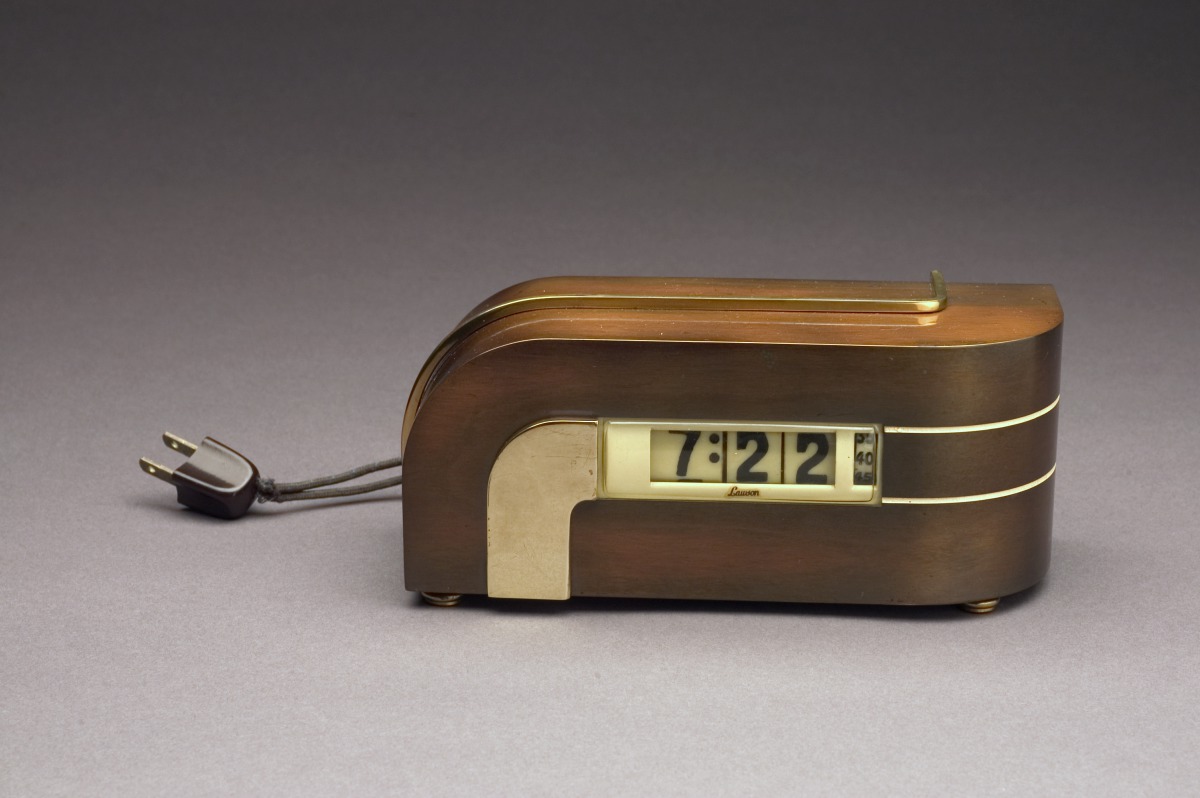
Designed by Paul Ferher, American (born Hungary), 1898–1990; and George F. Adomaitis, American, 1907–1982; made by Lawson Time Inc., Alhambra, California, active 1934–c.1941; Zephyr Electric Clock, 1934; brass, copper, Bakelite, and plastic; 4 x 9 x 5 inches; Saint Louis Art Museum, Gift of John Roslevich 77:2005
Zephyr Electric Clock
This sleek digital clock, named after the gentle, westward wind, was designed by Paul Ferher (1898–1990) and George F. Adomaitis (1907–1982). It features brass decoration on its face and top, with two horizontal stripes reaching from the right side of the clock window and curving around the side of the object. The hours and minutes are visible through the clock window; the numbers are on flat yellow blocks that turn to convey the changing time. The seconds, however, pass on a round, rotating dial.
The streamlined aesthetic of this clock, a style born from the optimistic and hopeful style of architecture that emerged after the Great Depression, was ideal for softening the mass of mechanisms found in appliances.
This work is on view in Gallery 135.
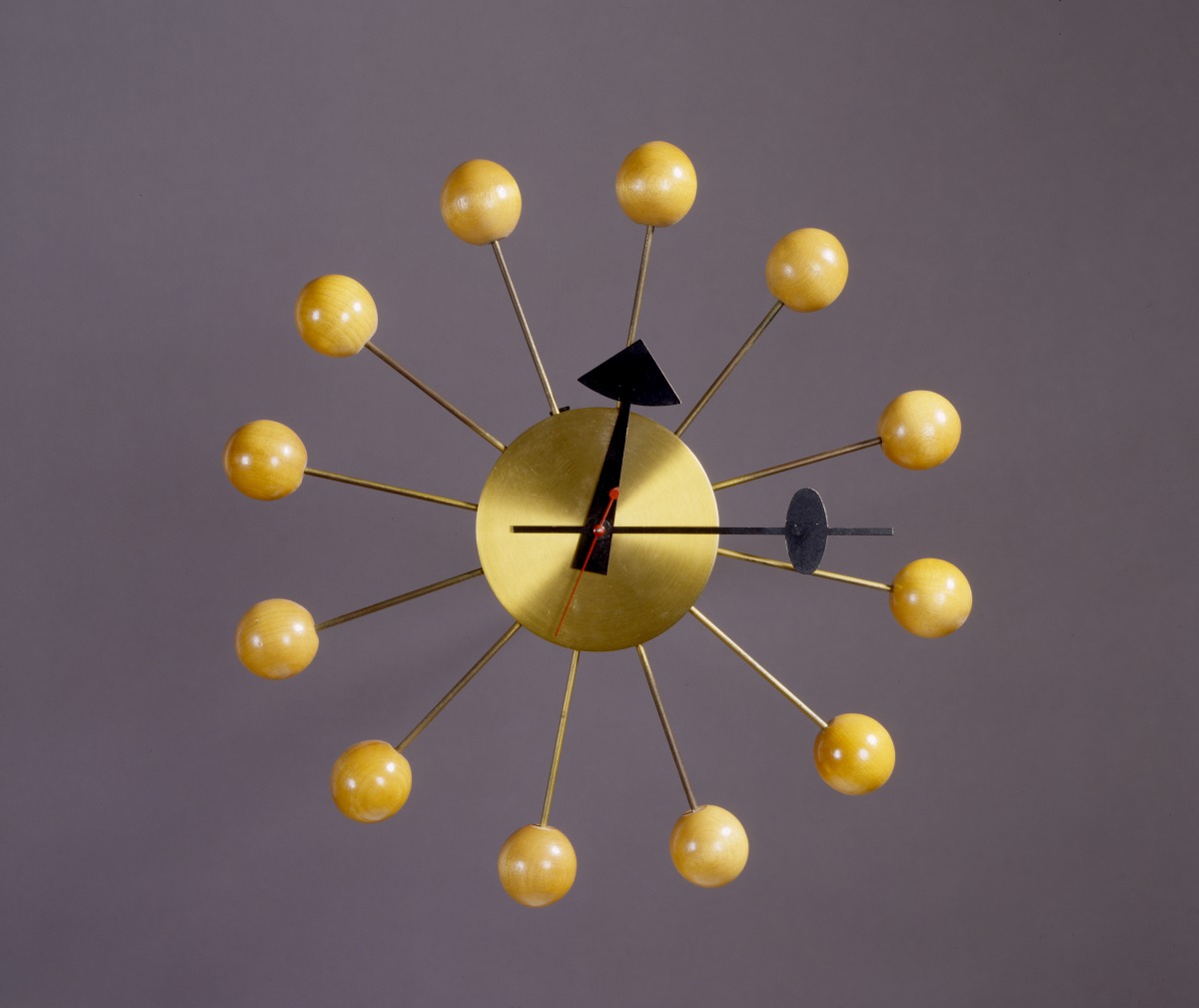
designed by George Nelson, American, 1908–1986; made by Howard Miller Clock Company, Zeeland, Michigan, founded 1937; Atomic Wall Clock, 1949; brass, steel, and birch; diameter: 13 1/2 inches; Saint Louis Art Museum, Museum Purchase, by exchange 46:1994
Atomic Wall Clock
Twelve brass rods extend from the brass centerpiece of this whimsical wall clock. Each rod is topped with a lacquered birch ball. The hour hand resembles an arrow, the minute hand a metronome, and the red second hand stays within the bounds of the centerpiece.
Clock designs by George Nelson for the Howard Miller Clock Company were considered radically modern due to their absence of both a clock face and numbers. The wall surface was to substitute for the traditional face, which in turn permits one to view the clock as part of the architecture of the room.