Alphonse Mucha, Czech (active France), 1860–1939; printed by F. Champenois, Paris, France; French Poster Advertising the St. Louis 1904 Exposition (detail), 1903; color lithograph; 41 3/8 x 29 inches; Saint Louis Art Museum, Funds given in memory of David R. Francis, President, Louisiana Purchase Exposition, 1904, by his granddaughter Miss Alice P. Francis 40:1969

The Palace of Fine Arts, now home to the Saint Louis Art Museum, had 11,000 works of art on display during the 1904 Louisiana Purchase Exposition. By comparison, SLAM today typically has around 2,400 works on view at any given time (around 6 percent of the Museum’s current collection of more than 38,000 pieces).
At the World’s Fair, the central Cass Gilbert-designed building housed American art, while the two adjoining, temporary wings were given over to art from 26 other countries. Most of the works were considered contemporary at the time, meaning they were made in the previous ten years.
Of that massive number of artworks on view 120 years ago, around two dozen works with ties to the fair have made their way back to SLAM over the decades. Some even remain staples of the collection galleries. Here’s a selection of the works at the Museum that have St. Louis World’s Fair connections:
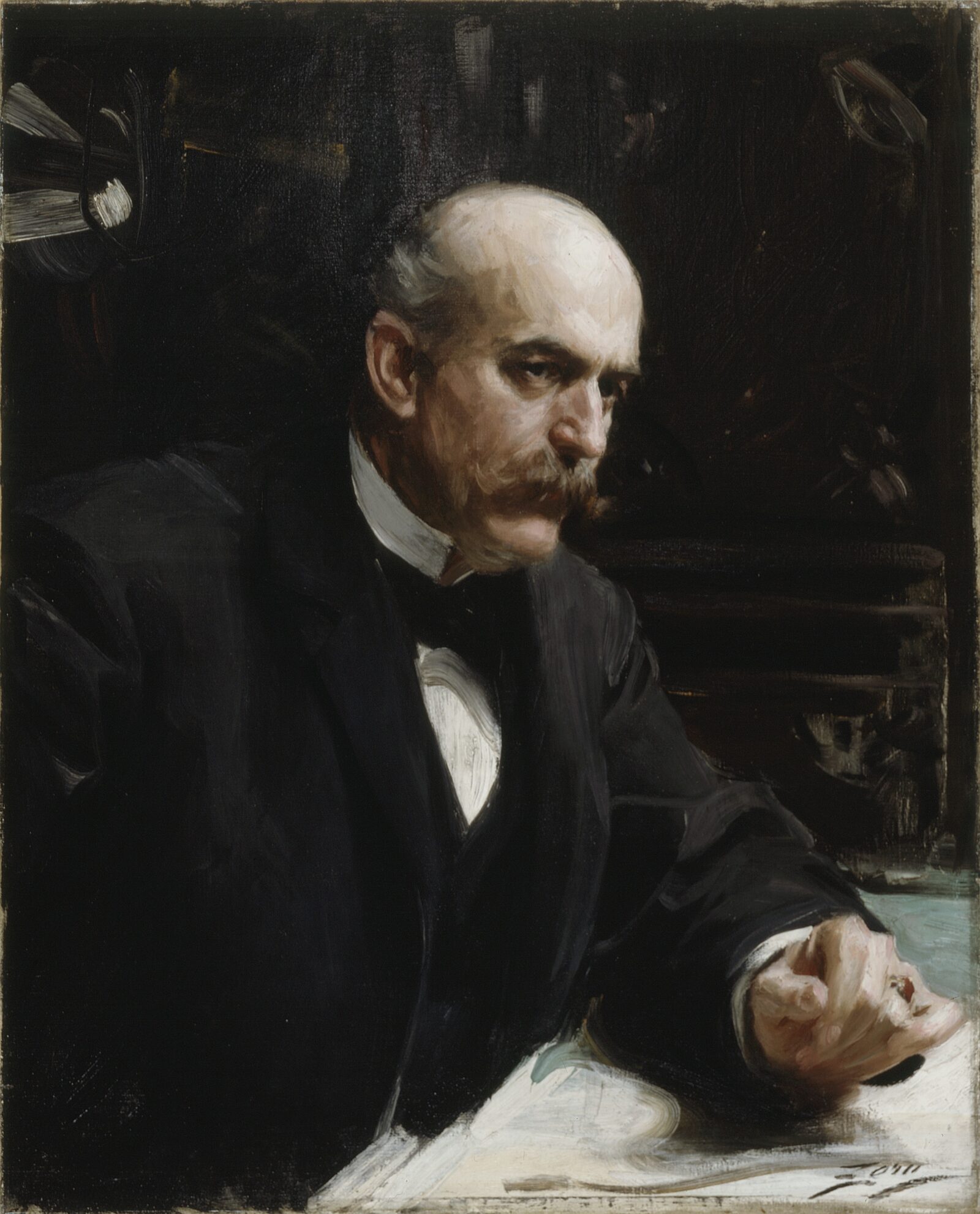
Anders Leonard Zorn, Swedish, 1860–1920; Halsey Cooley Ives, 1894–95; oil on canvas; 32 x 26 inches; Saint Louis Art Museum, Gift of Peggy Ives Cole 1828:1981
Halsey Cooley Ives
On view in Alice and Fred Conway Gallery 217, this portrait of Halsey Ives was painted by Swedish artist Anders Leonard Zorn. Ives was the founding director of the St. Louis School and Museum of Fine Arts, which would eventually become the Saint Louis Art Museum, and he served as chief of the art department at the St. Louis World’s Fair, a position he also held around 10 years prior at the Chicago World’s Fair.
The internationally known portraitist Anders Zorn painted Ives on a visit to St. Louis in the mid-1890s, when he also represented several prominent members of local society. The artist’s animated brushwork demonstrates the influence of French Impressionism upon his technique.
The painting was a gift to the Museum in 1981 by Peggy Ives Cole, the granddaughter of the subject.

John Donoghue, American, 1853–1903; cast by Gorham Manufacturing Company, Providence, Rhode Island, founded 1831; Young Sophocles, 1885; cast 1915; bronze; 91 x 50 x 22 1/4 inches; Saint Louis Art Museum, Museum Purchase 21:1915
Young Sophocles Leading the Chorus of Victory After the Battle of Salamis
This bronze sculpture of Sophocles was made in 1915 from a plaster version that was displayed at the Louisiana Purchase Exposition as well as at the 1893 fair in Chicago. The plaster work was made by American artist John Donoghue. The Museum purchased the bronze work in 1915 from the Gorham Manufacturing Company in Rhode Island.
The 7.5-foot-tall sculpture depicts Sophocles, the Greek dramatist of tragedy, after the Athenians defeated the Persians in sea combat in the Battle of Salamis in 480 BC. Sophocles was 16 at the time, and because of his musical abilities, he was chosen to lead the chorus of victory. He is depicted with his mouth open in song and playing a lyre.
The sculpture was once installed in a niche on the northeast side of the Museum facade. However, it was damaged by vandals in the 1960s. Despite some abrasions and part of the lyre breaking, it remained in the niche until the 1980s when it was removed for the installation of new windows.

Diné (Navajo) artist; Chief-Style Blanket, Second Phase, c.1880; wool and dye; 55 1/4 x 71 1/4 inches; Saint Louis Art Museum, Gift of Elissa and Paul Cahn 221:2017
Chief-Style Blanket, Second Phase
In this blanket made by a Diné (Navajo) artist, charcoal-gray bars and dashes float on a red ground, establishing massive, patterned bands that balance against the dominant white-and-black stripes. Diné peoples traded blankets like this one with neighbors in the Pueblos of Pecos and Taos, centers for Native trade networks. Starting in the 1820s, American traders also transported blankets from the Southwest to a series of commercial forts across the Plains. By the late 19th century, when the railway brought waves of travelers to the Southwest territories, these blankets circulated in the developing national market for Native art.
Thomas Dozier, an art and curio dealer based in the rail town of Española, New Mexico, displayed this blanket at the fair in 1904. It was later gifted to the Museum in 2017.

Jules Breton, French, 1827–1906; The Wounded Seagull, 1878; oil on canvas; 36 1/2 x 30 3/8 inches; Saint Louis Art Museum, Gift of Justina G. Catlin in memory of her husband, Daniel Catlin 27:1917
The Wounded Seagull
On view in Jordan Charitable Foundation Gallery 207, this 1878 painting by Jules Breton was shown in 1881 at the first special exhibition at the newly founded St. Louis School and Museum of Fine Arts, the predecessor of the Saint Louis Art Museum. It was later on view in the Palace of Fine Arts at the 1904 World’s Fair and was gifted to the Museum in 1917.
Breton regularly visited the coastal region of Brittany in the west of France and here represented an idealized Breton peasant in profile against the wind. The artist was fascinated by the “mystic wildness” of Breton women and focused on this peasant’s compassion for a wounded bird while other healthy birds glide in the distance.

designed by William Day Gates, American, 1852–1935; probably modeled by Fritz Albert, American (born France), 1865–1940; made by Gates Potteries, Terra Cotta, Illinois, active 1881–1966; Vase, c.1903–4; glazed earthenware; 27 x 12 inches; Saint Louis Art Museum, Lopata Endowment Fund, the E. Reuben and Gladys Flora Grant Charitable Trust, Richard Brumbaugh Trust in memory of Richard Irving Brumbaugh and Grace Lischer Brumbaugh, and Dr. and Mrs. Matthew Newman in memory of Susan Lorenz 2:2004
Vase
This vase and another formed a pair exhibited in the Palace of Fine Arts. It was designed by American William Day Gates and likely modeled by Fritz Albert in 1903–04. The vase has extensively modeled and hand-tooled surfaces with Native American portraits and strapwork designs in the style of architect Louis Sullivan. The pattern of fleurs-de-lis around body of the vase probably refers to St. Louis’s French heritage and the Louisiana Purchase.
On view in Gallery 129, the vase was purchased by the Musem in 2004 through an endowment fund.
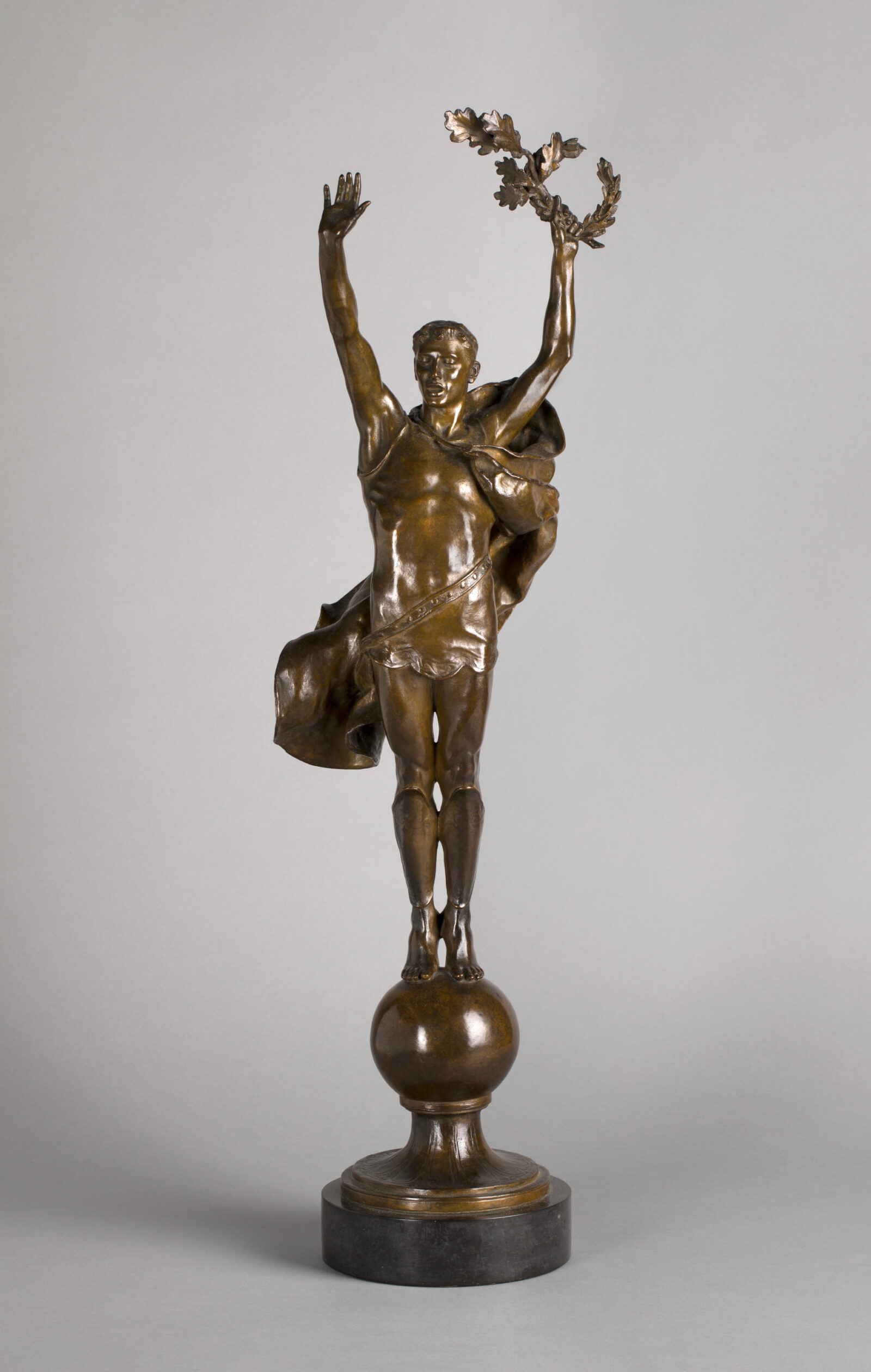
Evelyn Beatrice Longman, American, 1874–1954; cast by Roman Bronze Works, New York, New York, active 1897–1980s; Victory, 1903; cast by 1913; bronze; 28 1/2 x 8 1/2 x 7 1/8 inches; Saint Louis Art Museum, Museum Purchase 25:1913
Victory
This statuette is a reduction after a monumental version of Victory that was installed on top of Festival Hall at the World’s Fair. Artist Evelyn Beatrice Longman’s statue was a focal point of the fairgrounds and launched her career. This 28.5-inch-tall bronze replica statuette was cast by 1913 and purchased by the Museum from the National Sculpture Society. There were at least 35 replicas cast by the Roman Bronze Works in New York.
The sculpture presents a man standing with both feet on a sphere. His arms are raised above his head, and he holds a wreath of laurel and oak leaves in his left hand.

Frank Dillon, English, 1823–1909; The Colossal Pair, Thebes, 1856; oil on canvas; 25 x 72 1/4 inches; Saint Louis Art Museum, Gift of J. Lionberger Davis, Count Cecil Charles Pecci-Blunt, and Mrs. Eugene A. Perry in memory of her mother, Mrs. Claude Kilpatrick, by exchange 67:1989
The Colossal Pair, Thebes
On view in Pauline Gehner Mesker Gallery 205, this painting by English artist Frank Dillon captures the grand statues of the pharaoh Amenhotep III and his wife, which still stand on the plain of Thebes (where the modern town of Luxor now stands) in Egypt. A sense of desolate solitude is heightened by the inclusion of a camel’s skeleton in the foreground. Dillon produced this painting in 1856 shortly after his first visit to Egypt. The frame is original to the picture and is decorated with orbs and eagles’ wings at the center and corners.
Its inclusion in the Palace of Fine Arts display is unclear, though. According to the fair catalogue, the title of the Dillon work shown in 1904 was The Two Memnons, Thebes, which is the same subject as the SLAM work. Dillon created at least three paintings on the subject and SLAM’s appears to be his earliest and most ambitious treatment of the theme. However, it’s unknown if The Two Memnons, Thebes and The Colossal Pair, Thebes are the same painting.
The painting returned to the Museum in 1989.

Bessie Potter Vonnoh, American, 1872–1955; fabricated by Roman Bronze Works, New York, New York, active 1897–1980s; A Young Mother, 1896; bronze; 14 1/4 x 12 1/4 x 15 1/2 inches; Saint Louis Art Museum, Given in memory of Henry B. Pflager from his friends and wife, Katherine King Pflager, by exchange 134:1985
A Young Mother
A cast of this sculpture was exhibited at the World’s Fair, though not necessarily this cast. The bronze piece on view in Anheuser-Busch Foundation Gallery 335 was made by St. Louis native Bessie Potter Vonnoh in 1896. Potter Vonnoh served on the International Jury of Awards (for paintings drawings) and also won a gold medal for sculpture at the fair. A portrait of Bessie by her husband Robert W. Vonnoh was also featured at the fair.
The book Illustrations of the Selected Works in the Various National Sections of the Department of Art of the fair states, “Mrs. Vonnoh is represented in the division of sculpture by some of the most charmingly artistic works in the exposition.”
A Young Mother was given to the Museum in 1985.
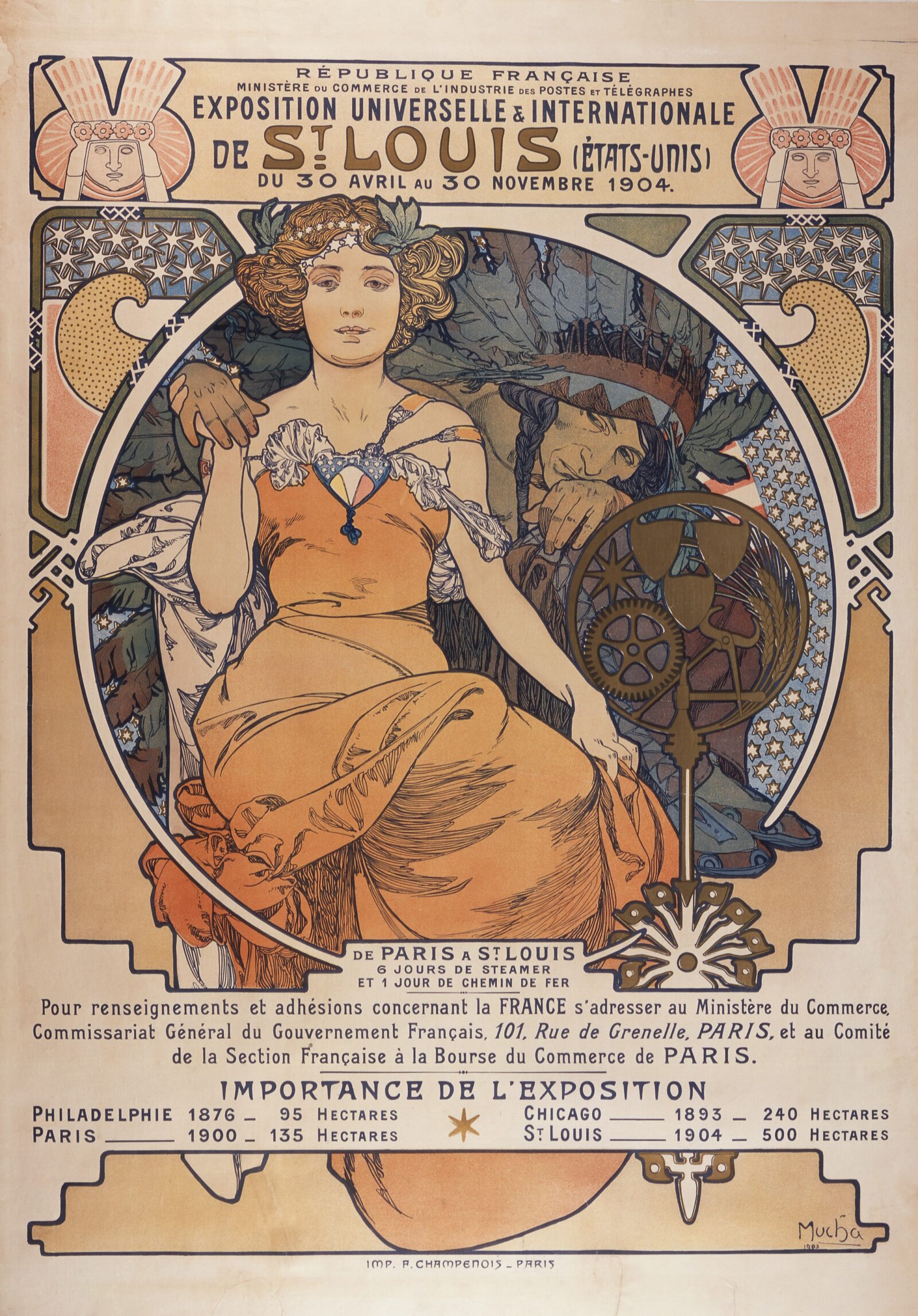
Alphonse Mucha, Czech (active France), 1860–1939; printed by F. Champenois, Paris, France; French Poster Advertising the St. Louis 1904 Exposition, 1903; color lithograph; 41 3/8 x 29 inches; Saint Louis Art Museum, Funds given in memory of David R. Francis, President, Louisiana Purchase Exposition, 1904, by his granddaughter Miss Alice P. Francis 40:1969
French Poster Advertising the St. Louis 1904 Exposition
In 1903, artist Alphonse Mucha designed this poster to promote trips from Paris to St. Louis for the World’s Fair that celebrated the 100-year anniversary of the Louisiana Purchase. Two allegorical figures stand in for abstract ideas, contrasting the form of a young white settler woman portraying progress with an Indigenous man representing a dying past. Such visual representations of American territorial expansion ignore the survival of sovereign Indigenous nations.
Funds were given to purchase the work in 1969 in memory of David R. Francis, president of the Louisiana Purchase Exposition, by his granddaughter Miss Alice P. Francis.

Frederick Oakes Sylvester, American, 1869–1915; The Bridge, 1903; oil on canvas; 38 1/4 x 48 inches; Saint Louis Art Museum, Gift of Robert R. Corbett 8:1981
The Bridge
This horizontal landscape shows the Eads Bridge in St. Louis at night. It was painted in 1903 by Frederick Oakes Sylvester, showing an orange and yellow sunset against the dark evening sky. The bridge is reflected in the smooth waters below. The halos of streetlamps lining the bridge are visible, and smokestacks from factories in the distance emit billows of gray smoke into the air at left. The bridge itself opened on July 4, 1874, connecting St. Louis, Missouri, and East St. Louis, Illinois. The painting was gifted to the Museum in 1981.
A catalogue of works displayed at the fair lists only paintings titled Moonlight on the River and The River, both by Sylvester; The Bridge is not included. However, the painting itself has an official label from the fair on its back confirming it was featured in the 1904 exposition. Was it a late addition that didn’t make it into the catalogue, or did the work go by multiple titles? The verdict is still out.