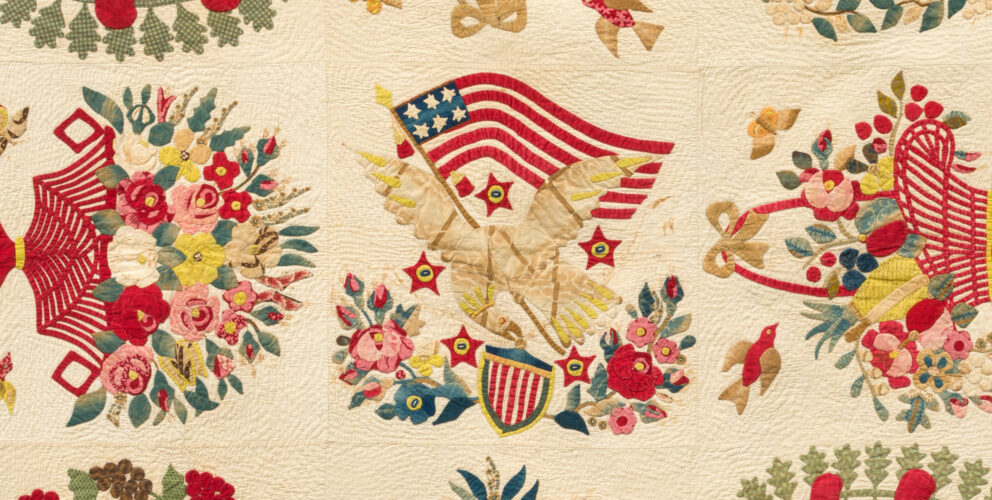
designs attributed to Mary Hergenroder Simon, American (born Germany), 1808–1877, and unknown designers; made by friends of Elizabeth Morrison; Album Quilt, 1848; cotton; 100 1/4 × 100 1/4 inches; Saint Louis Art Museum, Gift of Mrs. Stratford Lee Morton 1:1973
Quilt making in 19th- and 20th-century America was interwoven with the times. Saint Louis Art Museum visitors can see works exemplifying this in Quilts and Coverlets: American Needlework in White, a free exhibition through April 18, 2027; Picturing Independence, a free exhibition through January 24, 2027; and the Museum’s online collection. The exhibitions and collection feature quilts made by women who practiced their craft amid a rapidly changing country.
At the beginning of the 19th century, women often created wholecloth quilts made from a single type of cloth, usually wool. The quilts were warm and durable, making them particularly useful among pioneers or other individuals settling on the frontier during westward expansion. However, as the century progressed, quilt making evolved, with more women producing textiles not just for practical purposes, but also to commemorate relationships or milestones. When a group of women created these commemorative quilts together, they were called “album quilts” or “friendship quilts.”
Visitors can see an example of an album quilt in the Picturing Independence exhibition. Album Quilt was created by a group of Methodist churchwomen in Baltimore in the late 1840s as a tribute to Elizabeth Morrison, a dressmaker and figure in their quilting circle who zealously supported President Zachary Taylor. Visitors can find this connection in an inscription on the quilt reading, “From one of the Rough and Ready to the worthy president.” The phrase reflects Morrison’s admiration for the US army general turned president: Zachary Taylor was known to his troops as “Old Rough and Ready.”
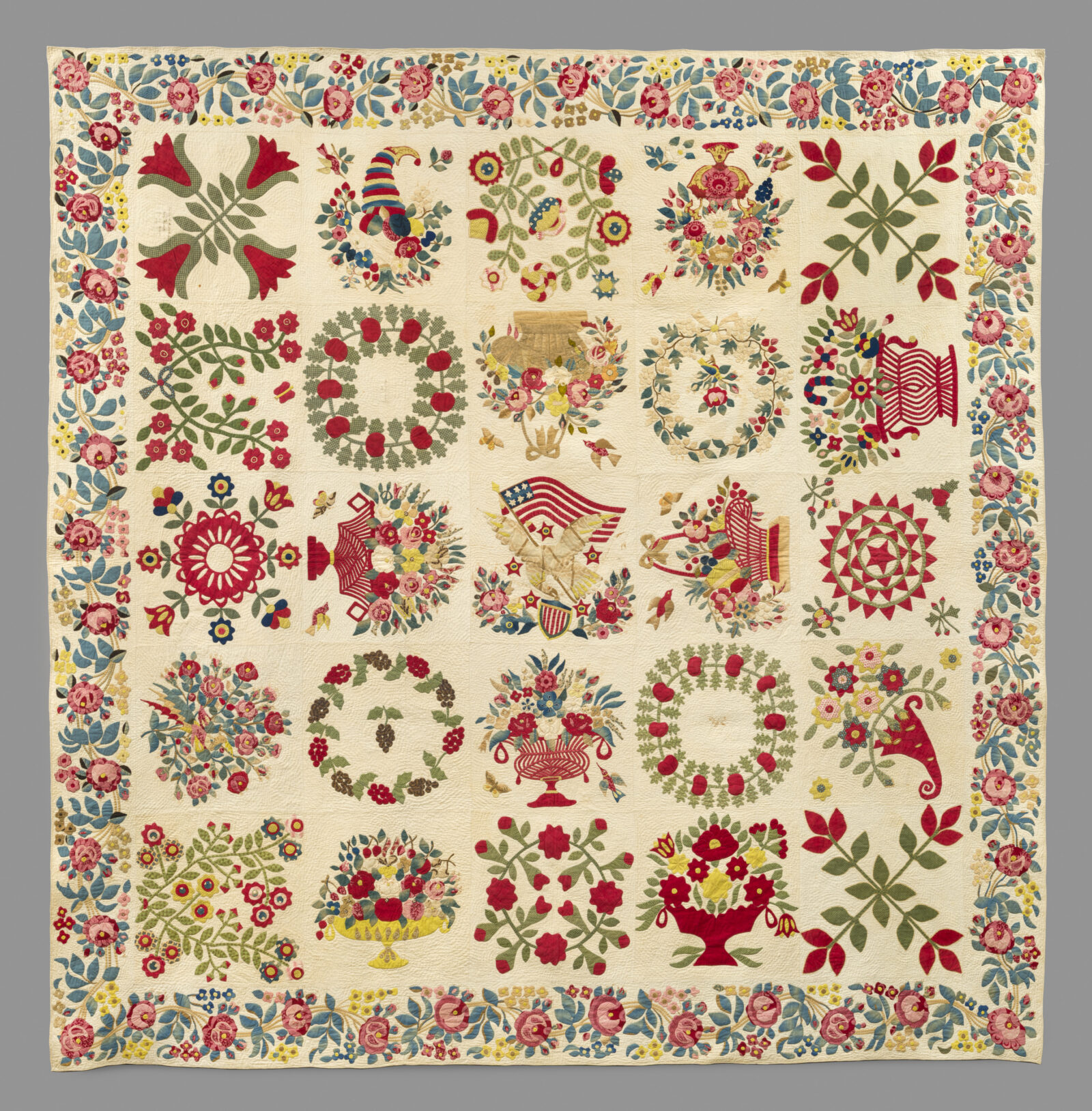
designs attributed to Mary Hergenroder Simon, American (born Germany), 1808–1877, and unknown designers; made by friends of Elizabeth Morrison; Album Quilt, 1848; cotton; 100 1/4 × 100 1/4 inches; Saint Louis Art Museum, Gift of Mrs. Stratford Lee Morton 1:1973
Although the Album Quilt artists are known in reference materials as “friends of Elizabeth Morrison,” the designs for many blocks are attributed to Mary Hergenroder Simon. Born in the Bavarian region of Germany, Simon immigrated in 1844 to Baltimore, where she quickly became known for her designs of quilts featuring intricately woven red baskets. Her bold, colorful patterns became so popular that she soon started creating and selling cut-and-basted quilt kits to provide supplemental income for her family. Elizabeth Morrison’s friends likely used one of these or obtained Simon’s patterns through some other means. This process made the quilt a collective artifact, not just a decorative piece.
The theme of “quilt as an artifact” extends to another aspect of 19th-century quilt making—one deeply tied to the history of slavery. Featured in SLAM’s online collection, Twenty-five Patch Quilt was created by Winnie Morton Rupe, who was born into slavery in the South in the 1850s. As a girl, Rupe escaped the plantation where she lived by stowing away in the boat of a visitor returning to the Midwest. She later lived as a free house servant in the Rupe home in Missouri, where she cooked and sewed.
Quilting was part of daily life for domestic workers like Rupe. Individuals in these roles were required to create quilts for families, often with limited time and resources. Despite these unjust constraints, quilting became a powerful creative outlet and form of personal expression, reflecting the women’s own taste, traditions, and community. They made complex, durable bedcoverings, often with minimal materials, to keep themselves and their families warm.
Rupe created Twenty-five Patch Quilt as her personal bedcover, stitching together colorful wool fabrics laid out in a checkerboard arrangement. Viewers can see Rupe’s name inscribed on a cloth square attached to the quilt (pictured below).

Winnie Morton Rupe, American, 1858–1946; Twenty-five Patch Quilt, late 19th century; wool and cotton; 64 × 78 inches; Saint Louis Art Museum, Gift of Cynthia Rupe Knock and Dr. Henry L. Knock 55:2009

Winnie Morton Rupe, American, 1858–1946; Twenty-five Patch Quilt (detail), late 19th century; wool and cotton; 64 × 78 inches; Saint Louis Art Museum, Gift of Cynthia Rupe Knock and Dr. Henry L. Knock 55:2009
The fact that Rupe’s name is recorded as the artist of the piece is noteworthy. Many quilts produced by enslaved people or domestic servants weren’t credited to the women who made them, reflecting flagrant disparities and oppression in that era and beyond. As a result, their artistic legacy has largely been erased. Some museums today are working to recover that legacy, recognizing the quilts as invaluable historic artifacts and works of art, and the women who made them as artists and trailblazers.
While Rupe’s Twenty-five Patch Quilt shows quilting from the perspective of personal agency and resilience, another quilt from Missouri history, Sunday Baby Quilt, highlights how the state’s immigrant communities created specialized textiles for family milestones. Many German immigrants fleeing political and economic hardship in their homeland settled on both sides of the Missouri River in the 1830s through the 1850s, establishing towns like Hermann and Washington, Missouri. Some German women learned how to quilt after settling in these communities. This reflected their ingenuity, as the women were more used to woven bedcovers before settling in the US.
Most quilts created by these women were intended for daily use, but by the turn of the 20th century, quilting had shifted toward marking special milestones. Visitors can see an example of this transition on Sunday Baby Quilt, which is on view in the Quilts and Coverlets exhibition. Women created quilts like this one from 1920 to wrap their babies up to take them to church on Sundays.

Sunday Baby Quilt, c.1920; American, Washington, Missouri; cotton and silk; 39 × 32 inches; Saint Louis Art Museum, Gift of Richard and Suellen Meyer 18:2014
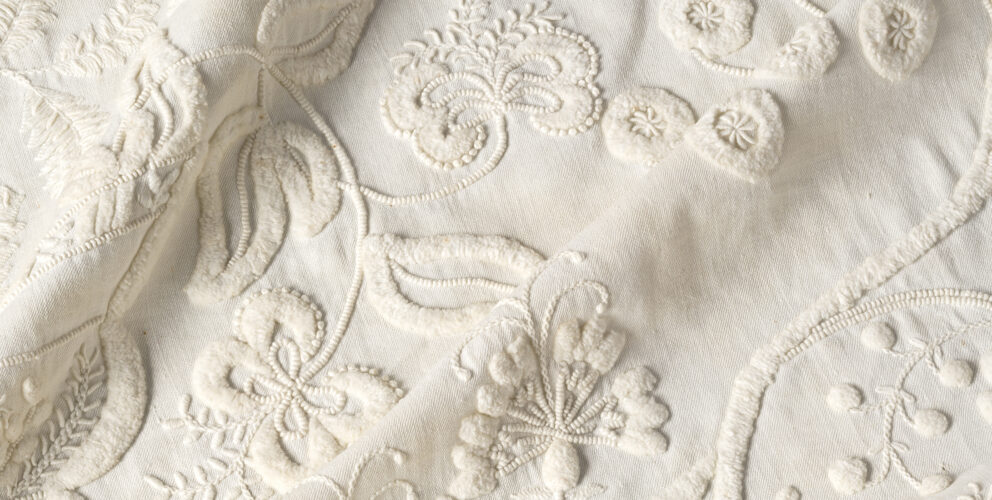
Notably, the wholecloth style of this quilt is rarely seen in Missouri-German quilt making. Wholecloth quilts originated from English traditions, which were prevalent in early America. They were made from one fabric and achieved their patterning through the quilting. By the time Sunday Baby Quilt was created, pieced or patchwork quilts replaced wholecloth as the standard for settlers. However, for a decorative item for Sunday church services and christenings, quilters often favored wholecloth techniques to avoid the utilitarian look of scrap piecing and to showcase their most intricate needlework.
Despite quilts’ important place in the fabric of American history, they were not widely considered from a formal artistic perspective until later in the 20th century. Clearly, communities valued quilts and acknowledged their artistic merit before then, as one can see in the intricate pieces in the SLAM collection and exhibitions. However, it wasn’t until the 1970s, alongside the influence of the Mid-Century Modernist and Abstract Expressionist movements, that quilts were considered more broadly from an artistic perspective. Visitors can see this trend at SLAM, where there were several quilt exhibitions from 1980 through the early 2000s, including Take Cover! Quilts and Coverlets from the Saint Louis Art Museum Collection (1980); Hear my Quilt: 150 Years of African American Quilt Making (1992–93); and Quilts in a Material World: Selections from the Winterthur Collection (2008).
This transition is partly thanks to 20th-century art collectors, such as Jonathan Holstein and Gail van der Hoof, who purchased antique quilts and sold them to art museums for modern exhibitions. Holstein and van der Hoof had a landmark exhibition at the Whitney Museum in 1971, Abstract Design in American Quilts, featuring 60 pieced quilts from their collection.
Merely hanging quilts in a museum changed people’s perception of them, sociologist Karin Elizabeth Peterson writes in her essay, “Discourse and Display: The Modern Eye, Entrepreneurship, and the Cultural Transformation of the Patchwork Quilt” (2003). Instead of viewing quilts as outdated relics stored in the attic or tossed across their beds, people began to see them as important artifacts worthy of display in a museum or cultural institution.
“The contemporary meaning of quilts has been transformed in part by [Holstein and van der Hoof’s] use of the modern eye, but also by other kinds of cultural arguments, including those of social historians and feminists,” Peterson writes. “Today, quilts have a multivocal existence: they can be read through the lens of abstraction, but also through the lens of women’s history and American social history more generally.”