
Jo Baker’s Birthday
- Material
- Acrylic on canvas with tie-dyed and printed fabric

Faith Ringgold, American, 1930–2024; Jo Baker's Birthday (detail), 1993; acrylic on canvas with tie-dyed and printed fabric; 74 1/4 x 78 1/2 inches; Saint Louis Art Museum, Museum Minority Artists Purchase Fund, the Honorable Carol E. Jackson, Casually Off-Grain Quilters of Chesterfield, Mr. and Mrs. Steven M. Cousins, Mr. and Mrs. Lester A. Crancer Jr., Mr. and Mrs. Solon Gershman, Mr. Sidney Goldstein in memory of Chip Goldstein, The Links, Inc., Gateway Chapter, the Honorable and Mrs. Charles A. Shaw, Donald M. Suggs, the Thimble & Thread Quilt Guild, and funds given in honor of Cuesta Benberry 10:1994; © 2026 Faith Ringgold / Artists Rights Society (ARS), New York
A vibrant quilt created from patches of floral fabrics features a dynamic view of Josephine Baker, while touching on themes such as gender and race across mediums. As one can see in Jo Baker’s Birthday, artist Faith Ringgold details the American experience as seen through the eyes of Black women. Ringgold drew on her own biography to produce the artwork, which is currently on view for a limited time at SLAM.
Born and raised in Harlem, New York, Ringgold grew up around the arts but didn’t quite find her artistic footing until the 1960s. Inspired by the Civil Rights Movement, Ringgold created works that reflected the hardships of Black Americans and people of color, creating works that criticized the American dream. Ringgold was often excluded from Black artistic collectives due to her gender and was typically the only Black woman in white feminist spaces. These experiences seemingly influenced Ringgold’s work, as she often highlighted Black women and their experiences.
This focus on Black women can be seen in Jo Baker’s Birthday, a painting on a quilt, which examines Josephine Baker’s career through a fictional character. The quilt also features writings about Josephine Baker as told by Willia Marie Simone, a fictional African American woman who lived in France during the 1920s. Josephine Baker, a St. Louis native, gained fame as an erotic singer and dancer in Paris. Baker was known for her costumes, the most iconic being a short skirt made only of fake bananas and strings of pearls.
Faith Ringgold, American, 1930–2024; Jo Baker's Birthday, 1993; acrylic on canvas with tie-dyed and printed fabric; 74 1/4 x 78 1/2 inches; Saint Louis Art Museum, Museum Minority Artists Purchase Fund, the Honorable Carol E. Jackson, Casually Off-Grain Quilters of Chesterfield, Mr. and Mrs. Steven M. Cousins, Mr. and Mrs. Lester A. Crancer Jr., Mr. and Mrs. Solon Gershman, Mr. Sidney Goldstein in memory of Chip Goldstein, The Links, Inc., Gateway Chapter, the Honorable and Mrs. Charles A. Shaw, Donald M. Suggs, the Thimble & Thread Quilt Guild, and funds given in honor of Cuesta Benberry 10:1994; © 2026 Faith Ringgold / Artists Rights Society (ARS), New York
The central scene on the quilt shows a moment of leisure for Baker as she rests before her birthday party. Ringgold poses Baker on a chaise lounge, reclining back with her arms laid above her head and her legs tangled, reminiscent of Henri Matisse’s painting of a woman in a similar pose, Odalisque couchée aux magnolias. In true Josephine Baker fashion, Ringgold keeps her bare chested but accessorizes her with strings of pearls, earrings, and flowers in her hair, along with fabric covering her lower half. This quilt shows Baker as a luxurious woman, with beautiful flowers behind her and a bowl of fruit at her side.
Encasing the central scene are 12 rectangular panels made up of white fabric. Through writings on these panels, Willa Mae Simone (as voiced by Ringgold) provides critiques of how race and the female body are viewed in different countries. Simone skillfully talks about the central painting, writing as if it is a letter to an “Aunt Melissa.” Throughout the writings, Simone talks about factors surrounding Baker’s success.
In Panel 1, Simone states “they say she is 25, however, she looks more like 16,” referring to Baker’s youthfulness. In Panel 6, Simone writes, “Josephine is Coloured . . . and they would never have let her seek fame and fortune in the states.” In Panel 8, Simone deduces that Baker’s fame was owed partially due to the French’s fetishization of Black bodies, often viewing them as “exotic.” Simone is less critical of Baker herself but rather the systems under which Baker is functioning. Simone grapples with the thought that the United States only made space for “great” African American artists that sing “like Bessie Smith and Billie Holiday” and did not hold space for a Black performer like Baker.
In later panels, Simone talks about the fickleness of fame, fortune, and men, along with the idea of motherhood and everlasting love. The writer touches on beauty and poses a question to Baker: “Is life worth living when the reality of being old and alone sets in? How can a woman be sure of everlasting love?” Simone’s final panel asks “What will be the result of the racism Josephine suffered? Can she ever feel completely loved?”
Making another reference to Matisse, Ringgold featured a reproduction of the French artist’s famous painting The Dessert: Harmony in Red in the background. Simone talks about this reference in Panel 3, describing the maid arranging the fruit and flowers on the table and the blue flowers flowing throughout the painting. Simone continuously places Baker in the French artistic scene as she “paints” Baker as a French model and as a French woman who would’ve owned a Matisse.
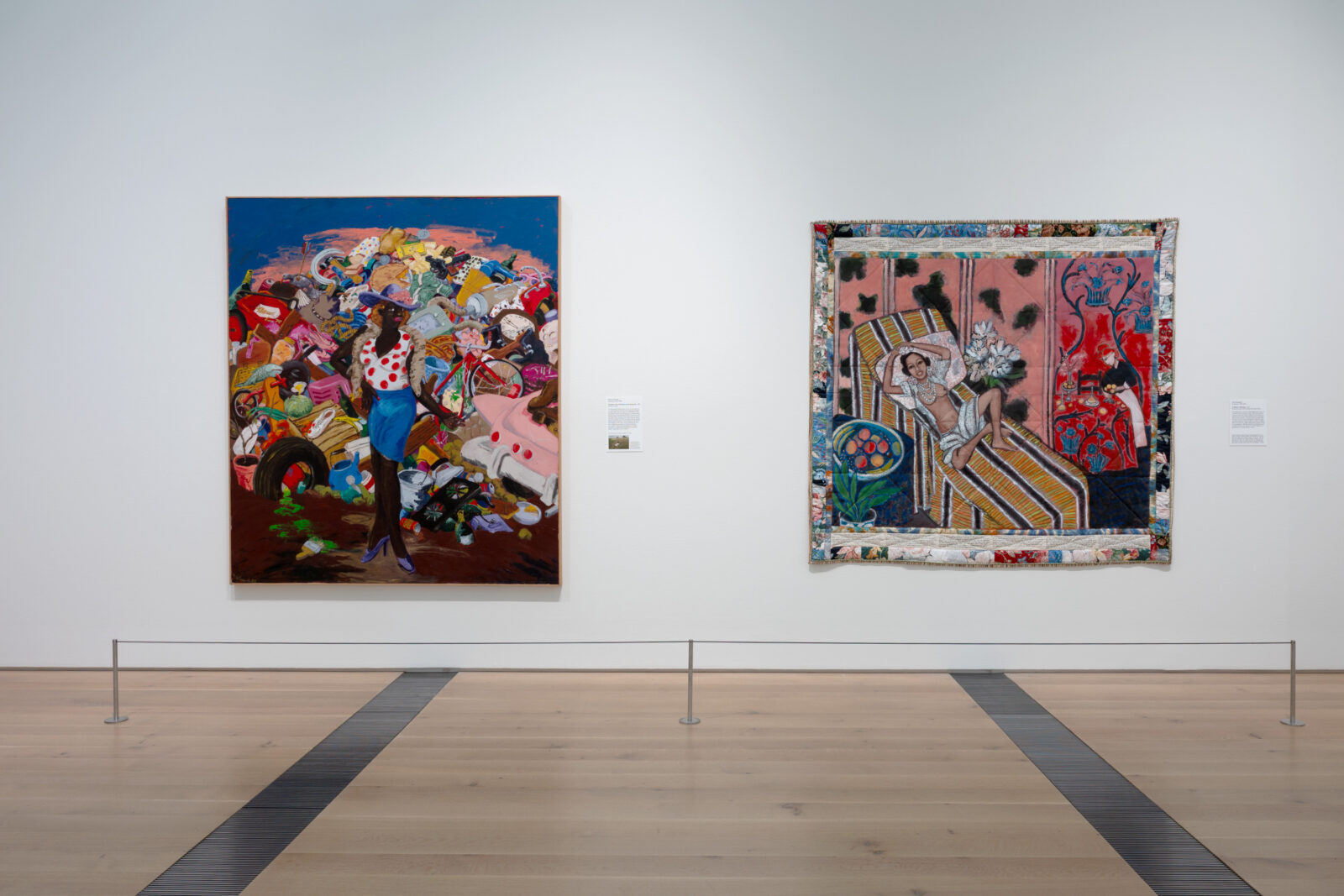
Installation view of Postwar and Contemporary Art - Spaces of Resistance. (left to right) Robert Colescott, American, 1925–2009; Christina's Day Off (Down in the Dumps II), 1983; acrylic on canvas; 84 x 72 inches; Saint Louis Art Museum, Gift of Brooke and Carolyn Alexander 213:1993; © 2026 Robert Colescott / Artists Rights Society (ARS), New York. Faith Ringgold, American, 1930–2024; Jo Baker's Birthday, 1993; acrylic on canvas with tie-dyed and printed fabric; 74 1/4 x 78 1/2 inches; Saint Louis Art Museum, Museum Minority Artists Purchase Fund, the Honorable Carol E. Jackson, Casually Off-Grain Quilters of Chesterfield, Mr. and Mrs. Steven M. Cousins, Mr. and Mrs. Lester A. Crancer Jr., Mr. and Mrs. Solon Gershman, Mr. Sidney Goldstein in memory of Chip Goldstein, The Links, Inc., Gateway Chapter, the Honorable and Mrs. Charles A. Shaw, Donald M. Suggs, the Thimble & Thread Quilt Guild, and funds given in honor of Cuesta Benberry 10:1994; © 2026 Faith Ringgold / Artists Rights Society (ARS), New York
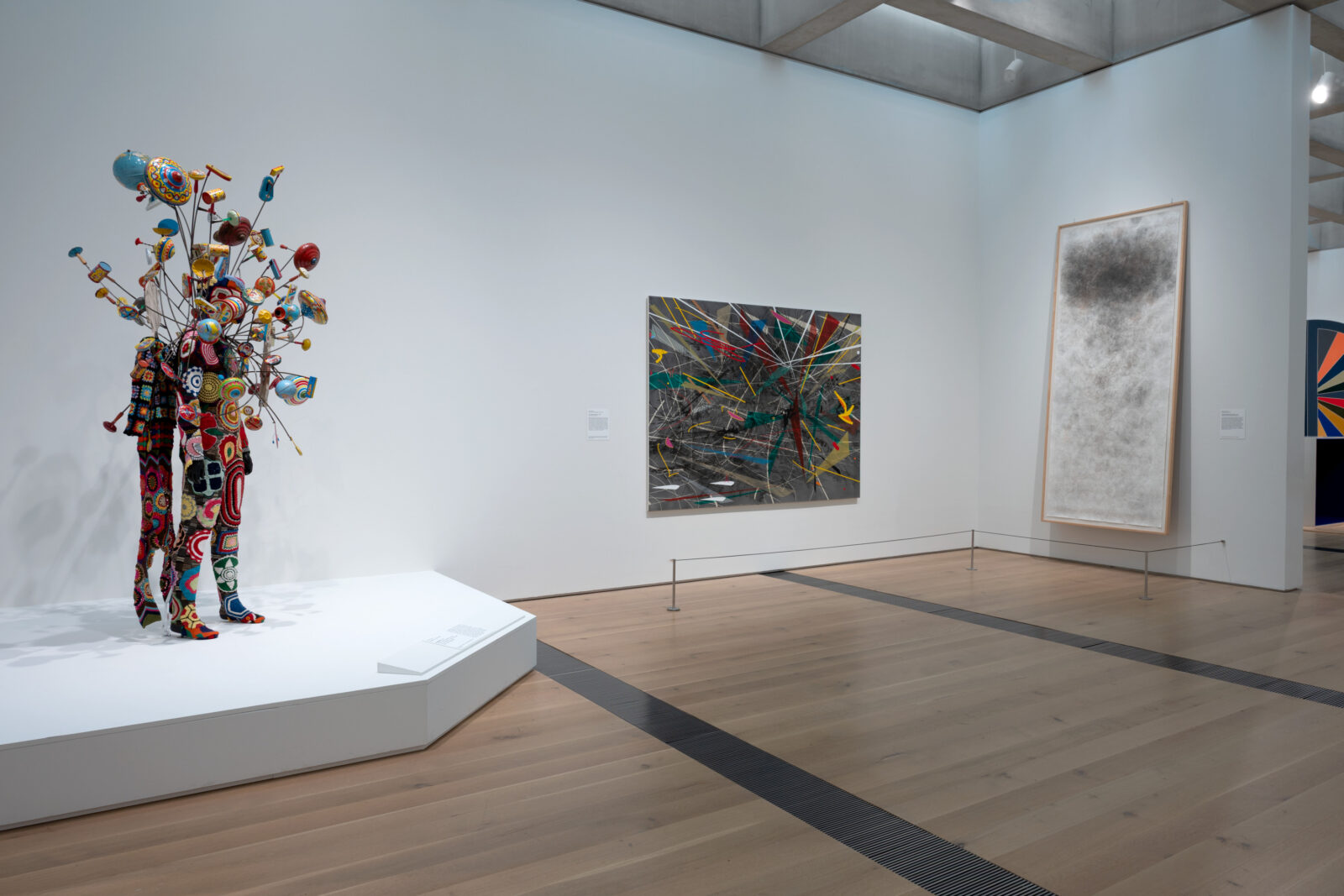
Installation view of Postwar and Contemporary Art - Spaces of Resistance; © Nick Cave, courtesy of the artist and Jack Shainman Gallery, New York; © Julie Mehretu; © David Hammons
Jo Baker’s Birthday displays Ringgold’s critiques of how Black women were perceived differently in two countries, while paying homage to a Black woman who succeeded under oppressive circumstances. Jo Baker’s Birthday is currently on view in the “Spaces of Resistance” Gallery 243 in the East Building’s postwar and contemporary art installation. “Spaces of Resistance” brings together works by artists Nick Cave, Robert Colescott, David Hammons, Glenn Ligon, Julie Mehretu, and Faith Ringgold to show how activism and cultural expression translate into art.
“Spaces of Resistance,” along with the rest of the postwar and contemporary installation, will be on view until August. Many of these works, including the Ringgold, are sensitive to light and are only able to be shown under gallery lights for a limited amount of time. A new postwar and contemporary art installation featuring different gallery themes and artworks will open later this fall.