Josephine Baker with her Delage D8-85, Paris, 1935; photograph in L’Officiel, July 1935
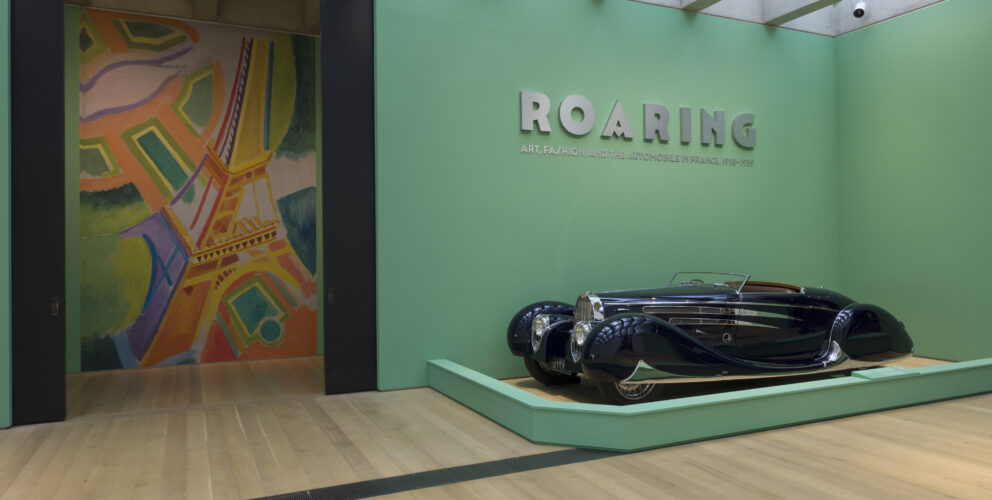
Women were getting behind the wheel in 1920s Paris, and St. Louis–born Josephine Baker was no exception as she dazzled France with her trendsetting fashion and innovative cars. The singer, dancer, and actress is featured in Roaring: Art, Fashion, and the Automobile in France, 1918–1939, on view through July 27.
The photograph below shows Josephine Baker during a concours d’élégance (competition of elegance) held at the Bois de Boulogne on June 7, 1935. Originating with carriages in the 17th century, the concours evolved into a juried gathering where private and company-owned cars were awarded prizes in various categories. They were family-friendly and leisurely competitions at parks and other natural settings.

Josephine Baker with her Delage D8-85, Paris, 1935; photograph in L’Officiel, July 1935
In the photo, Baker emerges from the dark interior of her Delage D8-85, a French luxury automobile with a custom body designed by coachbuilders Letourneur & Marchand, wearing a glamorous tailleur (woman’s suit). Her rayon peau d’ange (angel’s skin) ensemble consists of a calf-length skirt and a puff-sleeve jacket with a black and white feather collar.
Daniel Marcus, the curator of collections and exhibitions at the Columbus Museum of Art in Columbus, Ohio, details how women began to influence automotive design in his essay in SLAM’s exhibition catalogue for Roaring. Granting a new kind of freedom to a growing consumer base that included women, a car could be a work of art, a private sanctuary, a status symbol, or a fashion accessory. Reflecting this development, the fashion industry began to prioritize flexibility in clothing to reflect the active lifestyle of the modern woman. Using lightweight fabrics and loose silhouettes, designers combined function and adornment. Baker’s skirt, for example, features a slit that allows her to enter and exit the vehicle with ease. Like the automobile’s sleek upholstery, sculptural fenders, and circular motifs, her jacket’s two-tone rooster-feather collar mimics the color scheme of the car and conveys a sense of motion, with the lightweight material adding a playfulness to a classic shape.
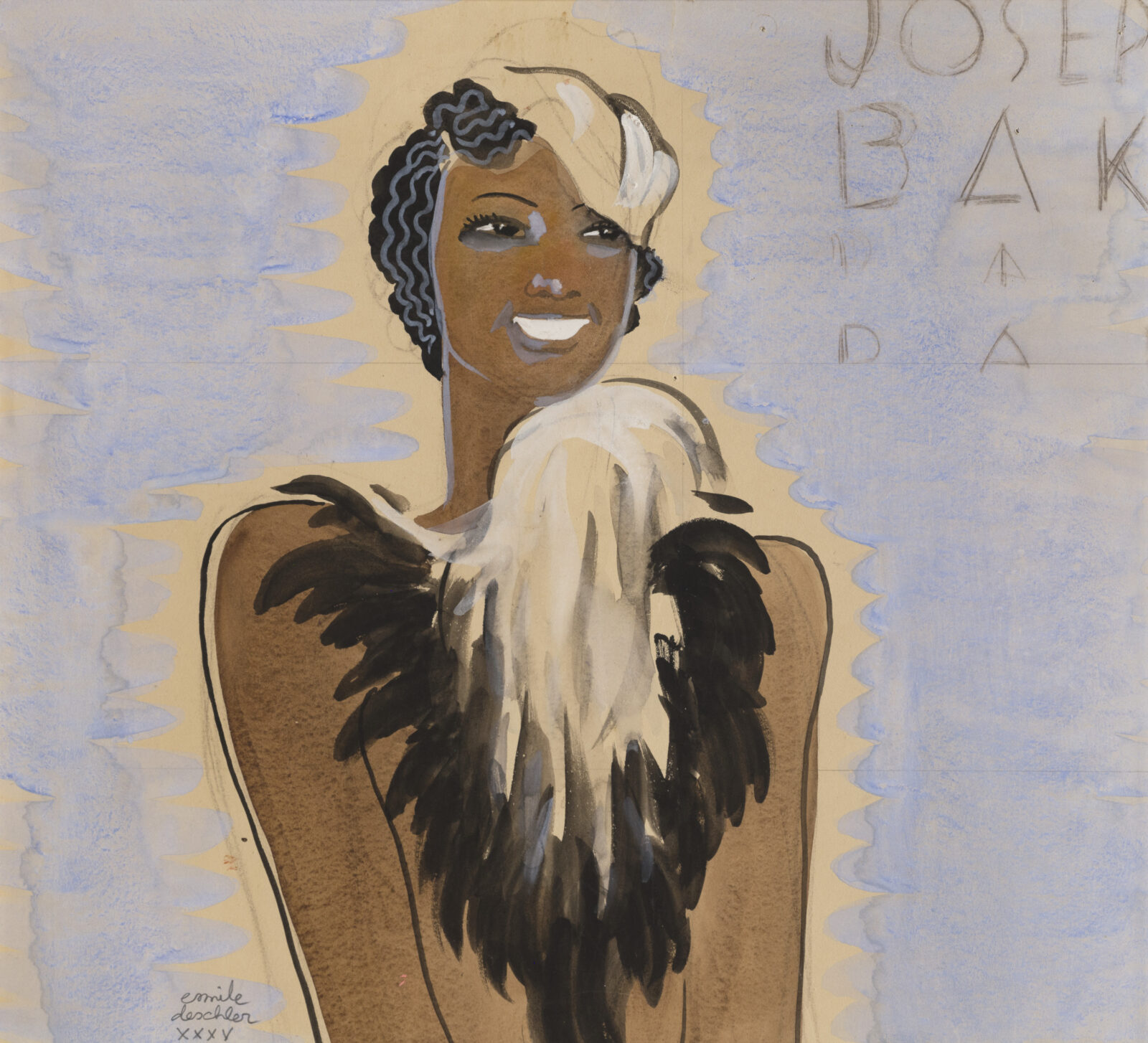
Émile Deschler, French, 1910–1991; Josephine Baker, 1935; gouache, ink and crayon maquette; 16 x 17 5/8 inches; From the Collection of Mary Strauss 2025.19
A gouache, ink, and crayon maquette (or model), likely for a poster by the French artist Émile Deschler, depicts Baker in a similar feathered collar and white hat. Her central placement, raised shoulders, and bright smile—rendered through gestural mark-making, black outlines, and simplified design—capture a sense of personality and vibrancy. In the painting, the role of the feather collar shifts from mere accessory to focal point, hinting at the spirit of her stage and screen persona. But Baker’s personal style acted to separate the characters she played from the public image she was cultivating in Paris.
Born as Freda Josephine McDonald in St. Louis, Baker’s talents and timing made her an international vaudeville sensation. She became the first Black woman to star in a major motion picture with Siren of the Tropics in 1927. Baker also starred in the French film Princesse Tam-Tam, which includes footage of her at the 1935 concours, one of the few historical recordings of the competition.
These events provided a stage for her to demonstrate her personal style and automobiles as embodiments of her agency, which were shaping the image of the modern French woman. As a fashion icon and car enthusiast, Josephine Baker exemplified the spirit of the concours d’élégance.
This information was adapted from the author’s essay “Concours d’Élégance: Josephine Baker, Fashion, and the Automobile,” which appears in the exhibition catalogue for Roaring: Art, Fashion, and the Automobile in France, 1918–1939. It is available for purchase online and in Museum shops.