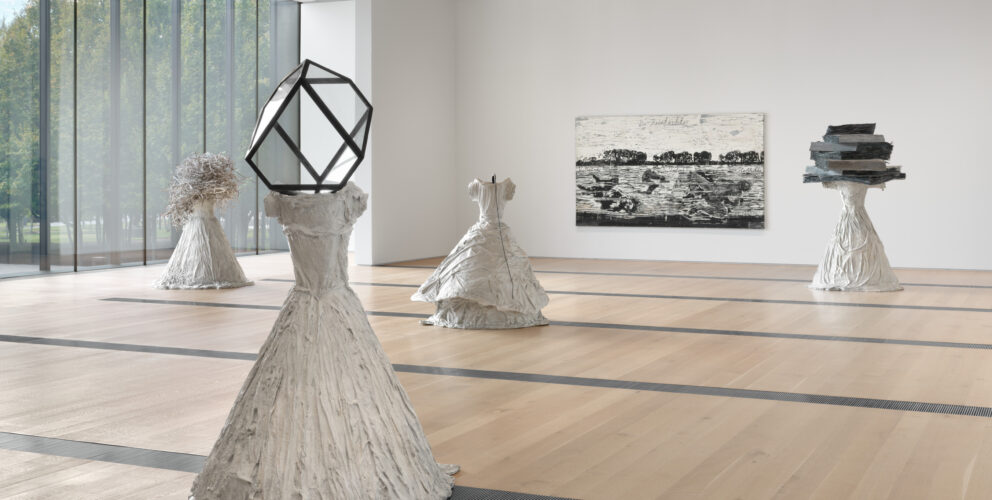
Anselm Kiefer, German, born 1945; Des Herbstes Runengespinst (Autumn's Runic Weave), 2005–06; emulsion, acrylic, oil, shellac, burnt wood, burnt books, charcoal, metal, and wire on canvas; 129 15/16 inches x 32 feet 1 13/16 inches × 7 7/8 inches; Collection of the artist 2025.313a-g; © Anselm Kiefer, Photo: Nina Slavcheva

In his most recent works, Anselm Kiefer conjures landscapes from shining gold, misty verdigris, and thick deposits of oil paint. These scenes appear suspended in time—golden echoes from deep memory. On these quiet banks of the Rhine River, nothing bad has ever—could ever—happen. The Rhine is more than a stretch of water in Kiefer’s art; it is a reservoir of German mythology, national identity, and personal memory, a place where beauty and history converge.
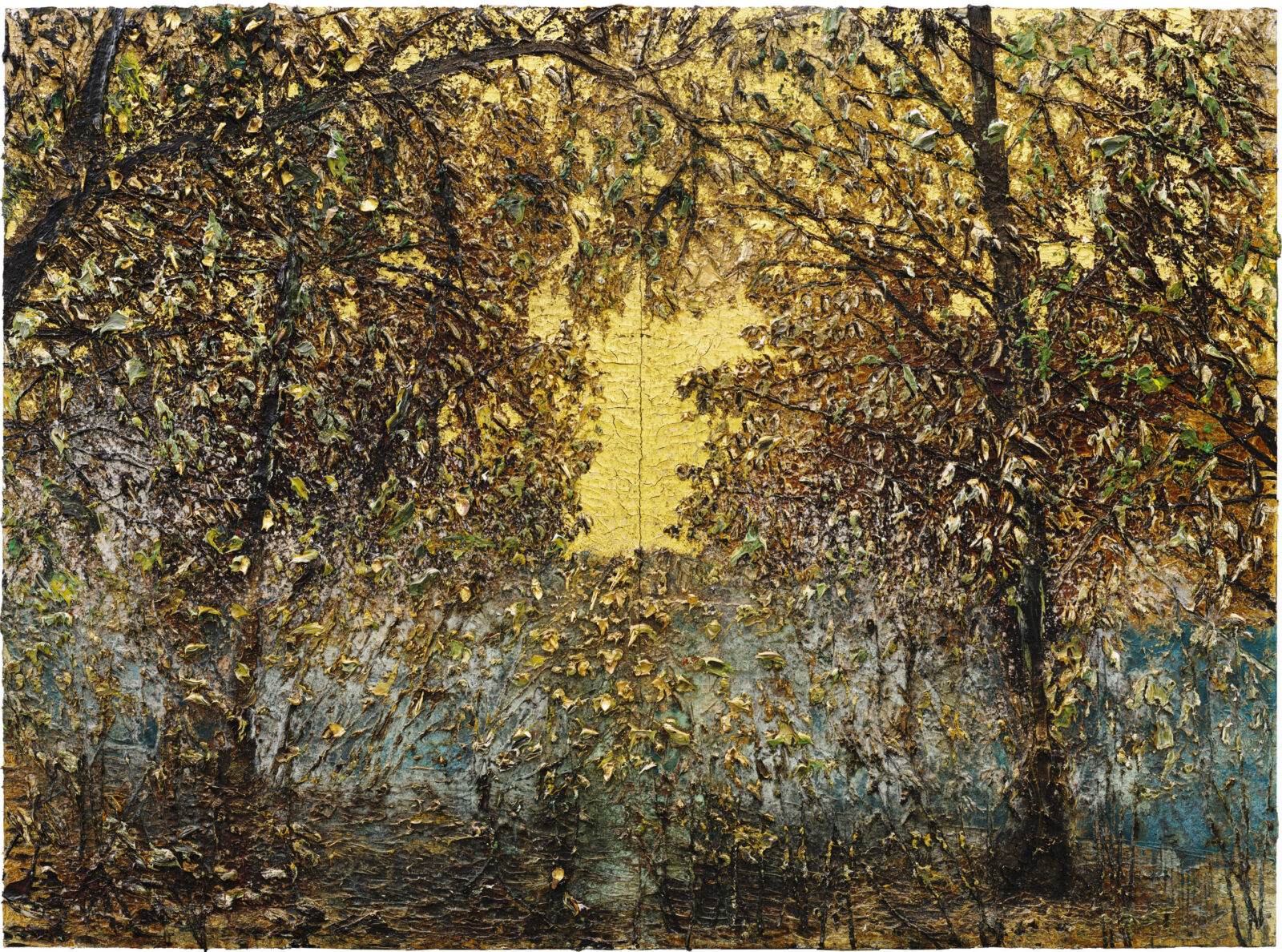
Anselm Kiefer, German, born 1945; Der Rhein (The Rhine), 2024; emulsion, oil, acrylic, shellac, gold leaf, and sediment of electrolysis on canvas; 110 1/4 inches x 12 feet 5 5/8 inches; Private collection 2025.317; © Anselm Kiefer, Photo: Nina Slavcheva
Yet the Rhine has not always been so serene in Kiefer’s work. In the late 1960s, he photographed himself on that same riverbank wearing his father’s military overcoat and performing the Hitler salute. When the images were later published, they shocked German audiences unwilling to confront the recent past. For Kiefer, the gesture was not homage but indictment—a provocation meant to expose postwar Germany’s deliberate silence surrounding the Nazi era and the dangers of forgetting.
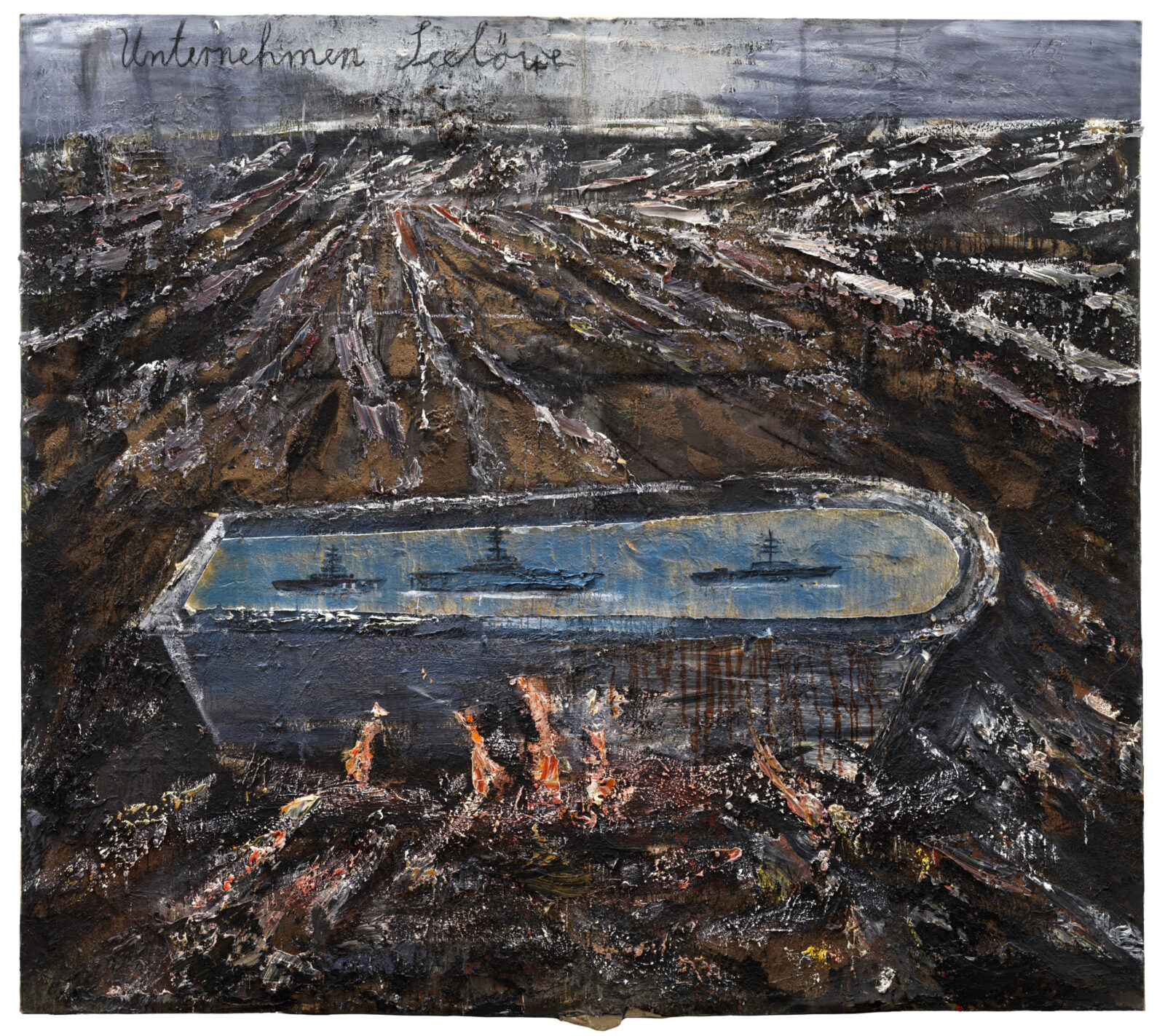
Anselm Kiefer, German, born 1945; Unternehmen Seelöwe (Operation Sea Lion), 1976; emulsion, oil, acrylic, shellac, sand, and charcoal on canvas; 129 15/16 inches x 12 feet 1 11/16 inches x 1 15/16 inches; Collection of the artist 2025.332 © Anselm Kiefer, Photo: Georges Poncet
Through the 1970s and beyond, Kiefer continued to scrutinize fascism—its symbols, leaders, architecture, and mythologies. He often underscored the Nazi regime’s delusions of grandeur by highlighting its monumental failures. In his paintings titled after Operation Sea Lion, Hitler’s unrealized plan to invade Great Britain by sea, Kiefer shifts the imagined battlefield from the English Channel to an old-fashioned bathtub, where toy ships represent the German Navy. The tub, distributed by the Nazi health ministry as part of a hygiene initiative, sits over a bonfire in a barren field. What was once envisioned as a world-altering conquest becomes instead a childish daydream, exposed as a fantasy of epic proportions.
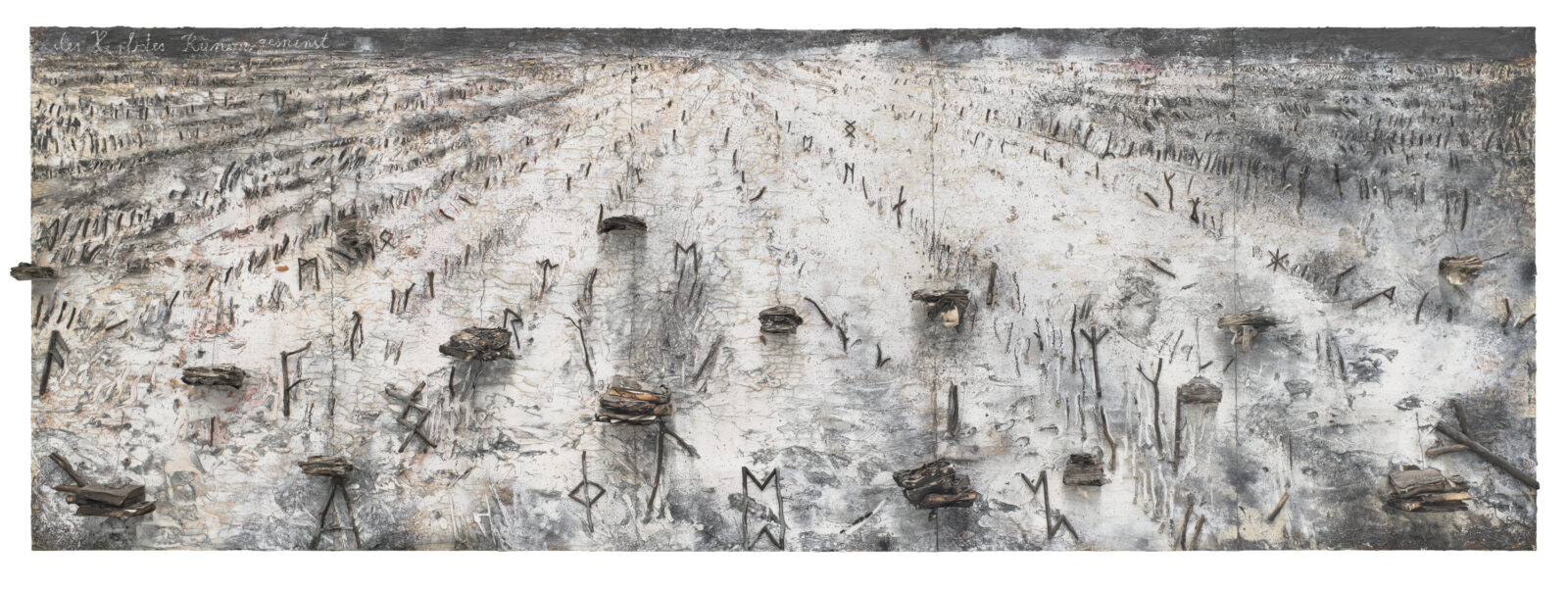
Anselm Kiefer, German, born 1945; Des Herbstes Runengespinst (Autumn's Runic Weave), 2005–06; emulsion, acrylic, oil, shellac, burnt wood, burnt books, charcoal, metal, and wire on canvas; 129 15/16 inches x 32 feet 1 13/16 inches × 7 7/8 inches; Collection of the artist 2025.313; © Anselm Kiefer, Photo: Nina Slavcheva
By the 2000s, Kiefer’s engagement with the Nazi past assumed a more meditative tone. Des Herbstes Runengespinst (Autumn’s Runic Weave) depicts a winter field under a dirty blanket of snow, its rows of stubble receding toward a distant horizon. In the foreground, broken stalks form ancient Germanic runes—letters the Nazi regime embraced with near-mystical fascination and which remain culturally fraught today. Suspended bundles of burned books hang from wires, evoking the regime’s public bonfires of censored literature.
The work’s title comes from “Septemberkrone” (September Crown), a poem by Paul Celan—a writer from whom Kiefer has drawn throughout his career. A Romanian Jew and Holocaust survivor, Celan wrote the poem in 1944, the year he was liberated from a labor camp. His verse fuses beauty and grief, mourning what has been lost yet insisting on memory.
The eastern skies are laden with silken twine:
your lovely name, the autumn’s runic weave.
Oh, with earthly bond I bound my heart to the heavenly vine
and weep when the wind now blows, that you sing and do not grieve.
Kiefer is widely regarded as the German artist who most forcefully confronted the darkest chapter of his nation’s history. Seen together in Anselm Kiefer: Becoming the Sea, these monumental works invite visitors not only to witness an artist’s lifelong reckoning with the past but also to consider how myth, power, and memory continue to shape the world we inhabit today.