Anselm Kiefer, German, born 1945; Des Meeres und der Liebe Wellen (The Waves of Sea and Love) (detail), 2017; oil, emulsion, acrylic, and lead on canvas; 74 13/16 inches x 12 feet 5 5/8 inches x 16 13/16 inches; Peter Marino Art Foundation 2025.335; © Anselm Kiefer

Anselm Kiefer’s career spans almost 60 years. His works have varied in size, scale, and medium—from delicate watercolors to massive canvases laden with dark, textured surfaces rich in symbolism.
It could be said, though, that a constant throughout his practice is his continual desire to experiment. This is especially evident through his diverse use of materials. The materials list for the works in the Museum’s landmark exhibition Anselm Kiefer: Becoming the Sea includes such varied substances as lead, straw, copper, sunflower seeds, leather, burnt books, gold leaf, stones, and so much more.

Installation view of Anselm Kiefer: Becoming the Sea, Photo: Dan Bradica
Anselm Kiefer, German, born 1945; Für Paul Celan (For Paul Celan), 2017–19; emulsion, oil, acrylic, shellac, lead, clay, terracotta, steel, chalk and charcoal on canvas; 129 15/16 inches x 12 feet 5 5/8 inches; Collection of the artist 2025.331; © Anselm Kiefer

Installation view of Anselm Kiefer: Becoming the Sea, Photo: Dan Bradica
Anselm Kiefer, German, born 1945; Des Herbstes Runengespinst (Autumn's Runic Weave), 2005–06; emulsion, acrylic, oil, shellac, burnt wood, burnt books, charcoal, metal, and wire on canvas; 129 15/16 inches x 32 feet 1 13/16 inches x 7 7/8 inches; Collection of the artist 2025.313a-g; © Anselm Kiefer
Melissa Venator, SLAM’s Andrew W. Mellon Foundation Assistant Curator of Modern Art, who assisted in curating the exhibition, said the artist’s use of unconventional materials began emerging in the 1980s. While artists have long experimented by mixing various substances into oil paints to add visual interest, Kiefer appreciates the many meanings associated with certain materials. He’s depicted dead sunflowers, their heads packed with real seeds, as symbols for death and rebirth. Similarly, ash and straw have been used throughout his practice, suggesting the opposing forces of light and dark as well as the figures of Margarete and Shulamith from Paul Celan’s poem “Todesfuge” (Death Fugue). Gold, specifically gold leaf, has become a prominent material choice in recent years because of cultural and sacred connotations, often referencing the divine.

Installation view of Anselm Kiefer: Becoming the Sea, Photo: Dan Bradica
Left: Anselm Kiefer, German, born 1945; Des Meeres und der Liebe Wellen (The Waves of Sea and Love), 2017; oil, emulsion, acrylic, and lead on canvas; 74 13/16 inches x 12 feet 5 5/8 inches x 16 13/16 inches; Peter Marino Art Foundation 2025.335; © Anselm Kiefer
Right: Anselm Kiefer, German, born 1945; Nibi, Apotamkin, Ne Hwas, 2018–24; emulsion, oil, acrylic, shellac, gold leaf, lead, sediment of electrolysis, and charcoal on canvas; 129 15/16 inches x 20 feet 3/16 inches; Collection of the artist and courtesy Gagosian 2025.320a-c; © Anselm Kiefer
One of the materials most-often linked to Kiefer’s oeuvre is lead. According to various interviews, Kiefer first became interested in the material in the 1970s, when plumbing work was needed at his old home in Germany. He became fascinated by the physical properties of lead, Venator said, but also its contradictory nature: It’s a metal but surprisingly soft with a low melting point, making it very malleable. It’s so dense, though, that it’s used to block x-rays; lead is toxic, so there’s a level of danger linked with it. Then there are historical connections the artist also finds significant: Lead is associated with the planet Saturn and the mood of melancholy; it’s also the metal that medieval alchemists believed they could transform into gold.

Installation view of Sculpture Hall in Anselm Kiefer: Becoming the Sea, Photo: Dan Bradica
Left: Anselm Kiefer, German, born 1945; Am Rhein (On the Rhine), 2025; emulsion, oil, acrylic, shellac, gold leaf and sediment of electrolysis on canvas; 30 feet 10 1/16 inches x 27 feet 6 11/16 inches x 3 15/16 inches; Collection of the artist and courtesy Gagosian 2025.334; © Anselm Kiefer
Right: Anselm Kiefer, German, born 1945; Missouri, Mississippi, 2024; emulsion, oil, acrylic, shellac, gold leaf, sediment of electrolysis and collage of canvas on canvas; 30 feet 10 1/16 inches x 27 feet 6 11/16 inches x 3 15/16 inches; Collection of the artist and courtesy Gagosian 2025.310; © Anselm Kiefer

Installation view of Anselm Kiefer: Becoming the Sea, Photo: Dan Bradica
Left: Anselm Kiefer, German, born 1945; Pence, 2015–24; emulsion, oil, acrylic, shellac, sediment of electrolysis, gold leaf, lead, and collage on canvas; 110 1/4 inches x 12 feet 5 5/8 inches x 3 15/16 inches; Private Collection 2025.319a-b; © Anselm Kiefer
Right: Anselm Kiefer, German, born 1945; Orithyia, 2024; emulsion, oil, acrylic, shellac, gold leaf, sediment of electrolysis and charcoal on canvas; 110 1/4 inches x 18 feet 8 13/32 inches; Collection of the artist and courtesy Gagosian 2025.318; © Anselm Kiefer
Kiefer is continually experimenting with both materials and techniques, finding new ways to incorporate them into his pieces. With lead, he often melts it in a crucible and splashes it across a canvas, creating waves, ripples, and peels. He has also used sheets of lead to form books or other objects, like in SLAM’s collection work Brennstäbe (Breaking of the Vessels). Another material that stands out in his new work on view in the SLAM exhibition is related to his experiments with various metals. It’s called “sediment of electrolysis.” Essentially, he submerges metal—in this case, copper—in a bath and exposes it to an electrical current, which corrodes the surface of the metal. After doing this enough times in his studio, Kiefer discovered that a beautiful blue-green sediment was collecting at the bottom of the electrolysis basin. He harvested the sediment to create a paint-like substance he could apply to canvas. With its almost murky, variegated surface, this new material was used in Anselm Kiefer: Becoming the Sea specially to designate water, as seen in the Sculpture Hall works.

Installation view of Anselm Kiefer: Becoming the Sea, Photo: Dan Bradica
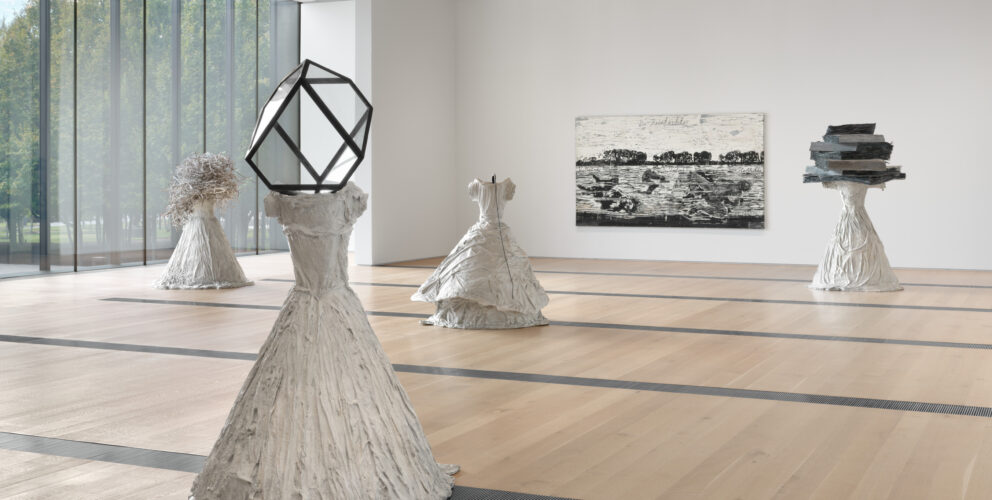
Left: Anselm Kiefer, German, born 1945; Thusnelda, 2019; resin, plaster, wood, and annealed wires; 63 x 55 1/8 x 78 3/4 inches; Collection of the artist and courtesy Gagosian 2025.327a-b; © Anselm Kiefer
Right: Anselm Kiefer, German, born 1945; Cette obscure clarté qui tombe des étoiles (This Dark Brightness That Falls From the Stars), 1997–2015; woodcut, sunflower seeds, and charcoal on paper, mounted on canvas; 12 feet 3 5/8 inches x 12 feet 11 7/8 inches x 3 1/8 inches; Eschaton Kunststiftung 2025.329; © Anselm Kiefer
With sediment of electrolysis and so many other material choices, Kiefer puts an emphasis on transformation—the modern equivalent of alchemy. He’s driven over sheets of lead to weather the metal, and entire artworks are burned with blowtorches. Bundles of thorns or other branches are dipped in plaster to give them an aged effect. Paint mixed with dirt or other natural substances is applied, layer after layer, so thick on a canvas it appears still wet. The list of materials and treatments goes on and on, but it’s not random, Venator said. His studio outside of Paris, which is a former department store warehouse, contains rows and rows of industrial shelving filled with buckets and bins of materials he’s collected and archived, Venator said, specifically mentioning Thusnelda, a Women of Antiquity sculpture on view in the exhibition. Thusnelda was a German tribal queen who was captured by a Roman general and displayed as a victory trophy. The sculpture’s head is made of a bundle of cherry branches Kiefer stored in his studio before inspiration struck. The bundled sticks refer to Thusnelda’s home in Germany’s ancient forests.

Installation view of Anselm Kiefer: Becoming the Sea, Photo: Dan Bradica
Anselm Kiefer, German, born 1945; Saturnzeit (Saturn Time), 1986; oil and acrylic emulsion, shellac, and crayon over painted photographs, ferns, and lead; 111 x 130 1/4 inches; Philadelphia Museum of Art: Gift of Keith L. and Katherine Sachs 2025.305; © Anselm Kiefer
“He famously does not throw anything away,” Venator said. “That’s why many of his paintings have a date range rather than a single date. He might start something in the ’80s, decide it’s not going anywhere, and put it aside. Then years later he’ll pull it back out, take pieces off, add something new, and suddenly he has an idea for how to use it. The way he keeps all that straight in his mind is unbelievable. For him, a work is never done; it’s always in a process of change.”
That constant state of change is central to Anselm Kiefer: Becoming the Sea, the artist’s first major American exhibition in 20 years. The exhibition uses the river as a metaphor for the flux of life and the passage of time. “He talks about making the infinite finite,” Venator said. “Our experiences in the world and our ideas about it are infinite; our memories are infinite, and as an artist, he has this impossible job of fixing that—giving it a concrete form.”