A school group enters the Museum in 1975. Courtesy of Saint Louis Art Museum Archives
“The origin of the museum is inherently linked to educational goals, the belief that the public should have access to works of art, even if 18th-century concepts of access and public differ from ours today.”
—Eilean Hooper-Greenhill
Museum and Gallery Education, 1994
This year marks the 100th anniversary of education programs at the Saint Louis Art Museum.
A century ago a shift in museum culture put more emphasis on the community, which led to the creation of the Education Department at what was then known as the City Art Museum. Mary Powell served as the executive and sole staff member, as noted in the 1923–1924 annual report.
“Substantial progress . . . [is] being made towards the development of a museum of quality rather than a museum of numbers, which will be of greater educational value and more efficient service to the people of this community,” Museum Director Samuel L. Sherer said in Museum and Gallery Education.
A fine arts librarian, Powell did not have any traditional art history training. And at the time, there weren’t any formal training programs for museum educators. She kept notebooks of information, clippings from magazines, and other resources.
Betty Greenfield Grossman, who joined the Education Department in 1935, provided a vivid picture of Mary Powell’s powerful personality in Museum and Gallery Education: “Mary Powell stood on her dignity, and everyone respected her. . . . [She] had the definite idea that the Art Museum was to serve the public. . . . She was an outstanding person, a lady in the best sense of the word. . . . She was interested in knowing Board members, seeing their collections, knowing the dealers, seeing what they had to offer.”

Mary Powell lectures in a gallery with young Museum visitors. In 1923 Powell became the first leader of the Education Department at what was then the City Art Museum. Courtesy of Saint Louis Art Museum Archives
In the 1920s and 1930s education at the Museum focused on children. Powell led many student tours and instructional drawing classes. One of her signature programs was a story hour for children on Saturday afternoons that involved drawing, games, and stories centered around art. During her tenure in the 1940s and 1950s, Grossman reached people beyond the gallery walls by casting schoolchildren and Museum staff in skits and interviews broadcast on local radio and television.
By the 1960s the Education Department had grown to eight staff members. Yet Jaquelin Ambler and later Thelma Richardson Stockho, who both led the department during that decade, saw the community demand for education efforts grow at an even faster rate. In response, the Museum established the docent program in 1963. Over the next three years, the number of students taking gallery tours rose by 10,000 each year. The 1960s also saw the introduction of seminars and lecture series with titles like Artists in Action, Aspects of Asiatic Art, and The Religion and History of Art.
In the 1970s the Teacher Resource Center was created as a place for teachers and Museum educators to meet and exchange ideas for ways to use the Museum for the benefit of their students. In 1978 SLAM educators and teachers in the University City School District piloted the Arts in the Basic Curriculum (ABC) program—one of the first multivisit student programs at an American art museum. ABC remains a signature program for students.
With the completion of renovations to the Education and Administration Services wing (now referred to as the South Administrative Building) in the 1980s, the department had more space to take on an active programming schedule, featuring gallery talks, slide lectures, Tuesday evening programs of films and lectures, drawing seminars, visitor information services, curriculum planning, and aids for teachers.

Senior lecturer Thelma Stockho gives a program in 1973. Courtesy of Saint Louis Art Museum Archives
The 1990s were marked by expanded programming for families and older adults. In 1991 and 1992 Senior Days and OASIS (Older Adults Service and Information Systems) programs were added, along with Family Days and Family Workshops. By late 1999 the Family Days program had become a Museum fixture, offered on the second Sunday of every month.
Efforts and initiatives to attract new audiences to the Museum continued in the early 2000s through expanded programming and resources. Youth SmART, a summer program for community groups and summer day camps, started in 2000, as did the Museum Assistant program, which employs and trains area high school students to lead interactive tours and facilitate art-making activities. In 2003 the Interpretive Materials Group was created with the mission of reviewing current and proposed exhibitions and collection installations to ensure that interpretive materials such as object labels, wall texts, and maps are coherent and meaningful for Museum audiences and in keeping with the objectives of the exhibition and the Museum.
In 2010, while the auditorium was closed for renovations and many galleries were closed during the construction of the East Building, the outdoor Art Hill Film Series was introduced. It has grown into a popular St. Louis summer tradition that draws large crowds to enjoy films under the stars on Art Hill. To attract young adult audiences, SLAM Underground was launched in 2014, offering DJs, live bands, art activities, gallery games, photo booths, and signature cocktails.
Beginning in early 2020, with the onset of the COVID-19 pandemic, the Museum’s educators originated live and on-demand virtual programs and digital resources designed for audiences of all ages. The Museum hired its first educator specializing in digital interpretation to produce audio guides and other digital experiences centered around the collections and exhibitions.
The Education Department that began in 1923 under the leadership of Mary Powell is now a division of the Museum known as Learning and Engagement, comprising three departments: Multigenerational Learning, Engagement and Interpretation, and the Richardson Memorial Library and Museum Archives. The scale and scope of the division has expanded to include professionally trained Museum educators, librarians and archivists, and administrative professionals. There are now 17 full-time employees, 10 part-time employees, and 93 active volunteers and docents who contribute to the Museum’s continued mission to serve the community.
In 1929 the number of people the Education Department was able to reach through in-person Museum instruction was 37,522. Today Learning and Engagement reaches more than 200,000 people each year through its in-person offerings at the Museum, throughout St. Louis, and via virtual resources and programs, and the Museum’s website provides 24/7 access to resources and information for teachers and others.
The Saint Louis Art Museum will celebrate this anniversary throughout 2023 with special programs and initiatives. We plan to recognize the many impactful staff, programs, and initiatives of the last 100 years, spotlight current offerings and approaches, and look forward to the next 100 years of learning and engagement.
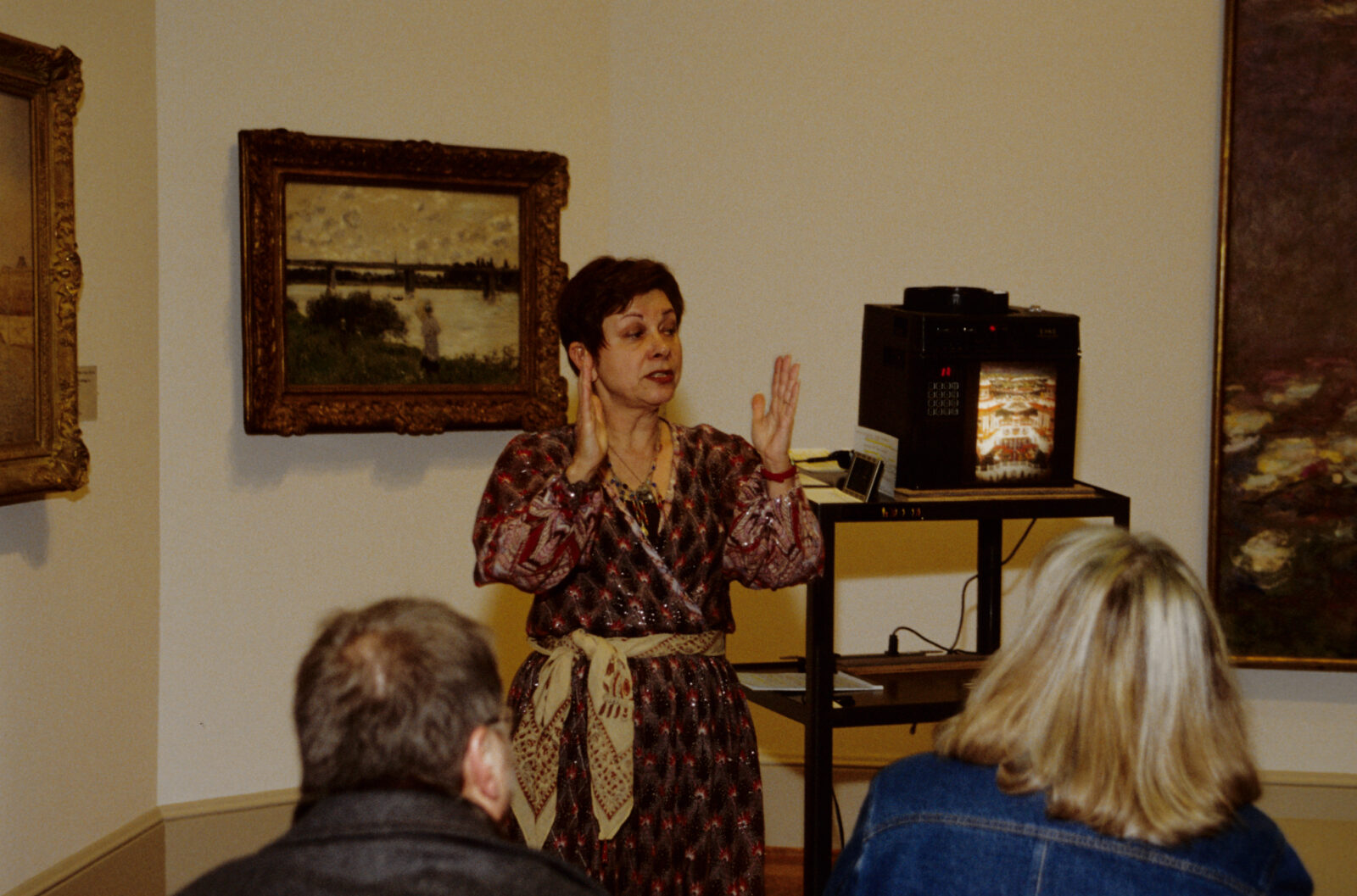
In 2002 Stephanie Sigala, manager of gallery programs, gives a lecture. Courtesy of Saint Louis Art Museum Archives