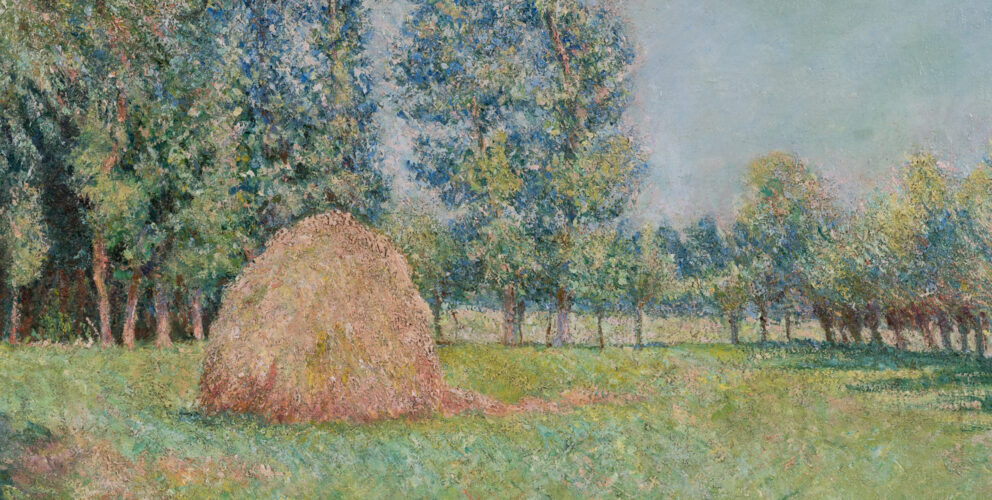
Edma Morisot-Pontillon, French, 1839–1921; Women in Woods (detail), 1860–69; oil on canvas; 19 3/4 × 25 1/2 × 1 inches; Saint Louis Art Museum, Gift of Bill Scott in honor of Simon Kelly 42:2026; Photo: Joseph Painter
The Saint Louis Art Museum’s current ticketed exhibition, Women Impressionists and the Land, opened on October 17, offering visitors a chance to see works by several major women artists in late 19th-century France. It is also an opportunity to see two paintings newly acquired by the Museum that are exhibited publicly for the first time.

Marie Bracquemond, French, 1840–1916; Still Life with Oranges, c.1880; oil on canvas; 18 1/4 × 21 15/16 × 7/8 inches; Saint Louis Art Museum, Gift of Mr. and Mrs. James W. Singer Jr., Dr. and Mrs. Harold Joseph, Mr. and Mrs. Morton D. May, Mr. and Mrs. Adam Aronson, Mr. and Mrs. Joseph Pulitzer Jr., Carl D. Lobell, and Samuel A. Marx, funds given by the Ruth Kelso Renfrow Art Club, gift of Leila and Monroe R. Meyerson, Emily Lambert Wilson, and Mr. and Mrs. Robert H. Shoenberg, all by exchange 43:2026; Image Courtesy Pavec, Paris, Photo: Pauline Assathiany
Marie Bracquemond, Still Life with Oranges, c.1880
Marie Bracquemond was described by French art historian Henri Focillon as one of the three “ladies of Impressionism,” but today her name is less known than her compatriots Mary Cassatt and Berthe Morisot. Newly discovered works by Bracquemond have come to light in recent years, thanks to two major auctions of her work in April and October 2024, as well as a large collection donated to the Musée d’Orsay in Paris by Bracquemond’s descendants, helping to reintroduce her to the public.
Much of what we know about Bracquemond (born Marie Quivoron), comes from an unpublished manuscript, “Vies de Félix et Marie Bracquemond,” written by her son, Pierre, in 1925, which has since been relayed by art historian Jean-Paul Bouillon, most recently in his chapter “Marie Bracquemond: The Lady with the Parasol” from the 2008 exhibition catalogue Women Impressionists published by Schirn Kunsthalle Frankfurt. Through these sources, Bracquemond’s life and artistic development comes into focus. She had a traditional artistic training, working in the studio of the great Academy painter Jean-Auguste-Dominique Ingres, then honing her skills by copying paintings at the Louvre Museum in Paris. Here, Bracquemond met several fellow artists, including the painter and printmaker Félix Bracquemond, whom she married in 1869.
Through Félix, Marie Bracquemond met several members of the Impressionist circle. Félix was friends with these artists personally but professionally rejected Impressionism. Marie, however, was deeply drawn to it, and began to move away from the darker tones and smaller-scale sentimental scenes that characterized her earlier work. By the mid-1870s, she began painting outdoors, experimenting with color and light like the Impressionists. Perhaps in recognition of this new direction of her work, Bracquemond was invited to exhibit in the 1879 Impressionist exhibition; she showed her work with them again in 1880 and 1886.
The 1880s marked a turning point in her career, as Bracquemond incorporated more-vibrant colors and lively brushwork into her paintings. She often worked in the garden of her home in Sèvres, a town to the southwest of Paris in France, and some of her most important work from this period depicts the lush greenery and fragrant flowers surrounding her balcony. Among these works is Still Life with Oranges, depicting an outdoor table setting with platters of oranges and cookies, and bottles possibly containing brandy and water, all arranged on a white tablecloth. Lilac blossoms surround the scene, creating a verdant backdrop to the still life.
The painting highlights Bracquemond’s skill as a colorist, with the vibrant orange fruit contrasting with the cool green and pale violet of the garden. The tablecloth in particular represents a key element of Bracquemond’s painting, as she was fascinated with the color white and the way light affected it; here, the white cloth is awash in glittering colors as it reflects the sunlight filtering through the lilac bushes. Still Life with Oranges was privately owned for years and remained unknown until recently. The Museum purchased the painting earlier this year, and it is currently on view for the first time in the Women Impressionists and the Land exhibition.
By the 1890s, Bracquemond had, unfortunately, largely given up painting, possibly due to her husband’s lack of support and her own ill health. Even though her work had been praised during her lifetime, she had mostly faded into Félix’s shadow in the years following her death, and much of her work remained out of public view. With the recent rediscovery and resurgence of interest in her work, Bracquemond may reclaim her place alongside the other great “ladies of Impressionism.”

Unknown photographer; Marie Bracquemond, c.1886; Imagine: Wikimedia Commons

Edma Morisot-Pontillon, French, 1839–1921; Women in Woods, 1860–69; oil on canvas; 19 3/4 × 25 1/2 × 1 inches; Saint Louis Art Museum, Gift of Bill Scott in honor of Simon Kelly 42:2026; Photo: Joseph Painter
Edma Morisot, Women in Woods, 1860s
While many people are familiar with the name Berthe Morisot as one of the major artists of the Impressionist group, her older sister Edma is less known. In fact, Edma is perhaps more recognizable as a model in many of Berthe’s early paintings; she can be seen in several works throughout the exhibition. However, Edma was also an accomplished artist, and recent scholarship on Berthe has further explored the dynamic between the two sisters as artists. For example, in the 2018 exhibition catalogue, Berthe Morisot: Woman Impressionist, art historian Marianne Mathieu examined the Morisot sisters’ artistic training as young women. According to Mathieu, the sisters took their lessons very seriously, with Edma even considered the more talented of the two.
In 1860, Edma and Berthe met the renowned landscape painter, Jean-Baptiste-Camille Corot, who encouraged them to paint outdoors. From then on, the Morisot sisters would work alongside one another, painting landscapes in the regions around Paris, and throughout France as they traveled on holiday with their family. Both Edma and Berthe exhibited their paintings in the official Paris Salon from 1864 to 1867, where their work was generally well received by critics.
However, in 1869, Edma married a naval officer, Adolphe Pontillon, and ultimately gave up painting. As a result, her work remains little known, and these rare paintings are only recently coming to light. Women in Woods is one such example. Depicting two figures on a dirt path through the woods, it is characteristic of Edma’s painting style from the 1860s. Her thick application of paint created the rough texture of the tree trunks, while her treatment of the leaves is wispy and soft, reminiscent of the style of her mentor, Corot. The painting was gifted to the Museum this year by the American painter Bill Scott, who has also written extensively on Berthe Morisot. Edma’s Women in Woods is currently being shown for the first time, on view alongside several early works by Berthe, serving as a testament to the bond between these artistic sisters.

Unknown photographer; Edma Morisot-Pontillon, c.1865, Private Collection, Paris