
The Vegetable Peddler
- Material
- Gelatin silver print

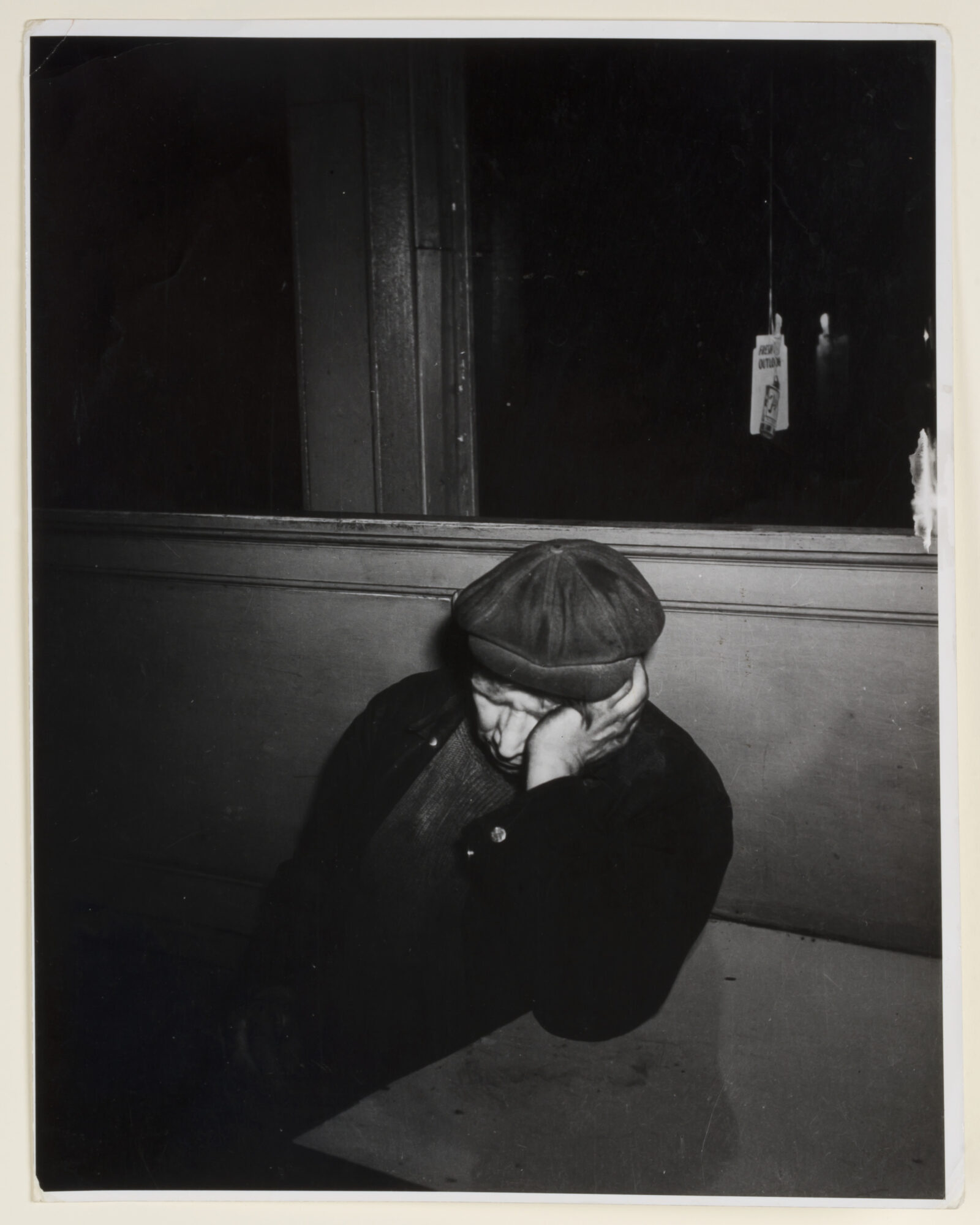
Weegee (Arthur Fellig), American (born Poland), 1899–1968; Sleeper in a Bar (detail), 1939; gelatin silver print; image: 13 9/16 x 10 5/8 inches, sheet: 13 15/16 x 10 15/16 inches; Saint Louis Art Museum, Gift of Bruce A. Kirstein in memory of Marc S. Kirstein 33:1978; © International Center of Photography / Getty Images
Photojournalist Arthur “Weegee” Fellig gained fame for his gritty black-and-white images capturing New York City crime and disaster during the 1930s and ’40s.
SLAM’s collection contains around a dozen Weegee works, ranging from murder scenes and a car crash to a man asleep on a New York City fire escape. Two Weegee photographs—The Vegetable Peddler and Sleeper in a Bar—are on view through early 2026 in May Department Stores Company Gallery 334.
Weegee (Arthur Fellig), American (born Poland), 1899–1968; The Vegetable Peddler, 1946; gelatin silver print; image: 12 1/2 x 9 9/16 inches, sheet: 14 x 11 inches; Saint Louis Art Museum, Gift of Bruce A. Kirstein in memory of Marc S. Kirstein 25:1978; © International Center of Photography / Getty Images
Weegee (Arthur Fellig), American (born Poland), 1899–1968; Sleeper in a Bar, 1939; gelatin silver print; image: 13 9/16 x 10 5/8 inches, sheet: 13 15/16 x 10 15/16 inches; Saint Louis Art Museum, Gift of Bruce A. Kirstein in memory of Marc S. Kirstein 33:1978; © International Center of Photography / Getty Images
Born Usher Fellig, Weegee took on the more American form of his name, Arthur, when he and his family arrived at Ellis Island from Poland in 1910 when he was a child. A self-taught photographer, he worked in a darkroom before getting behind the camera, shooting freelance for a variety of New York newspapers. Some sources attribute his nickname to his time working in darkrooms as a “squeegee boy” tasked with removing excess water from prints. However, the more popular anecdote of the moniker’s origin came in the 1930s based on the phonetic spelling of Ouija, the fortune-telling game; Weegee was said to possess an uncanny ability to arrive at a crime scene at or before the police, with a camera in hand.
Equipped with a police radio scanner in his 1938 Chevrolet and a mini darkroom in the trunk, Weegee believed in the immediacy of the image. He preferred high-drama pictures shot from unconventional angles and varied vantage points. The results prioritized harsh light, asymmetry, and bold lines. He often worked at night, attempting to capture the range of nocturnal life, which included quiet moments and isolated figures as well as subjects in vulnerable or even gruesome states. He approached these situations with a direct and unsentimental eye.
In 1945, Weegee published the first of five books, Naked City, whose films rights were sold to a Hollywood producer. Weegee moved to Hollywood to work on the film, and he photographed material for a later book, Naked Hollywood. When he returned to New York, he took on other photography projects, but his legacy in the medium was in the candid New York City street shots that exposed the harsh realities of urban life.
