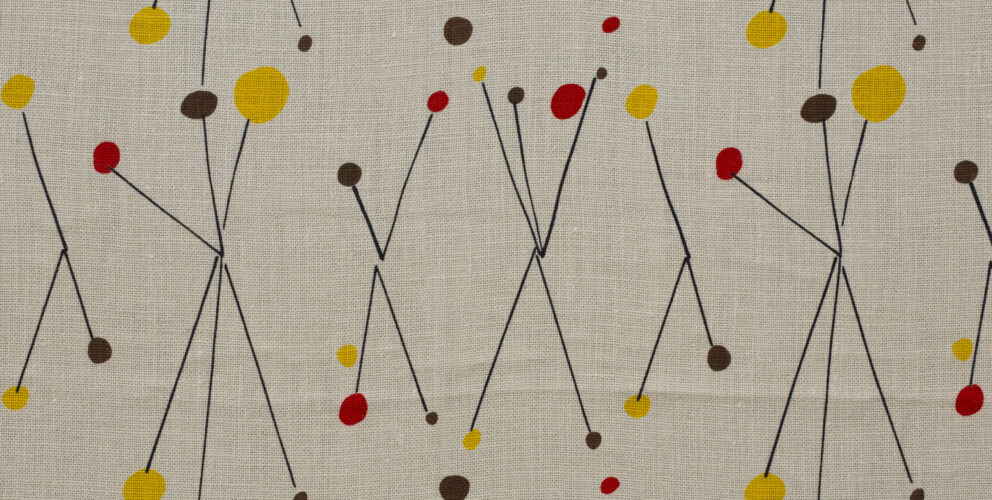
Gretl Wollner, Austrian, 1920–2006; and Leo Wollner, Austrian, 1925–1995; made by Pausa AG, German, 1911–2001; distributed by Knoll International, New York, 1969–1990; Rivers (detail), c.1972; printed cotton velvet; 48 1/2 x 122 inches; Collection of Michaela and Thomas Wollner 2024.273
After World War II, screenprinting became a bridge between handcraft and industry due to its speed and affordability. Prominent textile artists of the 1950s, ’60s, and ’70s—the height of experimental screenprinting—are featured in Bolts of Color: Printed Textiles after WWII, on view through April 20, 2025.
Screenprinting, a process in which ink is transferred to a textile or canvas using a stencil, first rose to prominence in the US in the 1930s. At the time, the technique was favored for producing the highway marking system, small- and large-scale advertising signage, and spare-tire covers. Screenprinting was slower to become popular in Italy and Britain, where the process was used for applying lettering to glass, printing book covers, and relief and glitter printing.
The demand for screenprinting increased dramatically during the tumultuous years of WWII. As a cheap and flexible alternative to other printing methods, screenprinting withstood the Great Depression and emerged on the other side as an established technique in the graphics industry. While WWII contributed to a decline in the advertising industry, it also generated an increase in government work, such as propaganda posters, maps, banners, Civil Defense armbands, dials for electronics, and more, according to Guido Lengwiler’s A History of Screen Printing: How an Art Evolved into an Industry. The production of these materials accelerated the development of the medium.
After the war ended and these government materials were no longer necessary, various other fields, including fine arts, took advantage of the advancements made to screenprinting processes. Stretchy, nylon screens allowed for improvement in dimensional stability and higher quality prints. Photographic stencils and knife-cut stencils largely replaced manual, handmade stencils, eliminating the problem of muddy edges in prints. An increase in automatic printing presses led to a similar increase in mechanized dryers and fast-curing inks.
Creative freedom coupled with rapidly changing fashions of post-Depression America encouraged artists and designers to experiment, realizing patterned fabrics with an incredible depth of color, texture, and precision. The bold and colorful screenprinted textiles on view in Bolts of Color respond to aesthetic and social trends of the postwar decades in the United States, Italy, and Britain, including the Pop and Op Art movements.
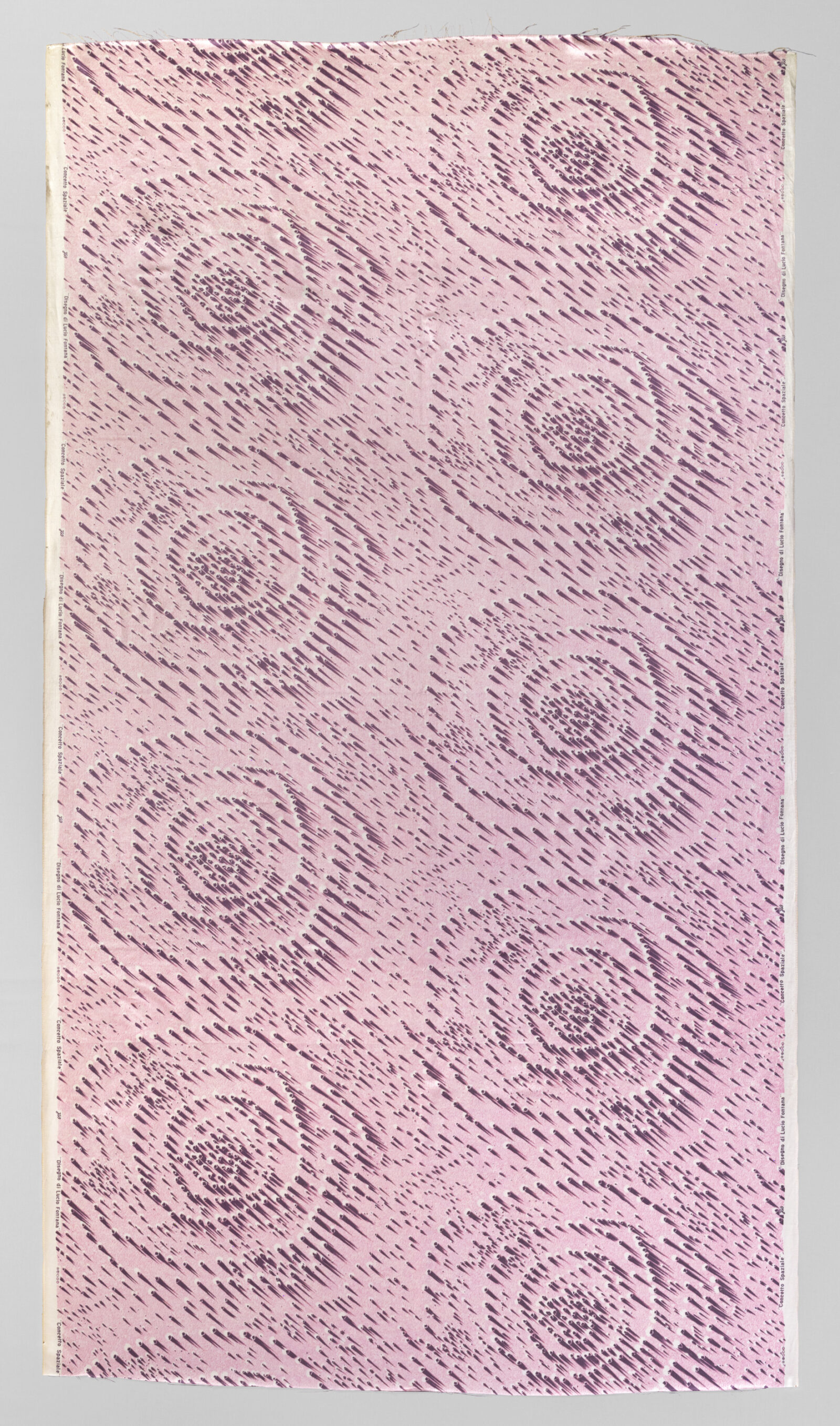
Designed by Lucio Fontana, Italian (born Argentina), 1899–1968; made by Manifattura Jsa, Busto Arsizio, Italy, Concetto Spaziale, 1954; screen-printed cotton sateen; 94 1/2 x 53 1/8 inches; Saint Louis Art Museum, Marjorie Wyman Endowment Fund 39:2023
In the postwar decades, Italian textile companies sought collaborations with artists to elevate their products, following a trend of combining fine art and design. Textile producer Manifattura Jsa led this trend, connecting with artists such as Lucio Fontana to produce avant-garde fabrics for modern homes. Fontana’s Spatial Concept, pictured above, was a response to these contemporary scientific leaps with an equally radical artistic approach. The stippled pattern of this printed textile evokes the pockmarked surface of the moon. Its photographic source employs raking light to dramatize the puncture marks, bringing dimension to the flat surface of the fabric.
Spatial Concept was used to upholster fashionable chairs, sofas, and beds, gaining widespread renown and popularity as an art textile after being displayed in 1954 at the 10th Milan Triennale, an art and design exhibition that occurred every three years.

Gretl Wollner, Austrian, 1920–2006; and Leo Wollner, Austrian, 1925–1995; made by Pausa AG, German, 1911–2001; distributed by Knoll International, New York, 1969–1990; Rivers, c.1972; printed cotton velvet; 48 1/2 x 122 inches; Collection of Michaela and Thomas Wollner 2024.273
Active across North America and Europe in the 1950s and ’60s, design duo and married couple Gretl and Leo Wollner were celebrated for their eccentric but sophisticated designs in fabrics and rugs. The artists shared a strong design ethos that prioritized experimentation, a standard prevalent in both Europe and the United States after the war.
In 1972, the pair collaborated with the US textile producer Knoll International to create a series of four large-scale textiles titled Three Meter Prints, including Rivers, pictured above. Rivers features ribbons of salmon pink, chocolate brown, sunny yellow, and dove gray that slither down the architecturally scaled textile, defying the clear boundaries between the strips. Intended to be displayed from floor to ceiling, the striking fabrics featured nonrepeating patterns printed using oversized screens, which needed four people to successfully maneuver them.
Screenprinting remains a popular medium across trades, especially fashion design. With tools like electronic presses, flash cure units, and synthetic inks and screens, modern screenprinting is faster than it has ever been.