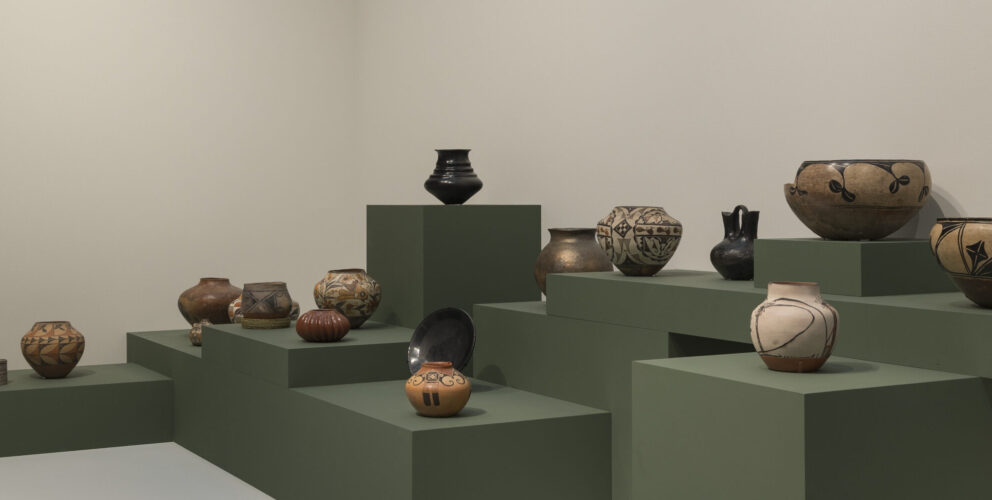
Installation view of Grounded in Clay: The Spirit of Pueblo Pottery.
Made literally from land, Pueblo pottery is one of America’s most enduring art forms. The exhibition Grounded in Clay: The Spirit of Pueblo Pottery showcases sculpture from two major collections, one in Santa Fe and one in New York City, and connects a remarkable group of Pueblo ceramics to contemporary Indigenous knowledge.
On view through September 14, Grounded in Clay offers a close study of an art form represented across SLAM’s collection galleries. The Museum’s collection of Pueblo pottery ranges from the ancient past to the 21st century, including artists from Pueblos in New Mexico, such as Acoma and Kha’p’o (Santa Clara), as well as Hopi in Arizona.

Ancestral Puebloan; Vessel with Painted Motifs (olla), c.1100–1250; ceramic with pigment; 10 1/2 x 14 inches; Saint Louis Art Museum, Funds given by the Children's Art Festival 172:1981
Vessel with Painted Motifs
A complex composition of black designs complements the large size of this jar. The repeating spiral and stepped motifs relate to an ancient ceramic style called Tularosa black-on-white.
Ancestral Puebloan peoples began painting ceramics in the first millennium CE. The Tularosa type is associated with later generations of artists, who were active from the twelfth to fourteenth centuries. This was the era when Pueblo peoples built cities at Mesa Verde and Chaco Canyon in the present-day Four Corners region.
This work is on view in Morton D. May and Louis D. Beaumont Foundation Gallery 113.
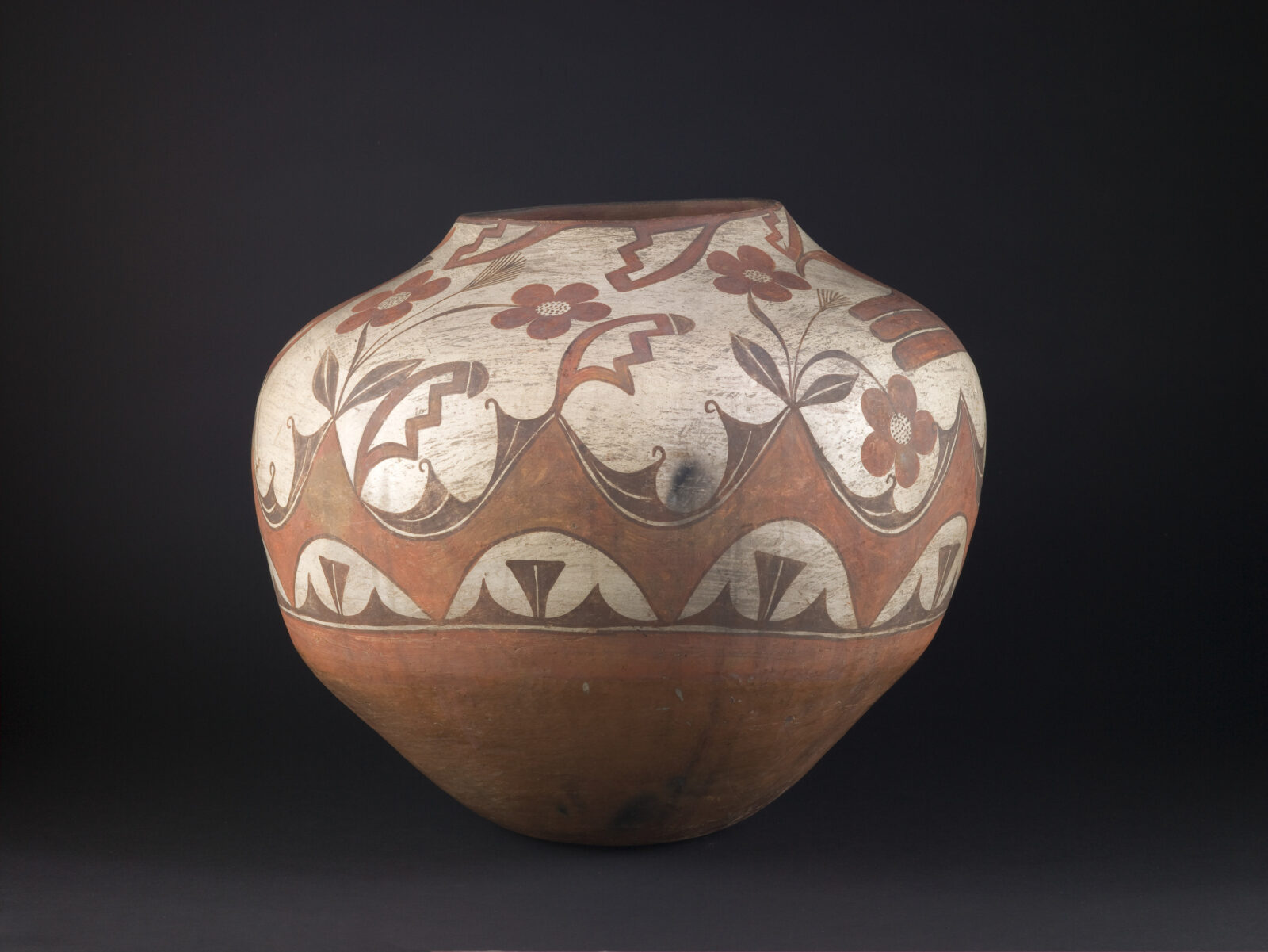
Zia Pueblo artist; Olla, c.1930; clay and pigment; 17 x 21 inches; Saint Louis Art Museum, Gift of Mary and Leon Strauss 121:2001
Olla
A rhythmic pattern encircles the center of the vessel shown above. A series of abstract medallions repeat across the base, while the swelling, pointed line at top gives way to a stylized landscape. Waves seem to crest in a series of arroyos, or gullies that channel flash floods. Above, large birds and flowers decorate the steeply in-curving shoulders and neck.
Artists from Zia Pueblo in northern New Mexico have long earned praise for compositions of paired birds and flora. This motif developed in the late nineteenth century, a period when artists developed locally distinctive styles of pottery painting at a number of Pueblos. Ethnographic collectors in the 1870s and, later, leisure travelers arriving on a new rail line helped to spur American markets for Pueblo pottery in the late 19th century.
This work is on view in Elissa and Paul Cahn Gallery 323.

Nora Naranjo Morse, Kha'p'o Owingeh (Santa Clara Pueblo), born 1953; Pods, 2016; clays (micaceous and Santa Clara) and pigment (bisque stains); on left: 30 x 10 x 10 inches; center: 36 x 13 x 13 inches; on right: 26 x 11 x 11 inches; Saint Louis Art Museum, Helen Kornblum Fund for Contemporary Native Women Artists; and Gift of Mr. and Mrs. Adam Aronson, by exchange 255:2022a-l; © Nora Naranjo Morse
Pods
In Pods, Nora Naranjo Morse, Kha’p’o Owingeh (Santa Clara Pueblo), responded to Pueblo aesthetic concepts that trace parallels between vessels, buildings, and the natural world. Organic forms repeat with subtle variations in size, proportion, and color. The bases resemble the beginnings of many hand-built ceramic vessels. Yet Morse kept going, creating seemingly self-contained ceramic forms. She extended the sculptures with elegant, tapering necks and adorned them with jewel-toned rings. Seedpods and dwellings each “contain, nurture, and protect another entity,” in the artist’s words. To hear more from the artist, check out the collection guide “Abstraction in Art of the Indigenous Americas.”
The artist created Pods in 2016. Morse is a leading figure in the fine-arts ceramic movement in northern New Mexico. In addition to her work in clay, she creates poetry, landscapes, and large-scale sculpture.
Pods is on view in Elissa and Paul Cahn Gallery 323.