


Stone Sea
- Material
- Missouri limestone
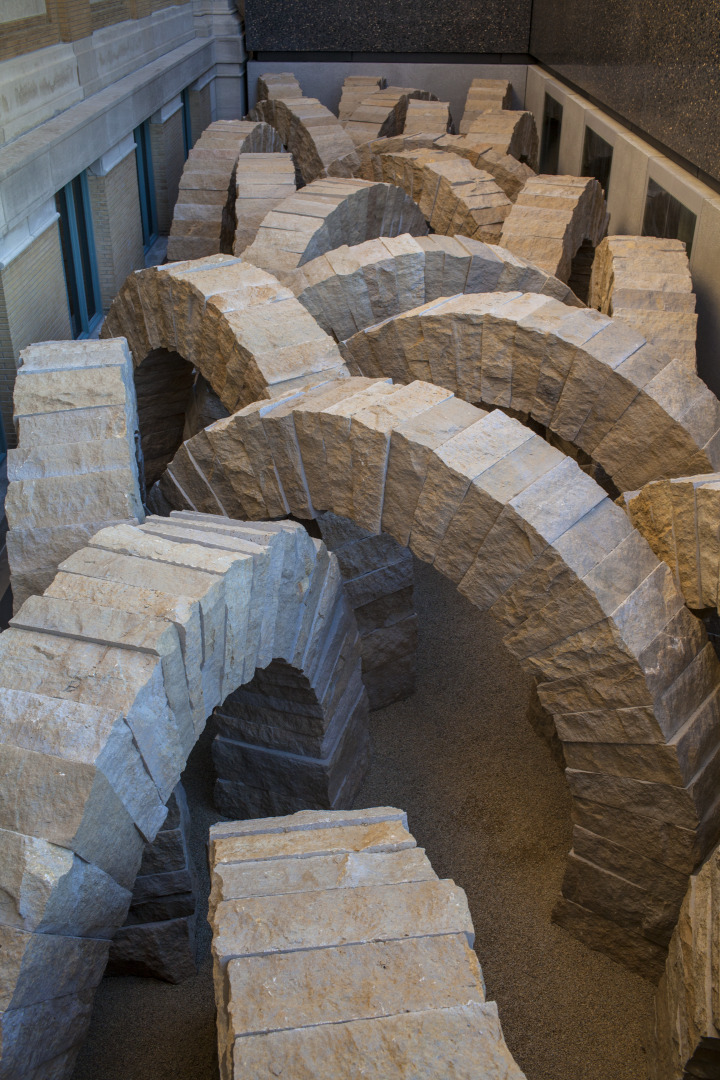
Andy Goldsworthy, English, born 1956; Stone Sea, 2012; Missouri limestone; courtyard: 12 feet × 73 feet × 20 feet; Saint Louis Art Museum, Commissioned by the Saint Louis Art Museum, Director’s Discretionary Fund, and funds given by Mr. and Mrs. Andrew C. Taylor, Paul M. Arenberg Family, James G. and Catherine B. Berges, Mr. and Mrs. F. Gilbert Bickel III, Alison and John Ferring, Roxanne H. Frank, Nancy and Kenneth Kranzberg, Mr. and Mrs. John Peters MacCarthy, Pam and Greg Trapp, Anabeth and John Weil, Mr. and Mrs. Gary Wolff, an anonymous donor, Mr. and Mrs. William C. Rusnack, Mr. and Mrs. David C. Farrell, Jane S. Shapleigh, Hope and Julian Edison, Eleanor J. Moore, Terry Moore Shepley, the Paul and Elissa Cahn Foundation, Mrs. Barbara S. Eagleton, Marcia Jeanne Hart, Bettie S. Johnson, Kodner Gallery, Jim and Dorte Probstein, Emily Rauh Pulitzer, Judge and Mrs. Charles A. Shaw, Susan and David Sherman III, Mary Ann and Andrew Srenco, the Third Wednesday Group, Keith H. Williamson, Jerome F. and Judith Weiss Levy, Helen Kornblum; and gift of Paul and Elissa Cahn and bequest of Guy A. Thompson, by exchange 30:2012; © Andy Goldsworthy 2012, Courtesy Galerie Lelong & Co., Photography by Scott Smith
The Saint Louis Art Museum revealed its largest artwork to the public in 2013, but the sculpture’s origins go back decades. The story began when renowned English sculptor Andy Goldsworthy first visited St. Louis in the 1980s. Goldsworthy didn’t know then that he’d return to the city more than 20 years later to create Stone Sea, a monumental, 300-ton sculpture located between the Museum’s historic Cass Gilbert–designed Main Building, and its newer, David Chipperfield–designed East Building. The sculpture marked a new era for SLAM, as the East Building opened in 2013 with Goldsworthy’s completed installation uniting old and new, both visually and symbolically.
Goldsworthy worked with a team including Museum leaders, curators, and staff to construct a giant sculpture visitors can see from multiple vantage points, including up close as they walk through it. Stone Sea is inspired by the immensity and power of the sea, as the name suggests. The sculpture’s dramatic stone arches reflect styles and techniques originating in ancient Rome, but Goldsworthy’s decision to work with local stones was informed by his previous experience working with raw materials around the world, as well as specifically in the Midwest. Stone Sea invites visitors to consider time, space, and evolution, and how these elements converge to create a work that reflects not only the city’s past and present, but also its future.
Andy Goldsworthy, English, born 1956; Stone Sea, 2012; Missouri limestone; courtyard: 12 feet × 73 feet × 20 feet; Saint Louis Art Museum, Commissioned by the Saint Louis Art Museum, Director’s Discretionary Fund, and funds given by Mr. and Mrs. Andrew C. Taylor, Paul M. Arenberg Family, James G. and Catherine B. Berges, Mr. and Mrs. F. Gilbert Bickel III, Alison and John Ferring, Roxanne H. Frank, Nancy and Kenneth Kranzberg, Mr. and Mrs. John Peters MacCarthy, Pam and Greg Trapp, Anabeth and John Weil, Mr. and Mrs. Gary Wolff, an anonymous donor, Mr. and Mrs. William C. Rusnack, Mr. and Mrs. David C. Farrell, Jane S. Shapleigh, Hope and Julian Edison, Eleanor J. Moore, Terry Moore Shepley, the Paul and Elissa Cahn Foundation, Mrs. Barbara S. Eagleton, Marcia Jeanne Hart, Bettie S. Johnson, Kodner Gallery, Jim and Dorte Probstein, Emily Rauh Pulitzer, Judge and Mrs. Charles A. Shaw, Susan and David Sherman III, Mary Ann and Andrew Srenco, the Third Wednesday Group, Keith H. Williamson, Jerome F. and Judith Weiss Levy, Helen Kornblum; and gift of Paul and Elissa Cahn and bequest of Guy A. Thompson, by exchange 30:2012; © Andy Goldsworthy 2012, Courtesy Galerie Lelong & Co., Photography by Scott Smith
While Goldsworthy’s St. Louis connection dates to the 1980s, his path toward creating Stone Sea began during his youth in England. Goldsworthy worked as a laborer on local farms during his teenage years, a physically demanding job he has compared to sculpting. His experience of farming was “as important, if not more important, than art school as a training ground,” Goldsworthy said in an interview with The Independent. He learned to work diligently all day, gaining strength and perseverance that would serve him well as an art student in England, and later as an internationally renowned artist based in Scotland.
In 1986, Goldsworthy visited St. Louis for the first time at the invitation of Tom Lang, a local artist and former art professor at Webster University. Lang brought Goldsworthy to visit SLAM during his time in town.
Following this trip, Goldsworthy went on to create some of his most famous works, including Herd of Arches (1994) in Dumfriesshire, Scotland, which features a series of large sandstone arches made from stone quarried near his home. In 2000, Goldsworthy was named an Officer of the Order of the British Empire (OBE) by the British government and Crown, recognizing his significant contributions to the arts.
Andy Goldwsworthy being interviewed at SLAM during the installation of his work Stone Sea
By the early 2000s, Goldsworthy had gained international acclaim for his works exploring art’s relationship to landscape. Even though he was based abroad and traveling often, Goldsworthy returned to St. Louis in 2008 after learning of an opportunity to work on a commission for the Museum.
Goldsworthy heard from Tom Lang about the Museum’s plan to expand its campus with the East Building. Blueprints for the new building included a sizeable open space because planners didn’t want to construct on top of the historic Main Building. To fill the space, SLAM decided to commission a permanent, site-specific installation. In 2008, Goldsworthy met with Chipperfield, the East Building architect, and Brent Benjamin, SLAM’s director at the time, to discuss a potential collaboration.
From around 2010, Goldsworthy; Andrew Walker, SLAM’s assistant director for curatorial affairs at the time; Simon Kelly, modern and contemporary art curator; and Tricia Paik, the Museum’s then assistant curator of modern and contemporary art, began devising a plan to create a work representing Missouri and respecting the open space for the installation. The team also wanted to incorporate local geology as a way to connect the past with the present. Goldsworthy’s prior experience working with local raw materials made the ambitious project more feasible.
Andy Goldsworthy, English, born 1956; Stone Sea: A Project for St. Louis, 2008; pencil on paper; sheet: 8 1/4 × 22 1/2 inches; Saint Louis Art Museum, Commissioned by the Saint Louis Art Museum 38:2013; © Andy Goldsworthy 2012, Courtesy Galerie Lelong & Co.
Goldsworthy is known internationally for his works made of stone, works that have influenced how people think about sculpture, landscape, time, and impermanence. Perhaps his best-known work is one he created more than a decade before making Stone Sea at SLAM: Storm King Wall (1997–98) at Storm King Art Center in New York. The 2,278.5-foot-long drystone wall winds through the Center’s landscape and disappears into a pond. Goldsworthy used locally sourced fieldstone for the wall, referencing the historic stone walls found in the Hudson Valley.
Goldsworthy also used natural materials to create sculptures in Midwest cities including Des Moines, Iowa, and Wichita, Kansas. In Wichita, Goldsworthy considered arches through the lens of regional geology. He used local stone to build an arch on the campus of Wichita State University in 2004, not realizing that almost a decade later, he would apply a similar knowledge base to his work at SLAM.
“Something that fascinates me about the whole Midwest is that it’s a very flat landscape with all this underlying geological rhythm and movement. The limestone originated in the sea—a material that is now so permanent was once part of something fluid,” Goldsworthy said in a 2013 Wall Street Journal story.
Andy Goldsworthy works on a model of Stone Sea (Photo © Whitney Curtis)
At the beginning of the Stone Sea project in 2009, Goldsworthy started researching what lay below the installation site at SLAM. He confirmed that limestone existed, which had formed in prehistoric times, when the region was covered with water. Goldsworthy wanted to create his sculpture from this limestone, but unfortunately, the bedrock under the Museum was too fragile to sculpt.
Instead, Goldsworthy decided to source similar limestone from the quarry Earthworks, Inc. in Perryville, Missouri, 70 miles outside St. Louis. He drafted a plan to create arches from the stones using ancient-Roman drystone engineering, a technique that requires no bonding agents or joints. The structure would remain stable through friction between each slab of stone and the natural pull of gravity. The interiors of each stone would be saw cut and sandblasted to add texture, and the exposed side of the stone would be guillotined, or rough cut with a straight, sharp blade. The resulting uneven surfaces would evoke a sense of unpredictability and energy, similar to the sea.
“Bedrock isn’t this dead, static material, but is something that’s alive and moving,” Goldsworthy said in an Architectural Digest interview about the project. “I wanted to reveal some of that fluidity that is in the ground and in the landscape.”
Installation of Andy Goldsworthy's Stone Sea, 2012; Saint Louis Art Museum Archives
To help bring Goldsworthy’s vision to life, a team extracted about six hundred pieces of stone from the quarry and loaded it into semitrucks. The stones went to a second fabrication site, where workers cut them to Goldsworthy’s specifications using a guillotine. Then, the stones were carefully transported on a flatbed truck one and a half hours north to SLAM, where Stone Sea installation would begin in the courtyard between the Main Building and East Building.
Construction on Stone Sea began in fall 2012. Before the stones arrived, a team excavated the area where they would be installed in an outdoor courtyard. Upon the stones’ arrival, workers stacked them near the Museum’s south facade in preparation for inventory. Each stone was marked to identify its future position in the installation. Afterward, the team used a large crane to lower stones one by one into the sunken courtyard. Once the stones were below ground level, an operator with a smaller spider crane lifted the stones to place them for the sculpture.
Installation of Andy Goldsworthy's Stone Sea, 2012; Saint Louis Art Museum Archives
Goldsworthy was involved in every step in the process, which resulted in a work of 25 roughly hewn arches weighing 300 tons total and measuring about 10 feet high; the Museum’s largest artwork.
The arches in Stone Sea are meant to symbolize the shallow seas of past millennia. The work is “a sea of stone, not because it’s meant to look like the sea, but because it IS the sea,” Goldsworthy said in a SLAM lecture, adding, “I’m drawing that out of the stone in the installation and the sense of movement.” Goldsworthy wanted visitors to experience the sculpture as powerful and energetic, the way they would watch or move through waves in the sea.
Andy Goldsworthy's Stone Sea Installation, 2012
Goldsworthy designed Stone Sea so visitors can experience the work from many perspectives. “I’ve never made a work that has so many very clear, distinct aspects to it. Each view is a different experience,” he said in a 2013 SLAM lecture.
One of the most popular ways to view the sculpture is by walking through it. Stone Sea is open to the public at certain times throughout the year. A list of dates and times for viewings is available on the SLAM events calendar. Currently, it can be viewed up close through the end of September 2026, weather permitting and on a first-come, first-served basis. Moving through the sculpture from the inside feels a bit like walking through desert rocks, with cool shadows and echoes throughout the arches.
Andy Goldsworthy's Stone Sea Docent Tours
Visitors can also view the work from various points around the Museum all year. From the Museum’s outdoor South Terrace, a visitor can look downward and see how Goldsworthy created fluidity and movement from static stone. The forms “seem to flow together, evoking the movement of the sea,” Kelly said.
Additionally, windows above Gallery 213; ground-level windows in Morton D. May and Louis D. Beaumont Foundation Gallery 113; and floor-to-ceiling windows along the Level 1 concourse offer a unique perspective on Stone Sea. Seen from inside the Museum, “each individual arch rises up like a cresting wave,” Kelly said.
Andy Goldsworthy, English, born 1956; Stone Sea, 2012; Missouri limestone; courtyard: 12 feet × 73 feet × 20 feet; Saint Louis Art Museum, Commissioned by the Saint Louis Art Museum, Director’s Discretionary Fund, and funds given by Mr. and Mrs. Andrew C. Taylor, Paul M. Arenberg Family, James G. and Catherine B. Berges, Mr. and Mrs. F. Gilbert Bickel III, Alison and John Ferring, Roxanne H. Frank, Nancy and Kenneth Kranzberg, Mr. and Mrs. John Peters MacCarthy, Pam and Greg Trapp, Anabeth and John Weil, Mr. and Mrs. Gary Wolff, an anonymous donor, Mr. and Mrs. William C. Rusnack, Mr. and Mrs. David C. Farrell, Jane S. Shapleigh, Hope and Julian Edison, Eleanor J. Moore, Terry Moore Shepley, the Paul and Elissa Cahn Foundation, Mrs. Barbara S. Eagleton, Marcia Jeanne Hart, Bettie S. Johnson, Kodner Gallery, Jim and Dorte Probstein, Emily Rauh Pulitzer, Judge and Mrs. Charles A. Shaw, Susan and David Sherman III, Mary Ann and Andrew Srenco, the Third Wednesday Group, Keith H. Williamson, Jerome F. and Judith Weiss Levy, Helen Kornblum; and gift of Paul and Elissa Cahn and bequest of Guy A. Thompson, by exchange 30:2012; © Andy Goldsworthy 2012, Courtesy Galerie Lelong & Co., Photography by Scott Smith
Andy Goldsworthy, English, born 1956; Stone Sea, 2012; Missouri limestone; courtyard: 12 feet × 73 feet × 20 feet; Saint Louis Art Museum, Commissioned by the Saint Louis Art Museum, Director’s Discretionary Fund, and funds given by Mr. and Mrs. Andrew C. Taylor, Paul M. Arenberg Family, James G. and Catherine B. Berges, Mr. and Mrs. F. Gilbert Bickel III, Alison and John Ferring, Roxanne H. Frank, Nancy and Kenneth Kranzberg, Mr. and Mrs. John Peters MacCarthy, Pam and Greg Trapp, Anabeth and John Weil, Mr. and Mrs. Gary Wolff, an anonymous donor, Mr. and Mrs. William C. Rusnack, Mr. and Mrs. David C. Farrell, Jane S. Shapleigh, Hope and Julian Edison, Eleanor J. Moore, Terry Moore Shepley, the Paul and Elissa Cahn Foundation, Mrs. Barbara S. Eagleton, Marcia Jeanne Hart, Bettie S. Johnson, Kodner Gallery, Jim and Dorte Probstein, Emily Rauh Pulitzer, Judge and Mrs. Charles A. Shaw, Susan and David Sherman III, Mary Ann and Andrew Srenco, the Third Wednesday Group, Keith H. Williamson, Jerome F. and Judith Weiss Levy, Helen Kornblum; and gift of Paul and Elissa Cahn and bequest of Guy A. Thompson, by exchange 30:2012; © Andy Goldsworthy 2012, Courtesy Galerie Lelong & Co., Photography by Scott Smith
Last but certainly not least, visitors can view Stone Sea year-round through a virtual tour available on the Museum’s website. The digital tour includes videos where Goldsworthy discusses specific aspects of creating the work, from its origins to installation. Visitors can also click to read captions describing Stone Sea and Goldsworthy’s inspiration for the sculpture.
No matter where visitors view the work, they will experience themes common in Goldsworthy’s art: a commitment to the arch form, which hearkens back to antiquity; the merging of interior and exterior; and perhaps most importantly, a connection between people and place. Stone Sea is a visual representation of St. Louis, reminding us of its history, while encouraging us to see the enduring power of art. The work seems to suggest that it’s impossible to see the future without considering the past. As Goldsworthy said in the SLAM lecture, Stone Sea “has become a connection between building and bedrock,” adding that he hopes children who visit the sculpture will carry the memory of being in that “forest of stone” into their own adulthood, and pass the experience on to their children.
