Made by Bow Porcelain Manufactory, London, England, active 1744–1776; Pair of Parrots, c.1760; glazed porcelain and enamel; Parrot, a: 6 5/8 x 4 3/4 x 5 1/4 inches, Parrot, b: 7 1/8 x 4 3/8 x 4 5/8 inches; Saint Louis Art Museum, Gift of Mr. and Mrs. Milton L. Zorensky, by exchange 431:2018a,b
Have you ever wondered why an artist has made an artwork part of a pair? Sometimes it is for functionality, such as the Pair of Torah Finials featured below, which adorned the two rods of a Torah scroll and brought attention to the text with their bells as the procession moved through the synagogue after readings. It could also be for aesthetic purposes; maybe the work felt unfinished without its partner. Whatever the reason, when it comes to art, the more the merrier.
Keep reading to view a selection of sculptures and metal works that were made to be part of a set, doubly enhancing SLAM’s collection.

Franz Anton Bustelli, German (born Switzerland), 1723–1763; made by Nymphenburg Porcelain Factory, Munich, Germany, founded 1747; Shepherd Playing a Lute, one of a pair, c.1756; glazed porcelain; 5 x 6 x 7 1/16 inches; Saint Louis Art Museum, Marjorie Wyman Endowment Fund and Museum Purchase; and bequest of Miss Josephine C. Cobb, gift of Mrs. Warren T. Chandler, Museum Purchase, gift of Mrs. William A. McDonnell, Friends of Mr. and Mrs. Henry Pflager, Mrs. Arthur G. Drefs, Horace Morison, bequest of Pearl B. Wright, gift of an anonymous donor, Mrs. Norman Laski, Mr. and Mrs. Charles Shucart in memory of Mr. and Mrs. Sebastian Pedrolie and Mrs. Jennie Shucart, Mr. and Mrs. Henry Kurusz Jr. in memory of Caitlin Elizabeth Kurusz, Gustave Taussig, Miss Dorothy L. Brown in memory of Miss Josephine C. Cobb, Mrs. James Stuart, Philip A. Windmuller, Mrs. Albert E. Blackmer in memory of her husband, Albert E. Blackmer, Mrs. Joseph H. Bascom, Dr. and Mrs. Charles Bennett, Mr. and Mrs. Oliver R. Burkart, Mr. and Mrs. Stanley J. Goodman, Mrs. William S. Bedal, and Jaquelin Ambler, by exchange 9:2012.2

Franz Anton Bustelli, German (born Switzerland), 1723–1763; made by Nymphenburg Porcelain Factory, Munich, Germany, founded 1747; Shepherdess Singing, one of a pair, c.1756; glazed porcelain; 5 1/8 x 4 3/4 x 4 1/8 inches; Saint Louis Art Museum, Marjorie Wyman Endowment Fund and Museum Purchase; and bequest of Miss Josephine C. Cobb, gift of Mrs. Warren T. Chandler, Museum Purchase, gift of Mrs. William A. McDonnell, Friends of Mr. and Mrs. Henry Pflager, Mrs. Arthur G. Drefs, Horace Morison, bequest of Pearl B. Wright, gift of an anonymous donor, Mrs. Norman Laski, Mr. and Mrs. Charles Shucart in memory of Mr. and Mrs. Sebastian Pedrolie and Mrs. Jennie Shucart, Mr. and Mrs. Henry Kurusz Jr. in memory of Caitlin Elizabeth Kurusz, Gustave Taussig, Miss Dorothy L. Brown in memory of Miss Josephine C. Cobb, Mrs. James Stuart, Philip A. Windmuller, Mrs. Albert E. Blackmer in memory of her husband, Albert E. Blackmer, Mrs. Joseph H. Bascom, Dr. and Mrs. Charles Bennett, Mr. and Mrs. Oliver R. Burkart, Mr. and Mrs. Stanley J. Goodman, Mrs. William S. Bedal, and Jaquelin Ambler, by exchange 9:2012.1
Shepherd Playing a Lute, one of a pair and Shepherdess Singing, one of a pair
These porcelains represent the 18th-century Rococo art style. This style was characterized by a lightness of colors, asymmetry, and opulent, fanciful subject matter. Franz Anton Bustelli’s (1723–1763) elegantly dressed porcelain lady sings for her companion, who plays a lute to accompany her song. Their natural setting is indicated by a tree supporting the female figure and a grassy bank adorned with flowers for the male. Each figure is beautifully modeled with great charm and exquisite costume detail, and this sense of character and expression is a distinctive attribute of Bustelli’s porcelain sculpture. He conceived his subjects as pairs and groups of individual figures, whose poses, gestures, and facial expressions suggest conversation and dynamic engagement. This evocative aspect of Bustelli’s figures explains his reputation with some experts as the greatest Rococo-style modeler of the 18th century.
These works are on view in Gallery 122.

Made by Bow Porcelain Manufactory, London, England, active 1744–1776; Pair of Parrots, c.1760; glazed porcelain and enamel; Parrot, a: 6 5/8 x 4 3/4 x 5 1/4 inches, Parrot, b: 7 1/8 x 4 3/8 x 4 5/8 inches; Saint Louis Art Museum, Gift of Mr. and Mrs. Milton L. Zorensky, by exchange 431:2018a,b
Pair of Parrots
These two white porcelain parrots were fired in London’s Bow Porcelain Manufactory around 1760. Ornamented with green, red, blue, yellow, and purple plumage, they are each perched on a tree stump dotted with modeled and multicolored flowers. The tree stumps are supported by a Rococo-style scrolled base, delicately brushed with purple pigment. One parrot is bowed and nibbles a small fruit clutched in its talons. The other is erect and looks over its shoulder while raising one foot, also clutching a small fruit in its talons.
These works are on view in Gallery 122.

Deep Dish with Design of the Seven Regal Treasures and the Eight Buddhist Emblems, 1842; Chinese, Qing dynasty, Daoguang period; Jingdezhen ware; porcelain with overglaze polychrome (famille rose) enamel decoration; 1 3/4 x 8 inches; Saint Louis Art Museum, Spink Asian Art Collection, Bequest of Edith J. and C. C. Johnson Spink 197:2014.1
Deep Dish with Design of the Seven Regal Treasures and the Eight Buddhist Emblems
A set of porcelain dishes with steeply rounded sides and short straight footrings, this work and another in the collection were created in Jingdezhen, China, in 1842. They are decorated in famille rose enamels around the exterior with seven leaf-shaped panels enclosing the “Seven Regal Treasures.” The “Seven Regal Treasures” are emblems of the Tibetan Buddhist pantheon and include the Wheel of the Law, the elephant, the horse, the jewel, a male deity, the minister, and the general. The panels are divided by stylized waves and rocks. Depicted on the upper and lower registers are the “Eight Buddhist Emblems,” divided by stylized shou characters. The base is marked in iron red with the two characters: Baragon Tumed in Mongolian script, meaning “Right or Western Wing of the Tumed Banners.“

Wilhelmus Angenendt, Dutch (born Germany), 1737–1817; Pair of Torah Finials, 1778; silver with gilding; height: 18 3/8 inches; Saint Louis Art Museum, The Deane and Paul Shatz Endowment Fund for Judaica 108:2000.1,.2
Pair of Torah Finials
These finials (rimmonim) capped the rods of a rolled Torah, the first five books of the Hebrew Bible and the most sacred object in the Jewish faith. Miniature breastplates, crowns, and precious textiles also adorned the scrolls when they were not in use. The finials’ bells drew attention to the Torah, draped in a trimmed mantle, or cloth cover, as a procession moved through the synagogue before and after readings.
Pair of Torah Finials are on view in Gallery 122.

Designed by Charles Sumner Greene, American, 1868–1957, and Henry Mather Greene, American, 1870–1954; made by Peter Hall Manufacturing Company, Pasadena, California, active 1906–1918; glass made by Emil Lange, American, 1866–1934; Hanging Lantern, from the Hallway of the Robert R. Blacker House, Pasadena, California, c.1908–9; mahogany, leaded glass, and ebony, with copper and silver inlay, and replacement leather straps; 29 x 18 x 18 inches; Saint Louis Art Museum, Friends Endowment Fund and funds given by the Marjorie Wyman Endowment Fund, the Joseph H. and Elizabeth E. Bascom Trust, the Richard Brumbaugh Trust in memory of Richard Irving Brumbaugh and Grace Lischer Brumbaugh, an anonymous donor, and the Allen P. and Josephine B. Green Foundation 62:2001
Hanging Lantern, from the Hallway of the Robert R. Blacker House, Pasadena, California
This lantern features panels of iridescent leaded glass depicting birds in flight, gently stepped contours, smooth edges, ebony pins, and a dramatic overhanging roof. These details reflect inspiration drawn from traditional Chinese furniture and Japanese prints and architecture. This lantern and another in the Museum’s collection were made originally for the Robert B. Blacker House in Pasadena, California, the first of the architectural firm Greene and Greene’s “ultimate bungalows.” For this expansive home, the Greene brothers designed interior woodwork, furniture, stained glass, and lighting to create an integrated artistic environment. They worked closely with skilled craftsmen, including glass artisan Emil Lange and cabinetmaker Peter Hall. Their expert handcraftsmanship distinguishes the Greenes’ furnishings from any other produced during the American Arts and Crafts movement of the early 20th century.
Both lanterns are on view in Gallery 129.
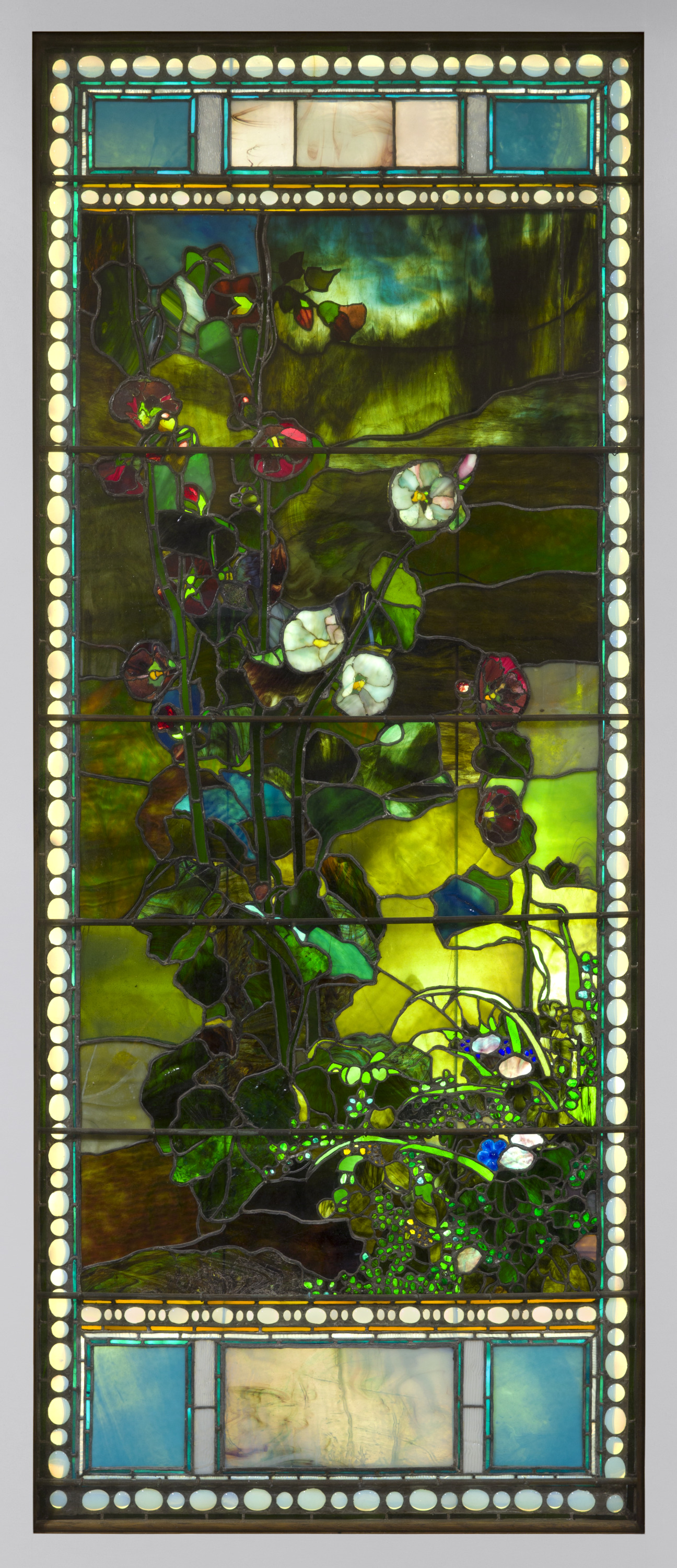
John La Farge, American, 1835–1910; Hollyhocks, window from the Frederick Lothrop Ames House, Boston, Massachusetts, 1882; leaded glass; 87 1/4 x 37 1/4 x 2 3/4 inches; Saint Louis Art Museum, Funds given by the Decorative Arts Society in honor of the Twentieth Anniversary of the Friends of the Saint Louis Art Museum 31:1972.1

John La Farge, American, 1835–1910; Flowering Cherry Tree and Peony, window from the Frederick Lothrop Ames House, Boston, Massachusetts, 1882; leaded glass; 87 1/4 x 37 1/4 x 2 3/4 inches; Saint Louis Art Museum, Funds given by the Decorative Arts Society in honor of the Twentieth Anniversary of the Friends of the Saint Louis Art Museum 31:1972.2
Hollyhocks and Flowering Cherry Tree and Peony, windows from the Frederick Lothrop Ames House
Hollyhocks, window from the Frederick Lothrop Ames House, Boston, Massachusetts and Flowering Cherry Tree and Peony, window from the Frederick Lothrop Ames House, Boston, Massachusetts were created as a pair in 1882 for the redesign of the Frederick Lothrop Ames house. The windows contain John La Farge’s revolutionary use of opalescent glass, significant because of the effects this glowing white glass had on light, color, and depth. The asymmetrical compositions and ornate floral patterns were inspired by La Farge’s paintings and his enthusiasm for Japanese art. La Farge was a painter, muralist, and decorator who shifted his artistic interests to the decorative possibilities of glass. His innovation lay in the way he exploited the characteristics of glass itself—manipulating, casting, and layering it to create myriad hues, textures, and depth, eliminating the traditional need for painted details.
Both windows are on view in Gallery 127.
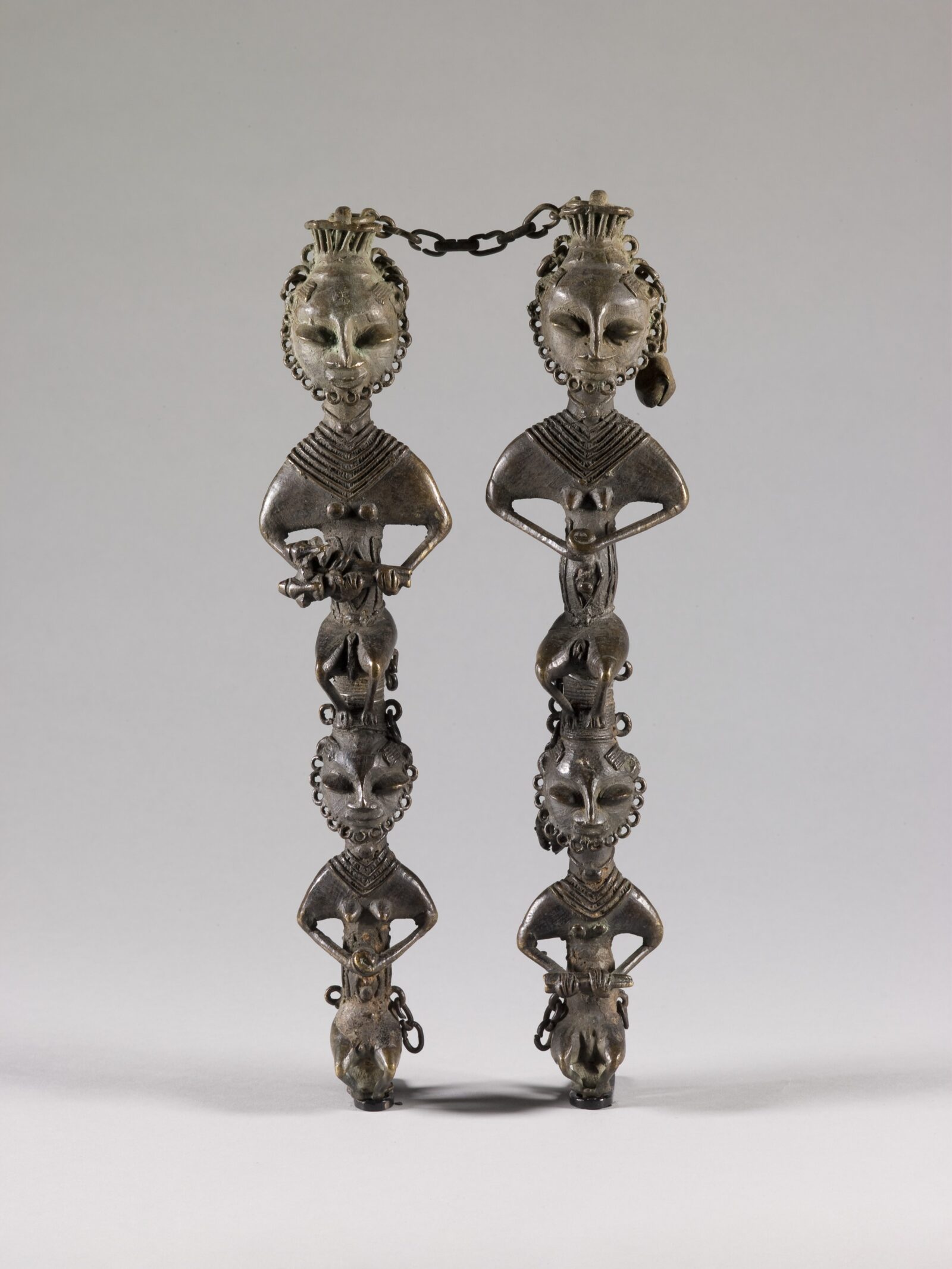
Yoruba artist, Nigeria; Staff Pair (edan ogboni), early 20th century; copper alloy, iron; 13 3/8 x 6 5/16 x 1 9/16 inches; Saint Louis Art Museum, Gift of Morton D. May 279:1972
Staff Pair (edan ogboni)
Repetition of paired imagery, as seen on this pair of staffs, emphasizes the wise male and female elders who make up the Oshugbo society, also known as Ogboni. This group of initiated members serves political, judicial, and religious functions, including the appointment of kings. These alternating, distinctively gendered figures suggest the importance of cooperation between men and women to sustain society—a principal Oshugbo tenet. Each elder would receive an edan, or pair of staffs upon initiation into the society. Here, the male figures hold figurative and nonfigurative edan. The female figures pose using the society’s hand gesture, left fist over right with thumbs concealed. Although proceedings of the Oshugbo society are largely secret, members could wear or employ edan for symbolic purposes in public settings.
This work is on view in Gallery 117.

Designed by Benjamin Henry Latrobe, American (born England), 1764–1820; made by John Aitken, American (born Scotland), 1760/65–1839; painted by George Bridport, American (born England), 1783–1819; Chair, 1808; painted and gilded yellow poplar, white oak, and white pine; gilded gesso; and original and replacement gilded cane; 34 1/4 x 20 x 19 1/2 inches; Saint Louis Art Museum, Funds given by the Decorative Arts Society in honor of Charles E. Buckley 217:1975.1

Designed by Benjamin Henry Latrobe, American (born England), 1764–1820; made by John Aitken, American (born Scotland), 1760/65–1839; painted by George Bridport, American (born England), 1783–1819; Chair, 1808; painted and gilded yellow poplar, white oak, and white pine; gilded gesso; replacement and original gilded cane; 34 1/4 x 20 x 19 1/2 inches; Saint Louis Art Museum, Funds given by the Decorative Arts Society in honor of Charles E. Buckley 217:1975.2
Pair of Chairs
Dramatically curved and boldly colored, these chairs heralded a new style of classicism in American furniture—a style that turned to ancient Greek forms for its models. The chairs are from a large suite of tables and seating furniture by the English architect Benjamin Henry Latrobe for the drawing room of the house he designed for the Philadelphia merchant William Waln. The simplified palette of red, black, and gold provides clarity and contrast for the classical assortment of gilded palmettes, lyres, and foliage that adorn the chairs’ surfaces. Each crest rail in the set of chairs features a different composition of mythological creatures. Latrobe’s innovative design presented a challenge for the furniture maker he commissioned to make the set. Writing to his client, Latrobe complained that the first model “was the ugliest thing I ever saw. To make a chair requires as much taste as to design one.”