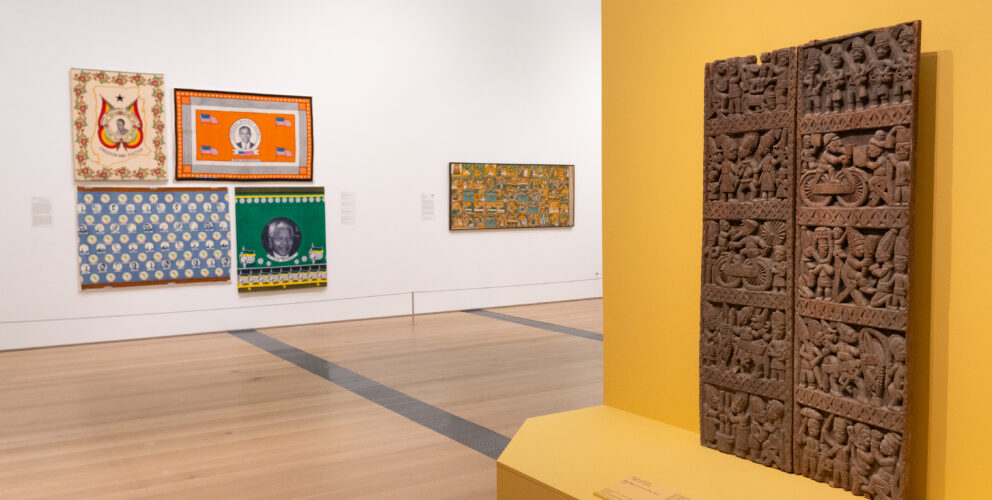
Installation view of Narrative Wisdom and African Arts, 2024
On view in Narrative Wisdom and African Arts, Sokari Douglas Camp’s work Relative illustrates the unimaginable cost of extractive capitalism, or the extraction of natural resources from the earth for profit. The sculpture by the Nigerian-British artist invites viewers to consider their relationship to land that has been lost to human-caused climate change.
Made of steel, acetate, glass, and gold leaf, Relative showcases a pair of figures dressed in metal renditions of traditional Kalabari formal wear. The feminine figure on the left wears an ankle-length wrapper, a white shirt, and a head tie. The masculine figure on the right wears a knee-length shirt called Etibo and a bowler hat. Between themselves, they hold a framed photograph of a pelican and its watery surroundings. This pose references the memorial traditions of the Kalabari peoples of the eastern Niger River Delta region, where Camp was born in 1958.

Sokari Douglas Camp, Nigerian (active England), born 1958; Relative, 2010; steel, acetate, glass, gold leaf; 38 9/16 x 31 7/8 x 7 7/8 inches; Courtesy of the Artist 2024.288; © 2024 Artists Rights Society (ARS), New York / DACS, London
During traditional Kalabari funerals, family members carry photographs of recently deceased relatives through town to demonstrate their relationship to those who have passed on. According to Camp, who was featured in the Narrative Wisdom audio guide, the family member represented in the middle of Relative is “the pelican who suffered very much in 2010 when there was an oil spill off the coast of Florida.” Camp created Relative the same year the tragic Deepwater Horizon oil spill occurred.
This disaster in the Gulf of Mexico made international news and prompted a campaign by then-President Barack Obama, encouraging BP to be held accountable for the explosion of their oil rig. According to Elyse Schaeffer—former research assistant for SLAM’s department of the arts of Africa, Oceania, and the Americas—in the Narrative Wisdom and African Arts exhibition catalogue, the campaign idolized the oil-slick pelican: “The doomed birds became the poster child” for the quest for compensation from BP. This inspired Camp to create Relative. As she says in the Narrative Wisdom audio guide, “I felt very struck by this [response] because people in the Niger Delta have been suffering from oil spills for over 30 years, if not 40 years, and we’ve never had front page news to say how much we’re suffering.”
It was always nice to go to this island and to walk around the palm groves and the mounds where our people are buried. Now we have a roaring oil well beside the island and so much pollution. It is no wonder that in the region, where there are still few modern conveniences, Kalabari people are only living to their fifties.
—Sokari Douglas Camp, 2023
According to the National Library of Medicine, “it is widely believed that an estimated 13 million barrels (1.5 million tons) of crude oil have been spilled since 1958 from over 7000 oil spill incidents; a yearly average of about 240,000 barrels.” Spilled oil contaminates ground water, sickens humans and wildlife, and damages habitats, all while methane-leaks from oil rigs heat the atmosphere and acidify rainwater. BP provided the United States $1 billion in restoration funds. Despite the Kalabari communities’ commitment to political resistance against oil companies that exploit the region’s resources, little compensation has been provided to those affected by fracking in the Niger River Delta.
Relative emphasizes the memory of the Niger Delta and its inhabitants that have been disrupted, displaced, and diseased. In the exhibition catalogue, Schaeffer describes the sculpture as an acute commentary on the gross mismatch between the environmental movement’s historical focus on “loss of animal life compared to the disproportionately large impact climate change has already had on Black and Brown communities.”
The work, also known by the title Relative Pelican, says “I’m your relative; take notice of me,” according to Camp. It urges viewers to consider their relationship to creatures and places we have lost due to human-caused climate change, for fear that even more will become pure memory as the cost of extractive capitalism.
This information was adapted from Elyse Schaeffer’s essay,“ Grounded Narratives,” which appears in the exhibition catalogue Narrative Wisdom and African Arts. The catalogue considers ways in which historical and contemporary African arts make visible narratives rooted in collective and individual memory and knowledge. It is available for purchase online and in Museum shops.