


America: A Hymnal
- Material
- Ink on laser-cut leaves of paper, bound in cloth-wrapped binding with ribbon bookmark

Installation view of Picturing Independence. Bethany Collins, American, born 1984; published by PATRON Gallery, Chicago, Illinois, founded 2015; and Candor Arts, Chicago, Illinois, active 2015–2021; America: A Hymnal, 2017; ink on laser-cut leaves of paper, bound in cloth-wrapped binding with ribbon bookmark; closed: 6 1/4 x 9 1/4 x 5/8 inches; Saint Louis Art Museum, Gift of Buzz Spector and Njara Stout in honor of Elizabeth Wyckoff 326:2021; © Bethany Collins
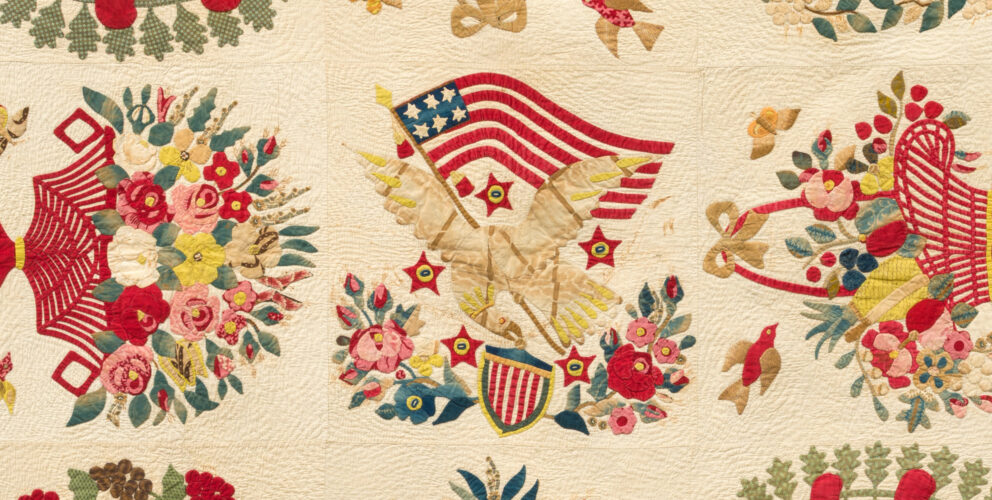
The Saint Louis Art Museum’s Picturing Independence exhibition explores how past and present artists depicted American independence, in honor of the United States’ 250th birthday. Many of the 32 works in the exhibition feature symbols Americans commonly associate with independence: the flag, bald eagles, and regal portraits of the founding fathers. Three artists, however, considered not only what independence looks like but also what it sounds like.
Bethany Collins, American, born 1984; published by PATRON Gallery, Chicago, Illinois, founded 2015; and Candor Arts, Chicago, Illinois, active 2015–2021; America: A Hymnal, 2017; ink on laser-cut leaves of paper, bound in cloth-wrapped binding with ribbon bookmark; closed: 6 1/4 x 9 1/4 x 5/8 inches; Saint Louis Art Museum, Gift of Buzz Spector and Njara Stout in honor of Elizabeth Wyckoff 326:2021; © Bethany Collins
Bethany Collins, the only known living artist from this exhibition, filled a book with 100 different versions of the American classic “My Country ’Tis of Thee.” Using a laser, she burned the unifying notes from the book, leaving only what made the songs different.
“My Country ’Tis of Thee” served as a form of protest and dissent throughout history. The melody originated in the British anthem “God Save the King,” praising monarchy. American author and minister Samuel Francis Smith rewrote the lyrics as a celebration of American independence. In 1831, a children’s choir debuted “My Country ’Tis of Thee” on the 4th of July. Since then, activists from the 18th to the 20th centuries borrowed the tune but changed the words to support political movements such as temperance, suffrage, abolition, and secession.
Collins’s work presents American independence as a fluid idea. American independence looks different depending on your age, class, gender, race, or religion. American independence feels different if you have always had the right to vote or if you only held that right for less than half of American history. American independence sounds different during interrogation and celebration—what Collins calls “a familiar chaos of dissenting versions of what it means to be . . . American bound together.”
Audrey Flack, American, 1931–2024; printed by Styria Studio, New York, New York; published by Lorillard Tobacco Company, Greensboro, North Carolina, active 1760–2015; Fourth of July Still Life, from the Kent Bicentennial Portfolio: Spirit of Independence, 1975; screenprint, laminated die cut; image: 36 x 36 inches, sheet: 40 x 40 inches; Saint Louis Art Museum, Gift of Lorillard, Inc. 52:1976.11; © Estate of Audrey Flack
Between the depictions of presidential war heroes George Washington and Ulysses S. Grant foiled against the 4th of July party streamers and fireworks, a polished trumpet slices its way through the screenprint. The trumpet is, perhaps, not a common national symbol. But its melodies surround American celebrations and requiems. At the beginning of sporting events, graduations, and more, the trumpet soars over other instruments in the “Star Spangled Banner.” The trumpet also stands alone to play “Taps” at Memorial Day celebrations and military funerals. These uniquely American melodies show how independence supports victory and loss.
Audrey Flack’s work is one of 12, originally commissioned for the Kent Bicentennial Portfolio: Spirit of Independence in 1975. Fifty years later, the icons Flack chose serve as a time capsule, showing Americans how independence has changed or stayed the same since the bicentennial.
Helen LaFrance, American, 1919–2020; Marching Band, 1994–99; oil on canvas; 18 x 24 inches; Saint Louis Art Museum, Funds given by Lotsie and Rick Holton 204:2019; © Estate of Helen LaFrance
Lawn chairs lining the sidewalks of the street; red, white, and blue decorations accessorizing the buildings; and a marching band filling the atmosphere with triumphant American melodies: Helen LaFrance’s oil painting emits American pride and nostalgia through a celebration of independence. To communicate feelings of childhood memories, she used abstracted patterns—like red, white, and blue balloons that become dots in the sky. The painting practically plays a rendition of “You’re a Grand Old Flag” when you look at it.
Marching bands have a deeper history than their celebratory nature would imply. During the revolution, marching bands used different rhythms to inform soldiers of commands on the battlefield. The purpose of marching band, like definitions of independence, grew and shifted as America aged. Now, they play in parades, inaugurations, and even American football games.
These works are on view in Shoenberg Gallery 236 as a part of Picturing Independence until January 24, 2027.

