Carlos Mérida, Guatemalan (active Mexico), 1891–1985; The Three Princesses, 1955; lacquer and casein on parchment mounted on laminated wood; 16 1/8 x 12 5/8 inches; Saint Louis Art Museum, Gift of Mr. and Mrs. Joseph Pulitzer Jr. 167:1959; © 2024 Artists Rights Society (ARS), New York / SOMAAP, Mexico City
National Hispanic Heritage Month, celebrated from September 15 to October 15, honors the history and culture of Hispanic and Latino Americans, whose ancestors came from Spain, Mexico, the Caribbean, and Central and South America. The Saint Louis Art Museum’s collection boasts more than 380 works by Hispanic artists. Continue reading to view a selection of contemporary and ancient objects by Hispanic artists.
Contemporary works
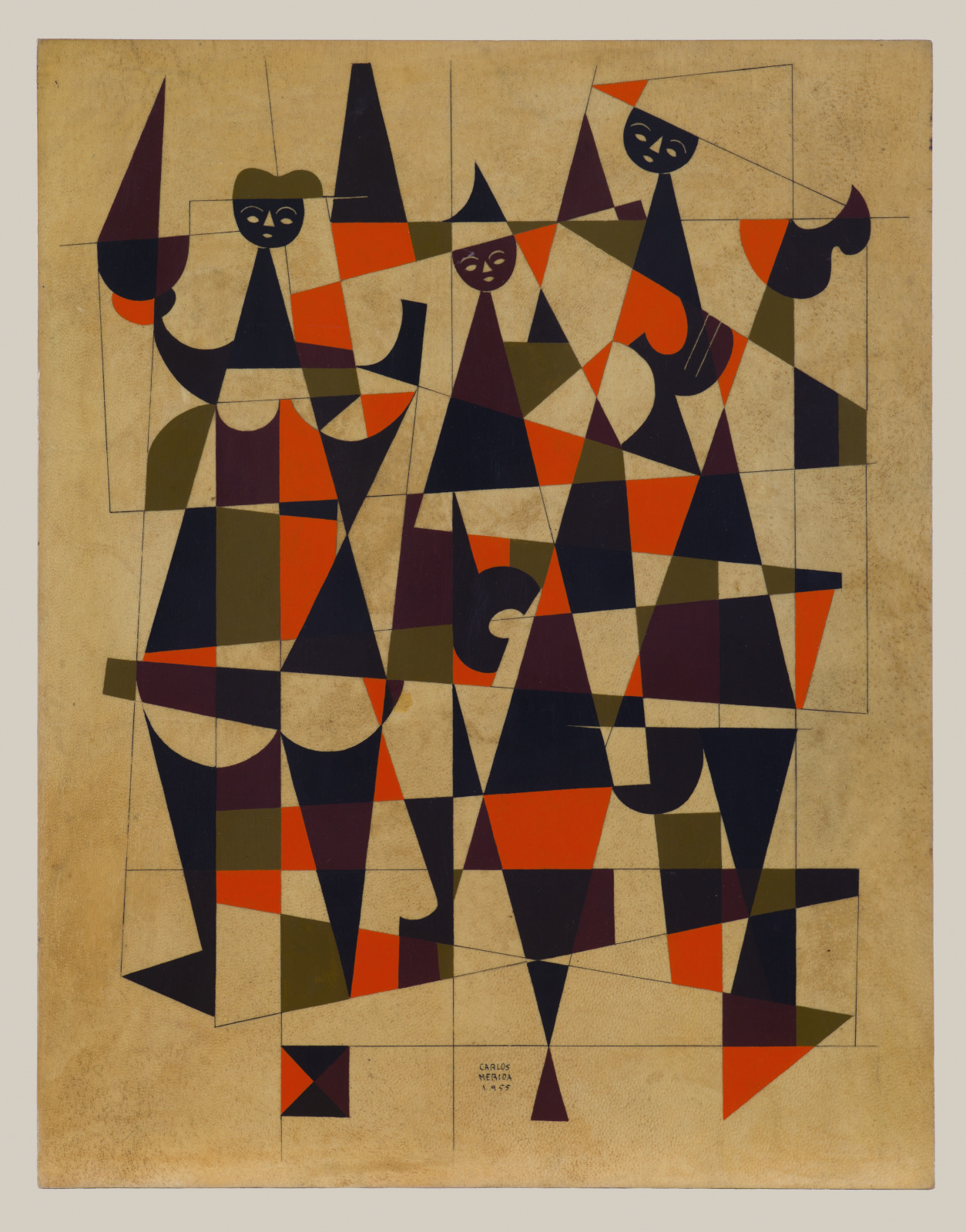
Carlos Mérida, Guatemalan (active Mexico), 1891–1985; The Three Princesses, 1955; lacquer and casein on parchment mounted on laminated wood; 16 1/8 x 12 5/8 inches; Saint Louis Art Museum, Gift of Mr. and Mrs. Joseph Pulitzer Jr. 167:1959; © 2024 Artists Rights Society (ARS), New York / SOMAAP, Mexico City
The Three Princesses
In this composition, intersecting lines create an irregular grid of triangles, curves, and unique shapes. These colorful components form the bodies and clothing of three female figures. Artist Carlos Mérida (1891–1985) advocated a type of abstraction based on the bold, geometric patterns and vibrant colors of Maya textiles and other Indigenous Latin American arts. Mérida, a Guatemalan artist who lived much of his life in Mexico, sought to establish a uniquely American form of abstract art in conversation with contemporary European artistic developments.
This work is on view in the Mae M. Whitaker Gallery 212.
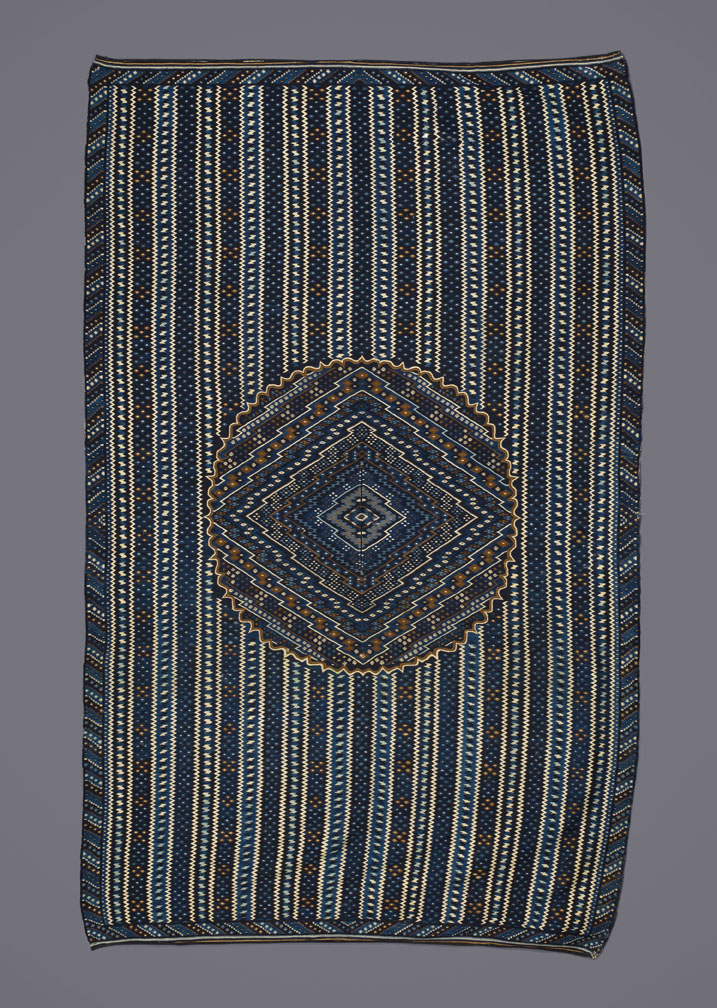
Mexican artist; Serape, c.1800; wool and dye; 93 x 56 1/2 inches; Saint Louis Art Museum, Gift of Elissa and Paul Cahn 262:2017
Serape
The intricate pattern of this wearing blanket achieves a striking sense of tension between the central diamond figure and the repeating, small-scale background. Featuring one of the most complex designs of its era, this textile was likely created by specialist weavers at a small workshop north of Mexico City.
Often called Saltillo serapes, these garments circulated widely across colonial Mexico (New Spain), including Santa Fe and Taos in the present-day United States. One of the major venues for trade in the colonial era was an annual fair in Saltillo, today the state capital of Coahuila, Mexico.

Diego Rivera, Mexican, 1886–1957; Yucatan Woman Waiting While Maize Is Ground, 1931; pen and ink and graphite; 19 x 12 1/2 inches; Saint Louis Art Museum, Gift of Mr. and Mrs. Irvin Dagen 144:1984; © 2024 Banco de Mexico Diego Rivera Frida Kahlo Museums Trust, Mexico, D.F. / Artists Rights Society (ARS), New York
Yucatan Woman Waiting While Maize Is Ground
Diego Rivera (1886–1957) drew this work for the frontispiece of Stuart Chase’s book, Mexico: A Study of Two Americas. Published in 1931, the book includes numerous illustrations by Rivera of scenes of traditional daily life in rural Mexican villages. This drawing exemplifies Rivera’s brush and ink technique, which is characterized by economy of line and clarity of image. The artist developed this style while on a government-funded trip in 1922 to Tehuantepec, where he hoped to learn more about Mexican art and culture for his public mural projects.
This work can be viewed upon request in the Museum’s Print Study Room.
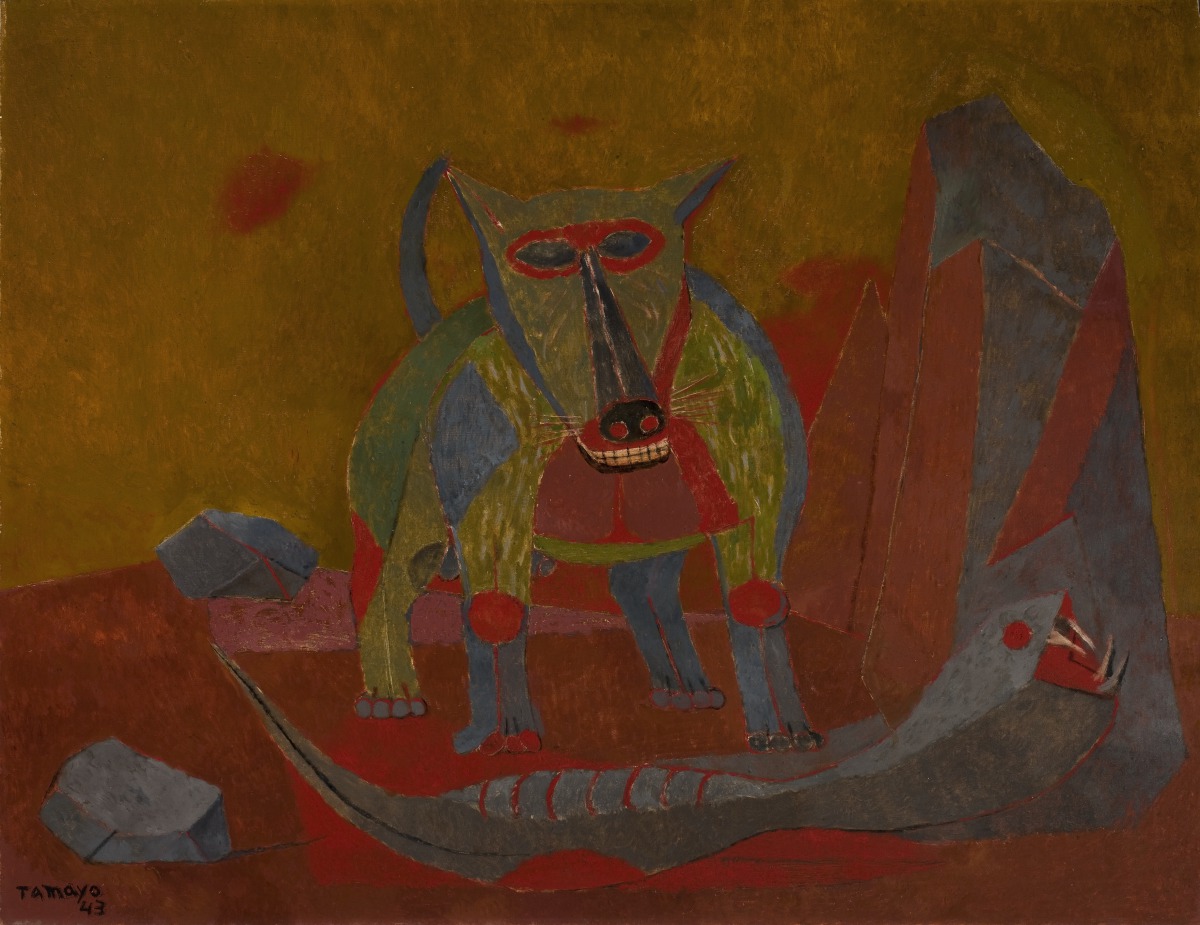
Rufino Tamayo, Mexican, 1899–1991; Dog and Serpent, 1943; oil on canvas; 34 1/8 x 44 1/4 inches; Saint Louis Art Museum, Gift of Morton D. May 234:1954; © 2024 Tamayo Heirs / Mexico / Artists Rights Society (ARS), New York
Dog and Serpent
In a rocky landscape, a short dog bares its teeth, ready to pounce on a fanged serpent. Artist Rufino Tamayo (1899–1991) modeled this native Mexican hairless dog after a type of Mesoamerican canine-shaped funerary vessel. Spending extended time in New York City during World War II, Tamayo became keenly aware of the worldwide conflict. The impending struggle between two wild animals is an allegory for this large-scale violence.
This work is currently on view in the Mae M. Whitaker Gallery 212.
Ancient works

Column with Hieroglyphs, 715; Maya, Mexico, Late Classic period; limestone with pigment; 22 7/16 x 9 1/16 inches; Saint Louis Art Museum, Gift of Morton D. May 384:1978
Column with Hieroglyphs
The elaborately carved figures and symbols seen on this column are Maya hieroglyphs, a writing system that mixes pictorial representations with phonetic signs. Most Maya monuments focus extraordinary emphasis on chronological precision as they describe detailed political histories of competing city-states. In Maya writing, dots record single units, and bars record five. Texts typically begin in the upper left, moving to the right and top to bottom in double columns. Here, the first nine glyphs record the date in an array of different Maya calendars that correspond to a day in April 715. On that day, the ruler of Bonampak commemorated the 13th anniversary of his reign. The text goes on to document his status as the vassal of a Tonina ruler known as K’inich B’aaknal Chaak, “Great-Sun Bone-Place Rain God.”
This work is on view in the Morton D. May and Louis D. Beaumont Foundation Gallery 113.

Vessel in the Form of a Calabash, c.1200–900 BC; Las Bocas, Mexico, Early Formative period; ceramic; 4 x 6 1/4 x 3 3/4 inches; Saint Louis Art Museum, Gift of Morton D. May 69:1980
Vessel in the Form of a Calabash
The elegant form and highly burnished surface of this vessel imitates shapes from natural squash plants like the calabash, pumpkin, and oval gourds known as tecomate. For the ancient residents and farmers of the Valley of Mexico, squash served multiple purposes. When complemented with maize and beans, its rich proteins formed a complete nutritional diet. Mesoamerican farmers often grew this triad of plants together; beans replaced the nitrogen taken up by maize and squash in the earth. Gourds could also be used as containers for food and water, making their ceramic counterparts a more permanent representation of the agricultural products that supported the complex societies of ancient Mesoamerica.
This work is on view in the Morton D. May and Louis D. Beaumont Foundation Gallery 113.

Incense Burner Lid in the Form of a Skeletal Canine, c.1200–1400; Mixteca-Puebla, Mexico, Late Postclassic period; ceramic with pigment; 30 7/16 x 21 7/8 x 18 1/2 inches; Saint Louis Art Museum, Gift of Morton D. May 333:1978
Incense Burner Lid in the Form of a Skeletal Canine
With protruding ribs and knees, and elbows seemingly scraped to the bone, this skeletal canine probably depicts Xolotl, a Postclassic deity of the night. Closely linked to the planet Venus in its evening appearance, Xolotl was paired with Quetzalcoatl, who was identified with Venus in its morning appearance. As a trusty canine follows its master, Xolotl would accompany the sun on its nighttime journey through the underworld. Objects like this would have been placed over beads of burning incense, causing smoke to emerge from the eyes and mouth.
This work is on view in the Morton D. May and Louis D. Beaumont Foundation Gallery 114.
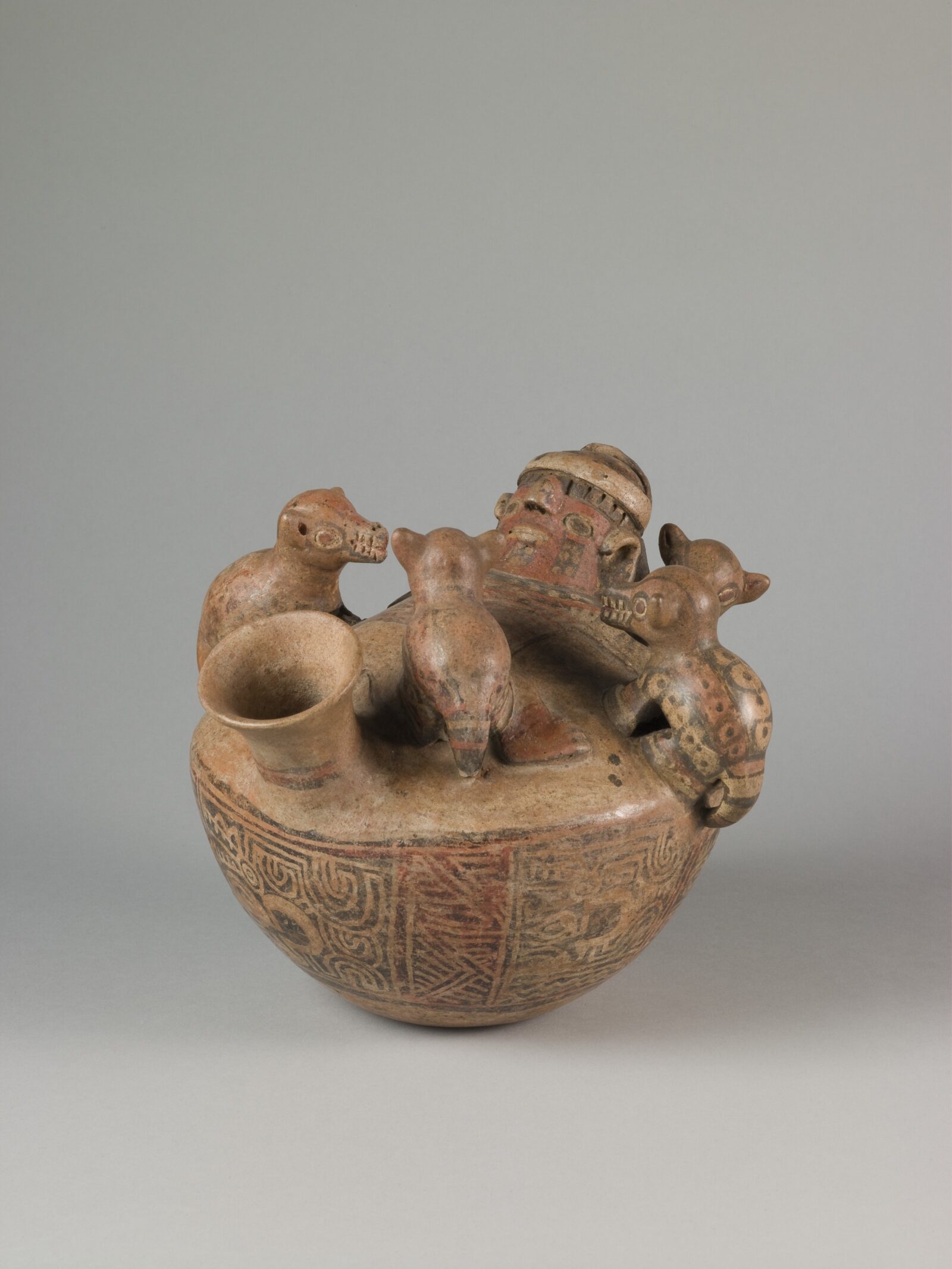
Vessel with Sacrificial Scene, c.100–600; Recuay, Peru, Early Intermediate period; ceramic with pigment; 7 5/16 x 8 3/4 inches; Saint Louis Art Museum, Gift of Morton D. May 347:1978
Vessel with Sacrificial Scene
Four canine creatures surround a man splayed on his back, baring their sharp teeth in preparation for attack. The man’s vulnerable yet seemingly willing position, as well as his elaborate clothing and headgear, suggest that this elite figure is offering himself as a sacrifice. This vessel was likely used in rituals that honored the ancestors whose deaths established their lineage.
Art from Recuay, Peru, often represents confrontations, celebrating moments when opposing forces interact. This emphasis on conflicting states of being is further embodied in the canine creature, which also appears painted in linear profile along the lower half of the vessel.
This work is on view in the Morton D. May and Louis D. Beaumont Foundation Gallery 111.
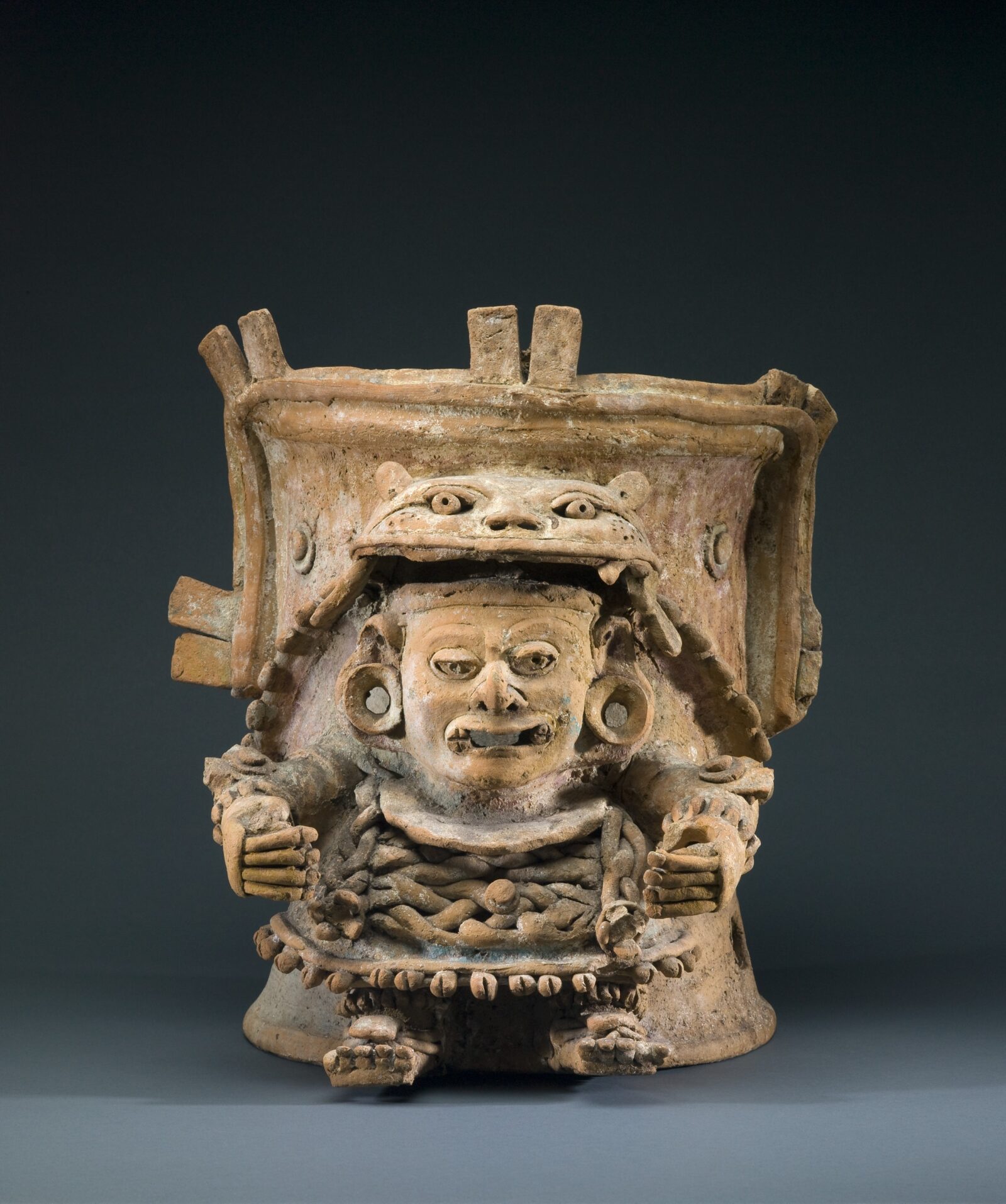
Incense Burner with Attached Figure, c.1200–1500; Maya, Guatemala, Late Postclassic period; ceramic with pigment; 15 1/4 x 13 3/8 x 14 3/4 inches, diameter at top of receptacle: 11 inches; Saint Louis Art Museum, Gift of Morton D. May 173:1979
Incense Burner with Attached Figure
The slightly wrinkled face and sunken cheeks suggest this figure represents Itzamnaaj, one of the oldest and most important deities of the Classic and Postclassic Maya. He wears a feline headdress and a costume of heavy, braided rope. The bottom of his tunic and pants are fringed with small bells typical of the copper ornaments worn during this period. Such censers became much more common in the Maya region during the Postclassic period. Their intimate size and scale suggest to some scholars a more individualized approach to religion at this time.
This work is on view in the Morton D. May and Louis D. Beaumont Foundation Gallery 114.