Napachie Pootoogook, Inuk, 1938–2002; printed by Iyola Kingwatsiak, Inuk, 1933–2000; Sea Spirits, 1964; stonecut; image: 7 x 9 1/4 inches, sheet: 16 x 19 7/8 inches; Saint Louis Art Museum, Gift of Susanne S. Renner and Robert E. Ricklefs 6:2022; © Estate of Napachie Pootoogook, Reproduced with the permission of Dorset Fine Arts
The Saint Louis Art Museum is actively expanding its collection of contemporary Indigenous art. Among works recently acquired are prints from the Canadian Arctic. Sea Spirits (1964) by Napachie Pootoogook (Inuk, 1938–2002) depicts a common subject among Inuit artists: a sea goddess. A group of four creatures with human heads, outstretched arms, and seal or walrus tails swim toward the left. Their bodies seem to reflect shimmering ocean waves, ranging from deep navy to beautiful turquoise—the color of glacial melt. Long fibers in the Japanese paper float around them like fragments of sea life.
Like most cultures, the Inuit have a strong oral tradition, with hundreds of stories that often explain natural phenomena. Protagonists are frequently shape-shifters—spirits that can transform into human or animal forms. The sea goddess is known by different names across the Arctic: Sedna, Taleelayuk, Aviliayok, or Nuliayuk. [1]
There are different versions of Sedna’s story. In 1958 an unnamed elder was recorded sharing this one with children:
There was once a girl who was thrown into the sea by a man. She tried to hold onto the side of the boat, but he cut off her fingers to prevent the boat from capsizing, and she sank to the bottom of the sea. There she made her home inside a huge bubble and became Nuliayuk, mother of all life in the sea. Her fingers grew into seals and walruses. It is Nuliayuk who sends us her seals to keep us from freezing and starving to death. For seal is not only our food, but blubber and oil give warmth and light for our snowhouses when the long night broods over our land. [2]
Pootoogook’s mother was prolific artist Pitseolak Ashoona (Inuk, 1907–1983), who created more than 9,000 drawings in the last 20 years of her life. Pootoogook made Sea Spirits when she was 26. Later in her career she stopped drawing spiritual beings in favor of scenes of everyday life, such as preparing hides, sleeping in igloos, and mothers caring for their children. Some of her drawings are scenes of domestic violence, rape, and suicide. She shared: “I want to have a reputation, to be known, as an artist who draws things that are only true . . . there is a bad side to all humans, not everybody’s life is perfect, so that’s why I draw these kind of things.” [3] Intensely personal subject matter distinguishes a younger generation of Inuit artists. Pootoogook’s daughter, Annie Pootoogook (Inuk, 1969–2016), became internationally known for her drawings depicting these subjects.

Napachie Pootoogook (Inuk, 1938–2002)
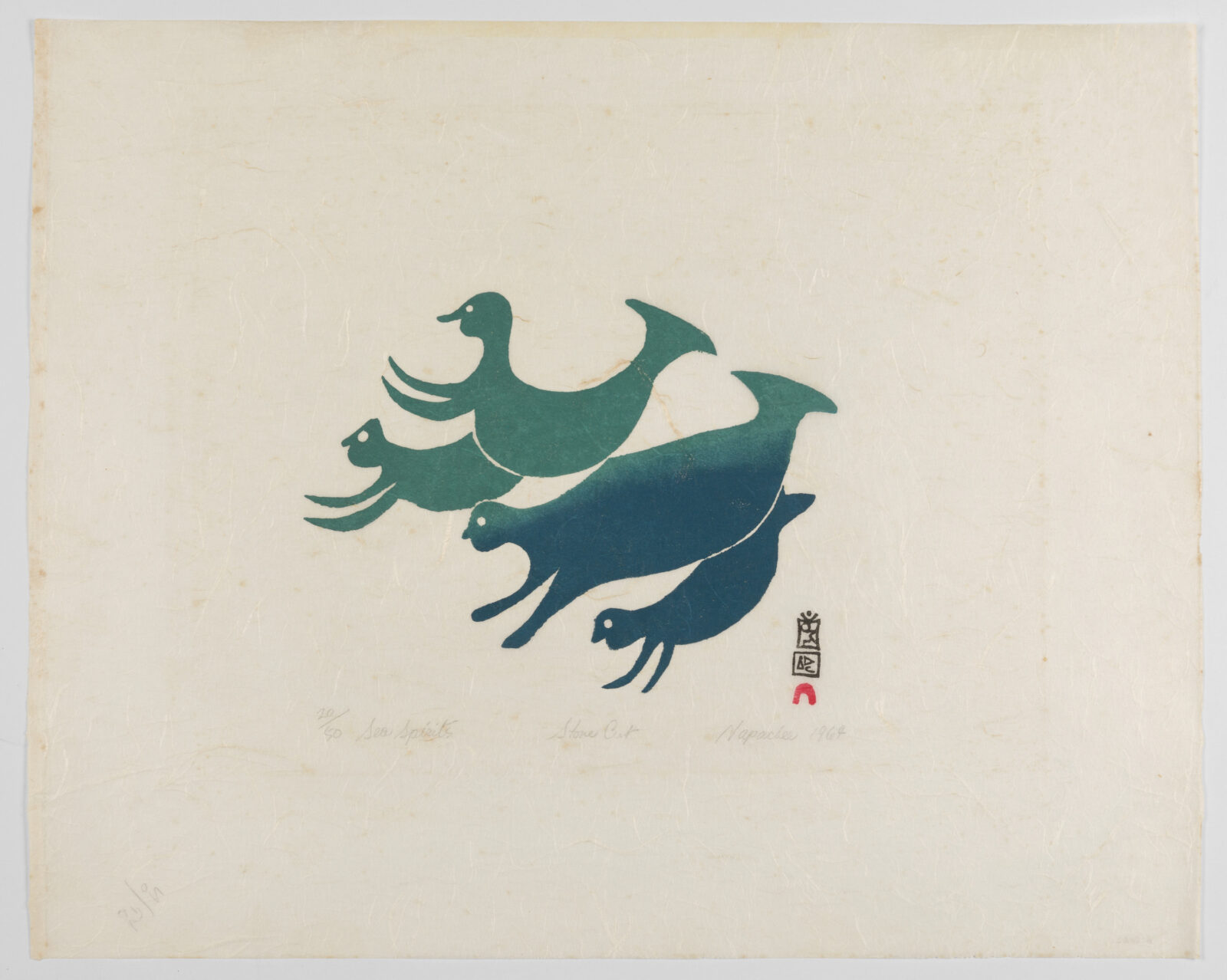
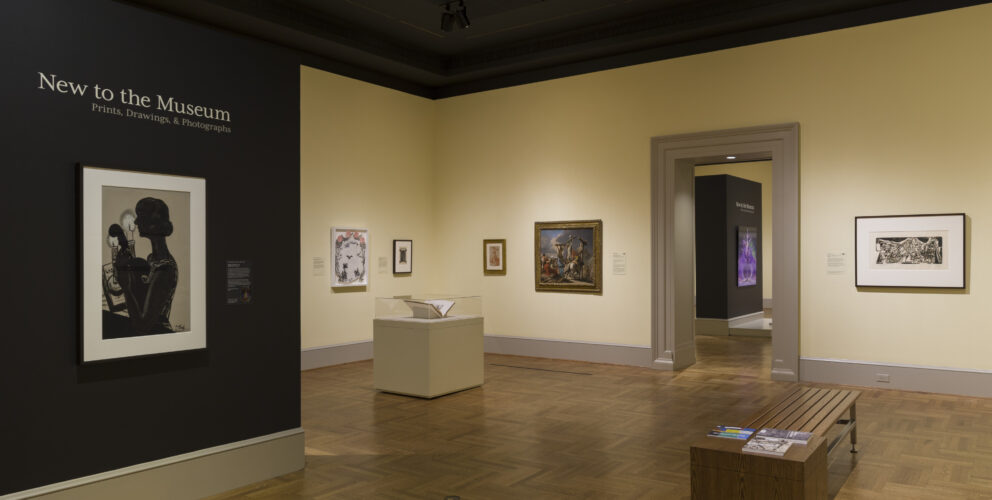
Napachie Pootoogook, Inuk, 1938–2002; printed by Iyola Kingwatsiak, Inuk, 1933–2000; Sea Spirits, 1964; stonecut; image: 7 x 9 1/4 inches, sheet: 16 x 19 7/8 inches; Saint Louis Art Museum, Gift of Susanne S. Renner and Robert E. Ricklefs 6:2022; © Estate of Napachie Pootoogook, Reproduced with the permission of Dorset Fine Arts
What is a stonecut print?
Inuit communities are widely dispersed from Alaska to Labrador. Utilizing every available resource in this harsh climate, Inuit people have long been highly skilled carvers. Bone, ivory, antler, and stone are some of the raw materials turned into utilitarian objects for daily life as well as sculpture for performance, devotion, trade, and fine art.
In the 1950s the Canadian government forced the Inuit to abandon their nomadic lifestyles and live in permanent settlements. This coincided with the decline of the fur trade, and the Inuit shifted from a subsistence to a currency-based economy. An international market for small-scale Inuit sculpture emerged from this change.
In 1957 Canadian artist James Houston introduced printmaking in Kinngait (previously Cape Dorset), a small community on Baffin Island in Nunavut, Canada. Houston learned woodcut techniques in Japan and brought that tradition to the Arctic. In a region devoid of trees, Inuit artists applied their carving skills to create low-relief matrices in stone that were then inked and printed. The stonecut technique is often combined with pochoir (printing with stencils). A co-op system developed wherein community members are provided drawing materials. They can sell their completed drawings to the co-op. Printers select some drawings to carve into serpentinite or slate, and those are produced as limited-edition prints. A portfolio is then released annually, providing income for the community. There are now several art centers throughout the Arctic with sophisticated facilities for all printmaking mediums, including lithography and intaglio.
Sea Spirits was included in the 1964 Cape Dorset portfolio. In a later interview the artist admitted: “Sometimes the [drawings] I really like don’t end up being printed. . . . I have been told before by the printers that most of my art is very hard to put on stone.” [4]
The McMichael Canadian Art Collection just north of Toronto manages Kinngait’s drawing archive, which includes Pootoogook’s graphite sketch for this print. The collection of more than 89,000 drawings is currently being digitized.
What are the symbols at the bottom of this print?
The Inuktitut language developed over hundreds of years but was not a written language until the 19th century. In the 1840s Methodist missionary Thomas Evans created a syllabic system for Cree and Ojibwe. In 1876 Edmund Peck adapted these syllabics for the Inuit language. [5] Inuktitut is the official language of Nunavut.
In the Japanese print tradition, the artist and the printer sign works with a chop mark, or chop. Following that practice, Inuit prints also have chops indicating the artist, printer, and co-op. There are three chops in Sea Spirits: Pootoogook’s at the top, followed by the printer’s, Iyola Kingwatsiak, and the red igloo at the bottom shows the print was made at Kinngait.
The work is also signed in English according to European convention. In the bottom left the fraction 20/50 means this is the 20th impression in an edition of 50. Each print in an edition is original and unique; unlike machine-made copies, it is impossible to make exact reproductions. Discovering subtle variations in texture and color is part of the pleasure in appreciating fine art prints. In Sea Spirits the edition number is followed by the title, medium, artist’s name written phonetically, and the year it was completed.
Currently, SLAM has 18 works on paper by Inuit artists. Sea Spirits is on view in the exhibition New to the Museum until July 9, 2023.
-
Footnotes
[1] Maija M. Lutz, Hunters, Carvers, and Collectors: The Chauncey C. Nash Collection of Inuit Art (Cambridge, MA: Peabody Museum Press, 2012), 41.
[2] John Feeney, dir., Tom Daley, prod., The Living Stone (Montreal: National Film Board of Canada, 1958), 35 mm film, 32 min.
[3] Jean Blodgett, et al., Three Women, Three Generations: Drawings by Pitseolak Ashoona, Napatchie Pootoogook, and Shuvinai Ashoona (Kleinburg, ON: McMichael Canadian Art Collection, 1999), 83–84.
[4] Three Women, 43.
[5] Ingo Hessel, Inuit Art (New York: Harry N. Abrams, 1998), 8.