Installation view of a decorative arts and design gallery.
No, you cannot actually sit on any of these chairs.
As inviting as SLAM’s collection of chairs may look after a long walk through the Museum, they are delicate decorative arts. Some of the chairs on view are more than 250 years old, created before St. Louis was incorporated as a city in 1822. One of the oldest chairs in SLAM’s collection, made from 18th century material salvaged from a shipwreck in the 1990s, is dated 1700–1710. There are currently 51 chairs on view, primarily in SLAM’s Level 1 decorative arts and design galleries. The entire collection features more than 200 chairs.

Chair, 1700–1710; American, Boston; maple, oak, leather, and brass; 44 5/8 x 18 5/8 x 16 5/8 inches; Saint Louis Art Museum, Gift of Mr. and Mrs. Edward J. Nusrala 249:1989
Chair
This chair represents a type of seating furniture widely made and exported throughout Colonial America. The design uses several refinements aimed at greater comfort—the turned wooden posts that form the back are slightly sloped and the seat and back are softened with light padding and leather covers.
The upholstery treatment on this chair is a modern interpretation, based on similar chairs that survive with their original upholstery intact. The stitched square in the middle of the seat would have kept the stuffing, usually plant fibers and animal hair, from shifting. The leather used by the Museum to replicate this chair’s early appearance is Russia leather, recognized by the crosshatched surface pattern. This 18th century material was salvaged in the 1990s from a shipwreck in the Baltic Sea.
This chair is currently on view in Gallery 134.

Chokwe artist, Angola; Chief's Chair, 19th century; wood, brass, hide; 29 1/4 x 11 x 17 1/2 inches; Saint Louis Art Museum, Museum Purchase 7:1943
Chief’s Chair
This chair is a symbol of political power and social hierarchy. The top of the chair back features the heads of five Chokwe chiefs in royal headdresses. Below the chiefs on the lower back are carved images of three initiates of the young men’s masking society, an association controlled by the chief. Underneath the initiates on one side are a pair of musicians who carry and play a wood slit drum. On the opposite rung are two women with tall pestles pounding food in a mortar. The other two rungs feature carvings of scenes from Chokwe life, including a man leading a cow. From the 16th century, Portuguese traders imported European-style joinery chairs and presented them as gifts to their African trading partners. As the chairs were traded into the interior, they became prestige objects and eventually served as prototypes for chairs used by Chokwe chiefs.
This chair will be featured in Narrative Wisdom and African Arts, an upcoming ticketed exhibition opening October 19.

Ron Arad, English (born Israel), born 1951; A.Y.O.R. (At Your Own Risk) Chair, 1990; stainless steel and lead; 36 7/8 x 19 1/4 x 20 inches; Saint Louis Art Museum, Museum Shop Fund 6:2006; © Ron Arad
A.Y.O.R. (At Your Own Risk) Chair
A meditation on balance, this faceted steel chair tips forward like a tottering question mark. Israeli-born Ron Arad developed an appreciation for humble sheet metal early in his career, creating an influential series of experimental hand-welded furniture in his London studio. This A.Y.O.R. (At Your Own Risk) Chair was meticulously crafted by Arad himself. Its highly polished seams and surface give an illusion of a sculptural whole.
This chair is on view in Gallery 131.

Attributed to Gebrüder Thonet, Vienna, Austria, founded 1853; Doll's Chair, designed 1885–86, made c.1890; beech and cane; 12 3/4 x 7 1/4 x 9 1/4 inches; Saint Louis Art Museum, Gift of Jane and Warren Shapleigh 30:2001
Doll’s Chair
During the 1850s, Michael Thonet perfected his process of bending lengths of steamed beachwood rods around iron molds. This technological development, which eliminated laborious hand carving and simplified production, led to the first mass-production of inexpensive standardized furniture. Before the development of this technique, the design of most furniture depended on sculptural joints for the intersections of separate pieces of wood. The lightness of the bentwood frames is often emphasized by seat and back panels of semi-transparent woven cane. The Austrian firm of Gebrüder Thonet was ingenious at marketing and manufacturing bentwood furniture in a great variety of forms. Early on, their production included a line of furniture for children and even one for dolls. This chair is just over 12 inches tall.
This chair is on view in Gallery 122.
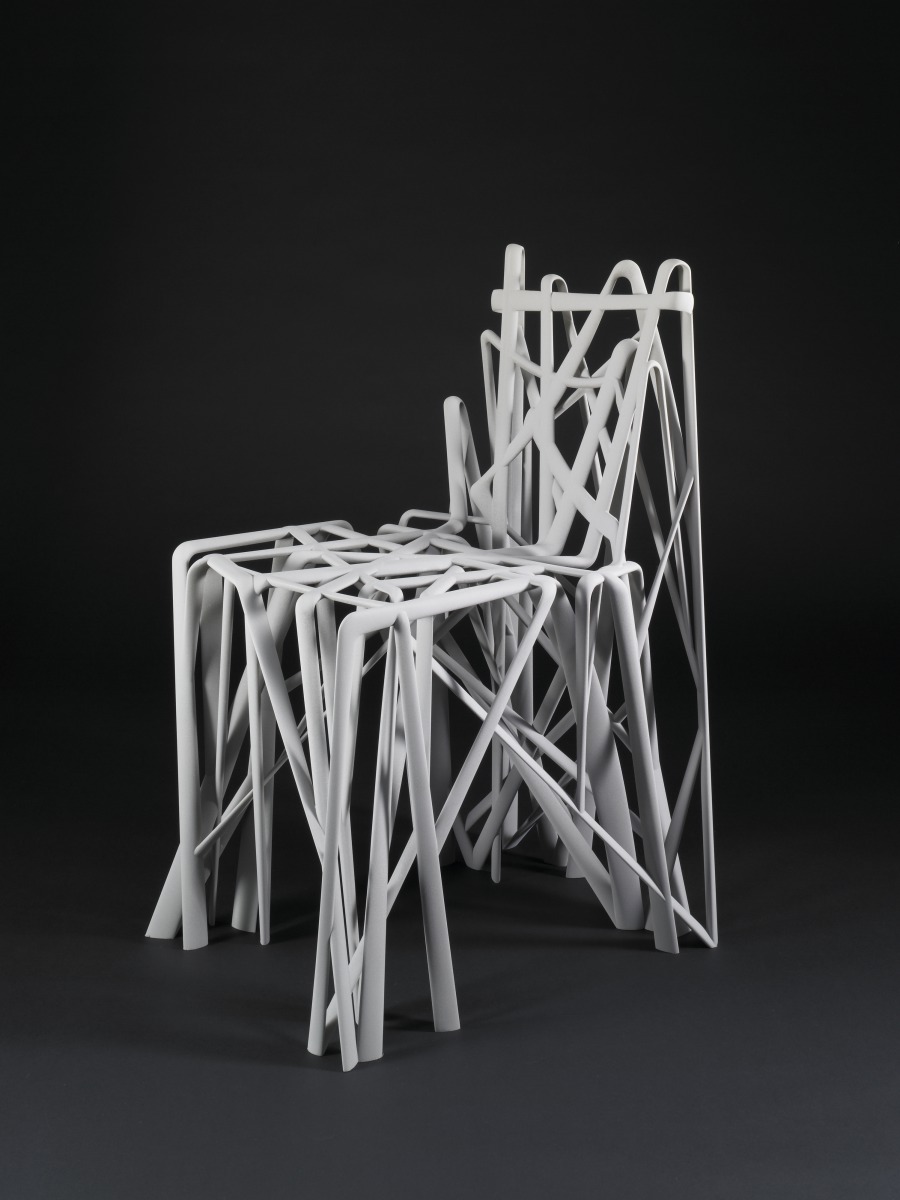
Patrick Jouin, French, born 1967; manufactured by Materialise, Leuven, Belgium; Solid C2 Chair, 2004, manufactured 2007; painted epoxy resin; 30 1/2 x 15 1/2 x 20 inches; Saint Louis Art Museum, Funds given by Zoe and Max Lippman in honor of Cara McCarty 12:2007; © Patrick Jouin
Solid C2 Chair
French industrial designer Patrick Jouin uses the 3D printing technique known as stereolithography to produce furniture. Jouin drew the chair in a computer program that converts the design into a digital 3D model. The computer files are then connected to a laser that prints the chair, layer by layer, in liquid resin. Contact between the laser beam and resin cures the resin, hardening it to produce a 3D object that is built up in strata like a stalagmite. The poetic inspiration for this chair was nature, specifically the patterns created by crisscrossing blades of grass that bend, twist, fold, and turn corners.
This chair is on view in Gallery 131.

Designed by Eero Saarinen, American (born Finland), 1910–1961; made by Knoll Associates, New York, New York, founded 1938; Tulip Chair, designed 1956, manufactured c.1960; plastic, fiberglass, foam, aluminum, and original nylon upholstery; 32 x 25 1/2 x 27 1/4 inches; Saint Louis Art Museum, Gift of Michael Ashworth 8:2000
Tulip Chair
Architect Eero Saarinen’s sleek, sculptural design is an icon of 20th-century furniture. Prior to World War II, he collaborated with Charles Eames on designs for organic furniture using bentwood. Following the war, Saarinen’s furniture designs included new materials including plastics to achieve a modern form. This chair’s one-piece base was designed to replace the visual clutter of traditional furniture. In Saarinen’s words, “The undercarriage of chairs and tables in a typical interior makes an ugly, confusing, unrestful world. I wanted to clear up the slum of legs. I wanted to make the chair all one thing again.”
This chair is on view in Gallery 130.

Designed by Hector Guimard, French, 1867–1942; made by Ateliers d'Art et de Fabrication, Paris, France, active c.1897–1914; Side Chair, c.1905; pearwood and original leather; 42 3/4 x 17 7/8 x 20 1/4 inches; Saint Louis Art Museum, Bequest of Ruth Sudholt Wunderlich by exchange and Museum Purchase 75:1985
Side Chair
Nature was the primary source of inspiration for the French architect Hector Guimard, who animated his designs with abstract clusters of buds, unfurling plant forms, and writhing tendrils. Guimard sought a new mode of expression that broke from historical styles. Rather than applying the ornament as separate decorative elements, he worked like a sculptor, fusing structure and ornament, often creating linear whiplash contours that conveyed movement. During the Art Nouveau period, architects worked in a variety of materials, designing not only entire buildings and architectural ornaments, but their interiors and furnishings as well.
This chair is on view in Gallery 135.

Designed by Joe Colombo, Italian, 1930–1971; made by Kartell S.p.A., Milan, Italy, founded 1949; Armchair, c.1963; plywood, polyester lacquer; 23 x 27 3/4 x 27 inches; Saint Louis Art Museum, Museum Purchase by exchange 161:1993
Armchair
The cracked surface of this low-slung armchair reveals a frustration of its designer, Joe Colombo. He wanted it to be made entirely of plastic. When Kartell, an Italian manufacturing company and a leader in plastics technology, was unable to realize his vision, the artist turned designer settled for bent plywood finished with a glossy, plastic-like paint. Despite the material setback, Colombo’s ambition to create an economical, hardware-free chair was successful. This example’s three-part, interlocking notched construction negates the need for nails or screws.
This chair is on view in Gallery 130.