Muriel Nezhnie Helfman, American, 1934–2002; Flaggedy Ann (detail), 1970; wool, tapestry weave, with some plaiting, brass wire form; 58 × 44 inches; Saint Louis Art Museum, Gift of Thomas Alexander 189:1978; © Estate of Muriel Nezhnie Helfman
Muriel Nezhnie Helfman wove herself into the tapestry of the St. Louis arts and craft scene.
Nezhnie’s 1970 free-form tapestry Flaggedy Ann is on view for the first time in Picturing Independence. The exhibition, which celebrates the nation’s 250th birthday, is divided into four sections: “Revolution,” “Democracy,” “the Flag,” and “Liberty.” Amy Torbert, the Andrew C. Mellon Associate Curator of American Art, who curated the exhibition, said she chose works for the “Flag” section with Flaggedy Ann in mind.
“I realized that if I designed a section looking at flags and how artists have engaged with the history and imagery of the United States flag, then I could feature her,” Torbert said. “So, the reason the show has a section on flags is one hundred percent because of Flaggedy Ann.”

Muriel Nezhnie Helfman, American, 1934–2002; Flaggedy Ann, 1970; wool, tapestry weave, with some plaiting, brass wire form; 58 × 44 inches; Saint Louis Art Museum, Gift of Thomas Alexander 189:1978; © Estate of Muriel Nezhnie Helfman
Flaggedy Ann tells many stories through different lenses. Most obviously, the tapestry oozes passion for America.
“I wanted Picturing Independence to strike a good balance between joy and also a space to talk about tough topics, and I felt like we couldn’t have one and not the other. Flaggedy Ann is that representation of joy, celebration, and patriotism,” Torbert said.
The tapestry also tells the stories of American makers. Nezhnie’s weaving features a manipulated American flag, and she parodied the tapestry’s name after the iconic American children’s toy Raggedy Ann. Raggedy Ann herself is named after the American writer James Whitcomb Riley’s poems “The Raggedy Man” and “Little Orphant Annie.”
Additionally, Flaggedy Ann can be understood through a feminist lens. Flaggedy Ann’s focal point is a feminine figure, carving space for herself in the American story through a reconstruction of the flag. From the 1950s to the ’70s, the second wave of feminism sought to carve spaces for women outside of their traditional social sphere. Traditionally, women created everyday household items like clothing and bedding. Weavers like Nezhnie pushed against the norm and united to create tapestries to be displayed as art.
“It was a response from weavers to work with what were considered feminine materials, but to create art that made a statement, rather than just a pretty doily or a nice rug; it was a piece of art to hang on the wall,” textile conservator Miriam Murphy said. “Weaving was traditionally known as women’s work or craft, and it wasn’t really valued as an art form in the United States.”

Muriel Nezhnie Helfman, American, 1934–2002; Flaggedy Ann (detail), 1970; wool, tapestry weave, with some plaiting, brass wire form; 58 × 44 inches; Saint Louis Art Museum, Gift of Thomas Alexander 189:1978; © Estate of Muriel Nezhnie Helfman
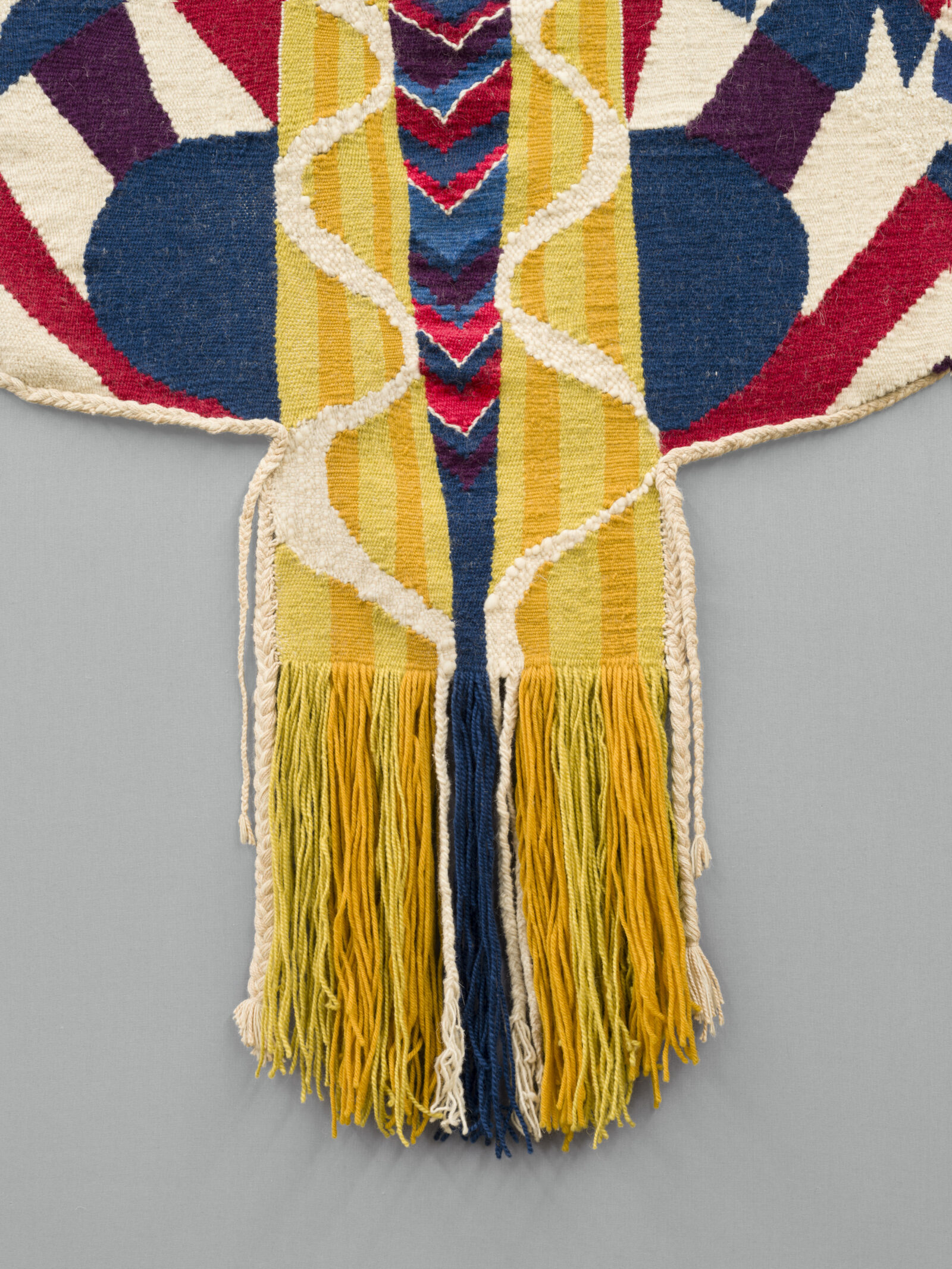
Muriel Nezhnie Helfman, American, 1934–2002; Flaggedy Ann (detail), 1970; wool, tapestry weave, with some plaiting, brass wire form; 58 × 44 inches; Saint Louis Art Museum, Gift of Thomas Alexander 189:1978; © Estate of Muriel Nezhnie Helfman
While Picturing Independence is Flaggedy Ann’s debut at the Saint Louis Art Museum, Nezhnie has a long history in St. Louis and with the Museum. In 1974, SLAM displayed Nezhnie’s tapestry Breath of Life as part of an exhibition series that showcased local artists. Only two artists a year received this honor, and Nezhnie was selected for the third-annual exhibition.
Linda Rees details Nezhnie life and works in her book Nezhnie: Weaver & Innovative Artist (2004). According to Rees, Muriel Nezhnie was born on February 28, 1934 to her mother, Jean Shiezer Liftman, and father, Isadora Nezhnie, both Russian Jewish immigrants who were previously widowed. Her parents worked at the grocery store beneath their apartment in New Jersey, leaving Muriel with her stepsiblings Sarah and Robert. Her father and stepsister—whom Muriel credits for raising her—passed away before Muriel turned 10. Years later when she got married, Muriel used her maiden name, Nezhnie, professionally to honor them.
Nezhnie’s elementary school teacher introduced her to weaving in sixth grade, making blankets for the Russian War Relief. The other kids in her class struggled with the task, but Nezhnie instantly understood and instinctually wove the fibers together. Recognizing Nezhnie’s talent, her sixth-grade teacher acquired scholarship money for Muriel to take art classes every Saturday in New York City.
After graduating high school, Nezhnie attended The Cooper Union School of Art in New York where she received a degree in graphic design. In college, she met her husband, Sheldon Helfman. After graduation, Nezhnie followed Helfman to Germany, where he was stationed with the US Army. There she enrolled in a German craft school called Offenbach Werkkunstschule to advance her weaving skills. Her instructor spoke little English, and Nezhnie spoke little German. As a result, she studied weaving techniques through flamboyant gestures and slow demonstrations.
Back in the United States, Nezhnie moved to New Haven, Connecticut, where she had two children, Ilisha and Jonathan, and her husband received his master’s degree in architecture from Yale. After he graduated, the family moved to St. Louis, where Helfman was a professor at Washington University. In St. Louis, Nezhnie wanted an outlet to express her creativity and make money for her family. Weaving was her solution.

2011 photo from Nezhnie's Daughters of Auschwitz 1979 Holocaust series. Image/slide from Muriel Nezhnie and Sheldon Helfman's personal collection.
Nezhnie created around 90 tapestries in her 35-year career in St. Louis. Commissions from local synagogues and other religious institutions were the bulk of her work. Throughout her career, Nezhnie experimented with her weavings, though, creating free-form hangings—like Flaggedy Ann—and tapestry portraits. Famously, she wove six tapestries from real photographs of victims of Nazi persecution, called Images of the Holocaust. The St. Louis Kaplan Feldman Holocaust Museum displayed Nezhnie’s tapestries in 2012.
Quickly into her residency in St. Louis, she realized local crafters did not have spaces to create and sell art. Along with five other friends, Nezhnie founded St. Louis Craft Alliance in 1964. Opening its doors during the crest of second-wave feminism, Craft Alliance provided a marketplace for craftworkers.
The other founders repeatedly said Craft Alliance would have failed without Nezhnie, whose primary occupation was art making, unlike the other founders who were attorneys and journalists. Nezhnie had the time, dedication, and passion that Craft Alliance needed to survive. In 1992, she received an honorary doctorate of fine arts from University Missouri–St. Louis for her contributions.
Sixty-four years later, Craft Alliance still stands strong. While the execution evolved to fit modern times, Craft Alliance’s mission remains the same: to enrich, educate, and engage the St. Louis community through craft.

Nezhnie's work on view at the University City Public Library. Photo: Chris Yunker
Nezhnie’s weaving career ceased when symptoms of Alzheimer’s seeped into her work. Her husband tried to simplify the process with photos of the intended result, but her memory faded quickly. She died on April 9, 2002.
Flaggedy Ann is on view in Shoenberg Gallery 236 as a part of Picturing Independence until January 24, 2027. After Picturing Independence closes, St. Louisans have other opportunities to see Nezhnie’s work locally. Two tapestries titled Imprints are permanently on view at the University City Public Library.