designed by Francis Deck, American, 1918–2001; made by Emil Frei & Associates, Saint Louis, Missouri, founded 1898; Stained Glass Window Panels (detail), 1950s; glass, pigment, and lead; each overall (approx.): 108 x 38 x 3/8 inches; Saint Louis Art Museum, Gift of Emil Frei & Associates 163:2015.1,.2

The Museum’s collection contains around 20 works featuring stained glass, ranging from full window panels from the 13th century to more modern decorative-arts pieces, like a ceiling lamp by Frank Lloyd Wright.

Lancet Redemption Window, c.1220; French; pot-metal glass; framed: 108 3/8 x 17 1/2 inches; Saint Louis Art Museum, Museum Purchase 3:1935

Frank Lloyd Wright, American, 1867–1959; Ceiling Lamp, from the Francis W. Little House, Peoria, Illinois, 1902–03; glass, copper alloy, and zinc; 29 x 16 x 16 inches; Saint Louis Art Museum, Richard Brumbaugh Trust in memory of Richard Irving Brumbaugh and Grace Lischer Brumbaugh, Marjorie Wyman Endowment Fund, and Friends Endowment Fund 1:2014
Stained-glass windows date to the 12th century, when they were prominent fixtures in city spaces and homes for the wealthier classes. Most often, though, stained-glass windows—both then and now—are associated with sacred spaces. In a religious setting, large stained-glass windows depicting bible scenes or the lives of saints enhance the spiritual ambiance with colorful glimmering light.
How it’s made
Very little has changed in glass-making techniques since medieval times. It is made from two main ingredients—sand (silica) and ash (alkali)—that are heated together to their melting point at about 1400 degrees Celsius.
As it cools, this mixture hardens into glass. To color the glass, powdered metallic oxides are added to the sand-and-ash mixture during the melting process. This technique produces pot-metal glass, which is more deeply colored, as seen in this 16th-century German window from the Museum’s collection pictured below.
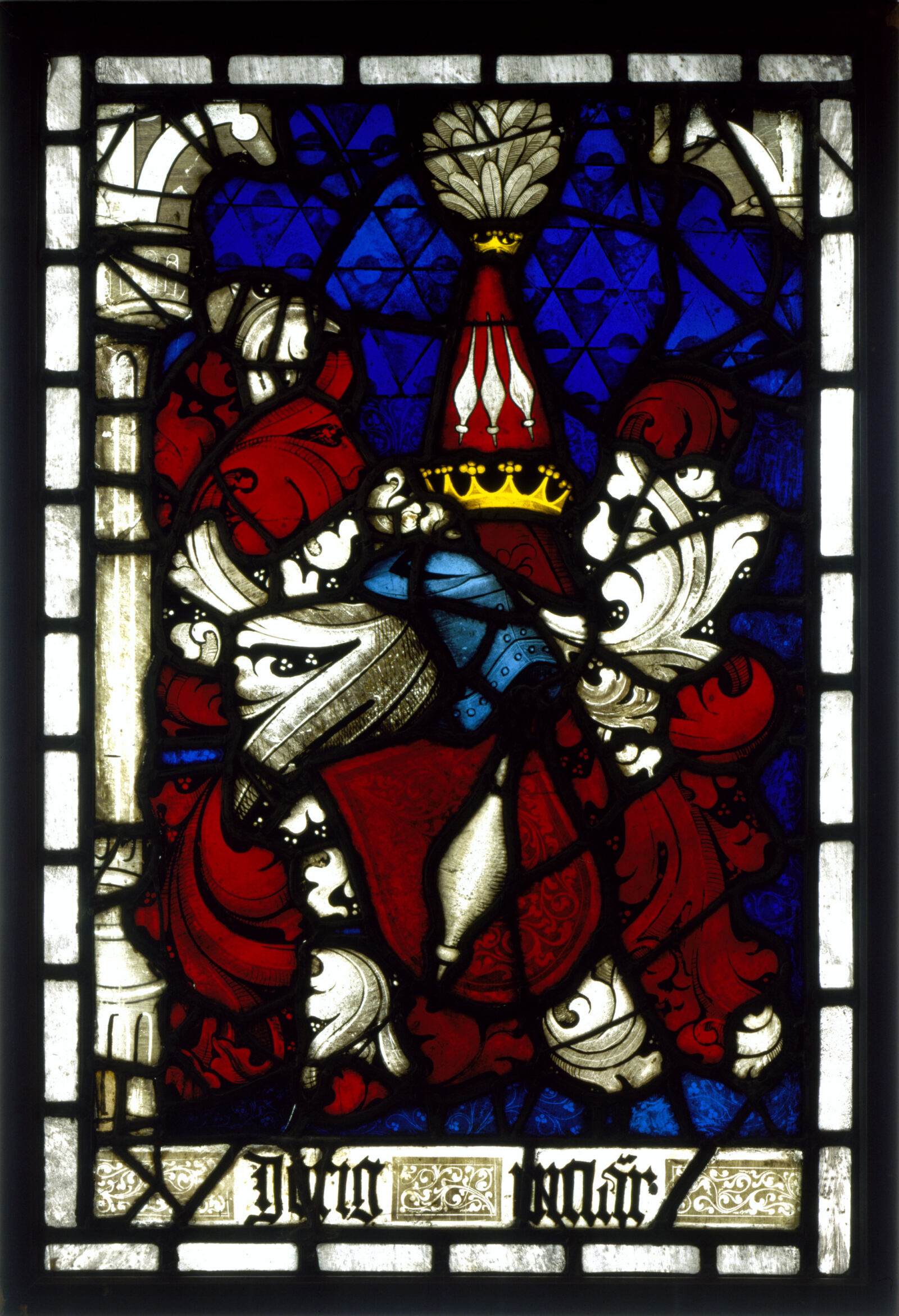
Window, 16th century; German; pot glass; by sight: 28 x 18 1/2 inches; Saint Louis Art Museum, Museum Purchase 1090:1920
Depending on the desired effect, medieval glassmakers sometimes used an alternate method to color glass, called flashed glass, in which a thin layer of colored, melted glass is placed over a layer of colorless glass. Flashed glass resulted in a more-translucent product that was often used along with pot-metal glass to achieve the desired design of a stained-glass window.
To make the windows, tinted sheets of glass are cut into pieces to form the design. In the medieval period, before paper became readily available, these designs were drawn with chalk on a wooden table to fit the actual size of the window opening. The table then served as a workbench for the assembly as well as a template for the person cutting the glass.
Next, a glass painter would use a special paint made of iron or copper oxide that could be diluted from a gray/black or brown color. The painters would use this to add outlines, texture, or shading to the glass. They could also scratch off some of the color to add depth or to control the amount of light passing through the glass.
Finally, the stained-glass window was assembled with strips of lead soldered together to hold the glass pieces in place. While important to the structure, the lead strips were also essential to the window design.
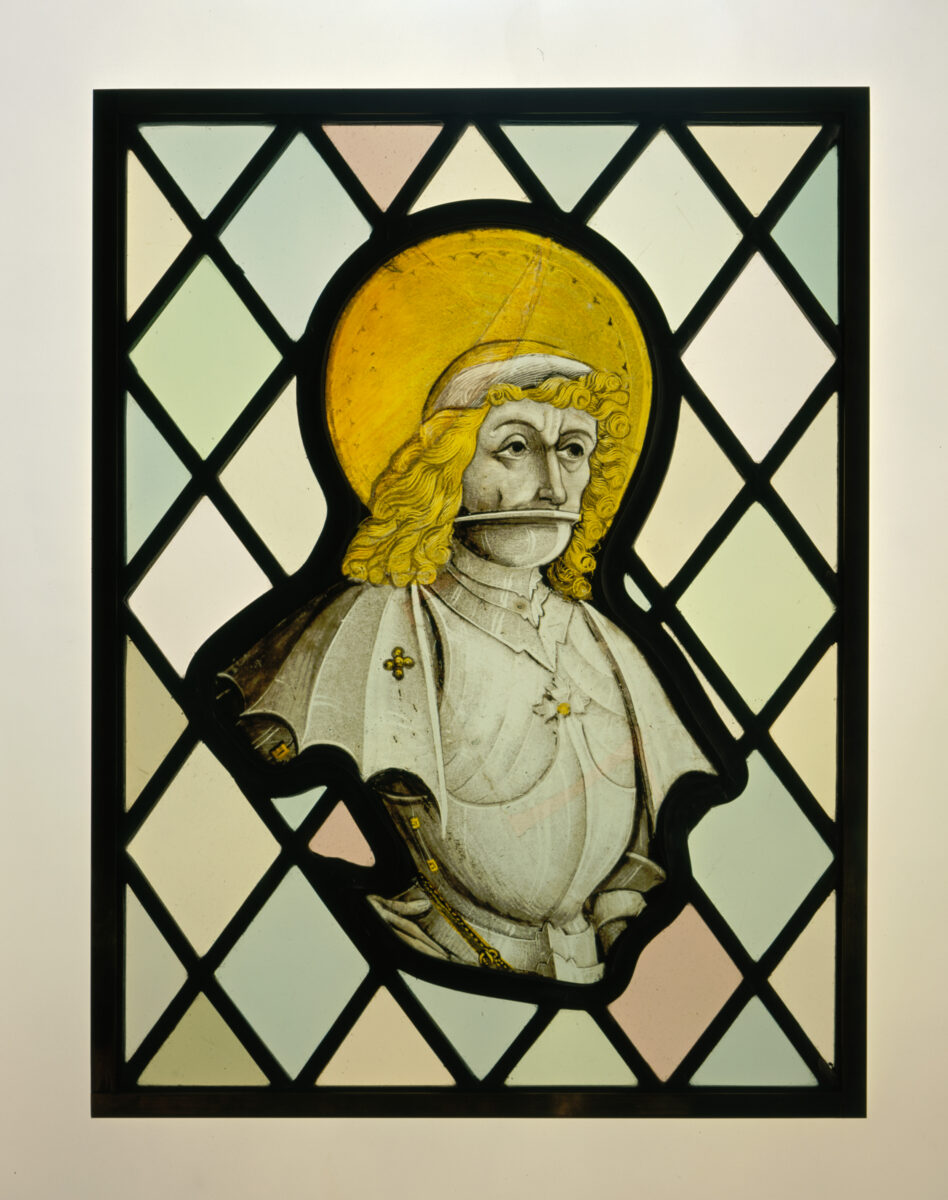
-
Window Panel Fragment with Armored Saint, 15th century; German; white glass with silver stain; 12 x 8 7/8 x 3/8 inches; Saint Louis Art Museum, Museum Purchase 1088:1920
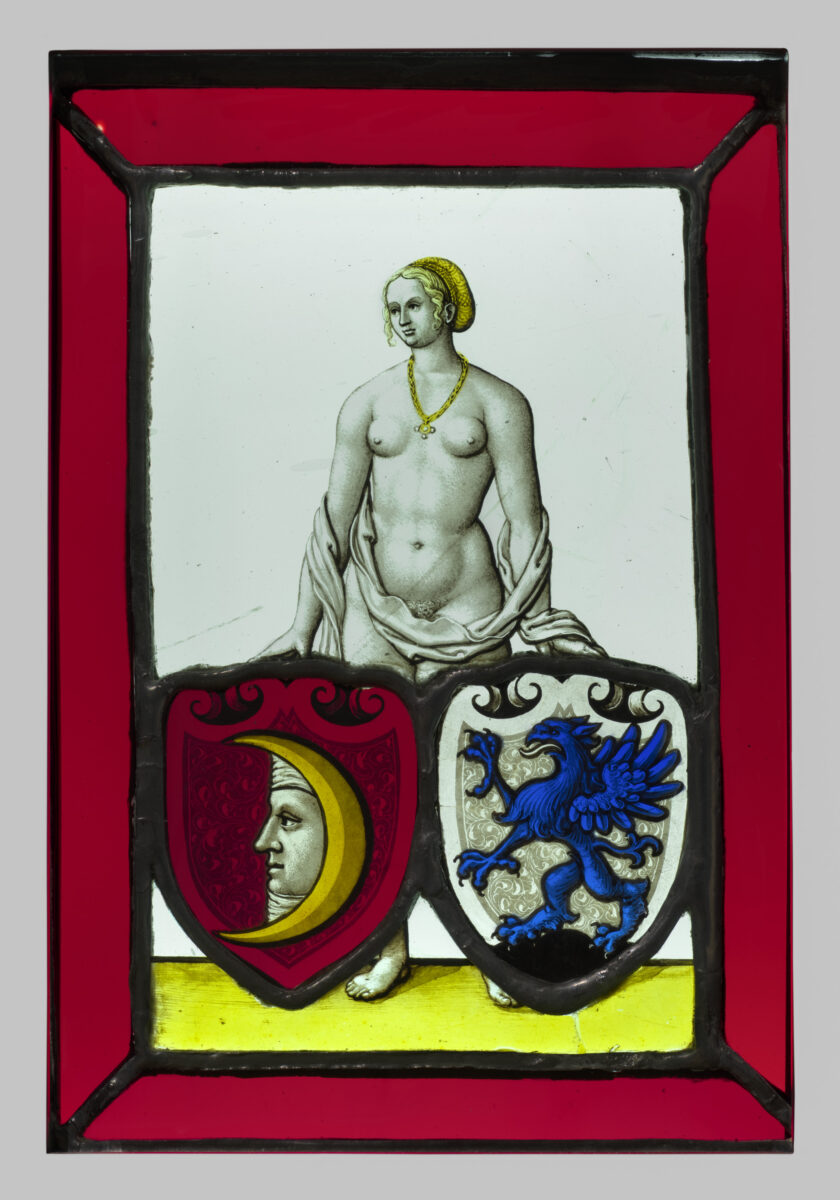
-
possibly after Georg Pencz, German, c.1500–1550; glass possibly painted by Augustin Hirschvogel, German, 1503–1553; Female Nude (Fortune?) Supporting Two Heraldic Shields, c.1535; pot-metal, flashed, and clear glass, yellow stain and black vitreous paint; 8 x 5 3/4 inches; Saint Louis Art Museum, Museum Purchase 9:1928
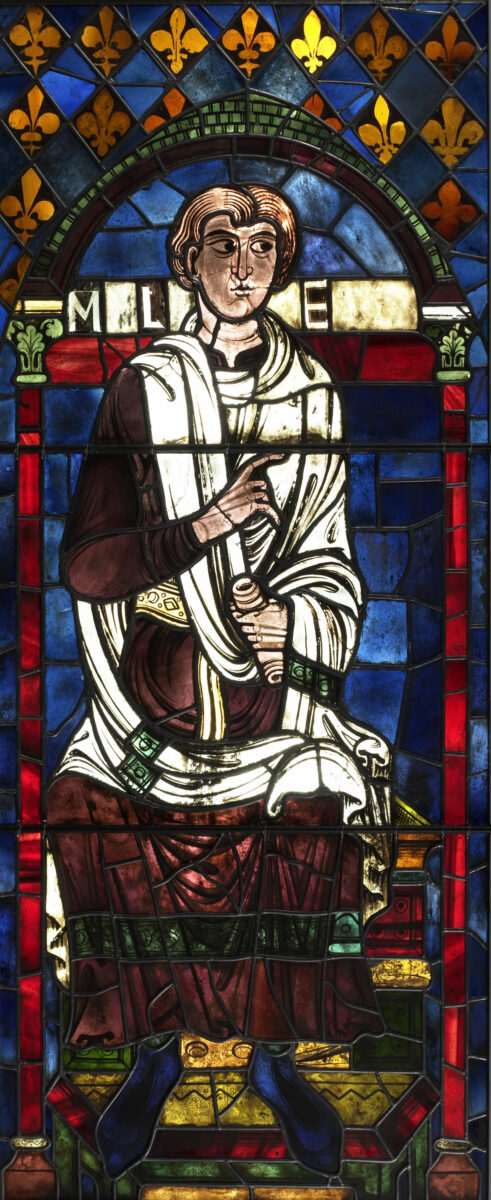
-
Seated Malaleel, Descendant of Adam and Eve, 13th century; French; painting in vitrifiable colors on pot-metal glass; 76 x 31 inches; Saint Louis Art Museum, Museum Purchase 137:1920
American stained glass
Moving into the more modern era, one name is ubiquitous with colored glass: Tiffany.
Son of the cofounder of the silver and jewelry firm Tiffany & Co., Louis Comfort Tiffany started his career as a painter before turning to glass and decorating in the late 1870s. He established several companies, including Tiffany Studios, in operation in New York from 1899 to 1930, which specialized in multicolored windows, lamps, and other glassware. In addition to leaded glass, Tiffany was known for its Favrile glass—usually decorative glass vases distinguished by rich colors and, sometimes, iridescent surface treatments.

Louis Comfort Tiffany, American, 1848–1933; made by Tiffany Studios, Corona, New York, 1900–1938; Lotus, Pagoda Lamp, c.1900–1905; bronze and leaded Favrile glass; 31 1/2 x 26 1/8 inches; Saint Louis Art Museum, Marjorie Wyman Endowment Fund, the Richard Brumbaugh Trust in memory of Richard Irving Brumbaugh and in honor of Grace Lischer Brumbaugh, the E. Reuben and Gladys Flora Grant Charitable Trust, and funds given by Mrs. Charles W. Lorenz, Mr. and Mrs. Kenneth F. Teasdale, Mrs. Ruth Goldstein and Sidney Goldstein in memory of Chip Goldstein, Dr. and Mrs. F. Thomas Ott, Dr. and Mrs. George R. Schoedinger III, Jane and Warren Shapleigh, the Fox Family Foundation, the Paul and Elissa Cahn Foundation, Mr. and Mrs. Martin E. Galt III, Mr. and Mrs. Richard Graham, Betty Greenfield Grossman, Mr. and Mrs. Robert R. Hermann Jr., Katharine W. Hoblitzelle, Mrs. James Lee Johnson Jr., Mr. and Mrs. Alan C. Kohn, Mrs. Clinton W. Lane Jr., Mary and Oliver Langenberg, Mr. and Mrs. L. Max Lippman Jr., Mr. and Mrs. Edward J. Nusrala, Mrs. William R. Orthwein, Dr. Alan Pestronk, Mrs. Mason Scudder, Barbara Shortridge, Mr. and Mrs. E. R. Thomas Jr., and the Decorative Arts Society 68:1997
The Museum’s collection contains several Tiffany works, including Lotus, Pagoda Lamp with a cast-bronze base and a stained-glass shade that features an elegant lotus design evoking a Japanese aesthetic. The shade includes green, yellow, and white Favrile glass. SLAM’s collection also includes a number of Tiffany vases, which showcase a range of Favrile glass types, from the inlaid paperweight vase to the feathered and iridescent flower-form vase, both of which are seen below.
The paperweight Tiffany vase is also currently on view in Gallery 129.

Louis Comfort Tiffany, American, 1848–1933; Paperweight Vase, c.1914–15; glass; 8 5/8 x 5 1/2 inches; Saint Louis Art Museum, Museum Shop Fund, gift of Mr. and Mrs. Charles W. McAlpin II, by exchange; and funds given by Dr. and Mrs. Wilfred R. Konneker, John Roslevich, and Bob and Signa Hermann 32:2005

Louis Comfort Tiffany, American, 1848–1933; Vase, c.1898–1900; Favrile glass; 16 3/16 x 5 1/2 x 5 1/2 inches; Saint Louis Art Museum, Director's Discretionary Fund and funds given by John Roslevich 3:2004
Tiffany also produced works featuring opalescent glass, which was first patented by John La Farge in 1879. Opalescent glass is made by covering a mass of molten colored glass with a layer of colorless glass containing bone ash and arsenic to produce a milky appearance.
The Museum’s collection of stained glass contains two window panels by La Farge—an important painter, muralist, and decorator who shifted his artistic interests to the decorative possibilities of glass.
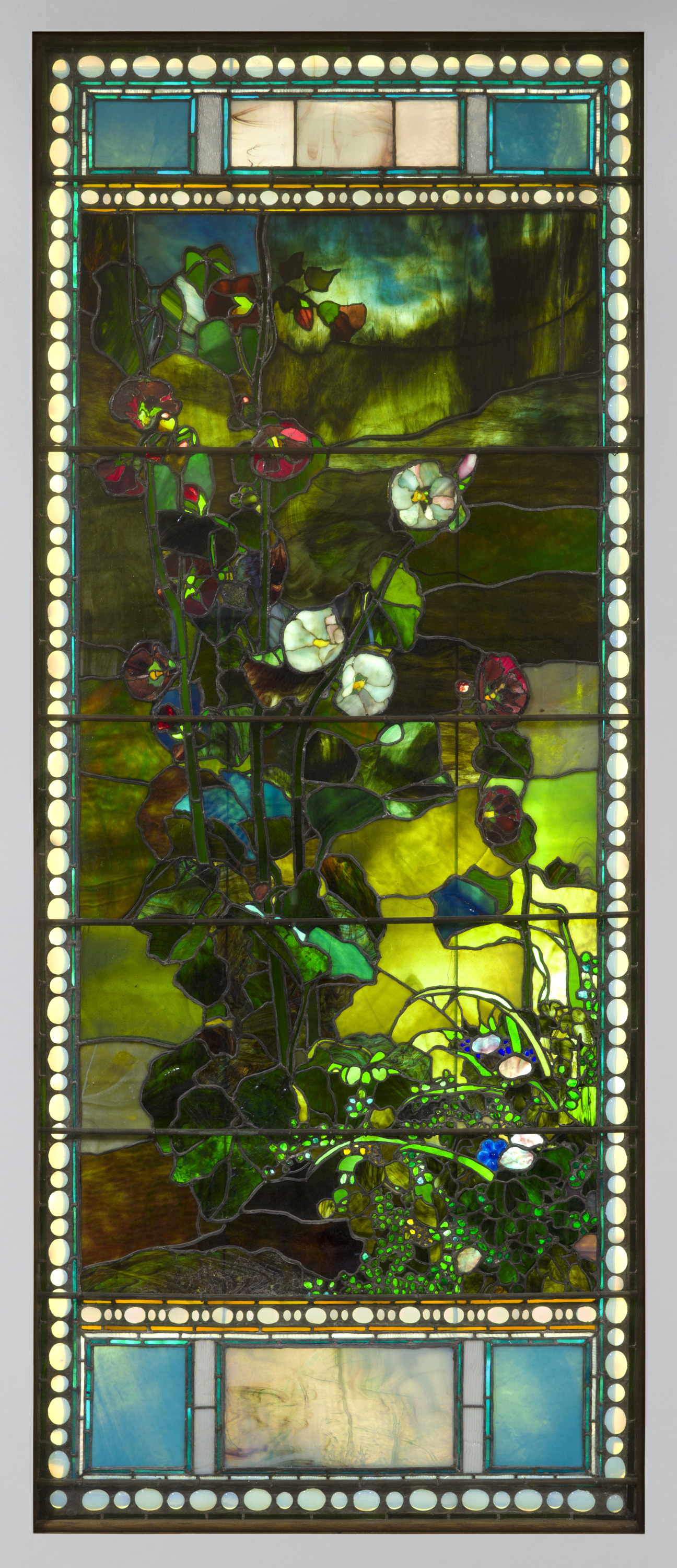
John La Farge, American, 1835–1910; Hollyhocks, window from the Frederick Lothrop Ames House, Boston, Massachusetts, 1882; leaded glass; 87 1/4 x 37 1/4 x 2 3/4 inches; Saint Louis Art Museum, Funds given by the Decorative Arts Society in honor of the Twentieth Anniversary of the Friends of the Saint Louis Art Museum 31:1972.1
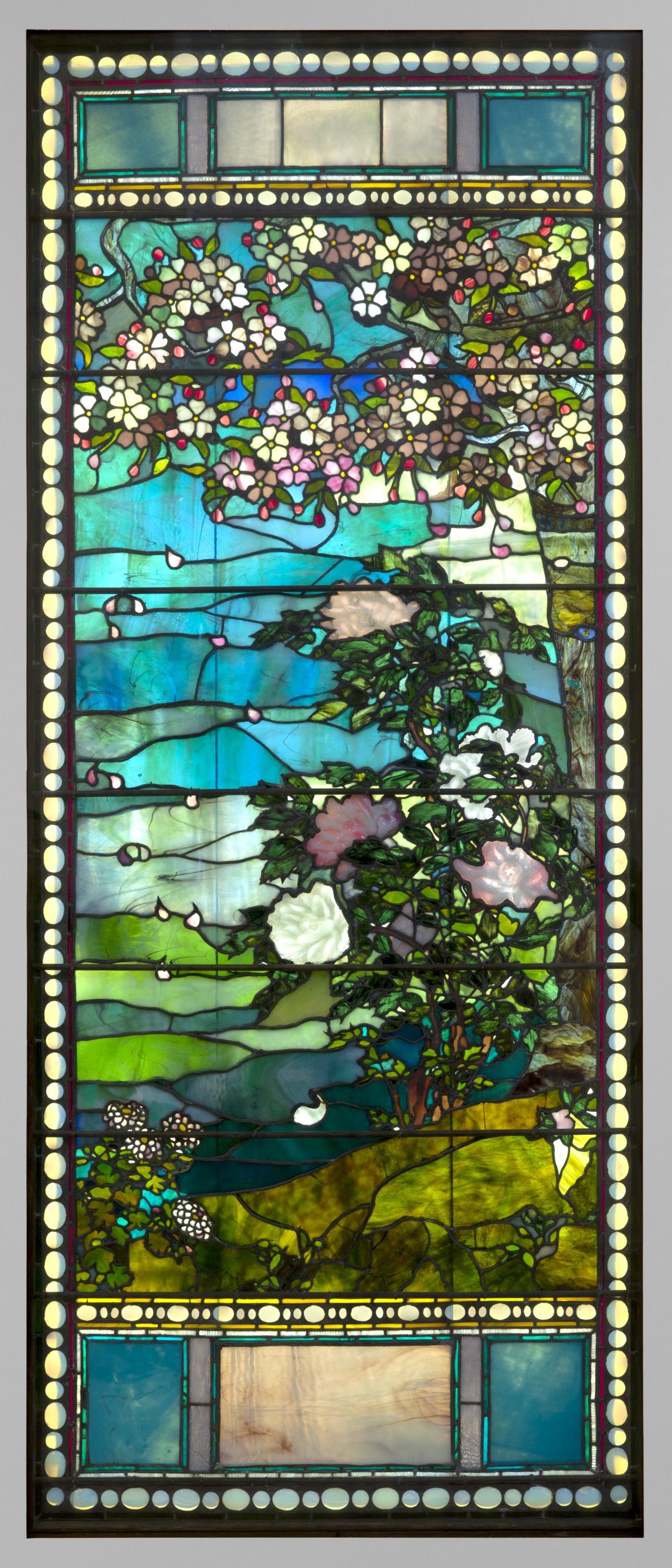
John La Farge, American, 1835–1910; Flowering Cherry Tree and Peony, window from the Frederick Lothrop Ames House, Boston, Massachusetts, 1882; leaded glass; 87 1/4 x 37 1/4 x 2 3/4 inches; Saint Louis Art Museum, Funds given by the Decorative Arts Society in honor of the Twentieth Anniversary of the Friends of the Saint Louis Art Museum 31:1972.2
Hollyhocks and peony flowers are featured in SLAM’s La Farge windows from the Frederick Lothrop Ames House in Boston, Massachusetts. The windows, made in the final decades of the 19th century, contain La Farge’s revolutionary use of opalescent glass, significant because of the effects this “glowing white glass” had on light, color, and depth. The asymmetrical compositions and ornate floral patterns were inspired by La Farge’s paintings and his enthusiasm for Japanese art.
The La Farge windows are currently on view Gallery 127.

designed by George Grant Elmslie, American (born Scotland), 1869–1952; and designed by William Gray Purcell, American, 1880–1965; made by Mosaic Art Shops, Minneapolis, Minnesota, active 1912–1930; Clerestory Window, from the Madison State Bank, Madison, Minnesota, 1913; glass and lead; including hangers: 75 x 22 3/4 x 5/8 inches; Saint Louis Art Museum, Funds given by Mr. and Mrs. Charles W. Lorenz in memory of Ann Lorenz Van Zanten 23:2009
Also, central to SLAM’s collection of stained glass is a work by George Grant Elmslie.
SLAM’s Clerestory Window is one of nine from the Madison State Bank, built in 1913 in Madison, Minnesota, by Elmslie and William Gray Purcell. Their architectural practice—Purcell, Feick, and Elmslie—was second only to Frank Lloyd Wright’s studio in the design of Prairie School architecture. Like with many Prairie School buildings, leaded stained glass featured prominently in the design and ornamentation of the Madison State Bank. The building was a long narrow block with a prominent brick façade enriched with aqua, orange, and yellow terracotta ornament and, over the entry doors, a clerestory of nine identical stained-glass panels. The tall, rectangular windows featured translucent glass in shades of cream, yellow, green, blue, and red. This design marked a transition in mid-career for Elmslie from organic, curvilinear ornament to a more rectilinear geometry.
The Elmslie window is on view in the Concourse.
Stained glass in St. Louis
During the postwar period, houses of worship sprang up in unprecedented numbers across St. Louis, enhancing the city’s already rich tradition of stained-glass design. This was primarily through the work of Emil Frei and his descendants, who established one of the 20th century’s most important stained-glass studios in the United States.
Emil Frei Sr. was born in Bavaria in 1869 and immigrated to the US to freely practice his art. He opened his stained-glass company in St. Louis in 1898, and it remains in operation today under Aaron Frei, the fifth successive family generation to lead the business.
The stained-glass windows at St. Francis Xavier (College) Church at Saint Louis University are some of the most widely acclaimed works by the company. They were designed by Emil Frei Jr., drawing inspiration from Chartres Cathedral in France. While liturgical art is what Emil Frei & Associates is known for, they have also crafted stained-glass windows for numerous local secular spaces like the Sheldon Concert Hall and St. Louis County Library’s Lewis and Clark Branch.
The Museum’s collection contains two stained-glass windows, each containing three panels, made by Emil Frei & Associates. Designed by Francis Deck, one of the studio’s leading postwar artists, the windows were commissioned for a renovation of the former St. Charles Borromeo Catholic Church. Their modern design demonstrates the flexibility of a medium that is perhaps most associated with medieval art.
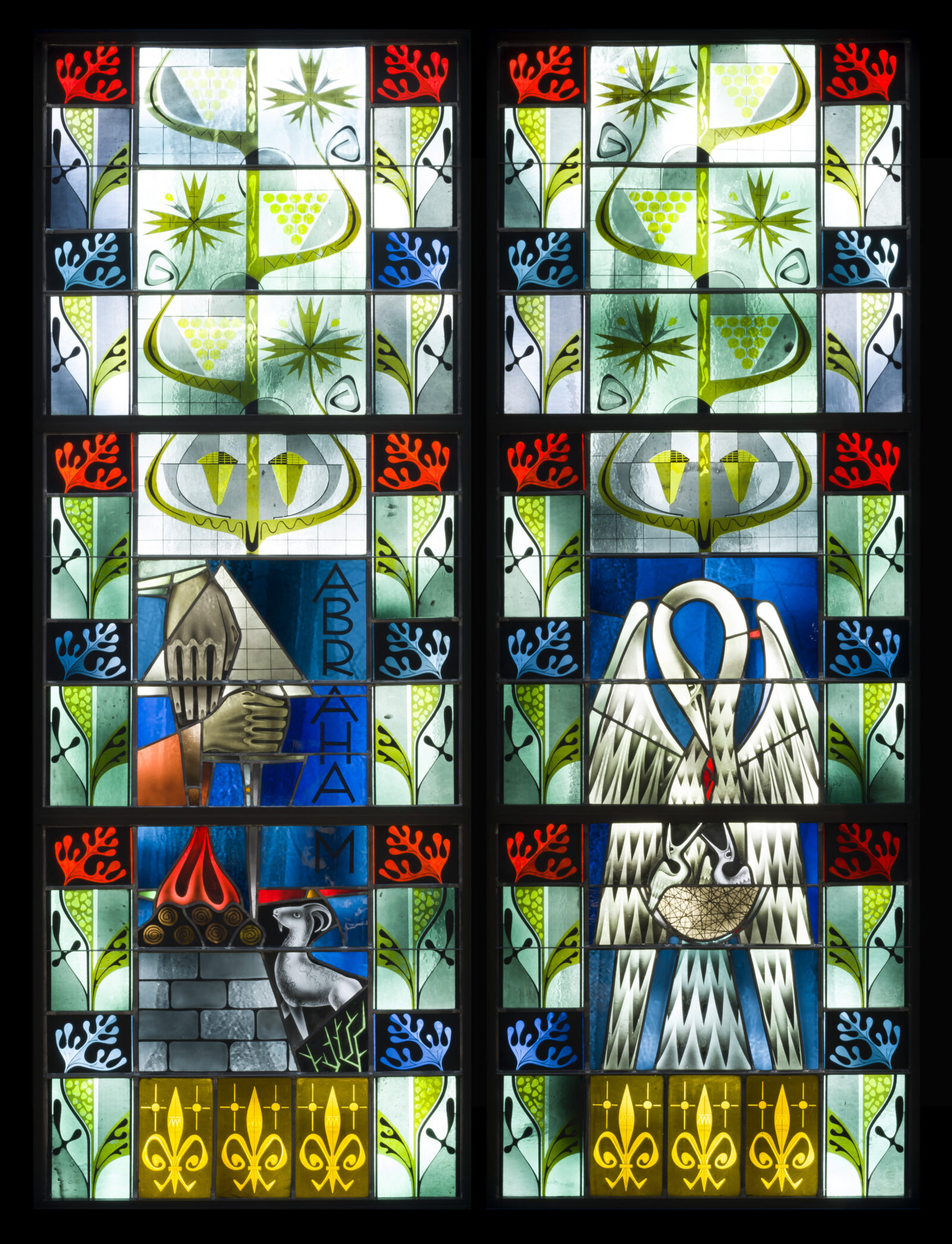
designed by Francis Deck, American, 1918–2001; made by Emil Frei & Associates, Saint Louis, Missouri, founded 1898; Stained Glass Window Panels, 1950s; glass, pigment, and lead; each overall (approx.): 108 x 38 x 3/8 inches; Saint Louis Art Museum, Gift of Emil Frei & Associates 163:2015.1,.2
One of the pieces, The Pelican in her Piety, features a large white bird with spread wings shielding two small white birds in a nest below; above the birds is a chalice and, above that, a vine with grapes. The second panel, Abraham and Isaac, shows a central image of a large hand descending vertically to a smaller horizontal hand holding a knife. Below this is a flaming pyre, and to the right is the ram that Abraham sacrificed in place of his son, according to the story in the Book of Genesis.