Anselm Kiefer, German, born 1945; Kopf im Wald, Kopf in den Wolken (Head in the Forest, Head in the Clouds) (detail), 1971; oil and fabric collage on canvas, two panels; each panel: 78 3/8 x 38 1/4 inches; The Broad Art Foundation 2025.308; © Anselm Kiefer

The Saint Louis Art Museum is home to not one but two iconic works by Anselm Kiefer: Fuel Rods (1984–87) and Breaking of the Vessels (1990). Created during the height of his international acclaim, these monumental paintings epitomize what made Kiefer so influential in the 1980s: vast scale, subjects drawn from world history and mythology, and unconventional materials loaded with symbolism. These works are predominantly abstract. Recurring motifs—fields, books, and vaporous clouds—appear again and again, but human bodies rarely do.

Image caption: Anselm Kiefer, German, born 1945; Brennstäbe (Fuel Rods), 1984–87; oil, acrylic, emulsion, and shellac on canvas with ceramic, iron, copper wire, straw, and lead; 129 15/16 inches x 18 feet 2 1/2 inches; Gift of Mr. and Mrs. Joseph Pulitzer Jr., by exchange 108:1987a-c; © Anselm Kiefer
Fast-forward to today and his newest works featured in Anselm Kiefer: Becoming the Sea. The fields and rivers remain, but now they are regularly inhabited by enigmatic figures so large in scale that they alter the emotional temperature of the paintings. In Grenze (Border), a man in tall boots and a long coat walks away from the viewer down a muddy road lined by a fence. The man is Kiefer himself. His back-turned pose recalls Caspar David Friedrich’s masterpiece Wanderer Above the Sea of Fog, while the coat references a series of early self-portraits in which Kiefer posed wearing his father’s army overcoat. Several paintings in the exhibition depict lone men, and all of them are self-portraits of the artist.
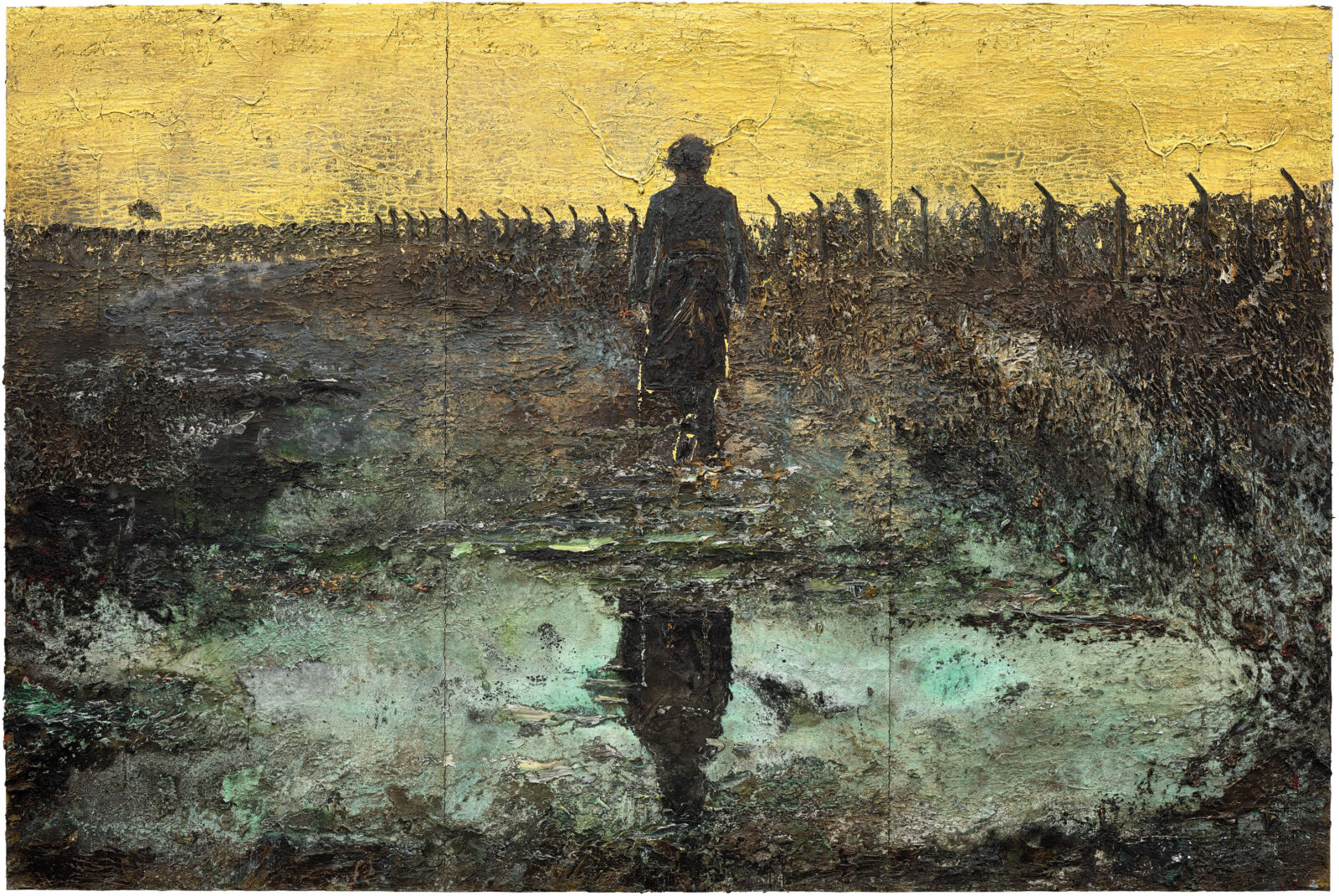
Anselm Kiefer, German, born 1945; Grenze (Border), 2024; emulsion, oil, acrylic, shellac, gold leaf and sediment of electrolysis on canvas; 12 feet 5 5/8 inches x 18 feet 8 7/16 inches; Collection of the artist and courtesy Gagosian 2025.312; © Anselm Kiefer, Photo: Nina Slavcheva
Yet men are far outnumbered by women in the exhibition—and far more varied in appearance and origin. Many, like Orithyia, fall into a category Kiefer describes as “water nymphs,” a term that draws on a global history of mythologies linking women and water. From the Rhinemaidens of German lore to the nymphs of ancient Greece, these women express heightened, sometimes ecstatic emotion. Draped in billowing fabric or nude against roiling skies and turbulent seas, they are by turns alluring, imperiled, and powerful. They are not allegories in the traditional sense so much as emotional registers for grief, longing, rage, surrender.

Anselm Kiefer, German, born 1945; Orithyia, 2024; emulsion, oil, acrylic, shellac, gold leaf, sediment of electrolysis and charcoal on canvas; 110 1/4 inches x 18 feet 8 13/32 inches; Collection of the artist and courtesy Gagosian 2025.318; © Anselm Kiefer, Photo: Nina Slavcheva
Taken together, the figures in Becoming the Sea make a striking contrast to the relative absence of bodies in Kiefer’s work of the 1980s. But their appearance does not represent a sudden departure. Human figures—especially portraits—featured prominently in his early work from the late 1960s and early 1970s. Kopf im Wald, Kopf in den Wolken (Head in the Forest, Head in the Clouds) from 1971 proves the point. The left panel shows Kiefer superimposed over a pine forest, while the right depicts his then-wife, Julia, in the clouds above a lake. These early portraits often intertwined landscape and figure, as though the self could be dispersed across space.
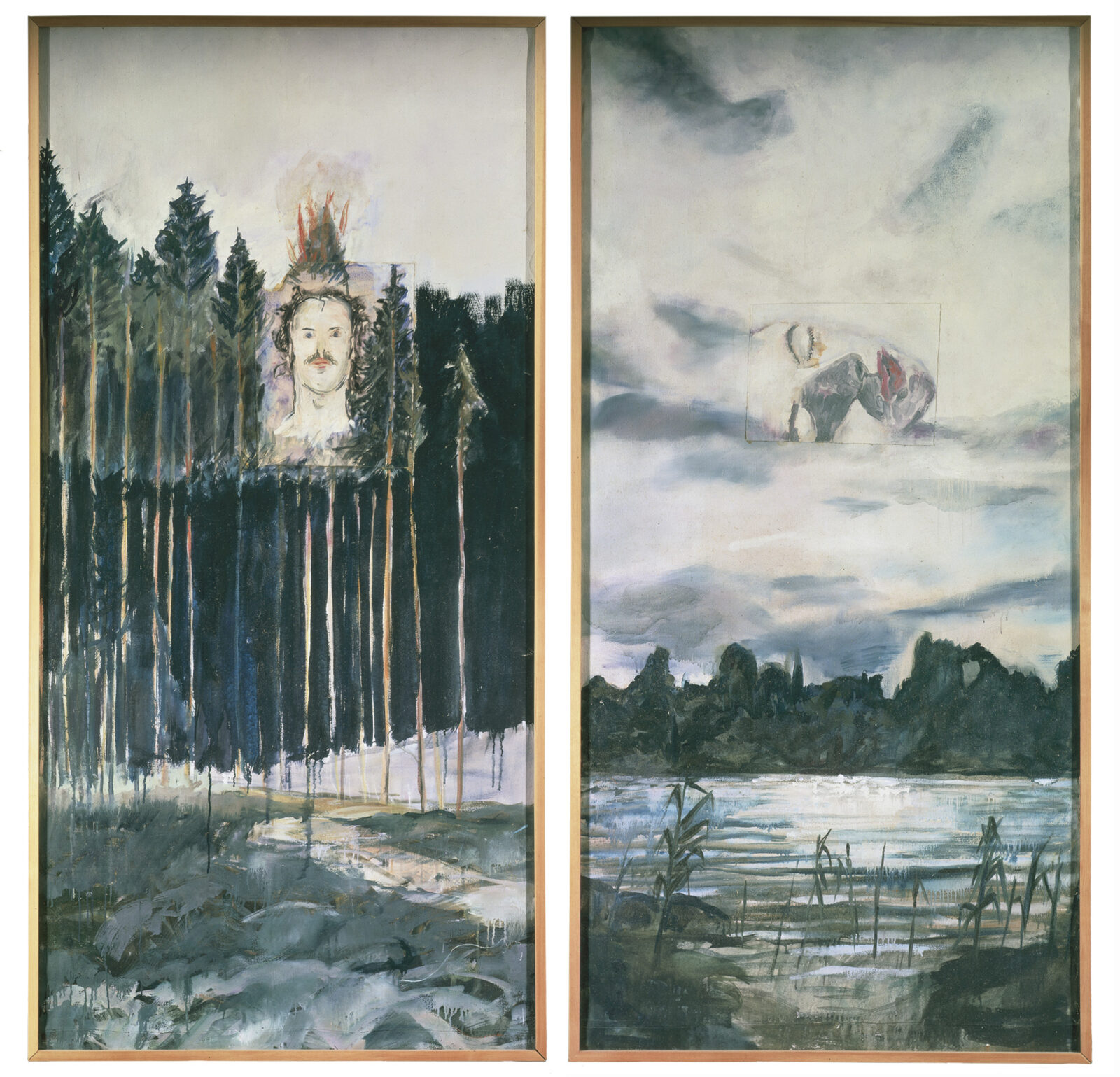
Anselm Kiefer, German, born 1945; Kopf im Wald, Kopf in den Wolken (Head in the Forest, Head in the Clouds), 1971; oil and fabric collage on canvas, two panels; each panel: 78 3/8 x 38 1/4 inches; The Broad Art Foundation 2025.308; © Anselm Kiefer
In this sense, the new figurative works do not break with tradition so much as complete a circle. Kiefer’s paintings have always dealt with the forces—history, myth, ideology, nature—that act on human beings. What has changed is that the human being is now fully present in the frame. The figures in Becoming the Sea make visible what has long been implicit in Kiefer’s art: that memory, catastrophe, and renewal are not abstractions. They are lived, embodied experiences, carried forward in human form.