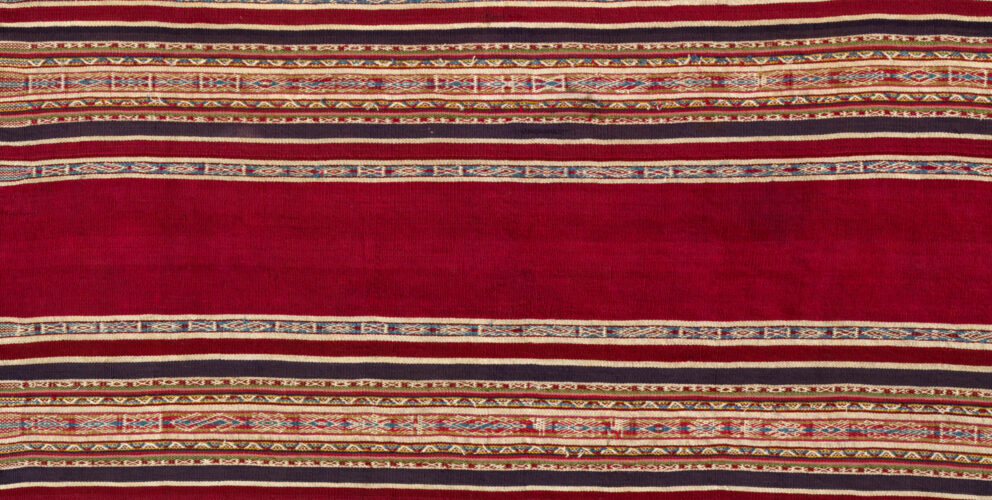
Quechua artist; Woman's Overskirt (aksu), 18th–19th century; camelid fiber and dye; 53 x 56 inches; Saint Louis Art Museum, Gift of Elissa and Paul Cahn 434:2018
Aymara weaving requires an artist’s proficiency in a set of complex techniques; viewed more broadly, across generations, the practice unites memory, cultural identity, and everyday experience. Viewers can see this dynamic in intricate skirts, mantles, and ponchos featured in Aymara Weavings: The Indigenous Andes, on view in Carolyn C. and William A. McDonnell Gallery 100 through September 13.
A viewer might experience a piece today based solely on how it looks, or two-dimensionally, but there is much more that goes into making these weavings than meets the eye. You can consider the shepherd who raised the animals from which the yarn was produced, the person who dyed the wool, and the experience and perspective of the weaver, all of which add identity and meaning to the finished piece. Seen through this lens, weavings become three-dimensional or even living beings, Bolivian artist Elvira Espejo Ayca said in a MoMA interview: A “textile is like a person: we can’t think about its structure without [metaphorically] thinking about its muscles or the nourishment that sustains it.” Complex lineage is reflected in finished garments, as viewers can see in the Aymara Weavings exhibition. Textiles take on their own lives, reflecting a rich history, individuality, and culture.
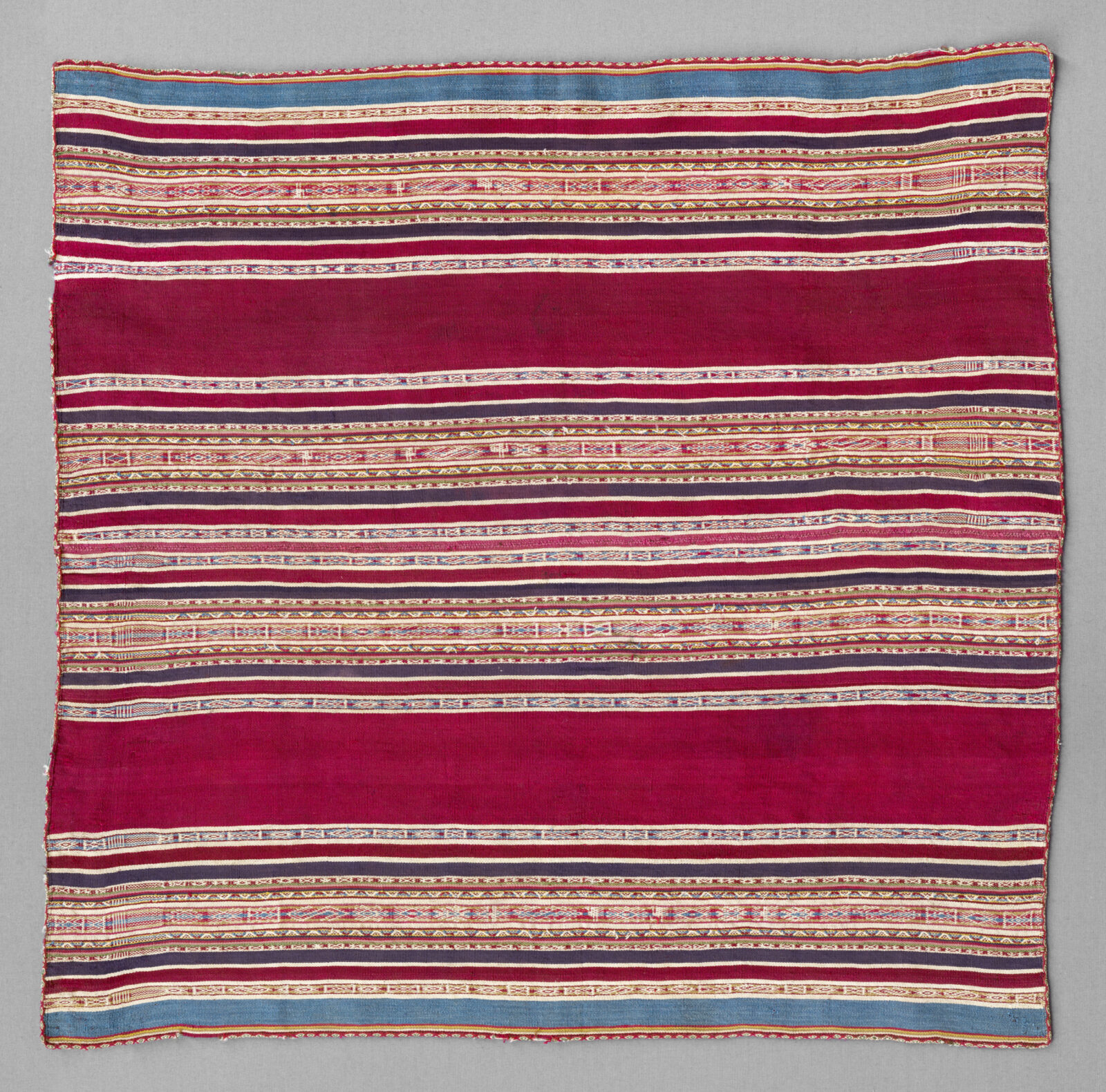
Aymara artist, Bolivia; Woman's Mantle (ahuayo), 18th–19th century; camelid fiber and dye; 33 x 34 inches; Saint Louis Art Museum, Gift of Elissa and Paul Cahn 443:2018
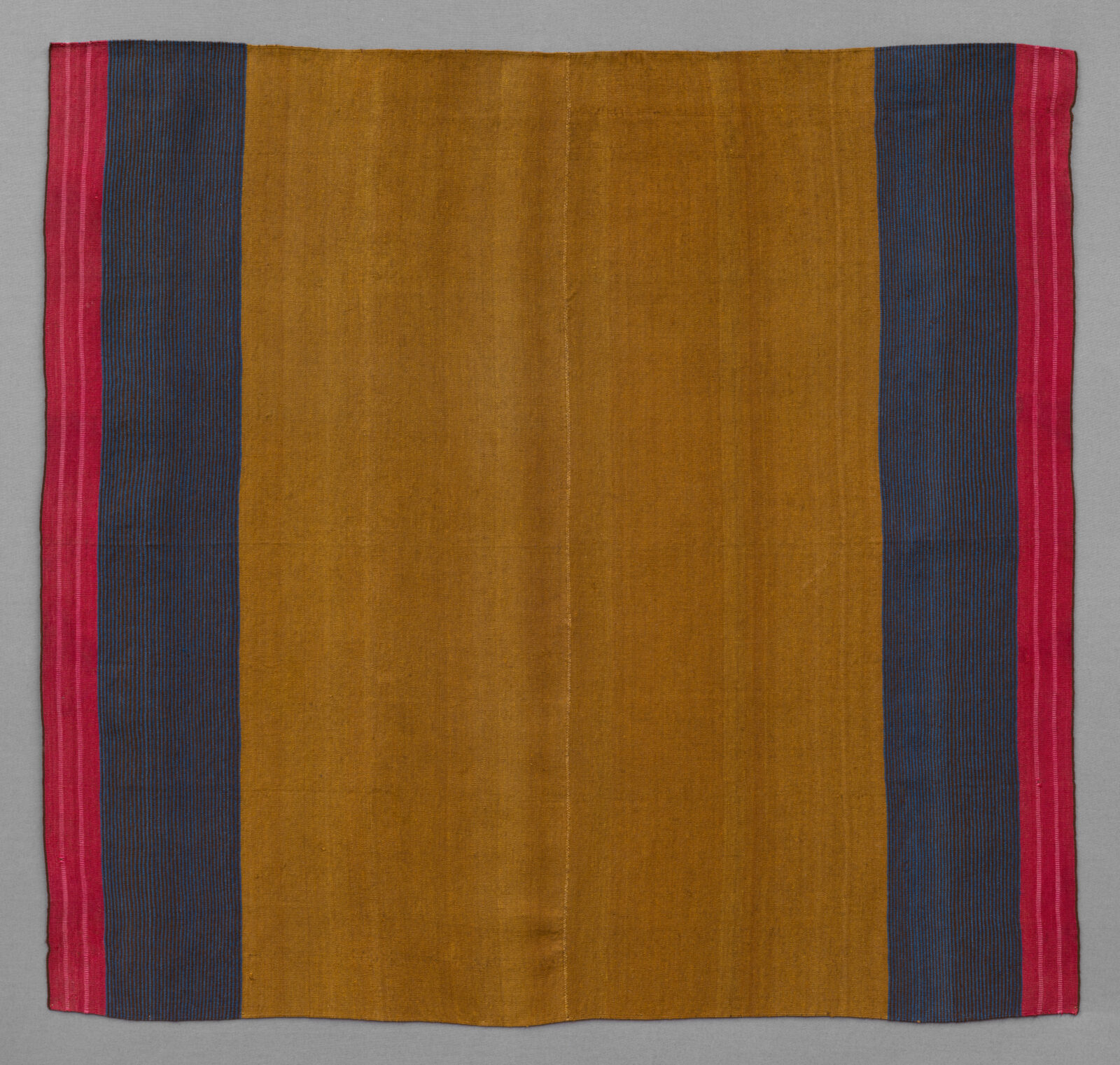
Aymara artist; Man's Mantle (llacota), 18th–19th century; camelid fiber and dye; 46 x 49 inches; Saint Louis Art Museum, Gift of Elissa and Paul Cahn 446:2018
While patterns and materials vary, 18th- and 19th-century weavers in the Central Andes produced these works using two main apparatuses: a four-stake loom and a backstrap loom. The four-stake loom contained four corner sticks, driven into the ground in a rectangle, and two horizontal crosspieces, around which the warp, or set of foundation threads, was wrapped. Weavers passed a ball of yarn back and forth to weave panels, as Shelley A. Burian, the Lisa and Bernard Selz Curator at The George Washington University Museum and Textile Museum, writes in her essay “Capturing the Rainbow: Bolivian Textiles from Ancient to Modern Times.” Weaving on a four-stake loom was primarily, but not exclusively, practiced by women.
Women were also the primary weavers using backstrap looms, which were more mobile than four-stake looms. Backstrap looms consisted of two sturdy horizontal sticks above and below the warp threads, or long threads that form the base of the fabric and are stretched vertically between the sticks. The upper stick was tied to a house pole or tree, and the lower one was connected to a belt around the artist’s waist. By leaning forward or backward, the weaver tightened or loosened the threads. Using a combination of heddles, or loops of string; and rods, or wooden sticks to manipulate the threads, she would lift alternating warp threads to create an opening called a “shed,” pass the weft thread through it, and then beat it into place with a flat wooden tool. The weaver would repeat this process to build the fabric row by row, with the cloth gradually growing outward from the weaver as she worked.
When a section of the weaving near the woman’s lap was complete, she would roll it to reach the next section. After each weaving session, the weaver could untie one side of the belt and roll the entire loom into a cylinder that could then be stored or carried without tangling the threads. Due to its mobile and body-centered nature, working on backstrap looms allowed for intense pattern control, as one can see in garments featuring more intricate patterns. The weaver could manually select and memorize thread groupings and could make small adjustments, all of which influenced the final design. You can see an example of this in the image below.
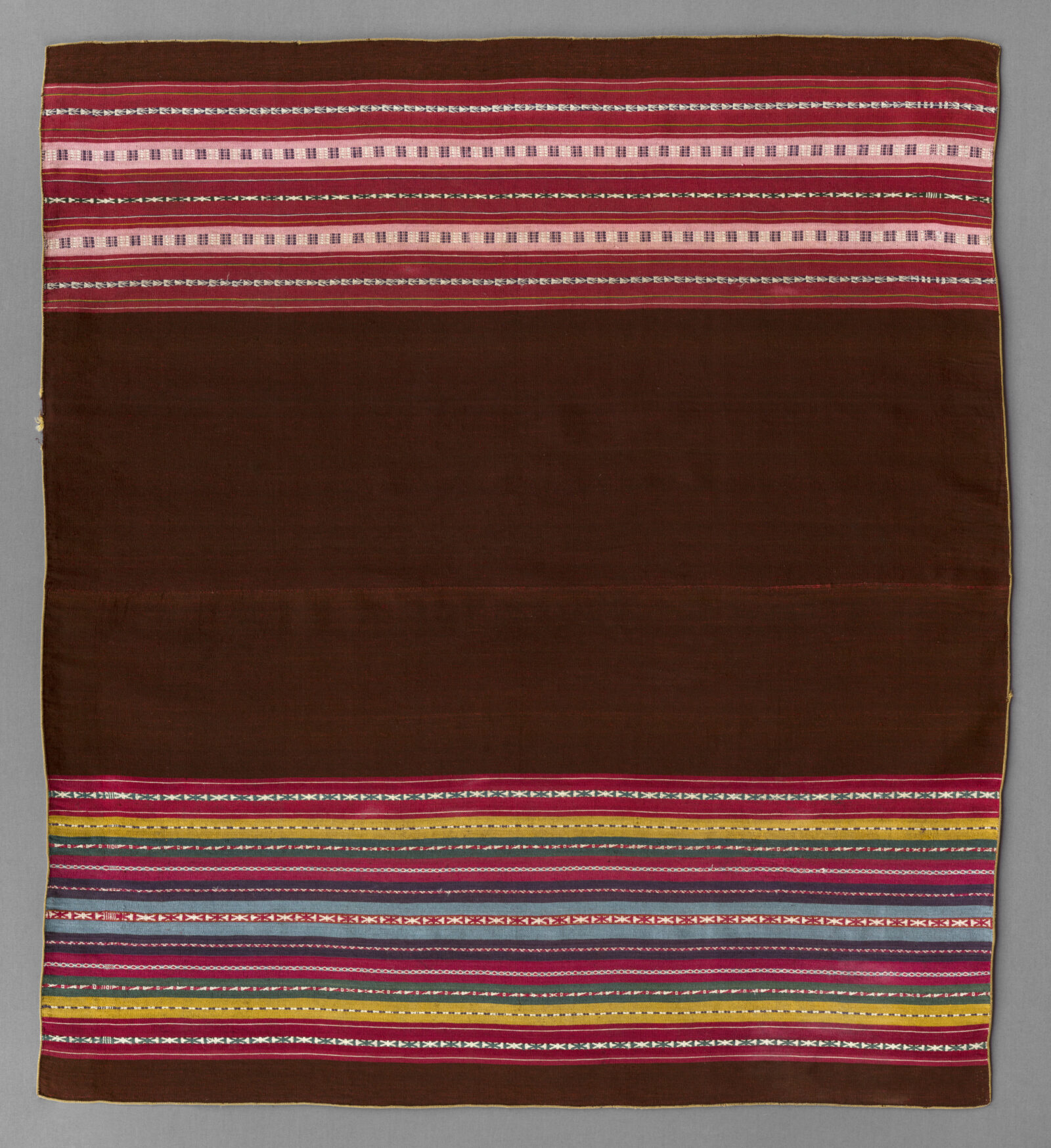
Quechua artist; Woman's Overskirt (aksu), 18th–19th century; camelid fiber and dye; 53 × 56 inches; Saint Louis Art Museum, Gift of Elissa and Paul Cahn 434:2018
In both processes, the cloth was fully finished on the loom. The loom was removed from the cloth, rather than cutting the cloth from the loom. As a result, the textile has selvedges, or tightly woven, finished edges. To embellish selvedges, weavers sometimes added tubular trim, as seen on a woman’s mantle in the Aymara Weavings exhibition. The tubing was done by hand and connected to the finished cloth, as seen in the image below.

Aymara artist, Bolivia; Woman's Mantle (ahuayo) (detail), 18th–19th century; camelid fiber and dye; 33 x 34 inches; Saint Louis Art Museum, Gift of Elissa and Paul Cahn 443:2018
Weavers produced garments on backstrap and four-stake looms even after the start of Spanish colonial rule in the 16th century brought significant restrictions to the types of clothing Andean people were allowed to wear. Despite these restrictive changes, Indigenous artists continued producing textiles, preserving a practice that defined communities. Entire families wore vibrant, detailed clothing created by talented weavers, with specific pieces indicating milestones, special occasions, and a person’s place within a larger social fabric.
Aymara Weavings is the debut presentation for a gift of historic Andean weavings. To add context, the Museum has also shared an online reading list that offers expanded analysis of the field.