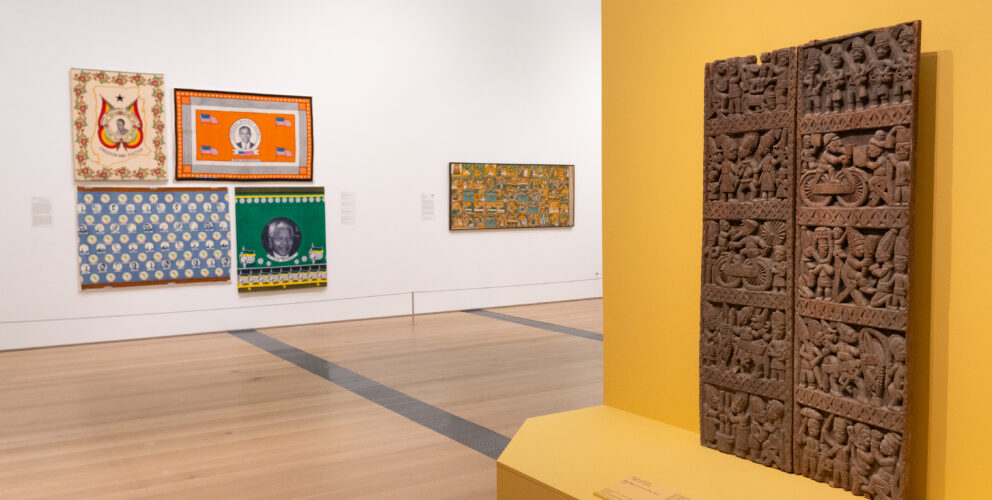
Installation view of Narrative Wisdom and African Arts
One of the most asked questions by visitors to SLAM’s sub-Saharan African art galleries is “Does this work tell a story?” according to Nichole Bridges, the Morton D. May Curator of the Arts of Africa, Oceania, and the Americas.
According to Bridges, when analyzing narratives from African perspectives, it’s important to acknowledge the essential role oral traditions play in preserving history. SLAM’s latest ticketed exhibition, Narrative Wisdom and African Arts, curated by Bridges and on view through February 16, 2025, features 150 works that facilitate, document, reinforce, or critique ancestral narratives.
The exhibition focuses on four main themes: the legitimacy and reach of leaders; memory of place; prescriptions for healing and destiny; and enduring ancestral wisdoms. As very few works in Narrative Wisdom and African Arts convey a continuous story from beginning to end, viewing the exhibition through the filter of these themes may help visitors understand not only the story being told but also consider the role of visual arts as a tool for disseminating oral history.

Installation view of Narrative Wisdom and African Arts
Leadership and Power Play
Oral histories have supported the historical and genealogical origins of leaders, chiefs, and kings in many African societies. By continuing stories of past power and riches through word of mouth, oral history legitimizes those in positions of power who gained their status through lineage. Visual arts have been fundamental to perpetuating these oral traditions and the legacies of rulers.
One section of this exhibition focuses on “leadership arts,” or works commissioned by kings and chiefs from selected west and central African kingdoms and chieftaincies. The artwork in this section considers the symbolic representation of certain royal and elite arts. These works, initiated by leaders themselves or instigated by their supporters, examine figural and pictorial arts as anchors for narratives that affirm a ruler’s legitimacy and reach.
The concepts introduced in this gallery can be further explored through leadership arts presented elsewhere in this exhibition.

Installation view of Narrative Wisdom and African Arts
Memory: Place and Commemoration
Memories depend on the human capacity to construct narrative to survive for later generations. The next section of the exhibition explores arts that document histories—with particular emphasis on place. The featured artists invoke links between lineage, land, and home to make traces of identity and memory tangible.
Many artworks address the perseverance of memory despite historical and contemporary challenges, including transatlantic trade, colonialism, environmental degradation, war, and migration. Most works refuse to abide by linear constructs of time, encouraging the viewer to contemplate the fluidity of time and the shapelessness of memory.
Modern and contemporary paintings, sculpture, and photography by artists working in Africa and abroad appear in this section in conversation with historical sculpture in wood, ivory, and metal. Audio and video works bring their subjects’ voices into the galleries as each person expresses their own narrative about rootedness in a homeland, or about leaving home behind and forging ahead in new lands.

Installation view of Narrative Wisdom and African Arts
Foretelling: Destiny and Healing
Ritual specialists, such as diviners, are endowed with the ability to communicate between spiritual and earthly realms. Often the specialist employs artworks to facilitate this work on behalf of a client who seeks to resolve any of life’s myriad problems. Together, diviner and object amplify messages from the otherworld, yielding prescriptive narratives toward resolution, healing, and alignment with one’s destiny.
In this section, traditions-based works from cultures in west, central, and east Africa represent some of the many forms and techniques associated with divination practices. Historical and contemporary arts for healing facilitated by diviners, other experts, or the artists themselves, demonstrate art’s ability to foster curative and vital inspiration.

Installation view of Narrative Wisdom and African Arts
Ancestral Wisdoms and Allegory
Visual arts illuminate ancestral connections and knowledge. This is relevant not only for elite or spiritual pursuits but also for guiding everyday approaches to life or making social commentary.
On view in this section, a spectrum of proverb-rich Akan arts from Ghana provide a foundation for exploring intersections between visual art and oral tradition in other African regions. The meanings of these works can vary greatly according to the context. Many employ allegories based on relative cultural iconography, while others incorporate text with images to communicate morals to their viewers.
Other artists honor their sources of insight and empowerment less directly. The convergence of studio-based, traditions-based, and vernacular artistic modes (or works by self-taught artists) from past to present demonstrates their enduring value to artists and their audiences alike. Works in this section and across Narrative Wisdom and African Arts help to make inherited wisdom accessible.