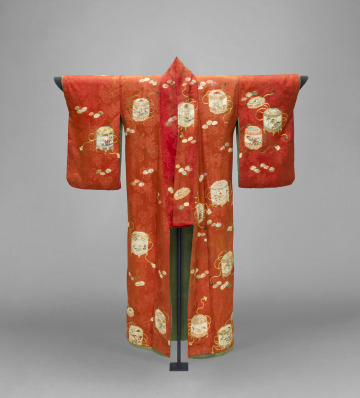
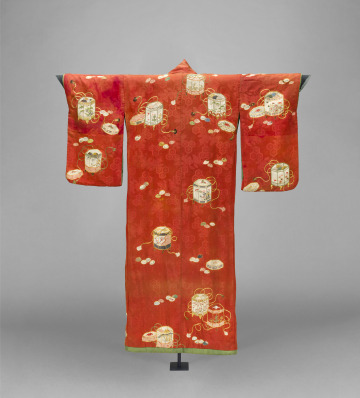
Woman’s Outer Robe (uchikake) with Design of Azai Family Crests with Shell Game Boxes (kaioke) and Scattered Decorated Shells

Culture
Japanese
Date
early 19th century
made in
Japan, Asia
Collection
Asian Art
Current Location
Not on view
Dimensions
62 1/2 × 48 1/4 in. (158.8 × 122.6 cm)
Credit Line
Museum Purchase
Rights
Public Domain
Object Number
113:1919
NOTES
The Azai family crest (kamon) appears throughout this red-dyed silk satin damask robe. The symbol for this well known Japanese clan—called mitsumorikikkō ni hanabishi—comprises three adjacent hexagonal tortoiseshells, each containing a rhomboidal, four-petaled flower. The embroidered designs feature lacquered shell game boxes (kaioke) with loosened ornamental cords and scattered decorated shells. Such boxes have been used since the Heian period (794–1124) for storing decorated shells for a popular shell-matching game (kai-awase).

An uchikake is a lined silk outer robe with a wadded hem. It is worn over another garment without a sash, usually for formal occasions, weddings, or stage performances. Such robes are usually constructed with white-, black-, or red-patterned satin and embroidered with multicolored threads and gold.

We regularly update records, which may be incomplete. If you have additional information, please contact us at provenance@slam.org.